Direct Answer: If only the laundry drain backs up and every other fixture drains fine, the clog is almost always in the laundry branch or the sink trap arm, not the main sewer line.
The washer hits its drain cycle. The garage sink or standpipe fills faster than it empties, and within a minute there’s water creeping across the concrete toward a full basket of clothes.
One Salinas homeowner described it almost word for word: the washing machine drains into the garage sink, it’s backed up now, and everything else in the house is still draining fine. That last part is the most useful clue in the whole situation.
This guide covers two things worth knowing before anyone comes out: how to tell a laundry branch clog from a main line problem, and why laundry lines in older Salinas homes tend to clog again on a schedule.
Why the Laundry Drain Is Usually the First One to Fail
A washing machine is the most demanding fixture in the house, and it has nothing to do with how dirty the water is. It’s the volume and the speed.
A bathroom sink trickles out a gallon or two over a minute. A washer pumps its entire tub out in about a minute or two, all at once, under pressure from the drain pump.
So a drain line that has lost part of its inside diameter can still pass everything else in the house without a complaint:
- A slow bathroom sink still empties, just lazily
- A shower still drains because water enters gradually
- A toilet still flushes because the bowl volume is small
- The washer overwhelms the restriction in seconds
That’s why a laundry backup often shows up weeks or months before both bathrooms start acting up. Treat it as an early warning rather than a one-off nuisance.
It’s also why the same line can behave perfectly the next morning. The water eventually finds its way through, the sink drains down overnight, and nothing looks wrong until the next load.
The 60-Second Read: Laundry Branch or Main Line?
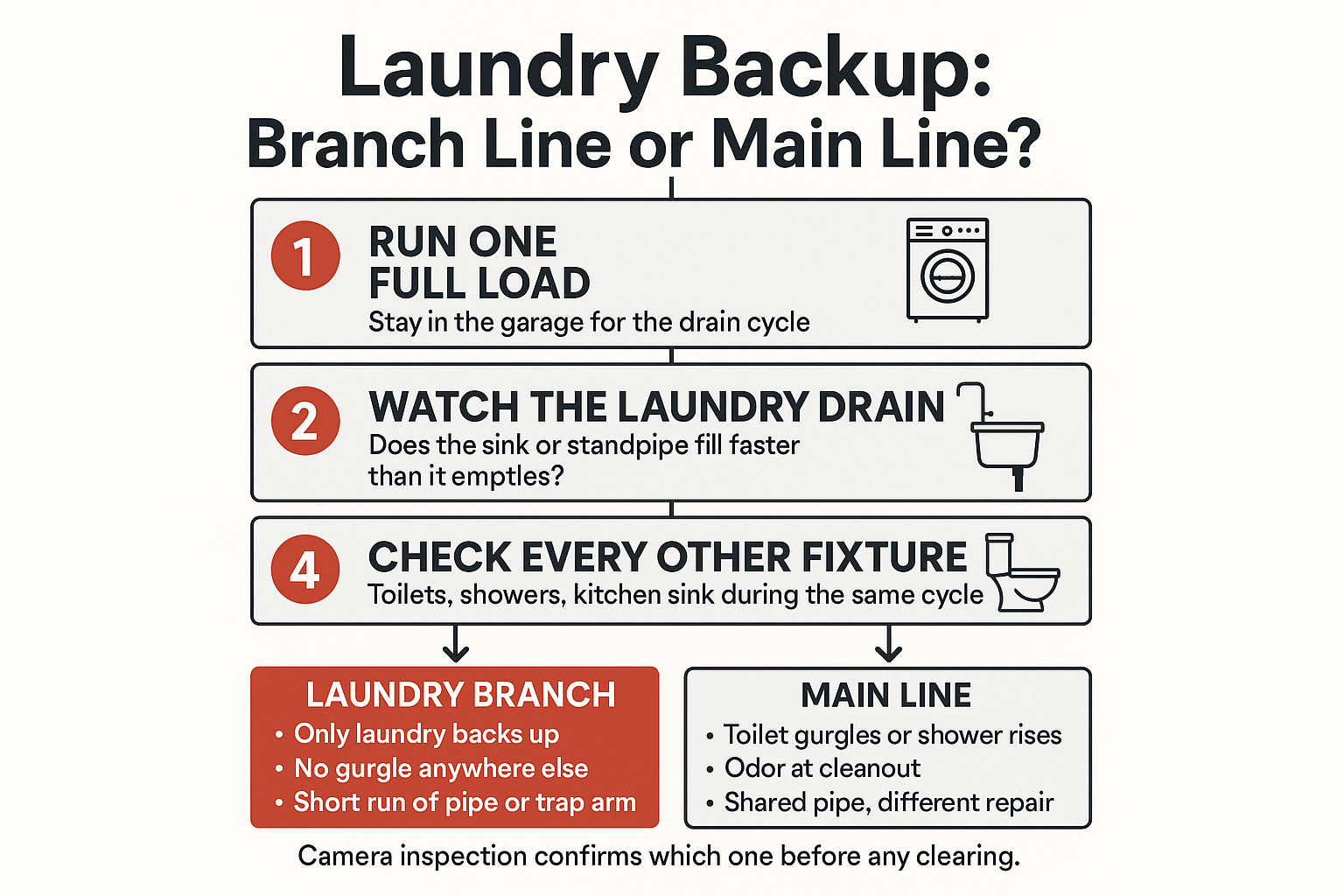
Before you call anyone, run one load and watch the rest of the house. This single observation changes the diagnosis, the repair, and the cost.
Almost certainly a laundry branch problem if, while the washer drains:
- Only the garage sink or standpipe fills and overflows
- Toilets flush normally with no gurgle
- The kitchen sink and both showers drain at their usual speed
- Nothing comes up anywhere else in the house
Points downstream toward the main line if, while the washer drains:
- A nearby toilet bubbles or gurgles
- Water rises in a shower pan or floor drain
- You smell sewer odor at a cleanout
- More than one fixture group is slow on its own
The first situation usually means the restriction sits in the laundry branch line or the sink trap arm, a short run of pipe between the sink and where it ties into the larger drain. The second means the problem is in shared pipe carrying the whole house, which is a different repair at a different price.
If the kitchen is also acting up, that’s a separate pattern worth reading about, because a kitchen sink that won’t drain fouls for its own reasons.
Laundry Lines Foul Differently Than Kitchen or Bath Lines
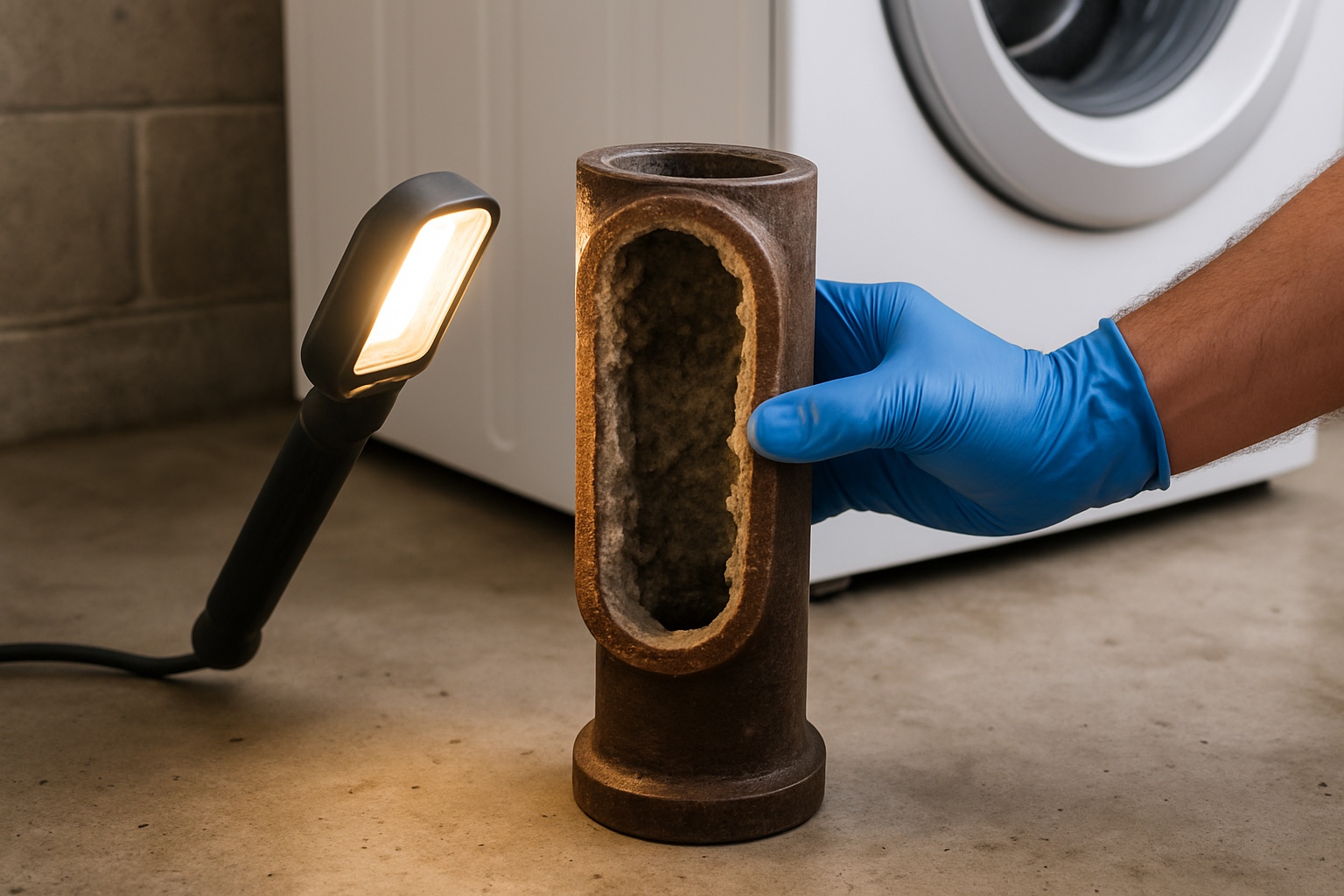
Kitchen lines clog with grease. Bathroom lines clog with hair and toothpaste. Laundry lines build something different: a soft, greasy film of lint, pet hair, and detergent residue that coats the pipe wall evenly instead of forming one plug.
Local water chemistry makes that film stickier. Cal Water’s Salinas system water quality report puts hardness around 254 ppm, with the Salinas Hills system closer to 320 ppm, and the utility classifies anything above 300 ppm as very hard.
Hard water minerals bind with soap and lint to form a scale-and-scum layer that clings to the inside of the pipe. Over years, the effective diameter shrinks. Nothing breaks, the pipe just gets narrower.
One homeowner with a 160 pound dog asked us straight out whether the washer discharge could be filtered, or the laundry area re-plumbed, to stop the repeat backups. The honest answer is in two parts:
- Filtering helps. A mesh lint screen over the discharge hose catches a real amount of hair and fiber before it enters the pipe. Rinse it after every few loads.
- Re-plumbing only helps if the pipe itself is the problem. If there’s a long flat run with poor slope, an undersized branch, or a failed section of cast iron, replacing it fixes the cause. If the pipe is sound, new pipe will coat up the same way.
Whole-house treatment is a related conversation, since Salinas water hardness affects fixtures and water heaters too, not just drains.
Reading the Symptoms Before You Call
This walks through the same check we ask about on the phone when someone reports a laundry backup.
Why a Snake Sometimes Only Buys You a Few Months
Here is the mechanical difference that explains most repeat laundry clogs. A cable snake punches a channel through soft lint and soap sludge. Water flows again, the sink drains, the job looks done.
But the coating is still on the pipe wall. It closes back around that channel over the following weeks, which is why the same drain can back up again on a similar schedule. We see the pattern often enough that we wrote a whole piece on why the same drain keeps clogging after it’s been cleared.
High pressure water works differently. It scours the pipe wall back toward its original inside diameter instead of boring a hole through the buildup. On a lint-and-soap line, that’s usually the difference between a few months and a few years.
Costs vary with pipe size, run length, access, and how bad the buildup is. General market pricing for jetting a residential line commonly lands in the several hundred dollar range, and the only honest way to give you a real number is to look at the line first and talk it through on the phone.
A camera look matters before anyone puts pressure in the pipe. Salinas housing skews older, with a median build year around 1976 and roughly 11 percent of the stock built before 1950, which means cast iron and galvanized drains are common here. Corroded or thin pipe calls for a gentler method, and choosing between jetting and snaking should follow what the camera actually shows.
Symptom, Likely Location, Usual Next Step
Use this as a quick reference while the washer is running. It reflects what we find most often on laundry calls across Salinas and the Monterey Bay Area.
| What You See | Where the Restriction Likely Is | Usual Next Step |
|---|---|---|
| Only the garage sink or standpipe overflows, everything else drains fine | Laundry branch line or the sink trap arm | Clear the branch, then camera the line if it has backed up before |
| Water rises, drains slowly, then clears on its own after the cycle | Soft coating on the pipe wall, not a hard plug | Camera look first, then high pressure water if the pipe can take it |
| A toilet gurgles or a shower pan rises while the washer drains | Further downstream, toward the main line | Main line camera inspection before any clearing |
| Sewer smell near the standpipe or floor drain | Dry or blocked trap, or a venting issue | Have the trap and vent arrangement checked |
| Backs up every few months on a similar schedule | Pipe never got back to full diameter | Camera inspection, then a talk about jetting or a section repair |
What’s Fair to Try, and Where It Stops
There’s a short list of reasonable things a homeowner can do on a laundry line, and a shorter list of things that just delay a real diagnosis.
Reasonable:
- Put a mesh lint screen over the discharge hose and rinse it regularly
- Pull and clean the sink strainer and the visible trap debris
- Stop stacking loads back to back so the line has time to clear
- Run less detergent, since excess soap is part of the coating
Not worth repeating: pouring chemical drain cleaner into a line that already backs up. It sits in standing water, does little to a lint-and-soap coating, and makes the line hazardous for whoever opens it next.
One homeowner told us they had tried liquid drain cleaner, baking soda and vinegar, hot water with dish soap, a hand snake, and taking the trap apart before calling. That’s a lot of Saturday spent on a problem a camera answers in half an hour.
One more thing worth knowing: changing a standpipe, trap arm, or venting arrangement falls under the California Plumbing Code that the City of Salinas has adopted. Re-plumbing a laundry area is permitted, inspected work, not a weekend project, and we handle that paperwork in-house when a job calls for it.
If You’re a Landlord, Property Manager, or Rental Operator
Fewer than half of Salinas housing units are owner occupied, so the person standing in the water is usually not the person paying for the fix. That split creates two different needs on the same call.
The tenant needs a same-day answer and dry concrete. The owner needs to know what caused it and whether it has happened before on that line.
For repeat laundry backups, ask for documentation, not just a cleared drain:
- Camera footage or still images of the pipe interior
- Written findings noting pipe material, condition, and location of the restriction
- Dates of prior clearings on the same line
- A clear note on whether the issue is the branch or the main
With that on file, a recurring backup can be argued as a line repair instead of an open-ended cycle of clearings every few months. It also helps when a short-term rental has back-to-back guests and there’s no room in the calendar for a surprise.
Reviews for our crews tend to mention this specifically. One customer put it simply: “Very informative on what he was doing and seeing.” On a repeat laundry clog, that explanation is the part that saves money.
Frequently Asked Questions About Washing Machine Drain Backups
My washer drain backs up but every other drain in the house works fine. Is that still a sewer problem?
Usually no. When the rest of the house drains normally, the restriction is almost always in the laundry branch or the sink trap arm, which is a much shorter and more accessible piece of pipe than the main sewer line.
Can I put a filter on my washing machine discharge hose?
Yes, a mesh lint screen over the hose end is a real help, especially in a house with a large dog or heavy pet hair. It won’t stop buildup on its own because detergent and hard water minerals still coat the pipe, but it cuts down how fast the coating forms. Rinse it every few loads or it becomes its own clog.
Why did my laundry drain clog again six months after it was snaked?
A cable clears a path through soft lint and soap sludge without removing the coating from the pipe wall. That coating closes back around the opening, so the drain fails again on a similar timeline. High pressure water scours the wall instead of boring through it, which is why it tends to last longer on laundry lines.
Does the whole laundry area need to be re-plumbed to stop the repeat backups?
Not usually. Re-plumbing makes sense when the pipe itself is the problem, like a long flat run with poor slope, an undersized branch, or a corroded section of cast iron. A camera inspection is what separates those cases from a sound pipe that simply needs the buildup removed. Keep in mind that changing a standpipe or vent layout is permitted, inspected work in Salinas.
Is this an emergency, or can it wait until Monday?
If water is actively spreading across the garage floor near stored belongings, drywall, or a water heater, it’s worth handling now. If the sink drains down on its own and you can hold off on laundry, it can often wait for a regular appointment. Either way, we answer the phone 24 hours a day, 7 days a week, so you can ask before you decide.
Want a straight answer on where that laundry line is restricted?
Alvarez Plumbing has been family run in Salinas since 1988, licensed, insured, and bonded, with a 4.94-star rating across 224 and more Google reviews. Somebody answers the phone around the clock at (831) 757-5465, which tends to matter when a laundry backup shows up on a Saturday afternoon with a full basket of clothes waiting. If you’d rather not decide in the moment, a quick call to describe what the other fixtures are doing is often enough to point you in the right direction.
