
Direct Answer: A kitchen sink that won’t drain after chemicals and a hand snake usually has hardened grease and mineral buildup coating the pipe wall. Clearing it takes mechanical cutting or high pressure water, not another product.
You poured in the drain cleaner. You tried baking soda and vinegar. You ran hot water with dish soap, then fed a hand snake down as far as it would go. The sink still holds water.
This is the single most common drain complaint we hear from homeowners in Salinas, and the story is almost identical every time. One homeowner told us she had already pulled the pipes apart under the cabinet herself before she gave up and called.
There are real reasons those fixes fail on a kitchen line, and they have a lot to do with grease, hard water, and how old your house is. Once you understand what is actually sitting in that pipe, the right next step gets a lot clearer.
Why the Drain Cleaner and the Hand Snake Didn’t Work
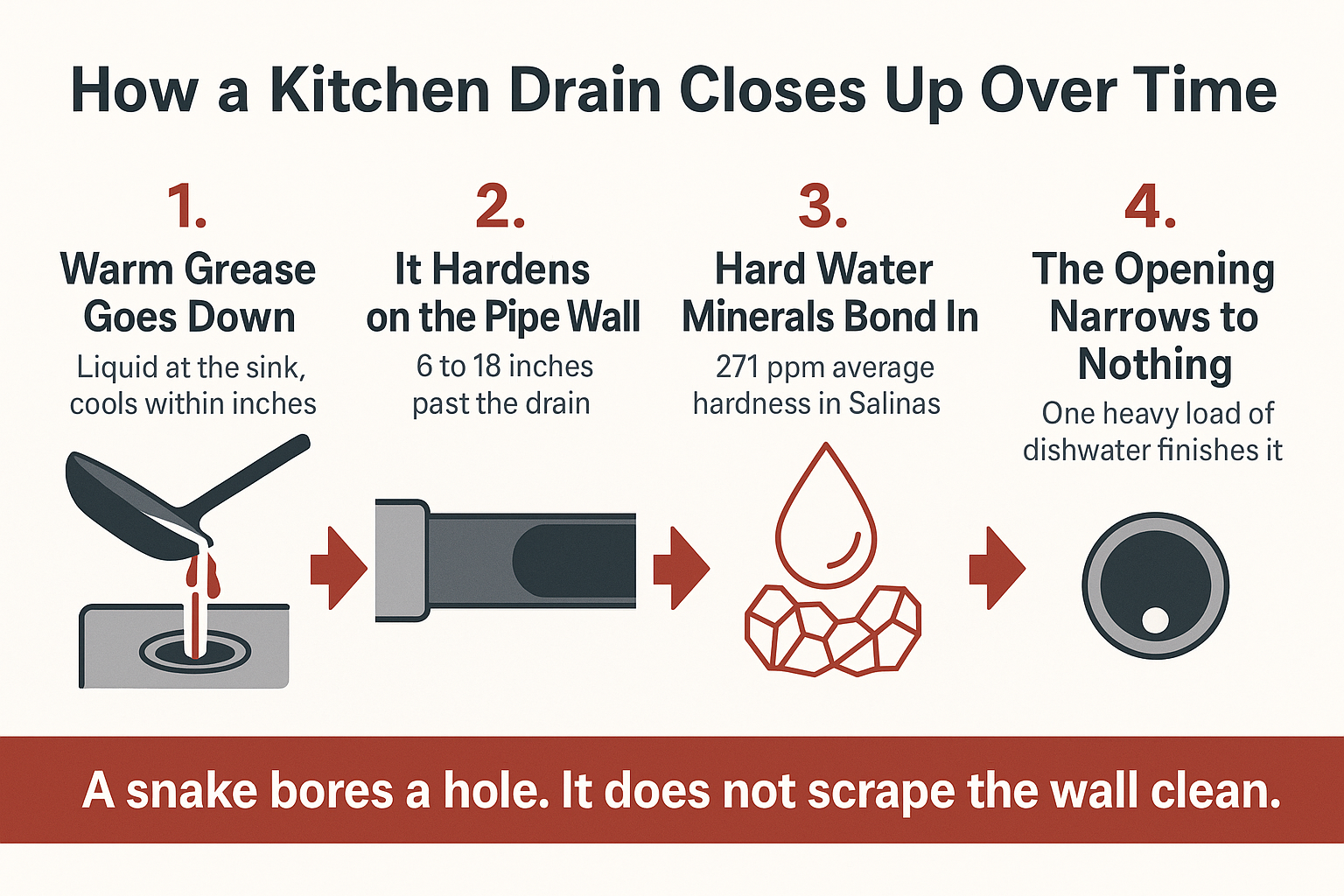
Grease is the dominant cause of kitchen drain failure around Salinas, and it does not behave the way most people assume. It goes down the drain warm and liquid, then cools and hardens on the pipe wall roughly 6 to 18 inches past the drain opening.
That happens a few tablespoons at a time, over years. The pipe does not clog all at once. The opening just narrows until one bowl of pasta water finishes the job.
Here is why the usual home fixes stall out:
- Chemical cleaners need contact time and flow. When a line is fully blocked, the product just sits in standing water above the clog and never reaches the hardened ring below it.
- Baking soda and vinegar makes foam. Foam does not cut through a solid, mineral-hardened grease layer.
- Hot water and dish soap can soften fresh grease near the top of the line. It does not touch buildup that set up months or years ago.
- A hand snake is thin and flexible. It punches a hole through the middle of the blockage instead of scraping the pipe wall clean.
That last one matters most. A hand snake often gets the water moving for a day or two, which feels like a win, and then the same clog comes back.
Hard Water Is Making Your Kitchen Clog Worse
Monterey Bay Area water is hard, and Salinas is no exception. California Water Service reports average hardness around 271 ppm in the Salinas system, which sits well inside the hard range on the USGS water hardness scale.
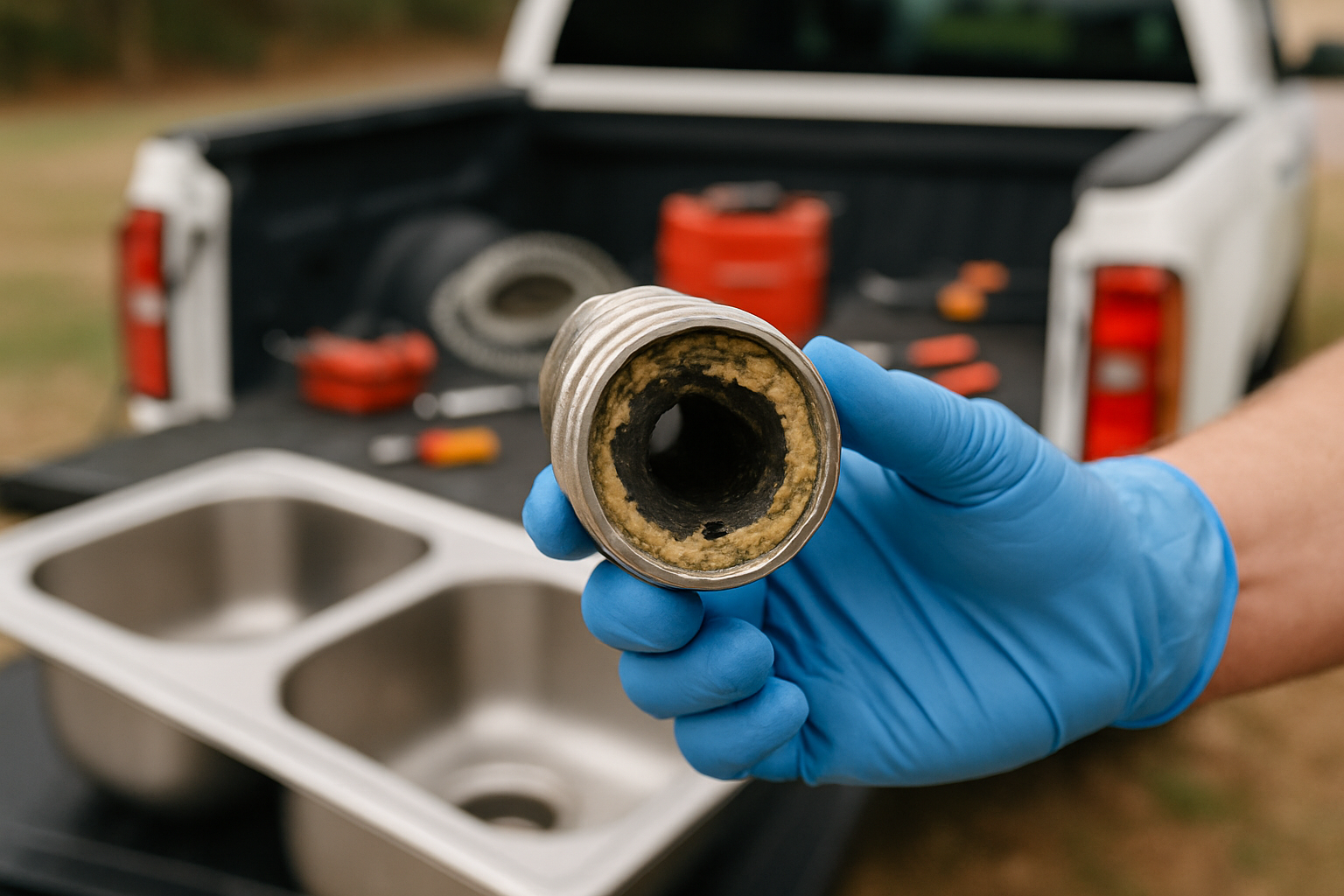
Those dissolved minerals do not just leave spots on your glassware. Inside a drain line, calcium and magnesium bond with grease and food particles and set up into something closer to soft concrete than sludge.
That is the difference between a kitchen clog here and a kitchen clog in a soft water region. A cable or a snake can bore straight through that material and leave a clean-looking hole while the pipe walls stay coated.
So the sink drains fine that afternoon. Then it slows again within days or weeks, because the actual diameter of the pipe never changed. We wrote more about that exact cycle in why the same drain keeps clogging even after it’s been cleared.
First, Figure Out Which Clog You Actually Have
Before anyone touches a tool, there is a simple thing you can check yourself. It tells you whether this is a small localized problem or something further down the system.
Run water in the kitchen sink and watch the rest of the house.
- If the kitchen sink alone is slow or stopped and every other fixture drains normally, the blockage is almost always local. Think the P-trap under the cabinet or the kitchen branch line that runs to the main.
- If the kitchen sink backs up while the dishwasher or washing machine runs, you are dealing with a shared drain line, and the blockage sits downstream of both fixtures. That is a different repair.
- If water rises in a tub or floor drain at the same time the kitchen fills, that points toward the main line, not the kitchen at all.
We get calls that mix these up constantly. One homeowner described a washing machine and dishwasher that had clearly been sharing one clogged drain, which is a much bigger job than clearing a trap.
Knowing which bucket you are in changes what gets recommended, what it costs, and how long it takes.
Kitchen Drain Symptoms and What They Usually Mean
Use this as a starting read on your own situation. It is not a substitute for a real diagnosis, but it will tell you what kind of conversation you are about to have.
| What You’re Seeing | Where the Problem Usually Is | What Typically Clears It |
|---|---|---|
| Only the kitchen sink is slow, everything else drains fine | P-trap or kitchen branch line | Cabling the branch line, or jetting if the walls are coated |
| Sink backs up when the dishwasher runs | Shared line downstream of both fixtures | Clearing the shared line, often with a camera check first |
| Sink gurgles when the washing machine drains | Shared waste line or a vent issue | Camera inspection before any clearing |
| Kitchen and a tub or floor drain fill at the same time | Main sewer line | Main line clearing, camera inspection recommended |
| Clog returns within days or weeks of being snaked | Pipe wall buildup or damaged pipe | High pressure jetting or a pipe condition evaluation |
How a Kitchen Drain Actually Closes Up
Most kitchen clogs are years in the making. This breaks the process into the four stages we see in the field.
The Age of Your House Changes the Answer
A 1962 bungalow off North Main and a house built in 2005 out toward Harden Ranch are not the same plumbing problem, even with identical symptoms.
Many homes built before the 1980s in Salinas, Watsonville, and on the Monterey Peninsula still have galvanized steel or early ABS drain piping. Corrosion and age leave the inside walls rough instead of slick.
That texture grabs grease and food debris and holds it. Buildup accumulates far faster in a rough pipe than in the smooth PVC used in newer construction.
This matters for two reasons:
- Diagnosis. A clog that keeps returning in an older home may be telling you the pipe itself is failing, not that you cooked too much bacon.
- Method. High pressure jetting is effective, but pipe condition gets checked first. Badly corroded lines can call for a gentler approach or, in some cases, a conversation about replacing the section.
If your home is older and the same drain has been cleared more than once in a couple of years, a camera look at the line is usually money better spent than another clearing. A sewer camera inspection shows what is actually on those walls.
Maintenance Flushing vs. Clearing a Blocked Line
These two things get confused all the time, and the difference explains why home remedies feel like they should work.
Maintenance flushing is preventive. Regular hot water flushes, enzyme treatments, and keeping grease out of the sink slow down how fast buildup forms. On a line that still has good flow, that habit genuinely extends the time between problems.
Clearing a blocked line is a different job. Once the passage is restricted, nothing you pour in is going to reverse a hardened layer that took years to form. It has to be cut out or blasted off mechanically.
That is where cabling and high pressure water jetting come in. Jetting uses water at high pressure to scour the pipe wall back toward its original diameter rather than punching a channel through the middle. Local market pricing for jetting a residential line commonly lands somewhere in the $300 to $800 range depending on pipe size, run length, and how bad the blockage is, and an exact number should come from a quote after the line is inspected.
If you want the longer comparison, we broke it down in snaking didn’t fix it, here’s what probably will.
What a Real Diagnosis Looks Like
A proper look at a kitchen drain takes a few minutes with the right equipment. Access the cleanout, check the trap and branch, and when the clog is recurring, put a camera in the line to see the wall condition.
One reviewer described the tech who came out as “very informative on what he was doing and seeing.” That is the part homeowners tell us they value most, and it is the part that changes the decision.
Because once you know whether you are looking at ten years of grease in a good PVC line or a corroded galvanized branch that is closing up for good, you can make a real call. Treat it now, jet it on a schedule, or plan for the pipe work.
We have been running these calls across Salinas and the Monterey Bay Area since 1988, and the kitchen sink is still the one that brings people to the phone at 9 p.m. on a Sunday.
Frequently Asked Questions About a Kitchen Sink That Won’t Drain
Will more drain cleaner eventually work if I keep using it?
Usually not, and repeated use has a downside. On a fully blocked line the product sits in standing water above the clog, and on older galvanized or corroded pipe repeated chemical exposure is hard on the pipe. If two rounds did nothing, a third round is not the answer.
Why did my sink drain fine after snaking and then clog again a week later?
Because the snake made a hole, not a clean pipe. The hardened grease and mineral layer is still coating the wall, so the opening closes back up quickly. That pattern, clear then clog within days or weeks, is one of the strongest signs the line needs scouring or a camera look rather than another cable.
Is a clogged kitchen sink an emergency?
On its own, usually not. If the kitchen is your only sink or water is backing up into other fixtures, that changes things. We answer the phone 24 hours a day, 7 days a week, but plenty of callers are better off booking a regular business-hours slot and avoiding the after-hours rate.
Does a garbage disposal cause kitchen clogs?
It contributes. A disposal grinds food into small particles, but those particles still travel into a line that may already have a grease coating, and they stick to it. Coffee grounds, rice, pasta, and fibrous vegetable scraps are the usual repeat offenders in the Salinas homes we see.
How do I keep it from happening again?
Pour cooking grease into a can and throw it away instead of down the sink, run hot water for 30 seconds after washing greasy dishes, and if your home is older, consider having the kitchen line jetted on a schedule. Most residential lines do fine at every 1 to 2 years, and restaurants need it far more often.
Want to Know What’s Actually in Your Kitchen Line?
If your kitchen sink keeps backing up in Salinas or anywhere around the Monterey Bay Area, a short look at the line will tell you more than another bottle of drain cleaner. Our team is licensed, insured, and bonded, and the line at (831) 757-5465 is answered around the clock if you want to talk it through. You can also request a visit at alvarezplumbingsalinas.com when it fits your schedule.
