
Direct Answer: Salinas water averages about 254 ppm hardness, roughly 15 grains per gallon. A softener removes that hardness, but sizing, drain access, and local sewer brine rules all shape the decision.
You feel hard water before you can name it. The shower door films over a day after you clean it, the coffee maker crusts up, and a shower cartridge that should last years starts dripping in eighteen months.
Cal Water’s published water quality reports put average hardness in the Salinas system near 254 ppm, and the Salinas Hills system closer to 320 ppm. The utility itself classifies both as very hard.
So the question stops being “is my water hard” and becomes “what do I do about it.” This article covers the three treatment paths, the settings that actually matter in Monterey County, the local brine rules nobody mentions, and what a water softener installation takes in a real Salinas house.
What 254 ppm Means in Grains Per Gallon
Softener dials are not marked in ppm. They are marked in grains per gallon (gpg), and the conversion is simple: divide ppm by 17.1.
That puts most of Salinas at roughly 15 gpg, and the Salinas Hills area closer to 19 gpg. Anything above 10 gpg is considered very hard water, so we are well past the line.
Here is what those numbers look like day to day in local homes:
- White scale on aerators, showerheads, and glass shower doors
- Spotted glassware and dishes even after a full dishwasher cycle
- Soap and shampoo that never quite lather
- Shower and faucet cartridges wearing out early
- Sediment building inside the water heater tank
That last one is its own conversation. We have already covered how hard water quietly shortens the life of your water heater, so we will keep tank talk brief here and stay focused on the treatment decision itself.
Three Paths, and They Are Not the Same Thing
Homeowners mix these up constantly, and sorting them out is half the value of getting good advice.
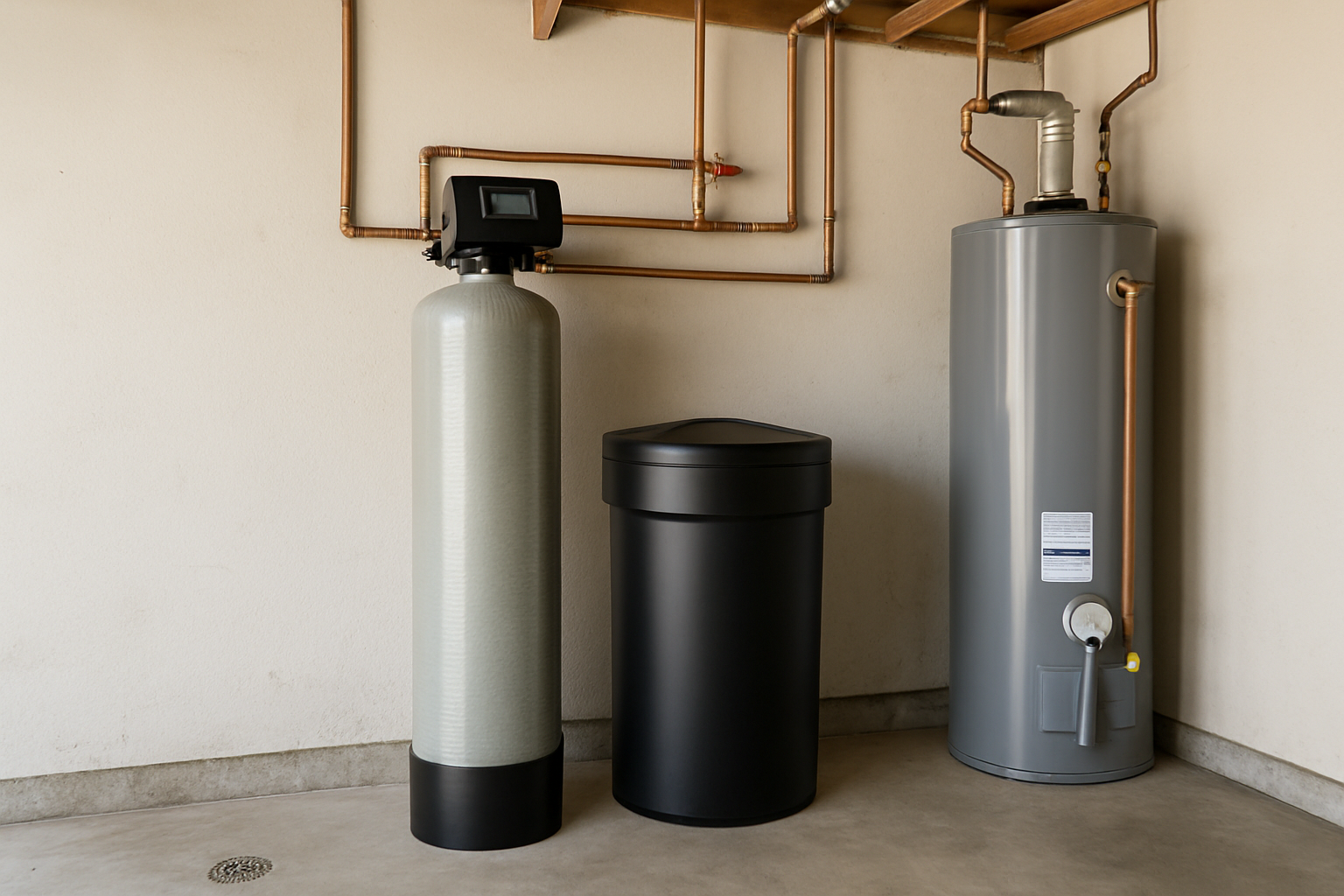
Salt-based ion exchange softener. This is the classic setup: a resin tank plus a brine tank, installed on the incoming main. It actually removes calcium and magnesium and regenerates itself on site using salt.
Salt-free conditioner. These change how minerals behave so they are less likely to stick, but they do not remove hardness. If you test the water afterward, it still reads 15 gpg. Some homeowners are fine with that trade, but go in knowing it.
Exchange tank service. A company delivers a charged resin tank, swaps it on a schedule, and regenerates it off site. No brine discharge at your house and no salt to haul. Monterey One Water lists exchange service as an alternative worth considering, which matters if your house has no floor drain anywhere near the water main.
One more thing worth clearing up: a reverse osmosis system under the kitchen sink solves a different problem. That is drinking water quality at one tap. A whole-house softener is about scale in your pipes, fixtures, and appliances. Plenty of homes end up with both.
Comparing the Three Treatment Paths
A quick side by side, based on how these systems actually behave in Salinas homes.
| Approach | Does it lower hardness on a test? | What it needs at the house | Ongoing commitment |
|---|---|---|---|
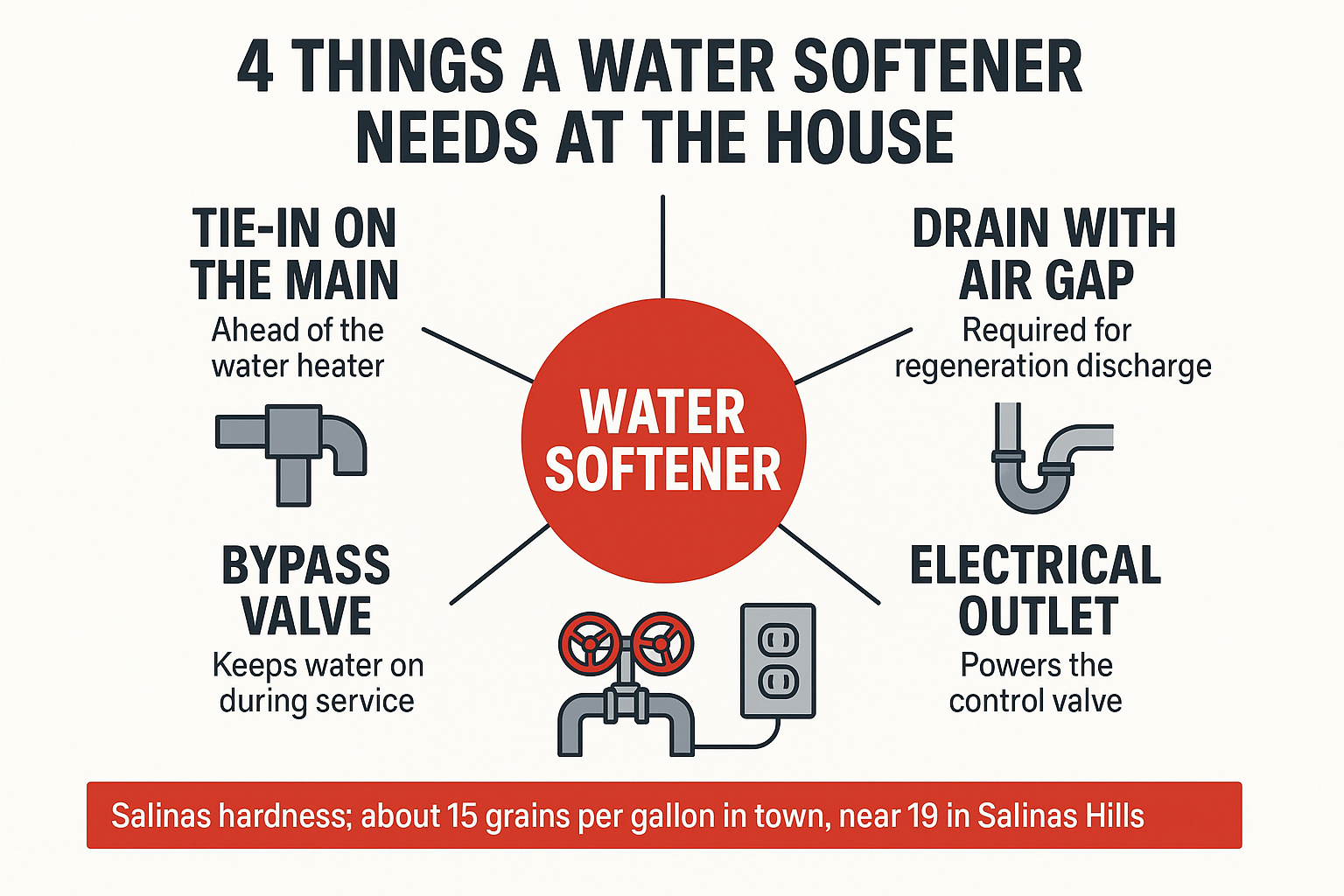
| Salt-based ion exchange | Yes, removes calcium and magnesium | Tie-in on the main, drain with air gap, electrical outlet, bypass | Salt refills, correct setting, occasional service |
| Salt-free conditioner | No, hardness reading stays the same | Tie-in on the main, usually no drain or outlet | Media replacement on a long cycle |
| Exchange tank service | Yes, while a charged tank is in place | Tie-in and space for the tank, no on-site brine discharge | Scheduled tank swaps by the provider |
Sizing and Settings: The Part Nobody Writes About
The equipment gets all the attention. The setting is where most of the waste happens.
Monterey One Water, the regional agency that treats wastewater for Salinas and much of the Peninsula, advises that softeners in Monterey County be set between 15 and 30 grains per gallon. The agency also points out that many units arrive from the factory set at the highest hardness level on the dial.
A unit dialed way above your actual hardness does three unhelpful things:
- Burns through salt faster than it needs to
- Regenerates more often, which wastes water
- Sends more sodium down the sewer line
There is also a real difference between unit types. Timer-based units regenerate on a fixed schedule whether the house used water or not, which is rough for a couple that travels or a rental that sits empty between guests. Demand-initiated units regenerate based on measured usage, which usually means less salt and less water.
And salt is not your only option. Some homeowners choose potassium chloride instead of sodium chloride. It costs more per bag, but it is a straightforward swap. You can read the agency’s guidance directly at Monterey One Water’s water softening page.
The Brine Question: Check Before You Buy
This is the local wrinkle that catches people off guard, and it is specific to where we live.
Salinas wastewater feeds a regional system that produces recycled water used on Salinas Valley farmland. The regional agency has publicly identified softener salt as a significant source of sodium in that recycled water. Sodium is a real concern for growers, so the topic gets attention here that it never gets in, say, Sacramento.
California Water Code section 13148, which came out of AB 1366 in 2009, gives local agencies in the Central Coast hydrologic region the ability to regulate or restrict residential self-regenerating softeners that discharge brine to a community sewer. That authority only kicks in by ordinance, after a public hearing and a finding from the regional water board.
So let’s be accurate about it. There is no statewide ban, and most of California allows salt-based softeners without issue. But the honest guidance for a Salinas or Monterey Peninsula homeowner is to call your local sewer agency or city before you buy a self-regenerating unit rather than assume anything. It is a five minute phone call that can save you a return trip to the store.
Homes on septic systems have a separate set of considerations, and that is worth asking about too.
What a Softener Needs at the House
Four things have to line up before a softener can go in cleanly. Missing one is the most common reason an install turns into a bigger job.
What Older Salinas Homes Run Into
The median Salinas home dates to the mid 1970s, and a meaningful share of the housing stock predates 1950. That history shows up the moment a plumber walks the job.
Common things we see around here:
- No plumbing loop stubbed out. Newer tract homes often have a softener loop waiting in the garage. Many Alisal and older east side homes do not.
- The main enters in an awkward spot, sometimes behind a finished garage wall or on an exterior side with no outlet nearby.
- Galvanized pipe still in service. Adding equipment to a corroded galvanized line is asking for a leak, so that gets looked at first.
- No drain within reach. This is the situation where exchange tank service starts making sense.
- Incoming pressure that is too high, which stresses the softener valve and everything downstream. Worth checking, since a failing pressure regulator causes its own set of problems.
Altering water lines is permit territory in some cases, and it is licensed contractor work either way. This is not a weekend project, and a bad tie-in on the main can flood a garage fast.
How Cost Actually Works Here
We get asked for one number, and there honestly is not one. What we can do is tell you what moves the price.
Cost drivers for a softener install:
- Unit type: salt-based, salt-free, or a service contract for exchange tanks
- Whether a drain and an electrical outlet already exist at the location
- Whether a section of pipe or a full loop has to be added
- Indoor versus garage versus exterior placement
- Condition of the existing piping, especially older galvanized lines
One request comes up constantly on our phones, usually in almost these exact words: “I already bought the unit. I just need someone to install it.” That is a normal job, and it is fine. What a plumber checks first is whether the unit is sized for roughly 15 grains per gallon, whether the fittings match your existing pipe, what the incoming pressure reads, and what shape the line it connects to is in.
One last honest note. A softener protects your system going forward, but it does not undo scale already sitting in your water heater. That is why a tank flush often gets scheduled at the same visit, especially on a unit that has never had one.
A walkthrough and a written quote for your specific house will always beat a number off the internet.
Frequently Asked Questions About Water Softeners in Salinas
Are water softeners banned in Salinas?
No. There is no statewide ban, and salt-based softeners are common throughout California. What exists here is local authority under California Water Code section 13148 for Central Coast agencies to regulate self-regenerating units that discharge brine to a community sewer, and only by ordinance after a public hearing. Call your sewer agency or the city before you buy so you know exactly where you stand.
What should I set my softener to in Salinas?
Monterey One Water advises a setting between 15 and 30 grains per gallon for Monterey County. With Salinas water running near 15 gpg in town and closer to 19 in the Salinas Hills area, most homes land near the low end. Check the dial, because many units ship set at the maximum.
Will a salt-free conditioner get rid of my hard water?
It will not lower the hardness reading. Salt-free systems change how minerals behave so they are less likely to build up, but the calcium and magnesium are still in the water. If your goal is a hardness test that reads soft, you need ion exchange.
Do I need a softener if I already have a reverse osmosis system?
They do different jobs. RO treats drinking water at one tap, usually the kitchen sink. A whole-house softener protects your pipes, fixtures, and appliances from scale. Plenty of Salinas homes run both.
Can a softener be installed if my garage has no drain?
Sometimes, depending on where the main enters and how far a drain line can reasonably run with a proper air gap. When there is no workable drain, exchange tank service is the alternative the regional agency points people toward, since the regeneration happens off site.
How long does the install take?
When the tie-in point, drain, and outlet are already in place, it is typically a same-visit job. If a loop has to be added, older pipe needs attention, or the main is buried behind a wall, plan on more time and a look at the whole line first.
Thinking Through a Softener for Your Salinas Home?
Alvarez Plumbing has been a family-run shop in Salinas since 1988, licensed, insured, and bonded, with permits handled in house and a 4.94 star average across more than 224 Google reviews. Softener work tends to show up in those reviews as routine, same-visit work, like this one: “Johnny Installed a water softener and toilet for us this morning. He is very professional, and completed the job quickly.” – Andrew B. If you want a walkthrough of your own setup and a written quote, we are reachable at (831) 757-5465, and 24/7 for emergencies across Salinas and the Monterey Bay Area.