
Direct Answer: Most water pressure regulators last 10 to 15 years. In hard water areas like Salinas, mineral buildup on the internal diaphragm often shortens that to closer to 8 to 12 years.
You replaced a shower cartridge last spring. Then a faucet started dripping. Now the toilet fill valve is buzzing and your water bill looks higher than it should.
Homeowners usually treat those as three separate small problems. Often they are one problem wearing three costumes, and the source is a failing pressure regulating valve sitting right near your main shutoff.
This article is about the back half of a regulator’s life: how long it actually lasts in Salinas, what happens when it quits, and how to check your own pressure before the guessing starts. We are assuming you already know what a regulator does and why homes on high-pressure lines need one.
Water Pressure Regulator Lifespan in Salinas, CA
Most manufacturers put a pressure regulating valve’s service life at 10 to 15 years. That number assumes reasonably clean, soft water moving through it.
Salinas does not have soft water. Local supply runs around 271 ppm hardness, which the USGS classifies as very hard at anything above 180 ppm.
Inside the regulator is a rubber diaphragm and a spring that work together to hold your house pressure steady. Calcium and magnesium scale collect on that diaphragm and on the seat it presses against.
Here is what that means for real timelines in our area:
- 8 to 12 years is a more realistic working life for a regulator on Salinas or Salinas Valley water
- Homes with a water softener often get closer to the full 15 years
- Regulators that never get looked at tend to fail without any single dramatic moment
- A lot of the 1960s-1980s housing stock around north Salinas and Seaside is still running an original or first-replacement valve
One more thing worth knowing: a regulator does not usually announce itself. It drifts. Pressure creeps up or slides down over months, and your fixtures absorb the damage quietly.
Failure Direction One: Pressure Climbs (The Expensive One)
When a regulator stops regulating, city pressure passes straight through to your house. On some Salinas streets that means well over 100 psi hitting fixtures built for 60.
The damage is cumulative, not instant. High pressure works on the weakest parts of your system first:
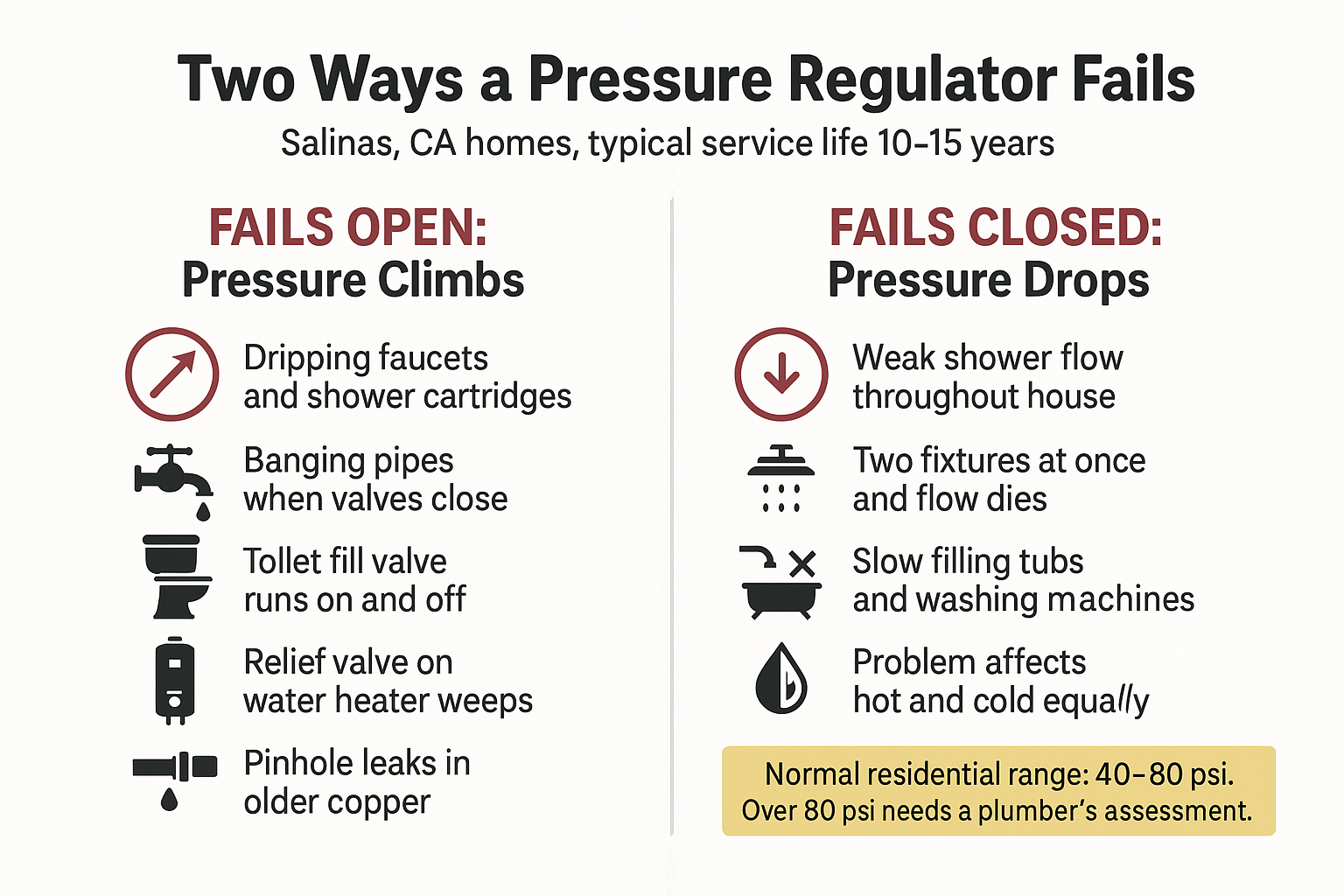
- Faucet stems and shower cartridges start dripping, then keep dripping after repair
- Toilet fill valves run on and off or refuse to seal
- Washing machine and dishwasher supply hoses bulge at the crimps
- Water hammer, that bang in the wall when a valve closes fast
- Pinhole leaks in older copper, often in a wall or under a slab
The part most people miss is the water heater. High incoming pressure means the tank has nowhere to put the extra volume when water heats and expands.
If your heater has a thermal expansion tank, it gets pushed past what it was sized for. If it does not, the temperature and pressure relief valve starts weeping to dump the excess, which looks exactly like a dying water heater.
We have been called out for a pressure relief valve that keeps leaking more than a few times where the tank itself was fine. The chain of symptoms pointed at a $1,900-plus replacement when the actual fault was a valve on the main line. Regulator replacement costs vary with valve size, access, and pipe condition, but many homeowners find it lands in the low hundreds rather than the thousands. Get a real quote before you assume either way.
The Two Ways a Regulator Quits
A regulator almost always fails in one of two directions, and each one produces a completely different set of complaints.
Failure Direction Two: It Sticks Closed and Pressure Drops
The other failure mode is quieter and gets misdiagnosed more often. Scale locks the valve down, or the spring loses tension, and your whole house loses pressure.
This one sends people chasing the wrong culprit. It feels like a clogged supply line, a failing main line, or a city problem on your street.
A few tells that point at the regulator instead:
- Pressure is low at every fixture, not just one bathroom
- Hot and cold are both weak, which rules out the water heater
- Neighbors on the same block report normal pressure
- Flow collapses when a second fixture opens
- It got worse gradually over months, not overnight
If the drop came on suddenly and you also see wet ground or a soft spot in the yard, that is a different conversation. A break between the meter and the house behaves differently, and main water line problems need their own diagnosis.
One detail that helps: a stuck-closed regulator does not waste water. So if your pressure is low and your usage is up, you are likely looking at two separate issues.
How to Test Your Own Water Pressure
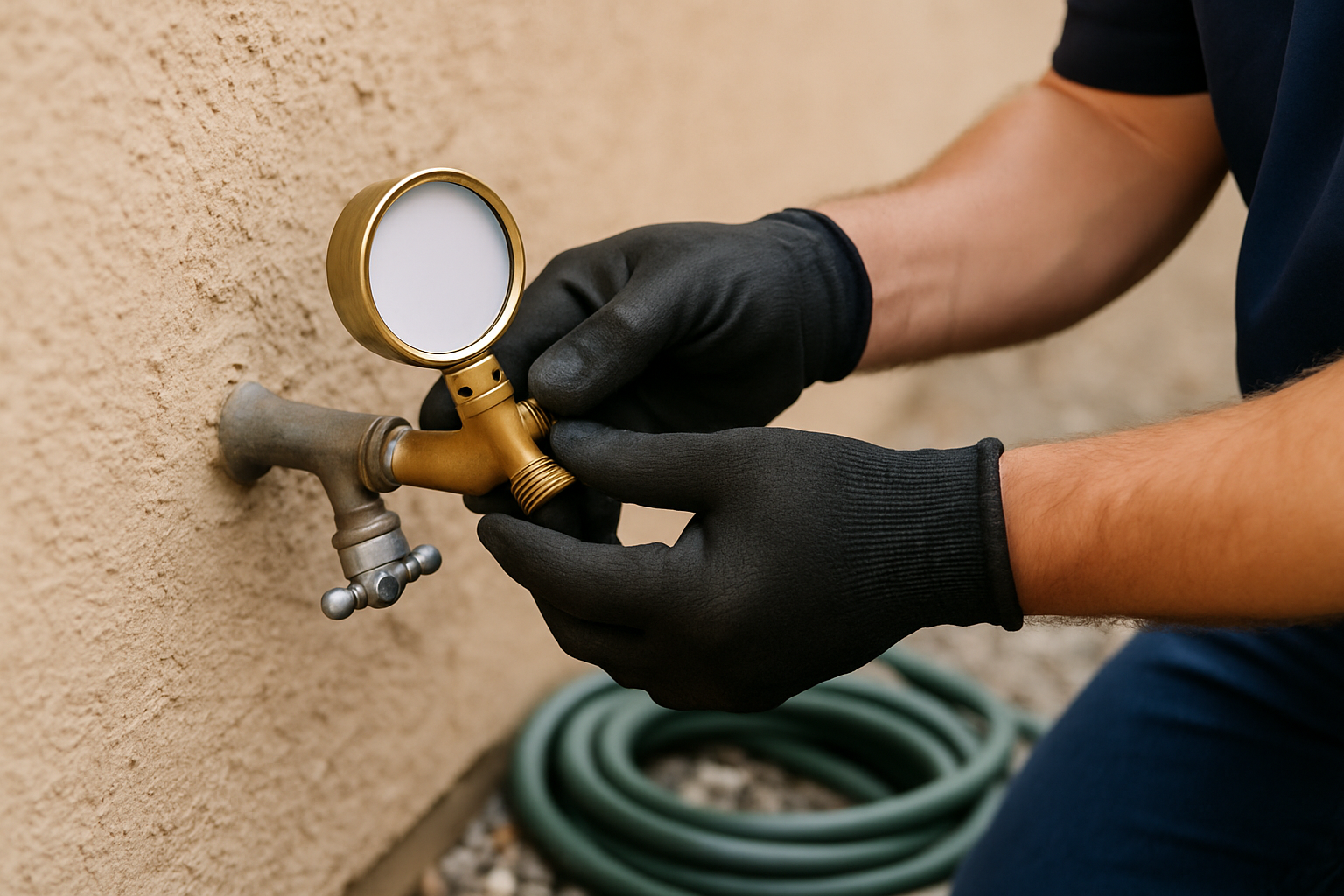
This is one of the few checks a homeowner can do safely, and it takes about five minutes. You need a screw-on pressure gauge with a hose thread, sold at any hardware store in Salinas for a modest price.
Do it like this:
1. Pick a hose bib on the front of the house, as close to the main line as possible
2. Turn off every fixture, appliance, and irrigation zone
3. Thread the gauge on hand-tight, then open the bib all the way
4. Read it, then check again in the early morning when street pressure peaks
Normal residential pressure in California runs 40 to 80 psi. Most homes feel best somewhere in the 50 to 65 range.
We get calls from homeowners who just opened a high water usage alert from their water utility and immediately assume a hidden leak. Sometimes it is a leak. Sometimes it is pressure driving a dozen small fixture drips at once, or a toilet flapper that cannot seal against 100 psi.
The gauge tells you which conversation to have. If it reads high, the pressure is the story. If it reads normal and usage is still climbing, then an underground or unseen leak becomes the more likely answer.
What Your Gauge Reading Actually Means
Take two readings on different days before you draw a conclusion. Street pressure fluctuates, especially in the early morning.
| Gauge Reading | What It Suggests | Reasonable Next Step |
|---|---|---|
| Under 40 psi | Regulator stuck closed, partially closed valve, or a supply restriction | Have the regulator and main shutoff checked |
| 40 to 80 psi | Within the normal range for California homes | Retest annually, especially if the valve is 10+ years old |
| 80 to 100 psi | Regulator is drifting or was set too high | Adjustment or replacement assessment |
| Over 100 psi | Regulator has likely failed open | Prompt evaluation before fixture and water heater damage adds up |
| Reading swings 30+ psi | Diaphragm is failing intermittently | Replacement is usually the honest answer |
Why This Matters More If Your Water Heater Is Aging
Pressure and water heater life are tied together in ways that are easy to miss. A tank already fighting hard water sediment has less margin for the extra stress of high pressure.
Running a heater at 90 psi does not blow it up. It shortens the tank’s life, keeps the relief valve cycling, and puts wear on the expansion tank bladder.
So before anyone recommends a new heater, the pressure should be verified. It is a five minute check that occasionally saves a homeowner from replacing a unit with years left in it.
The same logic runs the other way. If you are already planning a replacement, it is worth confirming the pressure is in range first, since hard water and sediment are quietly shortening tank life in this valley already. No reason to hand a brand new tank the same bad conditions.
Frequently Asked Questions About Pressure Regulator Lifespan
Can I replace a pressure regulator myself?
We would not recommend it. The regulator sits on the potable water main feeding your entire house, and the work involves cutting into pressurized supply piping. In California, work on the main water line is licensed contractor territory, and a bad joint there floods a wall cavity instead of dripping into a bucket. Testing your pressure with a gauge is fine. Swapping the valve is not a homeowner job.
Can a failing regulator make my water bill go up?
Yes, indirectly. High pressure creates and worsens drips at faucet stems, toilet flappers, and irrigation valves. A handful of small leaks running at 100 psi adds up on a monthly statement, which is why some homeowners get a high usage alert and never find one big leak.
Does every home in Salinas have a pressure regulator?
Not every one. Homes on lower-pressure sections of the distribution system may not have needed one when they were built. Older properties in central Salinas sometimes have one that was added later, and it may not be where you would expect it.
How often should I check my water pressure?
Once a year is plenty for most homes. If your regulator is past 10 years old, or you have replaced two or more fixtures or valves in the last year, check it sooner. Repeated fixture failures in a short window is the single best reason to put a gauge on the hose bib.
Can a regulator just be adjusted instead of replaced?
Sometimes. If the diaphragm is still intact and the valve simply got set too high, adjustment can bring it back into range. But if the reading swings, will not hold a setting, or the valve body is heavily scaled, adjusting it just delays the replacement by a few months.
Wondering What Your Home’s Pressure Is Actually Doing?
If your gauge is reading over 80 psi, or you have quietly replaced three fixtures in the last year, it is worth having someone look at the regulator before the next thing fails. Our team has been working on Salinas and Monterey Bay plumbing since 1988, and pressure testing is part of how we diagnose repeat fixture and water heater problems. You can reach Alvarez Plumbing at (831) 757-5465, or find service scheduling at alvarezplumbingsalinas.com, with 24/7 availability for the calls that cannot wait until morning.