
Direct Answer: A sudden water bill spike in Salinas often means a hidden underground leak. A licensed plumber can locate it using pressure testing and acoustic equipment without tearing up your yard.
California Water Service sends out high-usage alerts, and when one lands in a Salinas homeowner’s inbox, the first reaction is usually disbelief. The second is panic. You haven’t changed anything. Nobody’s been running extra water. And yet the meter says otherwise.
Hidden leaks are one of the most stressful plumbing situations we see in the Monterey Bay Area because the problem is real, the damage is accumulating, and you can’t find it with your eyes. The leak might be underground in your yard, under a slab, or inside a wall. You just know something is wrong.
This article walks through what underground leak detection actually involves, what to do right now if you suspect an active leak, and what the pipe condition underneath your property might be telling you, especially in older Salinas homes.
What to Do Right Now If You Suspect an Active Leak
One caller described it as simply as possible: “The water is just coming out and I can’t get it to stop.” That phrase captures exactly how disorienting a sudden, uncontrolled leak feels. Before you call anyone, do these four things:
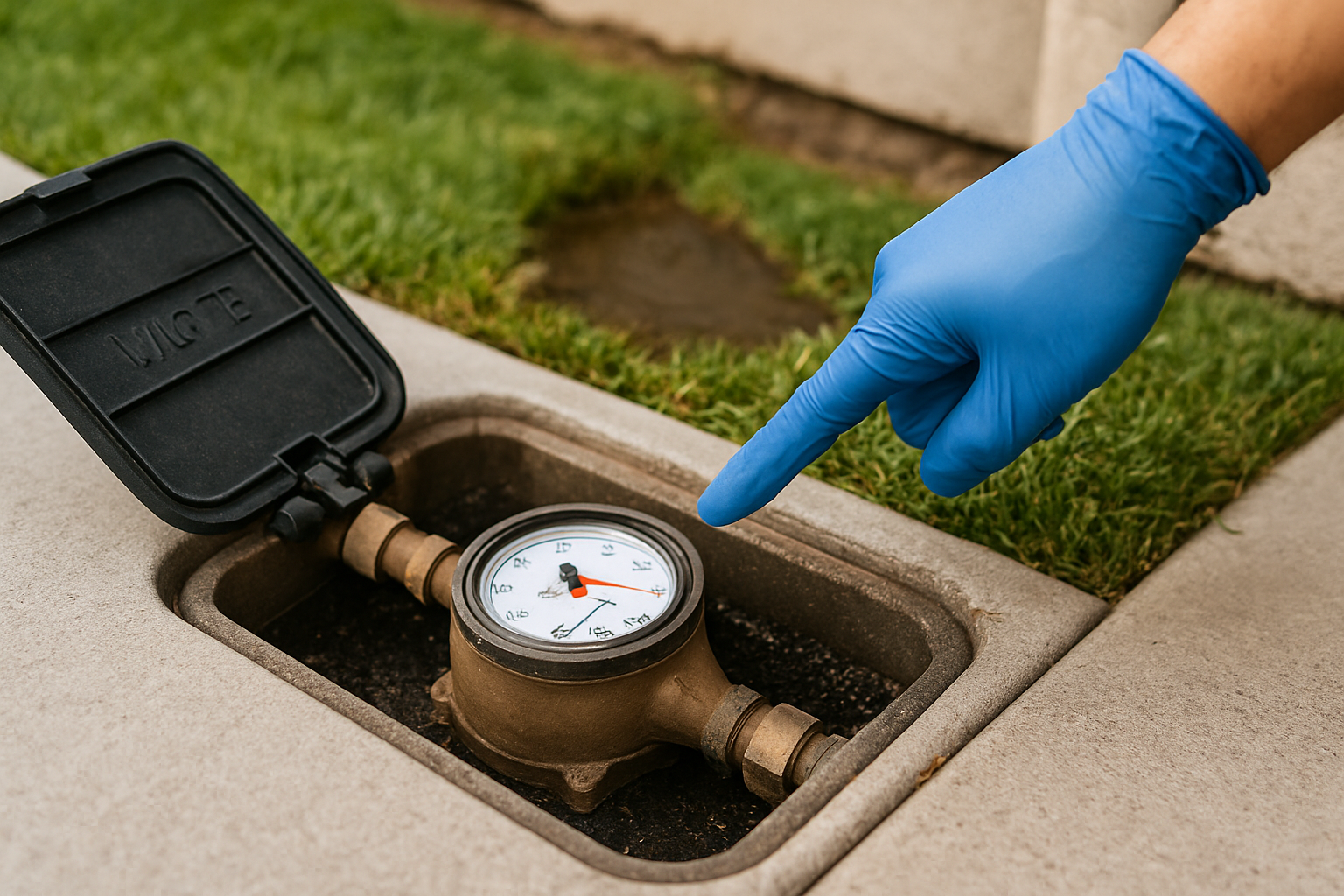
- Locate your main shutoff valve and close it. For most Salinas homes, it’s near the meter at the curb or where the supply line enters the house. Turning it off stops the flow and limits damage.
- Watch the meter after shutoff. If the dial or digital display continues to move after everything inside is off, that confirms water is still flowing somewhere between the meter and the house, a supply-side leak on your side of the meter.
- Document any wet spots. Soggy turf, a damp patch near the foundation, or a section of pavement that’s always wet are all clues. Take photos. A plumber will want to know where surface changes have appeared.
- Call a licensed plumber for a formal locate. Do not dig first. Digging without knowing the exact leak location means you might miss it entirely or cut into a pipe you weren’t expecting.
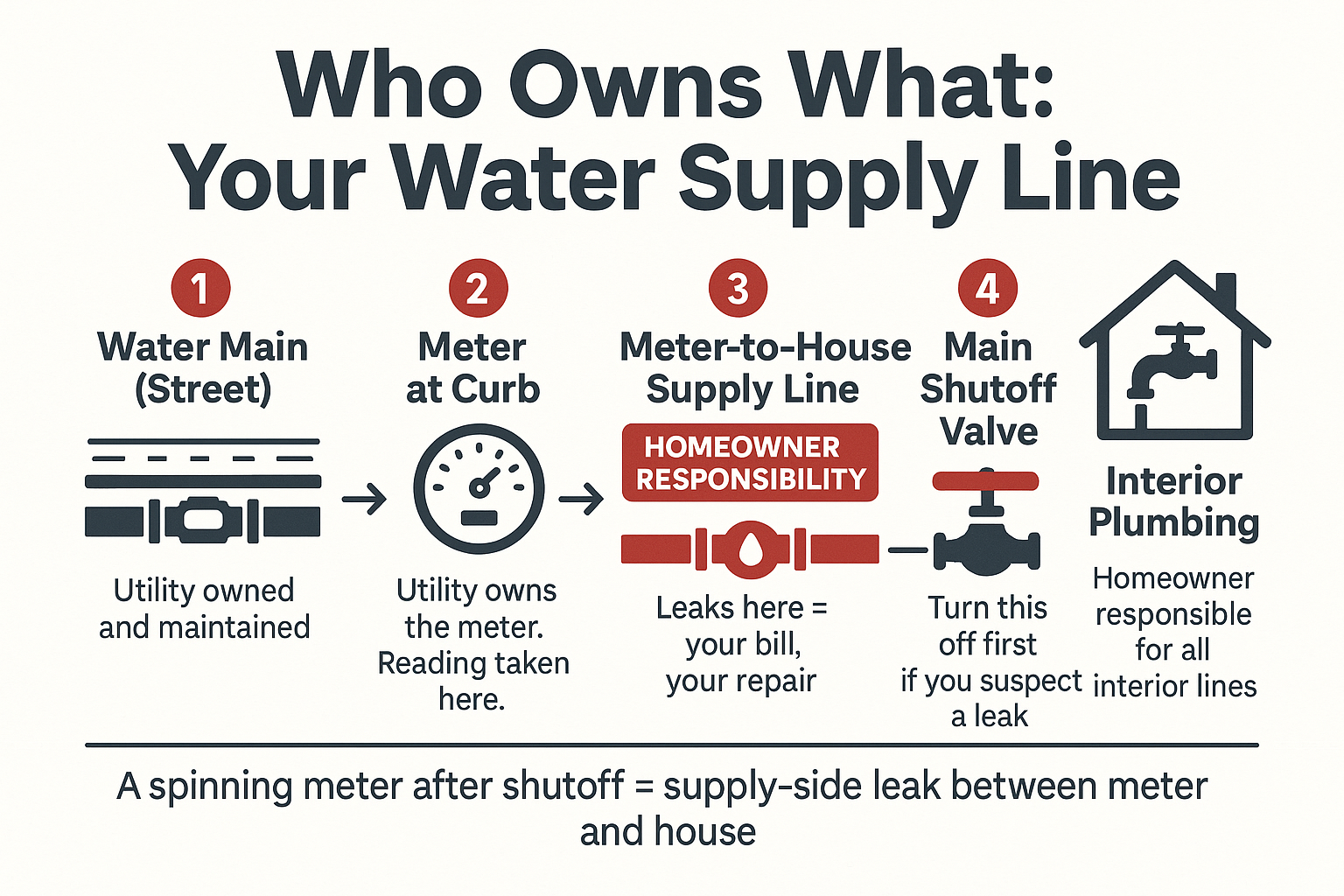
The meter test alone tells you a lot. If the meter stops moving after shutoff, the leak is likely inside the house. If it keeps moving, the problem is somewhere along the supply line between the curb and your home, and that line is your responsibility, not the water company’s.
That last point surprises a lot of callers. California Water Service and other local utilities own the infrastructure up to the meter. From the meter to your house, that pipe and every failure along it falls on the homeowner. Understanding that boundary matters because it tells you who you need to call and how urgently.
How Plumbers Actually Find Underground Leaks
The goal of leak detection is to find the exact location of a leak before any digging or demolition happens. A good diagnostic process is what separates a one-visit fix from a month-long guessing-and-patching cycle.
Modern underground leak detection typically combines several methods depending on the situation:
- Pressure testing isolates sections of pipe to confirm where pressure is dropping. If a section holds pressure and the next doesn’t, the leak is between those two points.
- Acoustic listening equipment picks up the sound of water escaping under pressure through soil or concrete. Trained plumbers move the sensor along the suspected run until the signal peaks, that’s the leak.
- Video camera inspection of accessible lines can confirm pipe condition and rule out secondary issues like root intrusion or joint separation. This is especially useful when a slab or foundation is involved.
- Thermal imaging is sometimes used for leaks behind walls or under flooring, where temperature differences from flowing water show up clearly.
The reason getting a proper locate matters so much in Salinas is the housing stock. A large share of homes in the area were built in the 1950s through 1970s, and many sit on concrete slabs. A slab-adjacent leak that gets dug up in the wrong spot causes expensive concrete work for no result. Knowing exactly where the pipe failed before you cut anything is not optional, it’s basic professional practice.
We use these methods to find leaks without tearing open every wall or digging up the entire yard. The video camera inspection step is particularly useful when there’s any uncertainty about what’s happening at joints or elbows along the run.
The Galvanized Pipe Problem in Older Salinas Homes
One homeowner recently submitted a service request describing a leaking underground pipe on their property, galvanized, supplying a garden hose, and they needed someone out within a day or two. That situation is familiar to anyone who works on pre-1970s homes in Salinas.
Galvanized steel pipe was standard in California residential construction until copper became the norm in the 1970s. The problem with galvanized is that it corrodes from the inside out. Mineral deposits and rust accumulate on the inner wall, which reduces water pressure over time, then eventually the wall thins enough to fail.
A single pinhole in galvanized pipe is almost never a one-off event. When the pipe wall has thinned enough to fail in one spot, it has usually thinned across the entire run. Homeowners who patch a single galvanized leak are often calling back within 12 to 24 months with a second failure in a different spot on the same pipe.
This creates a real decision point:
- Spot repair makes sense only if a camera inspection confirms that the surrounding pipe is in good condition, uncommon in galvanized over 50 years old.
- Section replacement is appropriate when the failure is isolated to a shorter run and the rest of the line is sound copper or PVC.
- Full repipe becomes the practical answer when galvanized runs throughout the home and multiple sections are showing low pressure, discoloration, or failure. It costs more upfront, but it’s a single project rather than an indefinite series of patch calls.
If you’re not sure which category your home falls into, a plumber who does a thorough diagnostic first, not just a quick patch, will give you a cleaner picture of where things stand. The repiping decision is worth making with full information rather than under emergency pressure.
Meter-to-House: Where Responsibility Starts and Stops
This infographic shows the ownership boundary between the water utility and the homeowner, and the key leak zones along a residential supply line.
Hidden Leak Warning Signs by Location
Different leak locations produce different warning signs. This table helps you connect what you’re seeing to where the problem might be.
| What You’re Noticing | Likely Location | Next Step |
|---|---|---|
| Unexplained water bill spike, no visible wet areas | Underground supply line or slab | Meter shutoff test, then call for acoustic locate |
| Soggy patch in yard that doesn’t dry out | Outdoor supply line or irrigation line | Document location, shut off water, call plumber |
| Wet area near foundation or driveway edge | Main line close to slab or under hardscape | Do not dig, get a formal locate first |
| Low water pressure plus discolored water | Corroded galvanized pipe inside or outside home | Pipe condition assessment, may indicate repipe |
| Meter spinning after all fixtures shut off | Supply-side leak between meter and house | Keep main closed, call licensed plumber same day |
| Damp drywall or ceiling staining without rain | Concealed interior pipe behind wall or above slab | Acoustic or thermal detection before opening walls |
What Leak Repair Actually Costs in the Salinas Area
Cost on a hidden leak job varies more than almost any other plumbing repair, because the total depends on how deep the pipe is, what material it’s made of, how much hardscape or landscaping is in the way, and what condition the surrounding pipe is in once you get there.
For a straightforward outdoor supply line repair in the Salinas area, many homeowners see estimates somewhere in the range of a few hundred to well over a thousand dollars, depending on depth, access, and pipe material. If the repair expands into a section replacement or repipe, costs go up significantly from there.
A few factors that drive the number higher:
- Concrete or pavement over the line (cutting and patching adds cost)
- Galvanized pipe that needs to be replaced rather than spliced
- Depth of the line, deeper means more excavation
- Whether a permit is required for the scope of work
For an accurate number specific to your property and situation, the right move is a diagnostic visit rather than a phone estimate. Every yard is different, and an honest quote requires seeing the actual conditions. Contact Alvarez Plumbing directly at (831) 757-5465 or through alvarezplumbingsalinas.com for a real assessment.
Frequently Asked Questions About Underground Leak Detection in Salinas
I got a high-usage alert from California Water Service. Does that mean I definitely have a leak?
Not necessarily, but it’s a strong signal worth taking seriously. High-usage alerts are often triggered by continuous water flow at the meter, which can mean a running toilet, a failed irrigation valve, or a supply line leak. The fastest way to check is the meter shutoff test: turn off your main valve, wait a few minutes, and see if the meter is still moving. If it is, you have a supply-side leak and should call a plumber.
If the leak is in my yard, is it my problem or the water company’s?
If the leak is on your side of the meter, it’s yours. The water utility’s responsibility ends at the meter. Everything from the meter to your house, including that underground supply line running across your yard, is the homeowner’s to repair and pay for. Many callers don’t know this until they call the utility and get directed back to a plumber.
Can a plumber find the leak without digging up my whole yard?
Yes, in most cases. Acoustic listening equipment and pressure testing can narrow the leak location to within a foot or two before any digging starts. The goal is always a targeted excavation, one small opening at the confirmed leak point, rather than exploratory digging across the property. Digging without a proper locate first is how small repairs turn into expensive yard restorations.
My home has galvanized pipes. Should I repair the leak or just repipe?
It depends on age and condition, but in older Salinas homes, especially those built before 1970, galvanized pipe that has failed once has usually thinned across a longer run. A camera inspection or pressure test can tell you whether the surrounding pipe is still sound. If it’s not, a section replacement or full repipe is almost always more economical over a three to five year window than repeated spot repairs. We cover this decision in more depth in our article on repiping and when small repairs stop making sense.
How long does a hidden leak locate typically take?
A diagnostic visit to locate the leak usually takes one to three hours, depending on the size of the property, how deep the pipe runs, and what equipment is needed. The repair itself is a separate scope and timeline, depending on what’s found. Getting the locate done correctly the first time is what makes the repair fast, without it, you’re guessing.
What if the leak is under my slab?
Slab leaks are common in Salinas given the age of the housing stock, and they require more careful detection work before any concrete is touched. Acoustic equipment and thermal imaging can often pinpoint the leak location through the slab. Once found, a plumber can assess whether a direct repair through the slab, a pipe reroute above the slab, or a full repipe is the right path. Don’t let anyone cut concrete before a proper locate is done, the hidden damage that builds before you call is already bad enough without unnecessary concrete work on top of it.
Getting the Diagnostic Right Before Anything Else
The most expensive version of a hidden leak repair is the one where someone starts digging or cutting before they know exactly what they’re dealing with. We’ve seen it, a homeowner gets a partial fix, then calls back six months later because the real problem was never found.
A thorough diagnostic, pressure test, acoustic locate, and camera inspection where needed, is not an upsell. It’s the difference between fixing the leak and fixing it once. If you’re weighing what a proper inspection actually shows, what a sewer camera inspection tells you walks through the process in detail.
For homeowners with galvanized supply lines, it’s also worth reading our article on buying a home and what a camera inspection can reveal inside the pipes, the same logic applies to any home where pipe condition is uncertain.
And if you’re trying to decide how urgent your situation actually is, what counts as a plumbing emergency and what can wait is a useful read before you call.
Suspect a Hidden Leak in Your Salinas Home?
If your water bill spiked, your meter won’t stop spinning, or you’ve got a wet patch in your yard that shouldn’t be there, the right next step is a proper diagnostic, not guesswork. Alvarez Plumbing serves Salinas and the greater Monterey Bay Area 24 hours a day, seven days a week, with licensed technicians who handle leak detection, underground supply line repair, and repiping for homes of any age. Call (831) 757-5465 or schedule online at alvarezplumbingsalinas.com.