
Direct Answer: A leaking water heater valve is either a failing TPR safety valve or a corroded inlet/outlet fitting. Location of the drip tells you which one you have, and they are two very different problems.
You spot water near your water heater and follow it to a valve or a pipe connection. It might be a slow drip, a damp fitting, or a small puddle below the discharge pipe. Your first instinct is probably to wonder whether the whole unit needs to go.
In most cases, that is not what is happening. But the right answer depends entirely on where the water is coming from, and homeowners consistently mix up two very different sources. One is a corroded inlet or outlet fitting. The other is the temperature and pressure relief valve, which is a safety device that deserves more attention than it usually gets.
We see this distinction matter every week in Salinas, CA, where the area’s hard water accelerates corrosion at threaded fittings and shortens the working life of valve components. This article explains how to tell the two apart, what each one means for your system, and when a plumber needs to be involved.
The TPR Valve: What It Is and Why It Matters
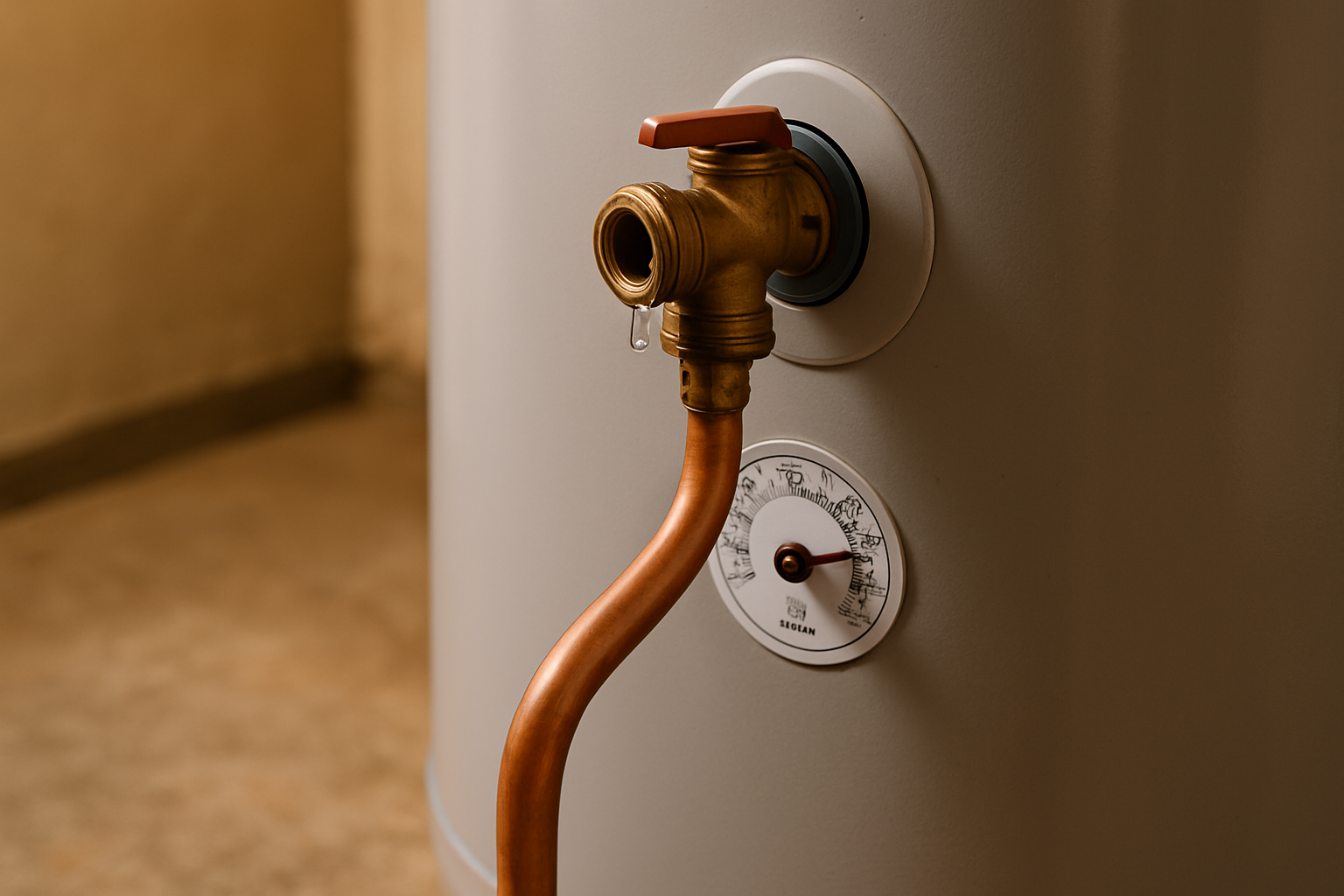
The temperature and pressure relief valve, almost always shortened to TPR valve, is mounted on the side of your tank, usually in the upper third. A copper or CPVC pipe connects to it and runs down toward the floor or into a drain. That pipe is the discharge line, and it is there for a reason.
The TPR valve is the last line of defense against a dangerous pressure buildup inside the tank. If the water temperature climbs above 210°F or the internal pressure exceeds 150 PSI, the valve opens automatically and releases water to prevent the tank from rupturing. The U.S. Consumer Product Safety Commission has documented water heater failures that resulted from improperly installed or bypassed TPR valves, this is not a theoretical risk.
A valve that releases a small amount of water occasionally is not necessarily broken. It may be responding to normal thermal expansion during heating cycles, especially in a closed water system without a thermal expansion tank. But a valve that drips continuously, or that releases and does not reseat cleanly, has either failed on its own or is signaling that system pressure is running too high.
Continuous Drip vs. Occasional Release: Two Different Problems
These two scenarios look similar from the outside but point to different root causes.
Occasional release during heating cycles usually means the system pressure is spiking when cold water heats up and expands. In a closed plumbing system, which most Salinas homes have, because of backflow preventers installed on the municipal supply, that expanded water has nowhere to go except into the tank. A thermal expansion tank absorbs that pressure and keeps it from pushing the TPR valve open. If your home does not have one, the valve may be doing exactly what it is designed to do.
Continuous dripping is a different situation. If the valve is seeping water steadily even when the heater is not in a heating cycle, the valve seat has likely worn or corroded and is no longer sealing properly. At that point the valve has failed as a safety device, it may not open when you actually need it to. Salinas water is moderately hard, and mineral deposits on the valve seat are a common cause of this exact failure on water heaters that have not had annual maintenance. Your Water Heater Has Never Been Flushed. Here’s What That Means. goes into more detail on how sediment and mineral buildup accelerate these kinds of component failures.
The Other Leak: Inlet and Outlet Fittings at the Top of the Tank
One of the most common form submissions we receive describes what one homeowner called a “copper pipe on top of water heater is leaking.” That is almost always a different problem entirely from a failing TPR valve, and it is actually more common.
At the top of most tank water heaters, two connections come in and out:
- Cold-water inlet, brings supply water into the tank
- Hot-water outlet, sends hot water to your fixtures
These are threaded brass nipple fittings, and in hard water areas, the threads corrode over time. A small weep at one of these connections can look almost identical to a TPR valve leak if you are not sure what you are looking at. The key difference is location: fittings are at the top of the tank, running up into the supply lines. The TPR valve is on the side, mid-tank, with a discharge pipe running downward.
A slow drip at a corroded fitting is not a safety issue the way a TPR failure is, but it is worth having a plumber assess it. Trying to tighten a corroded brass fitting on a tank that is 10 or more years old can fracture the fitting entirely and turn a small drip into a much bigger problem. The threads weaken over years of mineral exposure, and the margin between snug and cracked is very small.
How to Tell the Leak Source Apart at a Glance
Use this quick reference to identify whether your water heater leak is coming from the TPR valve or from an inlet/outlet fitting before you call.
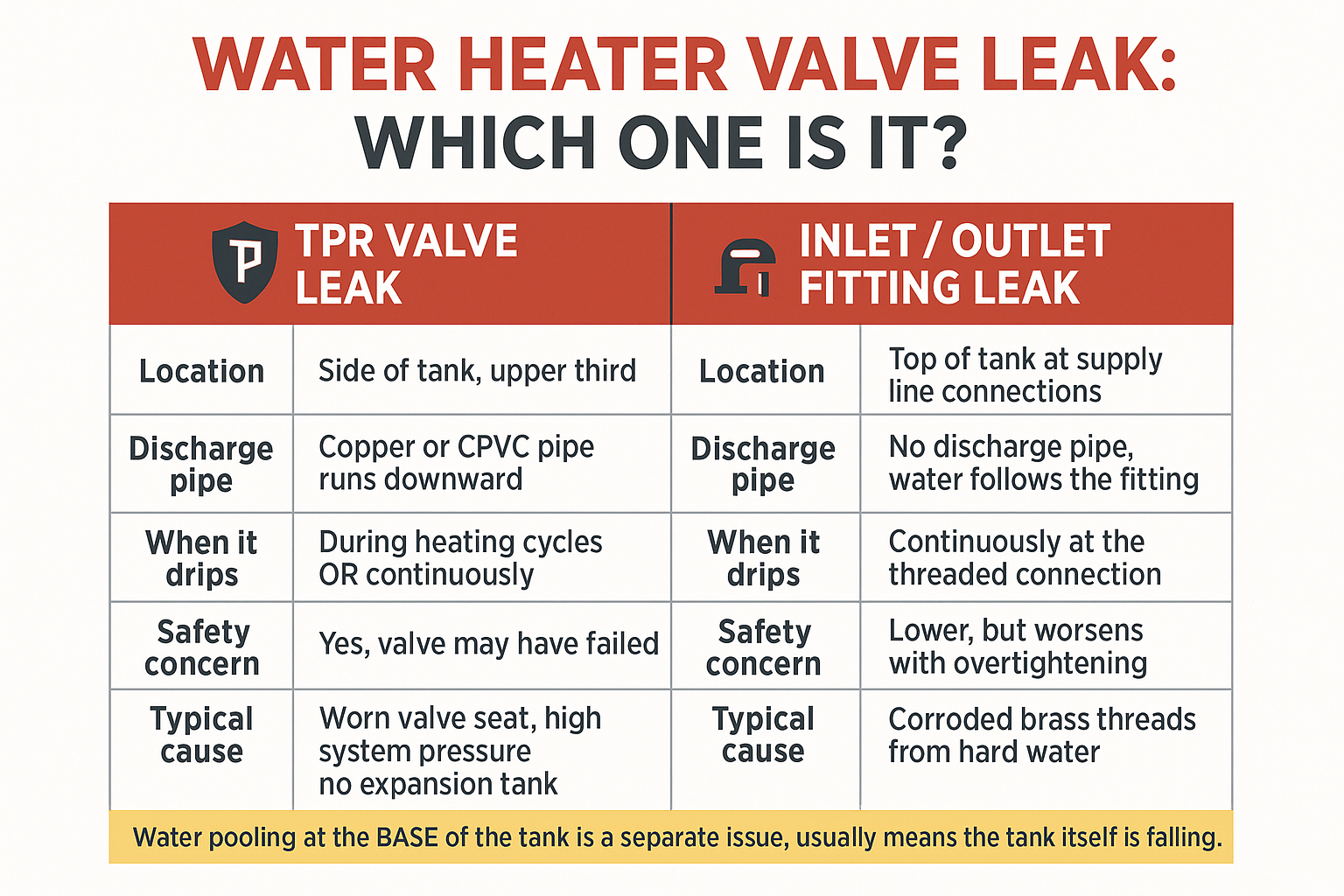
Quick Comparison: TPR Valve vs. Fitting Leak vs. Base Leak
Here is a side-by-side look at the three most common water heater leak locations, what each typically signals, and the general direction of repair.
| Leak Location | Likely Cause | Repair Direction |
|---|---|---|
| Side of tank, TPR valve | Failed valve seat or high system pressure | Valve replacement, possible expansion tank |
| Top of tank, threaded fitting | Corroded brass nipple from hard water | Fitting replacement by a licensed plumber |
| Base of tank, floor pooling | Internal tank corrosion or liner failure | Full water heater replacement |
What California Requires, and Why It Matters Here
Replacing a TPR valve in California is not a homeowner repair. California law requires a licensed plumbing contractor to replace or modify any component that is part of the closed water heating system, which includes the TPR valve, the discharge pipe, and associated fittings.
This matters beyond the permit question. A TPR valve that is the wrong pressure rating for your specific tank, or one that is installed with a discharge pipe that runs uphill instead of down, will not function correctly in an emergency. On a gas water heater, that failure mode carries real risk. A licensed plumber will confirm the correct valve specifications for your unit before touching anything.
For water heater replacements in Salinas, the City of Salinas requires a permit, and that permit process includes inspection of the TPR valve and discharge piping as part of the final sign-off. If you are already getting a full replacement, this is covered as part of the job. Yes, You Need a Permit to Replace Your Water Heater in Salinas. Here’s Why It Matters. has a full breakdown of what that process involves.
For repairs short of full replacement, the cost picture is generally much better than homeowners expect. When the leak is at a valve or fitting rather than at the tank base, many jobs come in well below the cost of a new unit. Full water heater replacements in the Salinas area generally run somewhere in the range of $1,900 to $2,100 installed based on recent local jobs, but a TPR valve or fitting repair is typically a fraction of that, a plumber can give you an accurate number once they see what you actually have.
The One Situation Where Replacement Is Usually the Right Call
If the water is not coming from a valve or fitting but is pooling under the tank itself, that changes the calculation entirely. Water at the base almost always means the tank’s inner lining has corroded through. There is no repair for that, the tank needs to come out.
A tank that is leaking at the base and is already 10 or more years old is past the point where repair makes financial sense even if a repair were possible. The Repair or Replace Your Water Heater? A Realistic Way to Think It Through article walks through that decision in more detail, including the age and repair-cost thresholds that most experienced plumbers use as a guide.
Salinas water is hard enough that sediment buildup is a real accelerant of tank liner corrosion, especially on units that have never been flushed. Hard Water Is Quietly Shortening the Life of Your Water Heater explains the mechanism and what it means for expected tank lifespan in this area.
Frequently Asked Questions About Water Heater Valve Leaks
My TPR valve is dripping but the water heater seems to be working fine. Is it safe to leave it?
A continuously dripping TPR valve should not be left alone, even if the unit seems to be producing hot water normally. A valve that is seeping at rest may not open when it actually needs to, the same corrosion that causes the drip can prevent a full release under high pressure. It also signals that something in the system, whether the valve itself or the pressure level, is not operating as it should. Get a plumber to look at it.
Can I tighten the leaking fitting myself to stop the drip?
That depends on the age of the fitting and the tank. On a newer unit with good brass threads, a small turn with the right wrench might stop a minor weep. On a tank that is 8-10 or more years old, which covers a lot of homes in Salinas, corroded brass threads can crack when overtightened, and that turns a drip into a flood. If you have any doubt about the fitting’s condition, let a plumber assess it first.
How do I know if I need a thermal expansion tank?
If your home has a backflow preventer or a pressure-reducing valve on the main supply line, you almost certainly have a closed water system. In that setup, California code requires an expansion tank on new water heater installations. If your current water heater was installed without one, your TPR valve may be opening periodically to relieve the pressure that the expansion tank would otherwise absorb. A plumber can check your system configuration and confirm what is needed.
Water is pooling under the tank but not at any fitting. Does that mean I need a new water heater?
In most cases, yes. Water at the base of the tank usually means the inner steel tank has corroded through. That is not a repairable condition, the tank needs replacement. Before you assume the worst, have a plumber confirm the source, because condensation can occasionally produce floor moisture on a humid day. But if there is a steady pool that is not clearing up, plan for a replacement conversation.
Someone replaced a bypass valve on my water heater and now it’s making a buzzing sound. Are those two things connected?
Possibly. A buzzing noise after a valve replacement can sometimes indicate water flow through a partially open valve, a check valve chattering under pressure, or air in the system that worked loose during the repair. It is also possible the two things are unrelated and the noise was always there but you are paying more attention now. Either way, it is worth a call back to the plumber who did the work to have them take a listen, that is a reasonable request after any service.
Not Sure Which Valve Is the Problem?
If you have water near your water heater and you are not certain where it is coming from, that is exactly the right moment to call a licensed plumber before the situation gets clearer in a bad way. We serve Salinas, Monterey, Seaside, Pacific Grove, Carmel, and the surrounding Monterey Bay Area, and we are available 24 hours a day, seven days a week for situations that cannot wait. Reach us at (831) 757-5465 or schedule service online at alvarezplumbingsalinas.com.