
Direct Answer: Whether to repair or replace your water heater depends on its age, what’s actually wrong with it, and how the repair cost stacks up against replacement. There’s no universal answer — it depends on four specific factors.
The question comes up on almost every water heater service call we go on: Should I repair this thing, or just replace it? It sounds like a simple question, but the honest answer depends on more than just the age of the unit or how bad the problem looks at first glance.
In Salinas and across the Monterey Bay Area, we see a wide range of situations — a 7-year-old heater that just needs a flush, a 20-year-old tank that’s actively leaking and long overdue, and everything in between. The right call for one homeowner is the wrong call for another.
This article walks through the four things that actually determine whether repair or replacement makes financial sense — so you can go into the conversation with your plumber already thinking clearly about it.
Start With Age — It’s the Most Reliable First Signal
Age doesn’t tell you everything, but it tells you a lot. Most tank-style water heaters have a realistic lifespan of 8 to 12 years. Some units push past that with consistent maintenance. But many don’t, especially here.
Salinas water tests at roughly 271 parts per million of hardness — firmly in the hard water category by any standard measure. That level of mineral content accelerates sediment buildup inside the tank, stresses the anode rod faster, and quietly shortens a unit’s effective life if it hasn’t been flushed and serviced on a regular schedule. A 10-year-old heater in Salinas that’s never been flushed is in a meaningfully different position than a 10-year-old unit in a soft-water area. You can read more about how regional water conditions affect equipment in our article on how long a water heater should last in the Monterey Bay climate.
As a general starting point:
- Under 7 years old — repair is almost always the right call, unless the tank itself is damaged
- 7 to 10 years old — depends heavily on the nature of the problem and maintenance history
- 10 years or older — replacement deserves serious consideration even for moderate repairs
- 12+ years with hard water exposure and no maintenance — replacement is usually the practical answer
Age alone won’t close the decision. But it sets the frame for everything else.
The Nature of the Problem Changes Everything
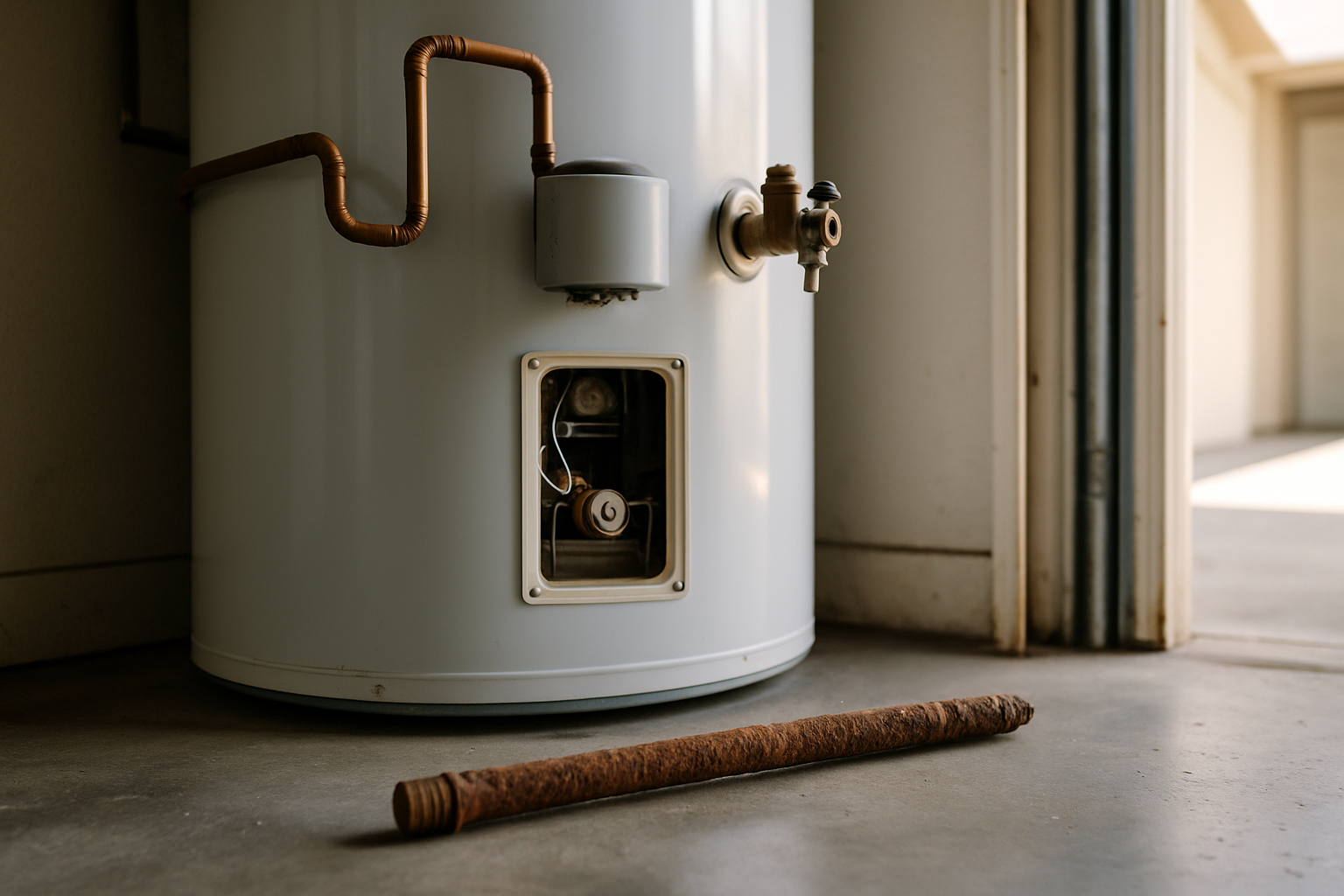
Not all water heater problems are created equal. Some are straightforward repairs. Others are signals that the unit is done.
Repairable problems — often at a fraction of replacement cost:
- Failed pilot light or igniter
- Bad thermostat or faulty heating element
- Worn pressure relief valve
- Leaking supply connections or fittings above the tank
- Leaking recirculation pump (more on this below)
Not repairable:
- A tank that is leaking from the body or bottom — that’s internal corrosion, and no repair stops it
- A tankless unit with a failed heat exchanger that’s out of warranty — parts and labor often approach or exceed the cost of a new unit
- Persistent sediment damage that’s causing rumbling, discolored water, and inconsistent temperatures across a unit that’s already aging
We had a homeowner reach out recently about a 7-year-old unit that had never been flushed and was producing slightly smelly hot water. That’s a maintenance issue — a flush and anode rod check, not a replacement. Completely different situation from the caller who described a 20-year-old tank that had stopped working and was leaking from the bottom. Those two calls led to two completely different conversations.
If you’re seeing warning signs from your water heater but aren’t sure what they mean, it’s worth having someone look at it before assuming the worst — or assuming everything is fine.
The Recirculation Pump Question Deserves Its Own Answer
Several homeowners who’ve contacted us specifically asked about leaking recirculation pumps — and it’s worth addressing directly because people often assume the pump problem means the whole system needs to go.
A recirculation pump is a separate component from the tank itself. In many cases, a leaking pump can be replaced independently without touching the water heater. It’s a legitimate repair, not a workaround.
That said, a pump failure is a good moment to take a clear-eyed look at the rest of the system. If the tank is also aging, or if you’ve been putting off maintenance, it may make sense to address both at once rather than spending money on the pump and then replacing the tank a year later. A plumber who’s honest with you will lay out both paths and let you decide.
The Repair-or-Replace Decision at a Glance
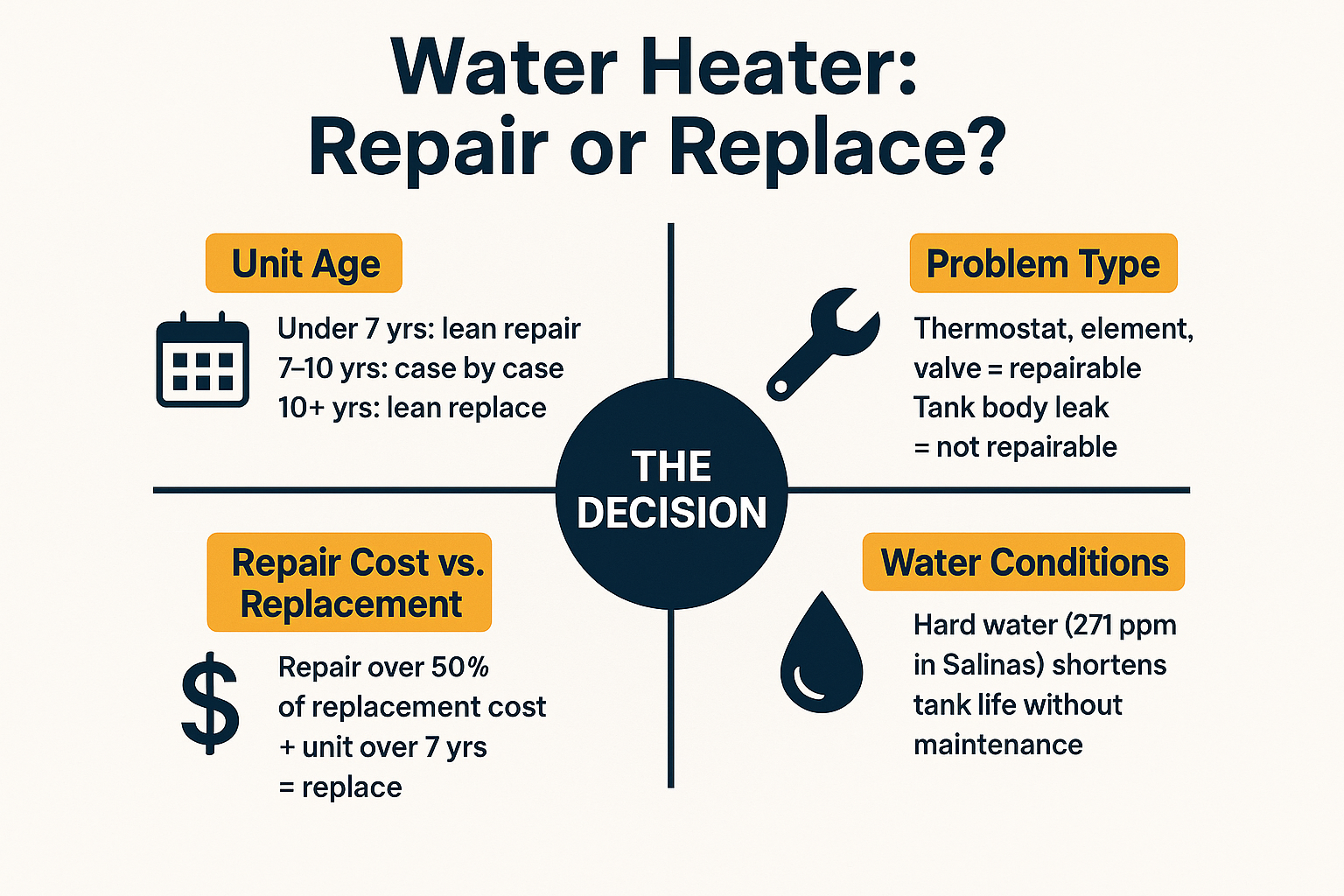
This framework summarizes the four variables that drive the repair-or-replace decision for most homeowners in Salinas and the Monterey Bay Area.
Running the Cost Math — A Practical Rule of Thumb
There’s a simple formula that holds up well in practice: if a repair costs more than 50% of what a comparable new unit would cost — and the existing unit is already 7 or more years old — replacement usually makes better financial sense over a 3-to-5-year horizon.
But that math shifts depending on context. A few factors that change the calculation:
- Simple repairs on a younger unit — a thermostat swap or a pressure valve replacement on a 5-year-old heater is almost always worth doing
- Switching unit types — going from a traditional tank to a tankless system, or moving to a heat pump water heater, involves installation costs, possible gas line or electrical work, and permit fees beyond just the equipment price. That’s a bigger upfront number, but can reduce operating costs over time
- Older units with multiple issues — if one repair reveals a second problem, or if you’re dealing with a unit that’s been patched before, the cumulative cost math changes fast
For what it’s worth, water heater replacement jobs in the Salinas area — based on the conversations we have regularly with homeowners — tend to fall somewhere in the range of $1,900 to $2,100 for a standard tank replacement, depending on unit size, equipment type, and job conditions. That’s a general market reference, not a fixed quote. The best way to get an accurate number is to have someone come out and look at your specific setup.
And if you’re weighing a larger repair bill against a replacement, this article on when small plumbing issues turn into bigger repair costs is worth a read before you decide.
Quick Reference: Repair or Replace?
This table summarizes the most common water heater scenarios and which direction the decision typically points. Use it as a starting point — not a final answer.
| Situation | Unit Age | Likely Direction |
|---|---|---|
| Failed thermostat or heating element | Any age | Repair |
| Pressure relief valve replacement | Any age | Repair |
| Leaking recirculation pump | Any age | Repair pump; evaluate tank separately |
| Smelly water, never flushed | Under 10 years | Service and flush first |
| Tank leaking from body or bottom | Any age | Replace |
| Multiple issues, repair cost near 50% of replacement | 7+ years | Replace |
| No hot water, unit over 12 years, hard water area | 12+ years | Replace |
| Tankless heat exchanger failure, out of warranty | Varies | Replace |
Permits Are Part of the Process — Not Optional
If you do go the replacement route, know that any water heater replacement in Salinas requires a permit through the City of Salinas. This isn’t a technicality — it’s a code requirement, and it protects you.
The 2025 California Building Energy Efficiency Standards are now in effect and changed the compliance baseline for new water heater installations. Any licensed contractor doing a legitimate replacement will handle permit logistics as part of the job. If someone offers to skip the permit to save money or time, that’s a red flag worth taking seriously.
You can get into the details of why this matters in our articles on why permits for water heater replacement in Salinas matter and California’s new water heater rules. The California Energy Commission publishes the current standards if you want to go straight to the source.
Frequently Asked Questions About Water Heater Repair vs. Replacement in Salinas
My water heater is 10 years old and stopped working. Should I just replace it?
At 10 years old in Salinas, with our hard water conditions, replacement is worth a serious look — but it’s not automatic. If the unit is leaking from the tank body, replacement is the clear answer. If it’s a failed element or thermostat, repair might still make economic sense depending on the unit’s maintenance history. Have a licensed plumber diagnose it before committing either way.
How much does water heater replacement cost in Salinas?
Based on the conversations we regularly have with homeowners in the area, a standard tank replacement typically runs somewhere in the $1,900–$2,100 range — but that number shifts based on unit size, equipment type, access difficulty, and whether any additional work is needed. Tankless or heat pump installations carry a different cost structure entirely. The only reliable number is a quote based on your actual setup.
Is smelly hot water a sign I need a new water heater?
Usually not. Sulfur or rotten egg smell in hot water is most often a sign that the anode rod has been depleted and bacteria have taken hold in the tank — a maintenance issue, not a replacement signal. A flush and anode rod replacement typically resolves it, especially in units under 10 years old. If the smell persists after service, that’s worth a closer look.
My recirculation pump is leaking. Does that mean I need a new water heater?
Not necessarily. The recirculation pump is a separate component and can often be replaced on its own. But a pump failure is a good time to evaluate the whole system — especially if the tank is aging. A plumber can tell you whether the tank itself looks healthy enough to justify the pump repair, or whether you’d be better off addressing both at once.
Does a water heater replacement in Salinas require a permit?
Yes — always. The City of Salinas requires a permit for water heater replacements, and the 2025 California Building Energy Efficiency Standards set the current compliance requirements for new installations. A licensed contractor will pull that permit as part of the job. If someone offers to skip it, that’s a problem.
What’s the difference in cost between repairing a tank versus switching to tankless?
Significantly different. A standard tank repair or swap is a relatively contained job. Converting to a tankless system often requires changes to gas line sizing, venting, or electrical capacity — depending on the unit — plus the equipment itself costs more upfront. It can make good long-term sense, but it’s a bigger project and a bigger initial investment. Get a side-by-side quote before deciding.
Not Sure Which Way to Go? A Diagnosis Is the Right First Step.
If you’re sitting with a water heater that’s acting up and you’re not sure whether a repair makes sense or replacement is overdue, the most useful thing you can do is get a professional set of eyes on it before spending money in either direction. Alvarez Plumbing has been handling water heater repairs and replacements in Salinas and the Monterey Bay Area since 1988 — we can walk you through exactly what we’re seeing and what makes sense for your situation. Call us at (831) 757-5465 or schedule online at alvarezplumbingsalinas.com.