Direct Answer: In the Monterey Bay Area, a tank water heater typically lasts 8 to 12 years. Hard water and coastal salt air can shorten that window, while regular maintenance can push it closer to the high end.
Most homeowners don’t think about their water heater until the morning they step into a cold shower. By then, the unit has usually been struggling for months — and the repair or replacement window has narrowed to whatever can get done fast.
If you own a home in Salinas, Monterey, or anywhere along the Central Coast, your water heater is working under conditions that most product warranties don’t account for. Hard water from the Salinas Valley aquifer, salt-heavy coastal air, and older housing stock all take a real toll on plumbing equipment over time.
This article breaks down what actually determines how long a water heater lasts in this specific region, what the warning signs look like before failure, and how to think about replacement timing so you’re making the decision on your schedule — not the tank’s.
What the Average Lifespan Actually Looks Like Around Here
The standard industry guidance says a tank-style water heater lasts 8 to 12 years. That’s a reasonable national average, but it assumes relatively neutral water chemistry and a dry indoor environment. Neither of those describes most homes on the Monterey Peninsula or in the Salinas Valley.
Water in this region runs hard. Mineral content — primarily calcium and magnesium — accelerates sediment buildup inside the tank. That sediment layer sits on the heating element, makes the burner work harder, and quietly shortens the unit’s usable life. In homes that never flush the tank or replace the anode rod, 8 years is a realistic ceiling, not a floor.
Tankless water heaters hold up better in hard water conditions than tank-style units, but they’re not immune. Without a descaling flush every 12 to 18 months, the heat exchanger in a tankless unit can clog — and that repair often runs $200 to $500 depending on the extent of the buildup.
A few things that consistently affect lifespan in this area:
- Water hardness — Salinas Valley tap water averages around 200–300 mg/L of hardness, which is considered hard to very hard
- Tank size relative to household demand — an undersized tank runs more cycles and wears out faster
- Anode rod maintenance — most homeowners have never replaced theirs; it should be checked every 3 to 5 years
- Installation quality — a unit installed without proper seismic strapping, correct pipe fittings, or a permit is more likely to fail early and create liability problems when you sell
The Signs That Your Tank Is Running Out of Time
A water heater rarely fails without warning. The problem is the warnings are easy to dismiss until they aren’t.
We’ve written before about the specific signals most homeowners miss — things like rumbling sounds during heating cycles, inconsistent hot water, or a pilot light that keeps going out. Those aren’t quirks to live with. They’re a tank telling you it’s getting close to the end.
Rust-colored water coming from the hot tap is one of the clearer signs. It usually means the interior of the tank has started to corrode, and at that point no repair fixes the underlying problem — the tank needs to come out. If you’re also running out of hot water faster than you used to, sediment buildup is the most likely cause.
Age alone is worth paying attention to. If your unit is past 10 years old, look at the label on the tank and find the serial number — the first four digits typically encode the manufacture date. A licensed plumber can tell you within a few minutes whether the unit is worth repairing or whether replacement makes more financial sense.
Common late-stage warning signs:
- Water pooling around the base of the tank
- Visible corrosion on the tank body or fittings
- Hot water that smells metallic or sulfuric
- Noticeably higher gas or electric bills without a usage change
- Pressure relief valve that has started to weep or discharge
Tank vs. Tankless: How They Age Differently in the Monterey Bay Area
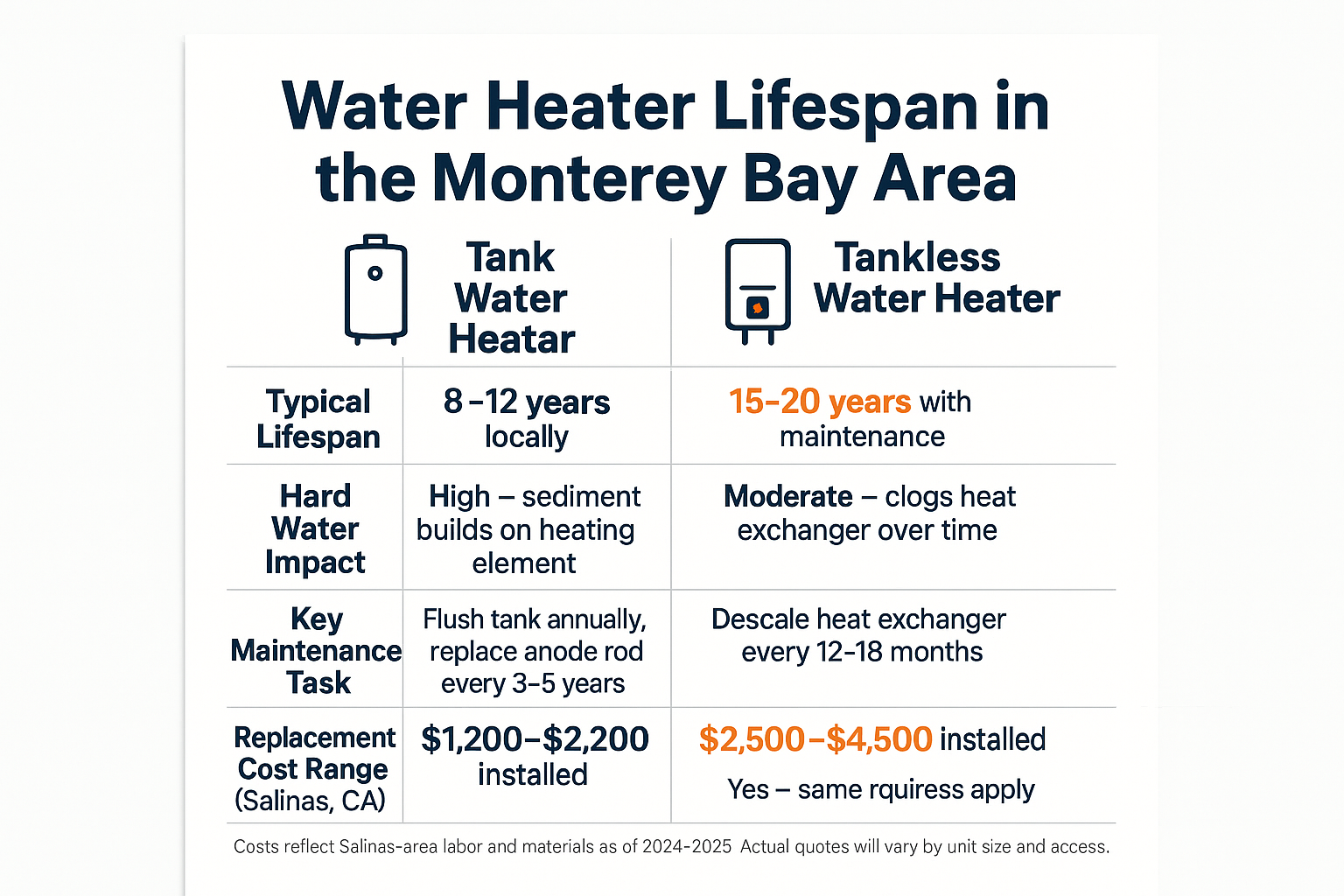
This infographic compares how tank and tankless water heaters hold up over time in Salinas and the greater Monterey Bay region, including local cost benchmarks and maintenance intervals.
Water Heater Lifespan by Type and Maintenance Level
This table gives a practical reference for what to expect based on unit type and how well it’s been maintained over the years.
| Unit Type | Well Maintained | Rarely Maintained | Monterey Bay Hard Water Factor |
|---|---|---|---|
| Tank (Gas) | 10–12 years | 7–9 years | Subtract 1–2 years without annual flushing |
| Tank (Electric) | 10–12 years | 7–8 years | Element scaling is the primary failure point |
| Tankless (Gas) | 18–20 years | 12–15 years | Heat exchanger descaling is non-negotiable here |
| Tankless (Electric) | 15–18 years | 10–13 years | Scale buildup reduces flow rate before it causes failure |
What Replacement Actually Costs in Salinas Right Now
Replacement cost is the question we hear most often after someone realizes their unit is failing. The honest answer depends on what you’re replacing it with and what the installation requires.
For a standard 40 or 50-gallon gas tank water heater in a Salinas home, total installed cost — including the unit, labor, fittings, and permit — typically runs $1,200 to $2,200. That range moves based on access to the installation location, whether any code upgrades are needed, and whether the gas line or flue needs modification to meet current California standards.
Tankless units cost more upfront. A gas tankless installation in the Salinas area generally runs $2,500 to $4,500 installed, depending on the brand and whether a new gas line or dedicated venting needs to be run. The higher cost is real, but so is the longer lifespan — especially if you maintain the unit.
One thing worth knowing: California’s 2025 Building Energy Efficiency Standards changed the rules for water heater replacements. Depending on your home’s setup, a straight like-for-like swap may no longer be code-compliant. We handle all City of Salinas permitting in-house, which matters here because pulling the right permit — and having the work inspected — protects you if you ever sell the home or make an insurance claim.
If you’re also thinking about related work — aging pipes, corroded fittings, or a water line that’s never been touched — it often makes sense to address those at the same time. Main water line replacement in Salinas homes is one of those jobs that pairs naturally with a water heater swap, especially in homes built before 1990.
How to Get More Life Out of the Unit You Have
If your water heater is between 6 and 9 years old and still performing reasonably well, there are steps that genuinely extend its useful life — not just plumbing folklore.
The most impactful thing you can do is flush the tank once a year. In Salinas, sediment accumulates faster than in most parts of California because of the local water hardness. A yearly flush takes about 30 minutes and removes the mineral layer that would otherwise force the burner to run hotter and longer.
The anode rod is the other piece most homeowners skip entirely. It’s a magnesium or aluminum rod inside the tank that sacrifices itself to corrosion so the tank wall doesn’t. When it’s gone, the tank corrodes instead. Replacing it every 3 to 5 years can add years to the unit’s life. If you’re having a gas water heater issue and the unit is under 10 years old, a depleted anode rod is one of the first things worth checking before committing to full replacement.
For tankless owners, annual descaling is the equivalent task. This region’s water will clog a heat exchanger faster than the manufacturer’s warranty timeline assumes. A licensed plumber can run a descaling flush in under an hour, and it’s far cheaper than a heat exchanger replacement.
What actually moves the needle on lifespan:
- Annual tank flush to clear mineral sediment
- Anode rod inspection and replacement on a 3–5 year cycle
- Annual descaling flush for tankless units
- Checking the pressure relief valve every couple of years — a stuck valve is a safety issue, not just a maintenance note
- Insulating exposed hot water pipes to reduce cycling in the unheated garage or utility closet common in older Salinas homes
Frequently Asked Questions About Water Heater Lifespan
My water heater is 11 years old and still working fine. Should I replace it anyway?
At 11 years, you’re past the average lifespan for a tank unit in this area. ‘Still working’ at that age usually means you haven’t noticed the signs yet — not that there aren’t any. We’d recommend having a plumber look at the anode rod condition and check for early corrosion inside the tank. If the rod is depleted and there’s any rust present, replacement now is almost always cheaper than an emergency call when the tank fails.
Does hard water really make that much of a difference?
Yes — and it’s not subtle. Water in the Salinas Valley consistently tests in the hard-to-very-hard range. Without regular flushing, you can lose 2 to 3 years off the expected lifespan of a tank unit compared to a home on softer municipal water.
Do I need a permit to replace my water heater in Salinas?
Yes. California requires a permit for water heater replacements, and the 2025 Building Energy Efficiency Standards added compliance requirements that affect what units can be installed. The permit process through the City of Salinas involves an inspection — it’s not optional and skipping it creates real problems if you sell the home or file an insurance claim.
What’s the difference in lifespan between a tank and a tankless unit here?
A well-maintained tankless unit in this region can realistically reach 18 to 20 years. A tank unit in the same home, with the same maintenance habits, typically tops out around 10 to 12 years. The gap is real, which is part of why the higher upfront cost of a tankless unit often makes sense for long-term homeowners.
My water heater is making a rumbling noise. Is that a sign it’s failing?
That sound is almost always sediment on the floor of the tank getting disturbed when the burner fires. It means there’s significant buildup, and the unit is working harder than it should. It’s not guaranteed failure tomorrow, but it’s a sign you’re past due for a flush — and worth having someone look at how much life the tank has left. We cover this in more detail here.
Can I get more years out of my unit by adding a water softener?
A water softener reduces mineral buildup and can meaningfully extend the life of your water heater and other plumbing fixtures. It’s a legitimate investment, especially in Salinas where the water hardness is high. That said, a softener doesn’t replace annual maintenance — it reduces the rate of buildup, not eliminate it.
Not Sure Where Your Water Heater Stands?
If your unit is past 8 years old or you’ve been noticing any of the signs above, it’s worth getting a professional set of eyes on it before you’re making decisions under pressure. Alvarez Plumbing serves Salinas, Monterey, Seaside, Pacific Grove, and the surrounding Monterey Bay Area — with 24/7 emergency availability and in-house permit handling for all water heater replacements. Call us at (831) 757-5465 or schedule online at alvarezplumbingsalinas.com.