
Direct Answer: Two bathrooms that share a wall usually share one plumbing chase. A wet wall on both sides almost always means one leak inside it, not two separate problems.
You walked into one bathroom and the baseboard was dark. Then you checked the bathroom on the other side of that wall and found the same thing. Now you are standing there wondering whether you have one problem or two.
Almost always, it is one. Two back-to-back bathrooms in a Salinas home usually share a single thick plumbing wall, and everything in that wall serves both rooms. One failed fitting inside it can show up in two places at once.
This happens often enough that we hear it described almost word for word. One Salinas homeowner wrote in this summer saying her two bathrooms seemed to be connected by the wall, both were leaking, and one was leaking through the wall. Below is what is actually inside there, how the leak gets found without demolishing your tile, and the one thing you can observe yourself right now that shortens the whole process.
What Is Physically Inside the Wall Between Two Bathrooms
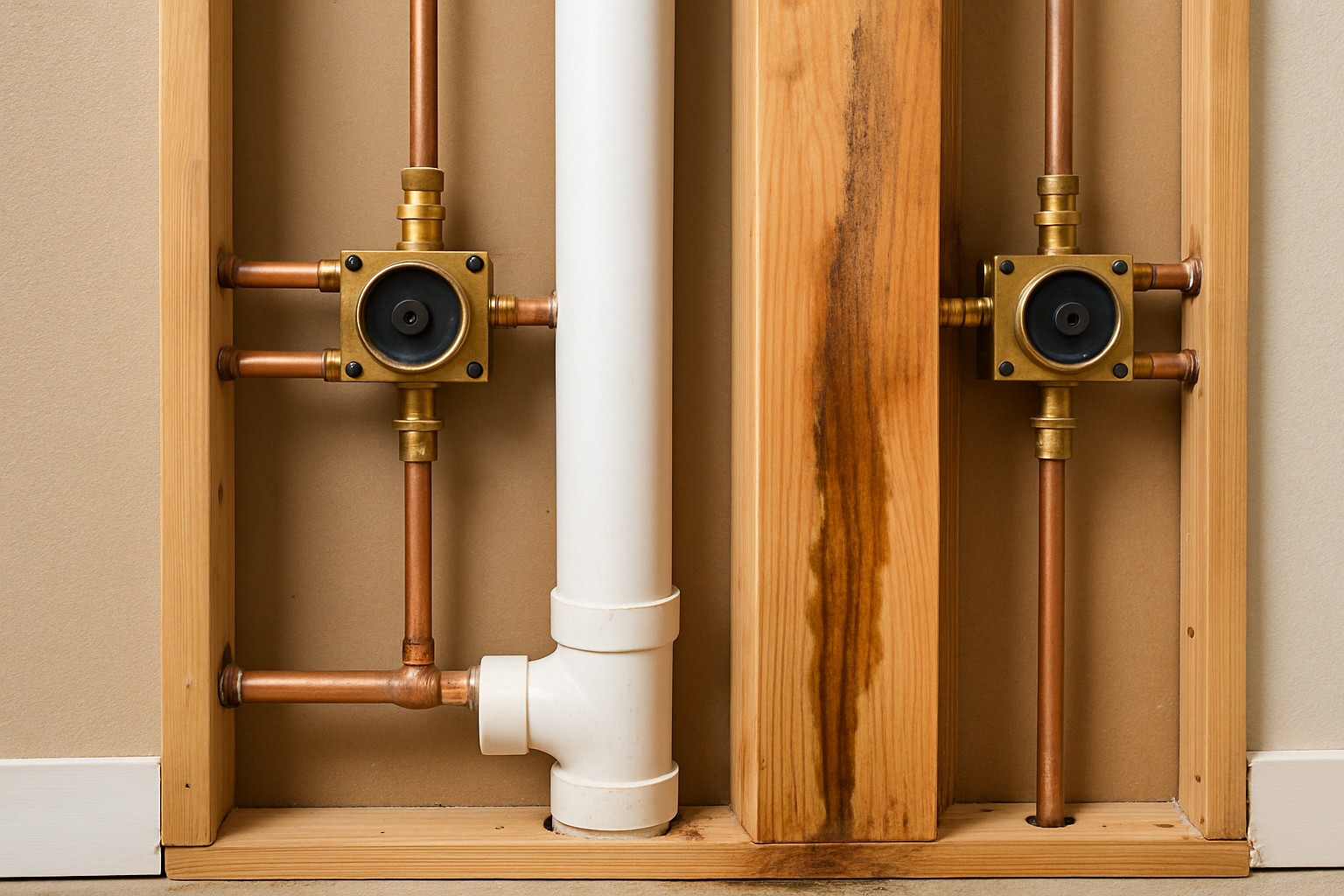
Builders group bathrooms back to back on purpose. It lets them run one set of pipes to serve both rooms, which saves material and labor. That shared wall is usually framed thicker than the rest of the house, often with 2×6 studs, because it has to hold more than wiring.
Inside a typical shared bathroom wall you will find:
- Hot and cold supply lines running under constant pressure, day and night
- The drain and vent stack, usually a vertical pipe carrying waste down and air up through the roof
- Drain arms branching off from each sink, tub, and shower
- Shower or tub valve bodies, frequently mounted back to back in the same cavity
- The closet bend feeding one or both toilets
Here is the part that confuses most homeowners. The wet spot you see is rarely sitting directly over the failure. Water leaves a pinhole or a loose joint, runs down the face of a stud, pools on the bottom plate at the base of the wall, then travels sideways until it finds a seam, a nail hole, or the gap behind the baseboard.
So a stain near the floor in one bathroom can easily come from a fitting four feet up on the other side. Same wall, same leak, two different rooms. Water does the same thing between floors, which is why a ceiling leak downstairs often traces back to the tub above.
The One Thing to Notice Before a Plumber Arrives: Timing
If you do nothing else, pay attention to when the wall is wet. That single detail narrows a wall leak faster than anything else a homeowner can observe.
Wet around the clock, or worse overnight with nothing running. That points to a pressurized supply line. Hot and cold lines hold pressure whether anyone is home or not, so a pinhole or a cracked fitting keeps feeding water at 2am exactly like it does at noon. These are the leaks that quietly show up on a water bill before they ever show up on a wall, which is why a sudden jump in your bill deserves a look.
Only darkens after someone showers, flushes, or fills the tub. That points to the drain side. Usual suspects:
- A cracked or separated drain arm behind a sink or tub
- A failed connection where the drain ties into the vent stack
- A shower pan that has split at a corner or around the drain flange
- Grout and tile letting water past the surface and into the wall cavity
- A wax ring under a toilet that has flattened out and stopped sealing
We see both patterns side by side in the calls that come in. One homeowner described water gushing downward from a failed coupling. Another traced a baseball-sized water ring on a downstairs ceiling to the master toilet sitting right above it. The difference between those two situations is almost entirely timing.
So note what was running in the ten minutes before the wall got wet. That answer genuinely shortens the visit, because it tells us which system to isolate first. If the toilet in one of those bathrooms rocks slightly and weeps when flushed, mention that too.
Reading the Symptom Before the Wall Opens
This is roughly how a wet shared wall gets sorted on arrival, before any cutting happens.
| What you notice | Most likely source | First thing checked |
|---|---|---|
| Damp 24/7, no pattern | Pressurized supply line | Water meter with everything shut off |
| Worse overnight, nothing running | Supply line or valve body | Static pressure test on hot and cold |
| Only after a shower | Drain arm, shower pan, or tile and grout | Run that shower alone and watch the meter stay still |
| Only after a flush | Wax ring, closet flange, or closet bend | Flush test with moisture meter on the wall |
| Warm damp spot, hot water side | Hot line in the wall or under slab | Thermal imaging to map the warm path |
| Sewer odor with the moisture | Vent or waste connection | Camera inspection of the stack |
How a Leak Inside a Wall Gets Located Without Tearing It Apart
This is the part homeowners never see, and it is what separates a careful diagnosis from guesswork. The goal is one small access cut in the right place instead of three in the wrong ones.
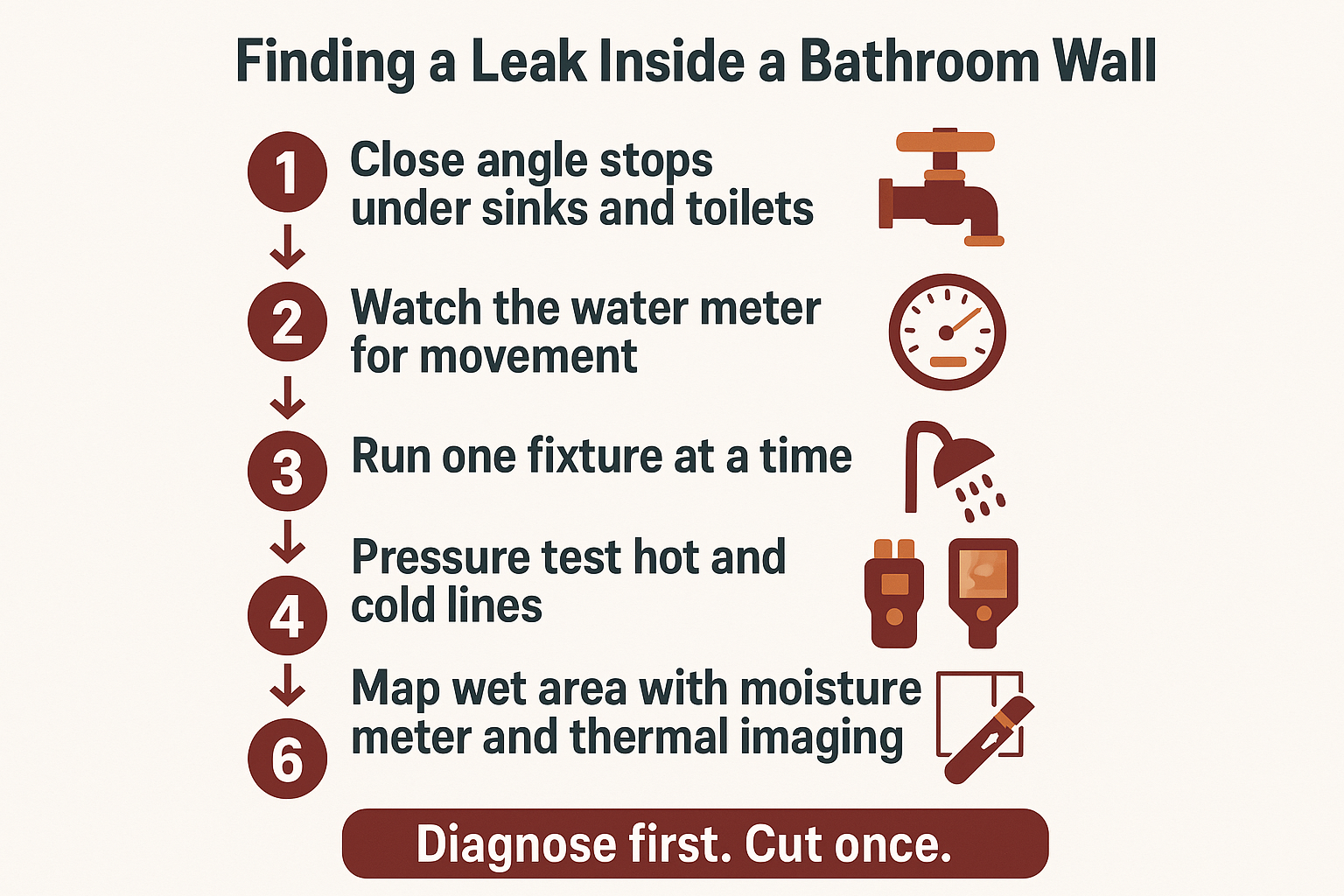
The sequence usually runs like this:
1. Shut the angle stops under both sinks and both toilets. This takes fixtures out of the equation.
2. Watch the water meter. If the dial still creeps with every fixture isolated, the leak is on a pressurized line inside the wall.
3. Run one fixture at a time. Shower, then sink, then flush. Whichever one wakes the leak up points at the drain branch serving it.
4. Pressure test the supply lines. A line that will not hold static pressure has a failure on it, full stop.
5. Map the wet area with a moisture meter and thermal imaging before a blade touches drywall. Moisture readings show how far the water has spread. Thermal shows where a hot line is warming the cavity.
6. Make the access cut at the highest confirmed wet point, because water travels down, not up.
A plumber who starts with a meter, a pressure test, and a moisture reading is protecting your drywall and your tile. Reviews from our own customers describe that same order of operations, diagnose first, explain, then open.
> “Hector arrived a day before I expected to diagnose the drain pipe failure and then came the next day with another Alvarez plumber to make repairs between the ceiling of one room and the floor above.” – Ron C.
The Diagnosis Sequence, Step by Step
Here is the order a hidden wall leak gets narrowed down before any drywall comes out.
One Bad Fitting, or the First of Several? The Salinas Pipe Question
Once the wall is open and the failure is in hand, there is a second question worth answering honestly. Is this a one-time accident, or the opening act of a system that is wearing out?
Local context matters here. The median Salinas home was built around 1976, and roughly one in nine homes in the city predates 1950. That means galvanized steel supply lines and early copper are common in this valley. On top of that, California Water Service has reported Salinas system hardness around 254 ppm, with the Salinas Hills system testing higher. Hard water drives scale and speeds up interior corrosion.
The honest test is evidence, not a sales pitch. Four things tell the story:
- Pipe material. Galvanized steel in a 1950s home behaves very differently than PEX installed in 2015.
- Condition of the section that gets cut out. A pinhole in otherwise clean copper is one thing. A pipe with heavy scale and thin walls is another.
- Water pressure readings. Pressure running high puts every joint in the house under extra load.
- Leak history. One homeowner wrote in this summer describing a leak in the same area of the house as the previous few years. That repeat pattern is the signature of a system failing in sequence.
If it is the pipe and not the fitting, repiping comes up. Costs vary a lot by home size, pipe routing, and material, but whole house repipes in the Monterey Bay area are commonly quoted in the low thousands, and a typical residential job runs a few days rather than weeks. An exact number only comes after someone actually sees the pipe. Anyone quoting a repipe over the phone is guessing. If you are buying a home and want to know what is in the walls before you own them, a camera inspection answers what a home inspector cannot.
Photograph the Wall Before Anyone Opens It
A wall leak is one of the few plumbing failures where what gets written down matters nearly as much as what gets fixed. Insurers generally want a cause of loss that is identified and dated, not a patched wall and a verbal explanation after the fact.
The numbers explain why carriers care. Water damage and freezing account for roughly 23% of all homeowner insurance claims nationally, second only to wind and hail, with an average claim near $15,400 according to the Insurance Information Institute.
Before the first cut, do these four things:
- Photograph the wet wall from both bathrooms, including the baseboard and floor
- Note the date and time you first saw moisture
- Keep the invoice that names the failed component, not just “leak repair”
- Ask for the moisture readings and any thermal images taken during diagnosis
Property managers and landlords already ask for this routinely, usually requesting work order references and photos for repairs on a unit they do not occupy. Homeowners should do the same. A dated, documented cause is what turns a repair into a claim a carrier can actually process.
Frequently Asked Questions About a Leak in the Wall Between Two Bathrooms
Both bathrooms are wet. Does that mean I have two leaks?
Almost never. Back-to-back bathrooms share one plumbing wall, so a single failure inside it can push water out on both sides. Two wet spots usually means one leak.
Should I shut off the water to the whole house?
If the wall is wet all the time and getting worse with nothing running, yes, shut the main and leave it off until someone can look. If it only gets wet after a shower or a flush, the supply side is holding and you can leave the main on while avoiding that fixture.
How much of the wall has to come out?
Less than most people expect, when the diagnosis is done first. A moisture map and a pressure test usually narrow it to one stud bay, which means one access cut rather than opening a whole wall. Tile and shower surrounds are worked around whenever the failure can be reached from the drywall side.
Can I just wait until Monday?
That depends on timing. A drain-side leak that only wets the wall after a shower can often wait if nobody uses that shower. A pressurized supply leak is feeding water into the framing continuously, and every hour adds to the drywall, insulation, and framing damage. Plenty of callers tell us it is not a true emergency but they need it done soon, and that is a fair call to make once you know which type you have.
Will mold be a problem?
Wet framing and insulation that stay closed up will eventually grow mold, which is part of why opening the cavity and drying it matters as much as fixing the pipe. Document the moisture readings so there is a record of how wet it was and when.
When You Want Someone to Look at That Wall
Leak detection, the repair itself, and a full repipe if the pipe turns out to be the real problem all sit with the same licensed, insured, and bonded family crew that has worked on Salinas and Monterey Bay homes since 1988. Our customers, across a 4.94 star average from more than 224 Google reviews, consistently describe technicians who explain what they found before they cut anything. Someone is reachable at (831) 757-5465 every day of the week, including after hours, for the nights when a wall goes wet at 8pm.
