
Direct Answer: A toilet that rocks has broken the compressed seal under its base, so every flush pushes water onto the floor. The cause is usually a failed seal, a corroded flange, or both.
One Salinas homeowner described this about as plainly as it gets. The toilet rocks a little, and when you flush, a small puddle of water runs out onto the floor. It got listed right alongside a slow drip under a bathroom sink, not flagged as an emergency.
That instinct makes sense. The water usually dries up between flushes, so the floor looks fine most of the day.
But the rocking and the puddle are not two separate issues. They are the same failure, and the floor underneath is usually paying for it. Here is what is actually breaking down, how to figure out where the water is coming from before anyone comes out, and why a new wax ring alone often does not solve it in older Salinas homes.
Why a Toilet Leaking at the Base When Flushed Is Always About Movement
A toilet does not sit on a gasket you can tighten like a garden hose fitting. It sits on a wax or rubber seal that gets compressed once, when the bowl is set down onto the closet flange, and that compression is what holds back water and sewer gas.
Wax has no memory. Once the toilet shifts, the seal deforms and it does not spring back.
So the sequence goes like this:
- The toilet develops a small amount of play, from loose closet bolts, a weak flange, or a soft spot in the floor.
- Every time someone sits down or stands up, the bowl rocks a fraction of an inch and works the seal looser.
- A flush sends a full surge of water through the horn at the bottom of the bowl, and that surge finds the gap.
- A little water escapes onto the floor, soaks in, and the floor under the base gets softer.
- A softer floor means more movement, which means a faster leak on the next flush.
That loop is why a wobble that seemed harmless in spring turns into a visible puddle by fall. Tightening the bolts does not reverse it, and overtightening cracks porcelain.
The Dry and Flush Test: Find Out Where the Water Is Really Coming From
Before anyone gets called out, you can narrow this down in about three minutes with nothing but a towel. This matters, because three completely different problems all end with water on the floor near a toilet.
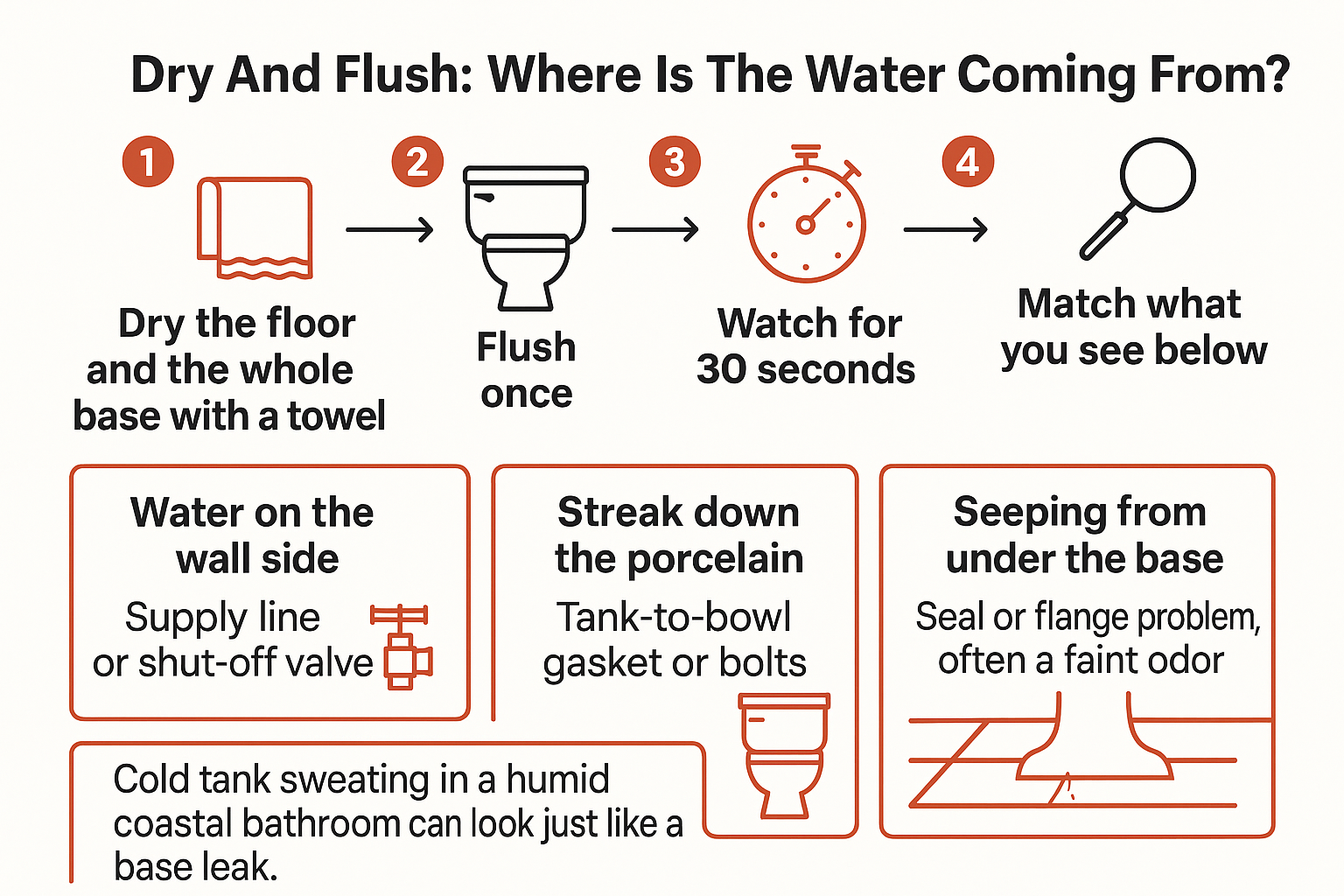
Dry the floor and the entire base of the toilet until the porcelain squeaks. Then flush once and watch these three spots:
- The supply line and shut-off valve. Drips here run down the wall side and pool behind the bowl. Clean water, no odor.
- The two bolts where the tank meets the bowl. A failing tank-to-bowl gasket sends clean water down the outside of the porcelain in a visible streak.
- The seam where the base meets the floor. Water that seeps out from under the base, with no streak above it, is a seal or flange problem. It often carries a faint odor.
If water appears on the outside of the porcelain, you are looking at a tank or supply issue, which is usually the simpler repair.
One local wrinkle worth knowing. In the coastal cities, Pacific Grove, Monterey and Seaside especially, a cold tank in a humid bathroom sweats enough to drip down and collect at the base. Condensation mimics a base leak closely enough to fool people, and the dry and flush test is what separates the two. Sweat reappears slowly across the whole tank. A flush leak shows up within seconds of the flush, right at the floor.
Why a New Wax Ring Alone Often Does Not Fix This in Salinas Homes
This is the part almost nobody explains before the visit, and it is the reason two plumbers can look at the same toilet and describe two very different jobs.
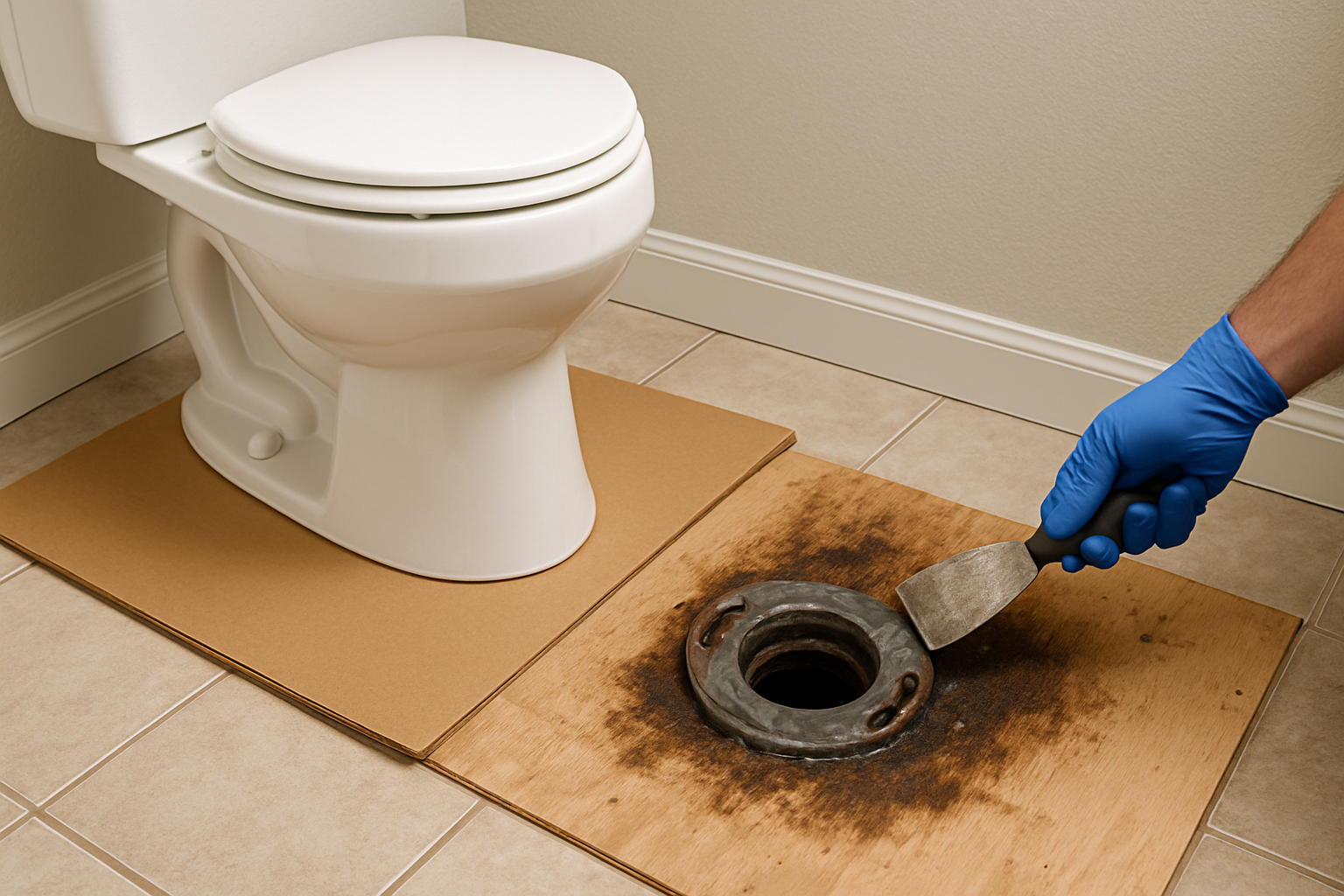
The seal only works if the closet flange underneath it is solid, level, and at the right height relative to the finished floor. The flange is the ring bolted to the floor that the drain pipe connects to and the toilet bolts into.
The median Salinas home was built around 1976, and roughly 11 percent of the city’s housing stock predates 1950. In that age range, a lot of toilets are sitting on cast iron or lead flanges, and the most common failure point is the slot where the closet bolt sits. Corrosion eats through the thin metal at the slot, the bolt no longer has anything to pull against, and the toilet starts to rock no matter how carefully it is tightened.
The other common one is height. When tile, laminate, or a second layer of vinyl got added over the original floor during a remodel, the flange ended up sitting too low. A standard seal cannot bridge that gap, and even a perfectly set new wax ring will not hold.
That is why the flange gets inspected after the toilet is lifted rather than guessed at from above. From the outside, a $20 seal job and a flange repair look identical.
The Three Minute Test Before You Call Anyone
This walks through the dry and flush check and what each result points to.
The Damage You Cannot See Is What Turns a Small Repair Into a Big One
A slow leak at a toilet base does not run across the floor and announce itself. It wicks into the subfloor and sits there.
Plywood or particleboard that stays damp loses its strength, and the fasteners holding the flange down lose their grip. Manufacturer guidance on wax ring replacement notes that a leak at the base, or water stains on the ceiling below, can mean the subfloor is already compromised. Soft subfloor means more rocking, which means the seal fails faster on every cycle.
Walk over and check for these:
- A floor that feels soft or springy right in front of the toilet when you step on it
- Dark discoloration ringing the base, or grout that has gone a different color near the seam
- Tile that sounds hollow when tapped, loose grout lines, or vinyl that is lifting at the edges
- In a two-story home, a stain forming on the ceiling below the bathroom
The reason to handle this sooner rather than watching it is the repair boundary. Reset a toilet on a sound floor and it is a short job. Wait until the subfloor is rotted and now there is carpentry involved, plus flooring, plus whatever is below.
For scale, insurance industry data puts water damage and freezing at roughly 23 percent of all homeowner claims, with the average claim landing near $15,400. Toilet leaks are a steady contributor to that number, and one of several reasons a water bill can jump without an obvious cause.
What If There Is a Smell but No Visible Water?
This version confuses people, and it is worth calling out on its own.
Wax can dry out and crack enough to let sewer gas pass through while still holding back liquid. So a bathroom that smells faintly like sewage, with a toilet that wobbles a little and a floor that stays dry, is usually a seal problem rather than a drain problem.
The practical tell is location and timing. The odor is strongest at floor level, right at the base, and it does not improve after the drain gets cleared. If the smell is spread across the house or shows up with slow drains and gurgling, that is a different conversation, closer to multiple fixtures backing up at once.
What Actually Drives the Cost of This Repair
Callers ask about price early and often, and the honest answer is that it depends on what is found once the toilet comes up. Here is what moves it.
| What the job turns out to be | What is involved | Why the price moves |
|---|---|---|
| Reset with a new seal | Pull the toilet, replace the seal, reset and secure it | The simplest version, assuming the flange and floor are sound |
| Flange repair | Add a repair ring or reinforce corroded bolt slots | Depends on flange material and whether the slots are salvageable |
| Full flange replacement | Cut out and replace the flange at the drain connection | Cast iron and lead connections take longer than ABS or PVC |
| Flange buried under tile | Tile has to be removed to reach the flange, then patched | Labor plus flooring work, and matching old tile is rarely easy |
| Subfloor repair | Cut out soft material, rebuild to a solid base | Scales with how long the leak ran and how far it spread |
| Fixture replacement | New toilet installed, old one hauled off | Needed if the bowl has a hairline crack or the trapway is damaged |
One Note If the Toilet Itself Gets Replaced
Costs for this repair vary widely, and anyone quoting a flat number over the phone is guessing. General market context puts a straightforward reset well below what flange plus subfloor work runs, sometimes by several times over, but the only way to get a real number is to have the toilet lifted and the flange looked at. The office can give you an exact figure for your own toilet.
One thing to know before you go shopping. California’s plumbing code cycle updated on January 1, 2026 and tightened fixture flow limits, so new toilets sold for these installs land near 1.28 gallons per flush.
That makes this a poor moment to reuse a decades-old bowl that has been sitting in a garage. It also means the replacement will likely flush differently than what you are used to, which is normal and not a defect.
Frequently Asked Questions About a Toilet Leaking at the Base
Can I keep using the toilet until someone can come out?
If the puddle is small and the floor is still firm, most people shut the supply valve off between uses and mop up after each flush. If the floor feels soft, or there is a stain spreading on a ceiling below, stop using that toilet and shut the supply valve until it is looked at.
Why can’t I just caulk around the base to stop the leak?
Caulk at the base is normal as a finish detail, but it is not a repair. It traps the water under the toilet instead of letting it show on the floor, so the subfloor keeps soaking while the symptom disappears. That is how a cheap fix becomes an expensive one.
Is it always the wax ring?
No, and that is the whole point of lifting the toilet to look. The seal is the part that fails, but the thing that caused it to fail is often a corroded flange, loose or missing closet bolts, or a floor that has gone soft. Replace only the seal and the same leak comes back, usually within a year.
Does this kind of repair need a City of Salinas permit?
Resetting or swapping a toilet in place is generally not treated like a water heater changeout, which does require a residential plumbing replacement permit. We handle City of Salinas permitting in-house when a job calls for it, so if your repair crosses into permit territory you are not the one chasing paperwork.
How long does a toilet reset usually take?
A clean reset on a solid floor is typically under an hour or so. Flange work adds time, and subfloor repair can turn it into a half-day or longer depending on how far the damage spread. You will know which one you are dealing with shortly after the toilet comes up.
Getting a Straight Answer on an Old Toilet and an Older Flange
What matters most with this repair is not speed, it is experience with old fixtures and old flanges, because the job can honestly end at a new seal or end at subfloor work. Customers in Salinas describe that approach in their own words, including one who wrote that the technician “explained what was needed, what options were available and the process for each options.” Our family-run shop has been working on homes across Salinas and the Monterey Bay Area since 1988, licensed, insured, and bonded, and someone is reachable around the clock at (831) 757-5465 if a leak will not wait until morning.
