
Direct Answer: A water heater that stops heating after only a few years usually has a failed control or ignition part, not a dead tank. Check the manufacture date before anyone discusses replacement.
You turned on the shower and got nothing but cold. The frustrating part is that the tank is only a few years old, and the first thing you think is that you just bought a lemon.
Usually you did not. A water heater that stops heating and a water heater that is worn out are two different diagnoses, and on a young tank the problem is almost always a part, not the tank.
We get this call constantly in Salinas. One homeowner contacted us this summer about a unit installed in 2023 that had quit heating, and they already suspected the temperature regulator or sensor. That instinct was a good one. Here is how to tell which category you are actually in before anyone starts talking about hauling the tank out.
Start With the Data Plate, Not the Price Quote
Before anything else, find the manufacturer label on the side of the tank. It lists the model, serial, and a manufacture date, and that date is the single biggest factor separating a repair job from a replacement job.
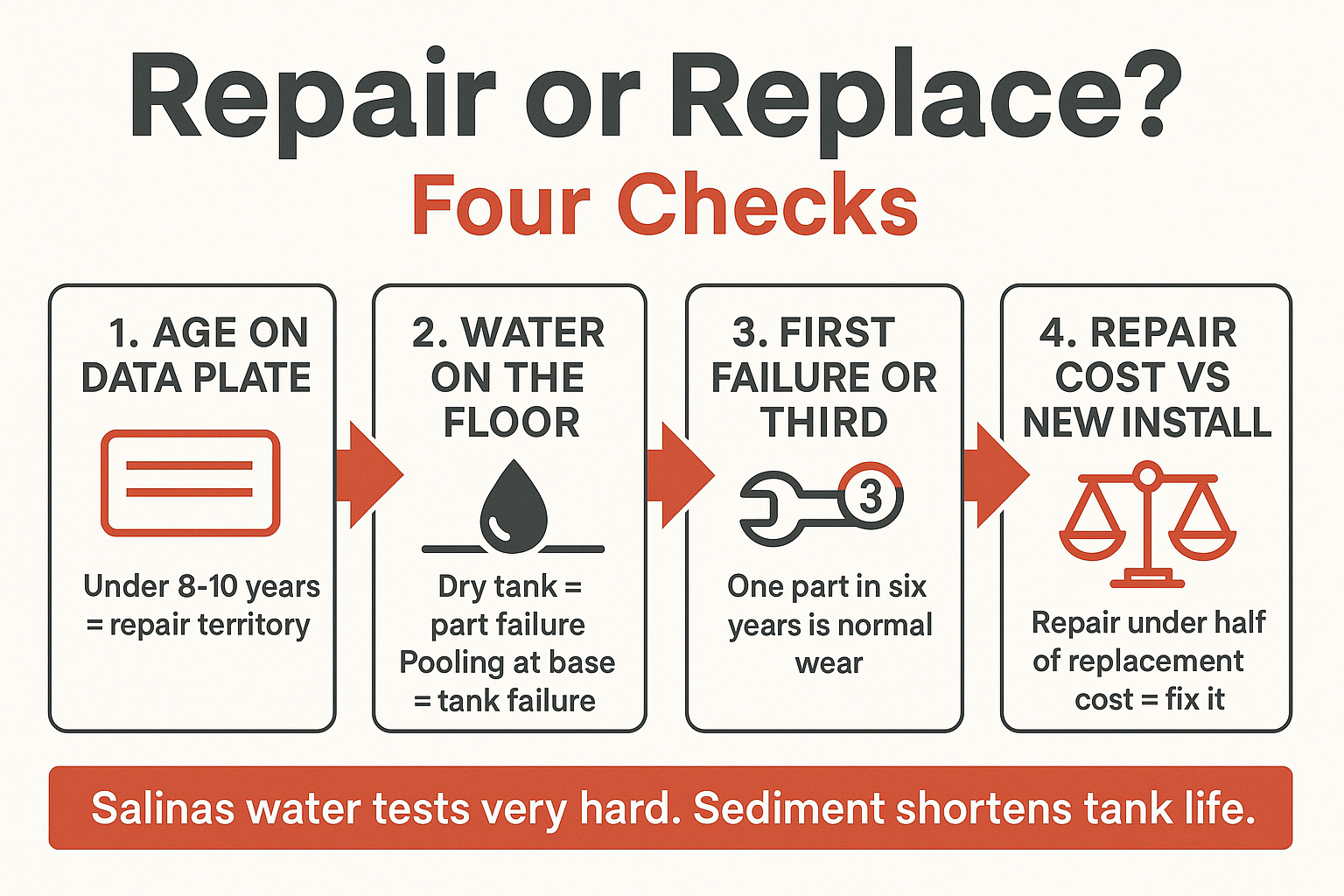
Our own repair or replace framework is simple. A unit under roughly 8 to 10 years old with one failed part sits squarely in repair territory when the repair runs under about half the cost of a new install. A unit past 10 years, corroded at the base, or failing in three different places is where replacement starts making real sense.
Three things tell you where you stand:
- The manufacture date on the label. Under 8 years is a young tank. Over 12 is a different conversation.
- Whether there is water on the floor. A dry tank that will not fire is a control problem. Water seeping from the base of the tank itself is usually the tank.
- Whether this is failure number one or failure number three. One part in six years is normal wear. Three service calls in eighteen months is a pattern.
If the answer is young, dry, and first-time, you should be hearing a part name from your plumber, not a replacement pitch.
What Usually Fails First on a Gas Tank
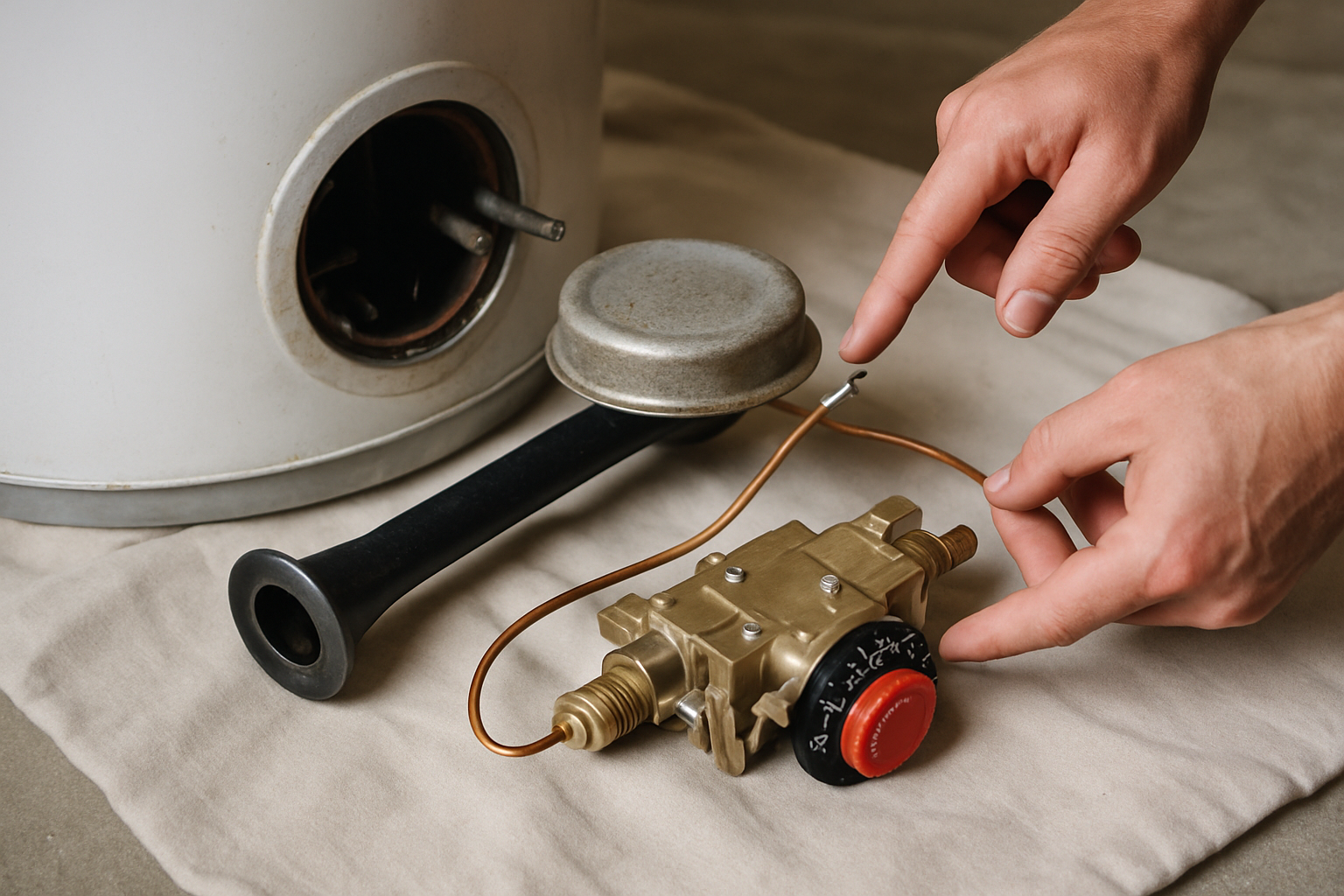
Gas tanks fail at the ignition and control side far more often than at the steel. The tank is just a container. Everything that can quit on you is bolted to the bottom of it.
The usual suspects on a unit under ten years old:
- Thermocouple or flame sensor. This is the part that proves to the gas valve that a flame actually exists. When it weakens, the pilot lights and then dies a minute later. If your pilot light will not stay lit, this is the first place a plumber looks.
- Gas control valve. The thermostat is built into this assembly on most residential tanks. When the sensor inside it drifts or fails, the burner never gets the signal to fire, and you get a full tank of cold water with no leak and no noise.
- Burner assembly. Dust, lint, and spider webbing in the air intake can choke the flame. Garage installs in older Salinas neighborhoods see this more than you would expect.
One homeowner wrote in last July with exactly this: a pilot that would not stay lit, on an otherwise healthy tank. That is a part, not a funeral.
We are not going to give you steps for testing gas components here. In California that is licensed work, and gas is not a place to learn by trial.
What Usually Fails First on an Electric Tank
Electric tanks have a different short list, and one of the items on it fools people into replacing a perfectly good heater.
- Upper and lower thermostats. These are two separate controls. When the upper one fails you get no hot water at all. When the lower one fails you get a little hot water that runs out fast.
- Heating elements. Most tanks have two. Lose the lower element and the top third of the tank still heats, which is why people describe it as “hot water for about four minutes.”
- High-limit reset switch. This is the small red button behind the upper access panel. When it trips, an otherwise perfect tank goes stone cold. It trips for a reason, though, so a switch that keeps tripping is pointing at a bad element or thermostat underneath.
Same rule applies on the electric side. Testing 240-volt wiring is licensed work in California, and the reset button is not a fix on its own if it keeps popping.
Symptom to Likely Cause on a Young Tank
This is the mental checklist a plumber runs on the way to your house. It will not replace a diagnosis, but it will tell you whether the conversation you are about to have makes sense.
| What you’re seeing | Common cause on a unit under 10 years | Repair or replace territory |
|---|---|---|
| No hot water at all, tank dry, no noise | Gas control valve or upper thermostat | Repair |
| Pilot lights, then goes out within a minute | Thermocouple or flame sensor | Repair |
| Hot water runs out in a few minutes | Lower element or lower thermostat | Repair |
| Popping or rumbling, lukewarm water | Sediment buildup on tank bottom | Repair plus a flush |
| Water pooling at the base of the tank | Tank failure | Replace |
| Third part failure in under two years | Multiple component wear | Usually replace |
Why a Young Tank in Salinas Can Act Like an Old One
Here is the local wrinkle. Cal Water’s reporting puts the Salinas system around 254 ppm hardness, and the Salinas Hills system near 320 ppm, both classified as very hard. The utility states plainly that hard water causes mineral buildup in pipes and water heaters.
That mineral load drops out of the water inside your tank and settles on the bottom. On a gas unit, that layer insulates the steel from the burner, so the burner runs longer to heat less water. On an electric unit, it buries the lower element until it cooks itself.
The popcorn sound people describe is water flashing to steam underneath that sediment layer. It is annoying, and it is also a warning.
The honest version: sediment is a maintenance problem on a young tank and a life-expectancy problem on an old one. On a five-year-old heater, a flush and a part usually solves it. On a fourteen-year-old heater, the sediment has already been working on the steel for a decade. If your unit has never been flushed, that is worth knowing before you decide anything.
Four Things That Decide Repair Versus Replacement
If you only remember four checks, make them these. They are the same ones a licensed plumber runs before quoting anything.
Questions That Tell You a Replacement Recommendation Was Earned
Plenty of people call us after getting a quote somewhere else and say some version of the same thing: they want to understand the number before they agree to it. That is a reasonable position, and a good plumber will not flinch at any of these.
Ask directly:
- “Which part failed?” You should get a name, not a category. Thermocouple. Lower element. Gas control valve.
- “Is that part still available for this model?” Sometimes the answer is genuinely no, and that is a legitimate reason a repair turns into a replacement.
- “What is the guarantee on the parts and the labor?” Ask for the length and what it actually covers.
- “Is this tank still inside a manufacturer warranty window?” Many tanks carry a six-year warranty on the tank and parts. Understanding what that warranty actually covers and what you still pay saves real money.
- “What specifically makes this a replacement instead of a repair?” A solid answer is specific. A vague answer about age alone is not.
About 8 percent of our August calls were people asking which brand goes in and what the warranty covers. Asking for a written quote by text or email before you decide is normal. We send them that way all the time for people who want to talk it over with a spouse first.
October Is the Cheap Month. Christmas Eve Is Not.
Emergency plumbing demand on the Central Coast runs low through late summer and early fall, then climbs hard through January and February. That is the same window when Salinas gets most of its roughly 13 inches of annual rain, with December alone averaging close to 2.8 inches.
The same failed thermocouple on a Tuesday morning in October and at 9 p.m. on Christmas Eve are two very different invoices and two very different waits. Regular-hours work gets scheduled on your calendar. After-hours work gets scheduled on the weather’s calendar.
If your heater is already heating inconsistently, running out early, or making noise, it is telling you something while you still have options.
One more thing worth knowing. If the repair does turn into a changeout, the new unit falls under California’s 2025 Building Energy Efficiency Standards, and the work becomes permitted, inspected work rather than a simple swap. In Salinas that means a residential plumbing replacement permit through Community Development. We handle that filing in-house, and there is more detail on why the permit matters if you want it.
What a Diagnosis-First Visit Actually Looks Like
A proper visit on a young tank starts with the label, the floor, and the burner or access panels. Then you get told what failed and what the options are, in that order.
One four-star reviewer summed up the standard we aim for: “He allowed me to watch and he answered all of my questions.” That is the whole job on a diagnostic call. Explain it, show it, then let the homeowner decide.
We have been doing this in the Salinas Valley since 1988, we are licensed, insured, and bonded in California, and we hold a 4.94-star average across 224-plus Google reviews. Those reviews mostly talk about technicians who explained things, which tells you what people actually value when the hot water is out.
Frequently Asked Questions About a Water Heater That Stopped Heating
My tank is five years old and completely cold. Does it need to be replaced?
Almost certainly not. On a five-year-old tank with no water on the floor, the problem is nearly always a control or ignition part. Get the failed part named before anyone talks about a new unit.
What does a water heater repair usually cost compared to a replacement?
Costs vary with the part, the fuel type, and access to the unit, but repairs on a young tank commonly land in the low hundreds. A full changeout installed in this area generally runs well over a thousand dollars once permitting and code requirements are included. Our published range for a standard replacement installed sits around $1,895 to $2,500, though the real number depends on your setup. Call for an exact quote on your unit.
I pressed the red reset button and it worked. Am I done?
Probably not. That high-limit switch trips because something upstream overheated, usually a failing element or thermostat. If it trips again, stop resetting it and get it looked at.
Does hard water void anything on my warranty?
Hard water itself does not void a warranty, but missed maintenance can. Many manufacturers expect annual flushing, and with Salinas water testing very hard, that matters more here than in softer-water regions.
Do I need a permit if the repair turns into a replacement?
Yes. A water heater changeout in the City of Salinas requires a residential plumbing replacement permit, and the new unit has to meet current state energy standards. We file the permit and manage the inspection as part of the job.
Want to Know Which Part Actually Failed?
If your heater quit and you want a straight diagnosis before anyone talks about replacement, Alvarez Plumbing is available around the clock for Salinas and the greater Monterey Bay Area. You can reach us at (831) 757-5465 or request a visit at alvarezplumbingsalinas.com, and we are happy to put the quote in writing so you can think it over.
