
Direct Answer: A six-year water heater warranty usually covers the tank and parts, not labor. Salinas homeowners still pay for the service call, installing the covered part, permits, and any code corrections.
Before anyone books a water heater replacement, two questions come up over and over on our phone line: what brand goes in, and what is the warranty on it? Several callers ask about Bradford White and the six-year coverage by name, which tells you homeowners here are using warranty length as the tiebreaker between quotes.
That is a fair way to shop. But a single advertised number hides two to four separate coverages that expire at different times, and they do not all work the way people assume.
This walks through what a six-year warranty actually pays for, what you still owe on a valid claim, and the two local conditions that cause the most denials in Salinas. No fine print decoder ring needed.
One Number on the Sticker, Three Different Warranties Underneath
When a manufacturer says “6 year,” they are usually talking about the tank. The other coverages ride along behind it with their own clocks.
Here is how we explain it standing in the garage next to the unit:
- Tank coverage. Covers the tank itself if it fails or leaks from a manufacturing defect. This is the headline number.
- Parts coverage. Covers components like the thermostat, gas valve, heating element, or sensor. On many residential units the parts term matches the tank term, but not always.
- Labor coverage. Covers the plumber’s time. Across the industry this is commonly the shortest of the three, sometimes one year or less, and on plenty of standard units it is not included at all.
There is a second wrinkle most people miss. Tank coverage is often non-prorated for an early window, then shifts to a prorated credit for the remaining years.
Non-prorated means a defective tank gets replaced outright. Prorated means you get a partial credit toward a new unit based on how much of the term has already burned off.
So a tank that fails in year five of a six-year warranty may only earn a fraction of the unit’s value as a credit. That is why a homeowner with a legitimate claim can still open a real bill.
What a Warranty Claim Actually Looks Like in Practice
Two recent situations from our own inbox show exactly where the layers separate.
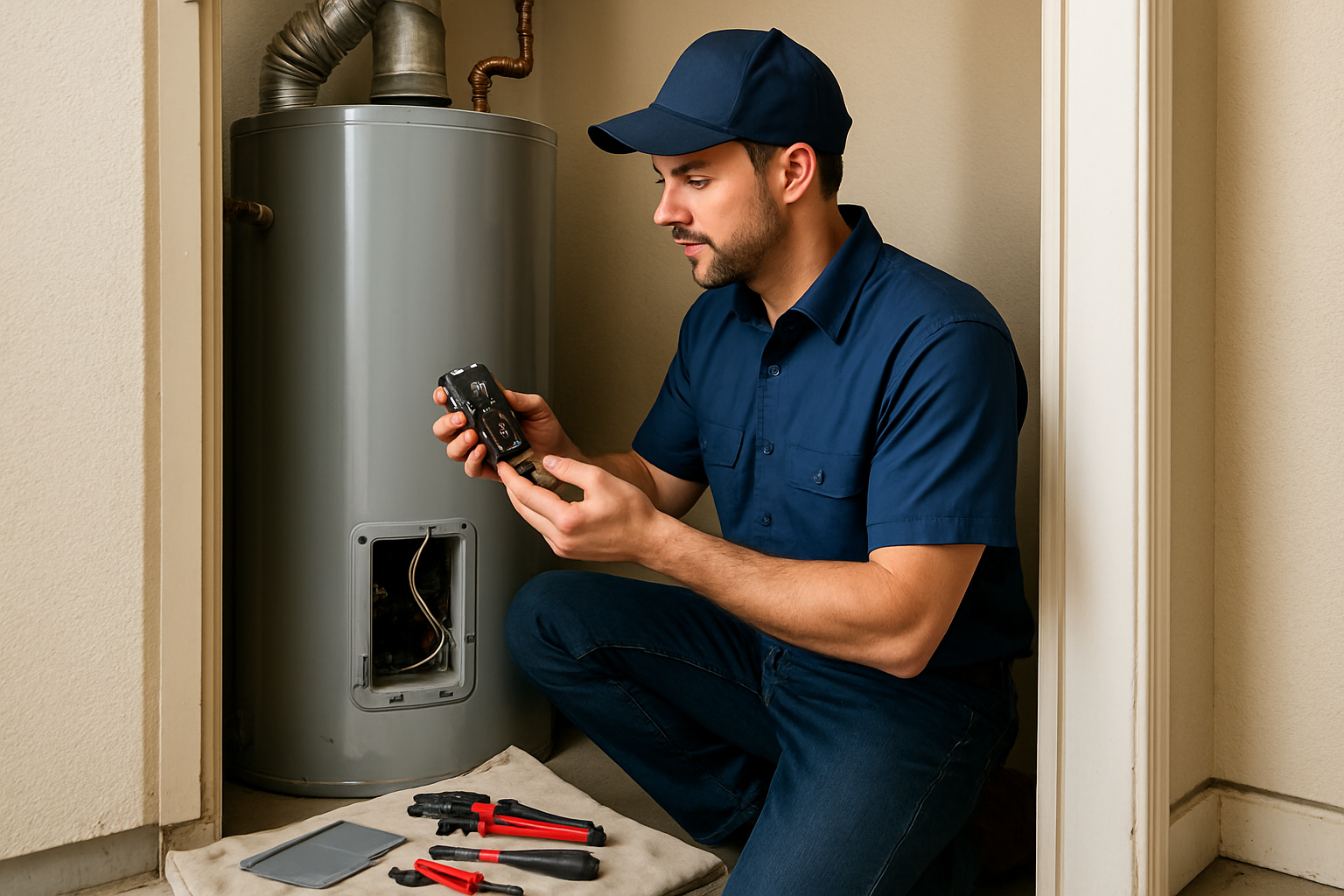
A homeowner near Salinas wrote in about a water heater installed in 2023 that had stopped heating. They suspected the temperature sensor had gone bad and wanted someone out to check it.
If that sensor is covered, the part arrives at no charge. But the trip, the diagnosis, and the labor to install it are still the owner’s cost unless labor coverage is in force.
Another local homeowner had a tankless unit throwing a fault code. The manufacturer had already mailed them a replacement flow sensor, and they needed a licensed plumber to put it in and confirm the unit was running right.
That is the shape of most claims. The manufacturer sends metal or plastic. Somebody still has to drive out, diagnose, drain, swap, test, and clean up.
A warranty rarely produces a zero-dollar outcome. Going in expecting a free part and a paid visit is the realistic frame.
Who Typically Pays for What on a Covered Claim
Exact terms vary by manufacturer and model, so read your own paperwork. This is the general pattern we see on residential units in the Monterey Bay area.
| Item | Usually Covered? | Who Typically Pays |
|---|---|---|
| Defective tank, early years | Yes, non-prorated | Manufacturer replaces the unit |
| Defective tank, later years | Prorated credit only | Owner pays the difference |
| Thermostat, gas valve, sensor, element | Usually yes, as a part | Manufacturer ships the part |
| Diagnostic visit and labor | Often no, or short term | Owner |
| Permit and inspection on a changeout | No | Owner |
| Venting, strapping, or code corrections | No | Owner |
| Haul-away and disposal of the old unit | No | Owner |
The Two Things That Void Coverage Most Often Around Here
Most denied claims are not close calls. They fall into two buckets, and both are unusually relevant in Salinas.
1. Installation without a licensed contractor or a permit.
Manufacturers generally require installation by a licensed contractor for the warranty to hold. California also requires a permit for a water heater changeout, and the state’s current energy standards spell out what a compliant replacement has to include. A regional summary of those requirements is available in this guide to residential water heater alteration permits.
A cash-and-carry swap with no permit and no paper trail can leave you arguing with a manufacturer four years later with nothing to show them. We cover the local side of this in more detail in our piece on why you need a permit to replace a water heater in Salinas.
2. Skipped maintenance.
This is the other common denial reason, and local water makes it sharper. Cal Water has reported average hardness around 254 ppm in the Salinas system and roughly 320 ppm in the Salinas Hills system, levels the utility classifies as very hard.
Sediment and mineral scale build faster here than in soft-water regions. That shortens tank life, and it gives a manufacturer an easy reason to point at neglect instead of a defect. Our breakdown of how hard water shortens water heater life walks through what that buildup actually does inside the tank.
Dated flush and anode records are the evidence that protects a claim. Without them, it is your word against the warranty department.
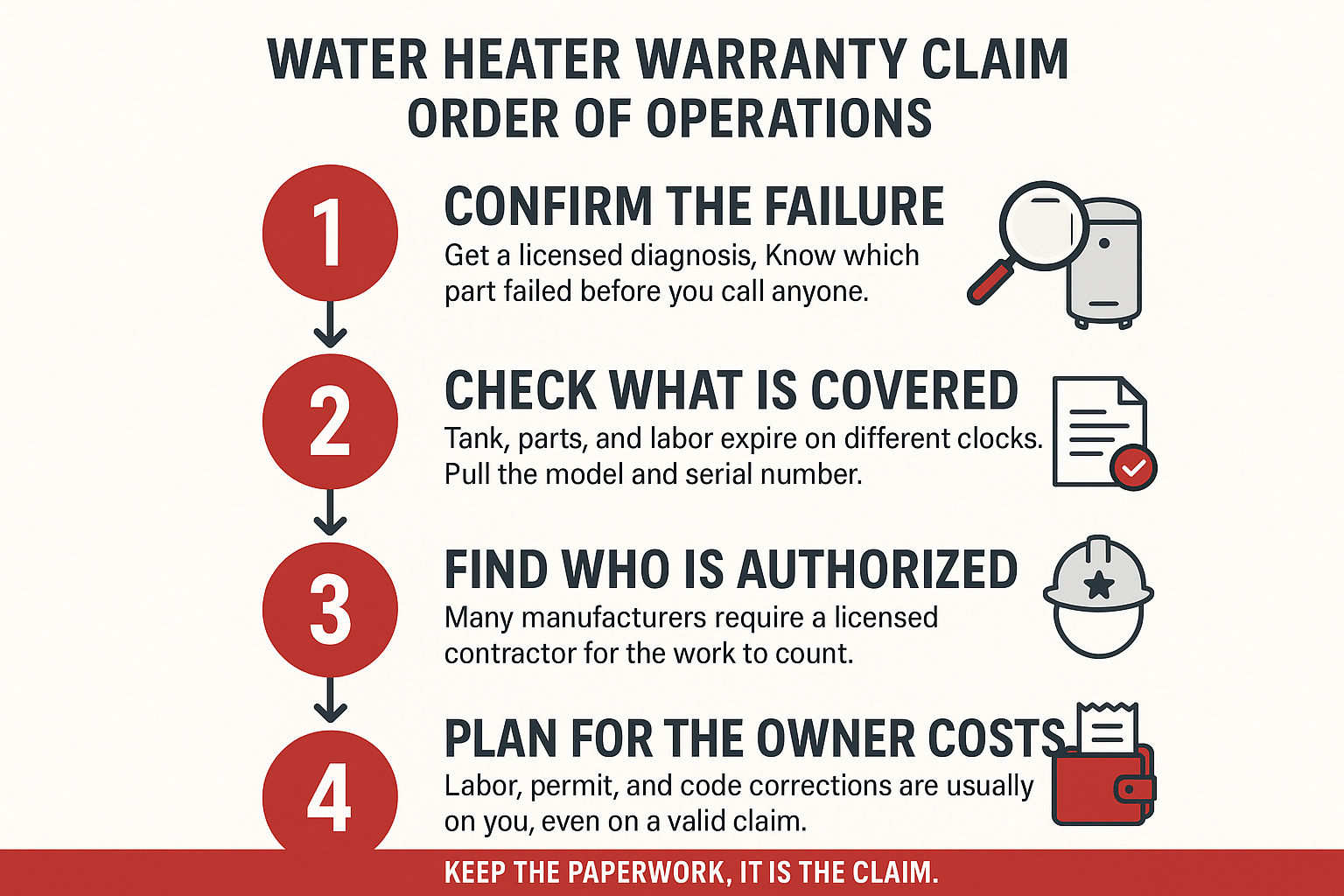
The Order of Operations When a Water Heater Fails Under Warranty
Most people call the manufacturer first and lose a week. This is the sequence that actually moves a claim forward.
The Short File Every Water Heater Owner Should Keep
You do not need a binder. You need five things in one folder or one phone album.
- Install date and the installing contractor’s license number
- Model and serial number off the data plate, photographed the day it goes in
- The permit final from the City of Salinas or your local building department
- Product registration, if the manufacturer requires it within a set window after purchase
- Dated records of every flush and anode check, including who did it
That registration window catches people. Some manufacturers shorten or void coverage if the unit is never registered, and the deadline can be as tight as 30 to 90 days after installation.
If you bought the unit yourself and hired out the install, the paperwork gets split between two parties. Our article on what changes when you supply your own water heater covers how that affects who stands behind what.
What Replacement Actually Costs, and Why No One Can Quote It Blind
One caller put it plainly: “My water heater is leaking and I think it needs to be replaced, what does that cost?” Another version we hear constantly is “I just want to know how much it would cost before I commit to anything.”
Both are reasonable. The honest answer is that the warranty credit, if there is one, comes off a number set by the job in front of you.
In the Monterey Bay market, the things that move that number are:
- Tank versus tankless, and gas versus electric
- Whether the unit sits in an open garage or a tight closet or crawlspace
- Whether venting and seismic strapping need to be brought current
- Whether the permit inspection turns up other code corrections
- Whether the gas line, water lines, or an expansion tank need work
Costs vary, but many local homeowners see a straightforward tank replacement land somewhere in the $1,900 to $2,500 installed range, with tankless and difficult access pushing higher. Treat that as market context, not a quote.
If you are still weighing whether a repair makes sense at all, our repair or replace walkthrough lays out the age and cost thresholds we use in the field. A written quote after someone sees the unit is the only real answer.
Frequently Asked Questions About Water Heater Warranty Coverage
Does a 6-year warranty mean the water heater will last six years?
No. It is a defect warranty, not a life expectancy promise. In Salinas, where water runs very hard, an unflushed tank can start showing sediment trouble well before the warranty runs out, and normal wear from scale is not a covered defect.
My unit is only three years old and stopped heating. Is the repair free?
Probably partly. If the failed component is covered, the part usually comes at no charge. The diagnostic visit and the labor to install it are typically the owner’s cost unless the unit carried labor coverage and that term is still active.
I already have the replacement part from the manufacturer. Can a plumber just install it?
Yes, that happens regularly, especially with tankless units where the maker mails out a sensor or board. You pay for the visit and the labor, and it is worth confirming the diagnosis is right before the part goes in so you are not chasing the wrong fault code.
Will an unpermitted install really void my warranty?
It can. Manufacturers generally require installation by a licensed contractor, and California requires a permit for a changeout. The bigger practical problem is proof: years later, a permit final and a licensed contractor’s name on the invoice are what let you argue the claim at all.
How often should I flush a water heater in Salinas to protect coverage?
Once a year is the baseline we recommend locally given the hardness levels in the Salinas systems. Keep the date and the invoice. That record is what a warranty department asks for when a tank fails early.
Does the warranty transfer if I sell the house?
Usually not in full. Many residential warranties are limited to the original owner at the original installation address, and coverage for a second owner is often shorter or voided entirely. Check the specific terms for your model before assuming it carries over.
Questions About Coverage, Brands, or Paperwork?
We are a family-run shop that has been installing water heaters in Salinas, Monterey, Seaside, and Watsonville since 1988, and we file City of Salinas permits in-house so the paper trail exists if a warranty claim ever needs it. Alvarez Plumbing carries a 4.94 star average across 224 plus Google reviews, and the office is happy to talk through what a specific model’s coverage includes before you decide anything. The number is (831) 757-5465.
