
Direct Answer: A pilot that lights then dies usually points to a failing thermocouple or thermopile. A pilot that never catches often means no gas to the pilot, a blocked air intake, or a dead igniter.
You hold the igniter, the pilot catches, and a minute later the flame is gone again. By the third try you are lying on a cold garage floor wondering if this thing is about to quit for good.
One homeowner in our area summed it up in a single line on our website: the pilot light in the water heater doesn’t stay lit. That phrasing shows up often enough around Salinas and the Monterey Peninsula that it deserves a real answer instead of a shrug.
Here is what that symptom actually points to, how to tell which version of the problem you have, and when it stops being a repair and starts being a replacement.
First, Figure Out Which Pattern You Have
There are two different behaviors people describe, and they point at different parts of the unit. Knowing which one you have cuts the diagnosis in half before anyone opens a toolbox.
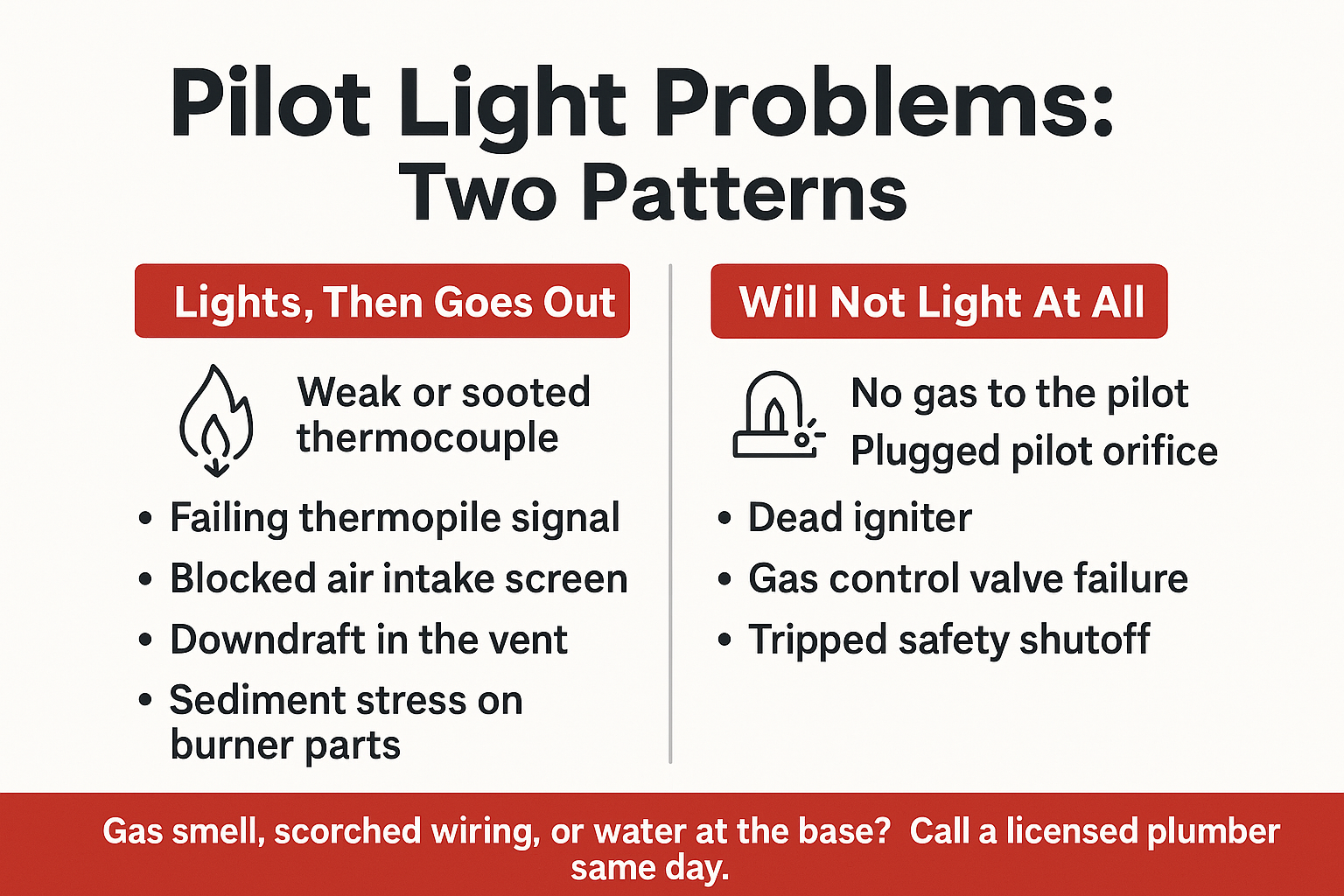
Pattern one: the pilot lights, then dies. It catches fine, burns for a few seconds or a few minutes, then drops out. That usually points at the flame sensing safety device or at something interfering with the flame itself.
Pattern two: the pilot won’t catch at all. No flame, or a spark with nothing behind it. That points more toward gas delivery to the pilot, a plugged pilot orifice, or a dead igniter.
Before you call anyone, note these:
- How long the flame stays lit once it catches
- Whether it fails more often on laundry days
- Any black soot marks around the burner door
- Popping or rumbling while the tank heats
- Any gas smell near the unit
- How old the tank is, if you know
That short list is genuinely useful to a plumber on the phone. In older Salinas neighborhoods where tanks sit in tight garage corners, those details often narrow things down before the truck arrives.
The Flame Sensor Is the Usual Suspect
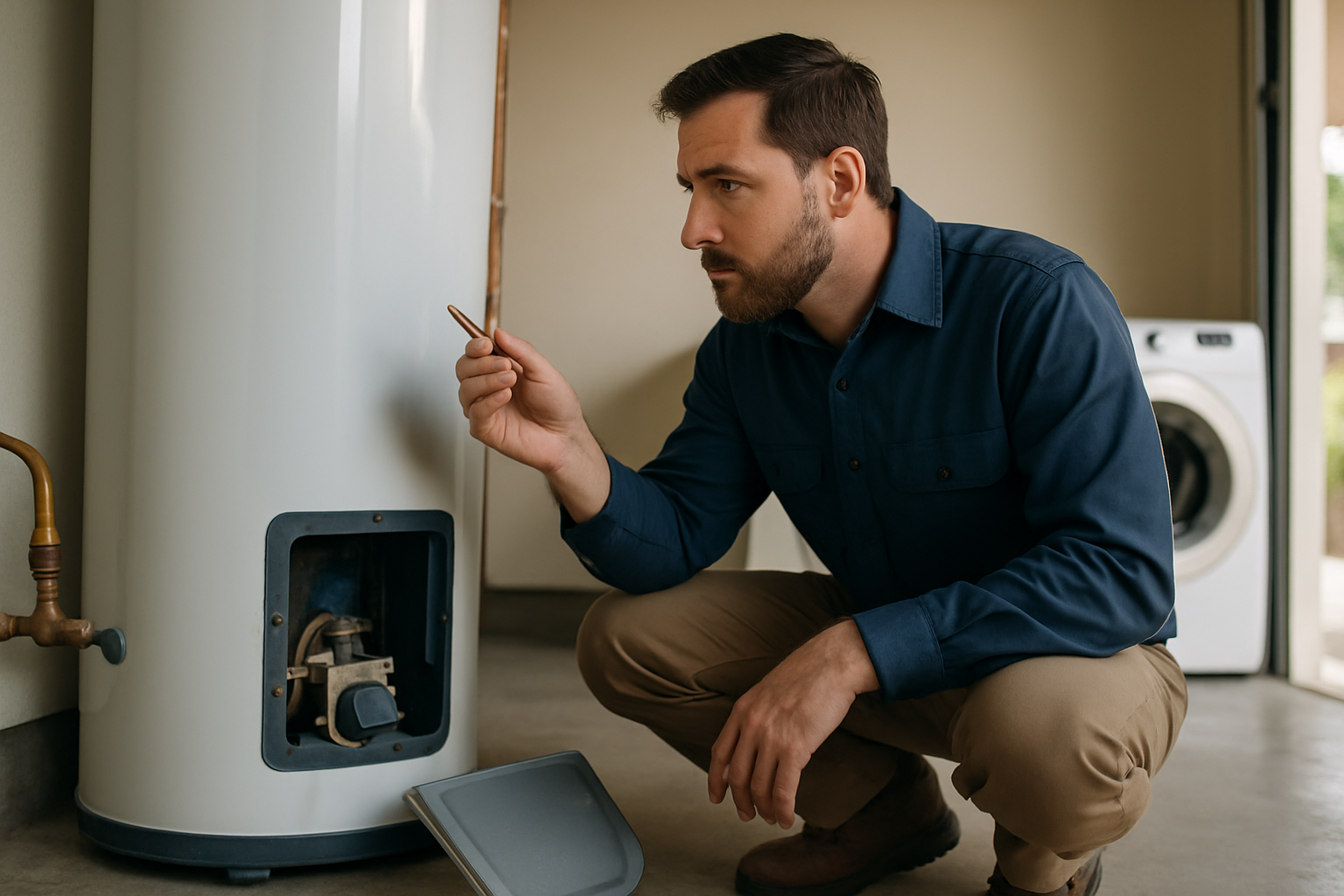
On a pilot that lights and then drops out, the most common cause is the small safety device that watches the flame. Depending on the age and type of your heater, that is either a thermocouple or a thermopile.
In plain terms, it works like this. The pilot flame heats a metal tip, the tip makes a tiny electrical signal, and that signal is what keeps the gas valve open. No signal, no gas.
When that tip gets old, gets coated with soot, or drifts out of the flame, the signal drops below the threshold. The valve closes on purpose. The water heater is shutting itself down because it can no longer confirm there is a flame there.
So the part is not failing at random. It is a safety feature doing exactly what it was built to do, which is why relighting it over and over usually buys you a day or two and nothing more.
This is also the cheapest and most common outcome on a service call. But gas control work on a water heater is licensed contractor work in California, not a weekend project, and that matters more than the price of the part.
Combustion Air Is the Second Big Driver, and It Is Very Local
A large share of water heaters in Salinas, Seaside, and Marina sit in the garage, and a lot of them sit within a few feet of a clothes dryer. That placement matters more than most people expect.
Lint, dust, and pet hair get pulled toward the burner compartment and settle on the flame arrestor screen at the base of the tank. That screen is the unit’s air intake. When it loads up, the flame starves and the pilot goes out.
Other common air problems around here:
- Storage boxes and bins stacked tight against the tank
- A water heater closet with painted-over or blocked louver vents
- Coastal wind pushing down the flue on a breezy Monterey afternoon
- Fresh paint, solvents, or pool chemicals stored next to the unit
The cues that point this direction are pretty readable. Soot marks or yellowing around the burner door, a pilot that fails more often right after a few loads of laundry, and a unit that has never had its intake screen cleaned in its life all lean toward an air problem rather than a part problem.
A screen that has never been serviced on a ten year old tank is not unusual. It is one of the first things worth checking on a garage install.
Two Symptoms, Two Different Diagnoses
This breakdown shows how the behavior of your pilot light points toward different parts of the water heater.
Hard Water and Sediment Change How the Burner Behaves
Salinas water is hard. Cal Water has reported average hardness around 254 ppm in its Salinas system, and above 300 ppm in the Salinas Hills system.
That mineral load settles out as a crusty layer on the bottom of the tank, right above the burner. Local tanks build that layer faster than the manufacturer’s average assumes, which is why a heater here often behaves older than its birthday.
The layer acts like insulation between the flame and the water. The burner has to run longer and cycle more to hit the same setpoint, and all that extra heat stresses the parts sitting near the pilot assembly.
So when someone tells us the tank has been popping or rumbling during a heating cycle and the pilot has started dropping out, those two things are usually related. It is worth reading up on how hard water builds sediment in a water heater and on what happens when a tank has never been flushed, because that is the background condition behind a lot of Salinas Valley pilot light calls.
What Each Symptom Usually Points To
This is a general guide, not a diagnosis. A licensed plumber confirms the cause by testing the unit.
| What you notice | Common cause | Typical outcome |
|---|---|---|
| Pilot lights, dies in under a minute | Weak thermocouple or thermopile | Part replacement, usually the least expensive fix |
| Fails more after laundry days | Lint-clogged flame arrestor screen | Cleaning and air-flow correction |
| Soot or yellowing at burner door | Poor combustion or venting issue | Venting inspection and correction |
| Popping or rumbling plus pilot dropout | Heavy sediment in the tank | Flush if the tank is young, evaluate if it is not |
| Pilot never catches, tank 10+ years old | Gas valve or end-of-life failure | Repair versus replacement conversation |
| Water pooling at the base | Tank shell failure | Replacement, permit required |
When the Pilot Problem Is Really an Age Problem
Not every pilot light call is an old tank. One homeowner wrote in about a unit installed in 2023 that stopped heating, and suspected the temperature regulator or sensor had gone bad. A young tank with one failed part is almost always a repair.
Age changes the math. Industry failure data puts the average age of a failed water heater near 10.7 years, with roughly three out of four failed by year 12.
What moves the decision one way or the other:
- Tank age and whether the base shows rust or moisture
- Whether the failed part is still available for that model
- How many things have failed in the past two years
- Whether the existing connections, venting, and seismic strapping still meet current code
On cost, repairs of a single gas control part tend to land well below the cost of a new unit, and a full replacement runs into the low thousands installed in this market. Those are general ranges, not a quote. An exact number comes from a licensed plumber who has looked at your unit and your connections.
If you want a fuller walkthrough of that call, we cover repair versus replace on a water heater in more detail.
What Warrants a Same-Day Call
Most pilot light problems can wait until morning. A few should not.
Do not wait if you have:
- A gas smell near the unit
- Scorched or melted wiring at the burner door
- Water pooling at the base of the tank
- A pilot that will not hold at all and no other hot water in the house
No hot water on a weekday evening is one of the most common after-hours calls in the Salinas and Monterey corridor. The calmest version of this decision happens before the water goes cold, not at 9pm with a full house.
If the answer turns out to be a replacement, the City of Salinas requires a permit for a water heater changeout, and a licensed contractor should be the one filing it. That matters more now than it used to, since updated California Plumbing Code changes took effect January 1, 2026 and a new install has to pass inspection against the current rules. Here is why the permit matters on a Salinas water heater replacement.
Why Local Experience Shows Up on This Particular Call
A pilot light call is a diagnosis call, not a parts call. The difference between a plumber who swaps a thermocouple and one who checks the intake screen, the venting, and the sediment load is whether you are lighting that pilot again next month.
We have been working on Monterey Bay area water heaters since 1988, we are family-run, and we answer the phone around the clock, including weekends and holidays. Across more than 224 Google reviews we hold a 4.94 star average, and the thing reviewers mention most is technicians who explain what they are seeing.
One customer put it this way: “Johnny of Alvarez Plumbing installed my new water heater promptly and answered all my questions knowledgeably and helpfully.” That is the standard we aim for on a cold-water morning.
Frequently Asked Questions About a Pilot Light That Won’t Stay Lit
Can I just keep relighting it myself?
You can follow the relight instructions printed on your unit, but if it keeps going out, relighting is not fixing anything. A safety device is shutting the gas off for a reason. If you smell gas at any point, stop, leave the area, and call for help rather than trying again.
How long does a thermocouple last?
Often several years, sometimes closer to the life of the tank. Hard water, heavy burner cycling, and a dirty air intake all shorten it. In Salinas, where hardness runs high, we tend to see these parts age faster than the national average would suggest.
Is it worth fixing a pilot problem on a 12 year old tank?
Sometimes, but go in with your eyes open. With roughly three in four water heaters failed by year 12, spending on a gas control part in that range can buy you a short runway. If the base is rusty or you have had two or more failures recently, replacement is usually the better use of the money.
Does a tankless unit have a pilot light?
Modern tankless units use electronic ignition instead of a standing pilot, so there is no small flame burning all day. They fail differently, usually with an error code on the display. If your tankless unit is throwing a code or failing to ignite, that is a diagnostic call, not a relight.
Do I need a permit if this turns into a replacement?
Yes. A water heater changeout in Salinas requires a residential plumbing replacement permit, and the installation gets inspected. We file and manage that paperwork in-house rather than handing it back to the homeowner.
Still Chasing That Pilot Light?
If your pilot keeps dropping out and you would rather have someone look at the flame sensor, the air intake, and the tank’s condition together, we are here in Salinas and available 24 hours a day, seven days a week. You can reach our office at (831) 757-5465 or request service at alvarezplumbingsalinas.com. We will tell you what we see, including when the honest answer is that the tank has more life in it than you thought.
