
Direct Answer: Most restaurant and commercial kitchen drain lines need clearing every 6 to 12 months. High-volume kitchens land closer to 6 months. Home kitchen lines usually hold up 1 to 2 years.
It’s 7:15 on a Friday. The dish pit is holding water, the three-compartment sink won’t drain, and there are tickets stacked on the rail. Nobody in the building has time for this.
We’ve been working kitchens in Salinas, Monterey, Seaside, and Watsonville for decades, and this call always sounds the same. The line didn’t fail that night. It had been closing down for months.
This is a guide to how often a commercial kitchen line actually needs clearing, why the local water makes that interval shorter than the national advice you’ll find online, and why the month you schedule it matters more than most operators expect.
The Short Answer on Commercial Kitchen Drain Line Cleaning Frequency
A home kitchen drain line generally holds up on a 1 to 2 year cleaning cycle. A restaurant or commercial kitchen line usually needs clearing every 6 to 12 months, and busy high-volume kitchens sit at the short end of that.
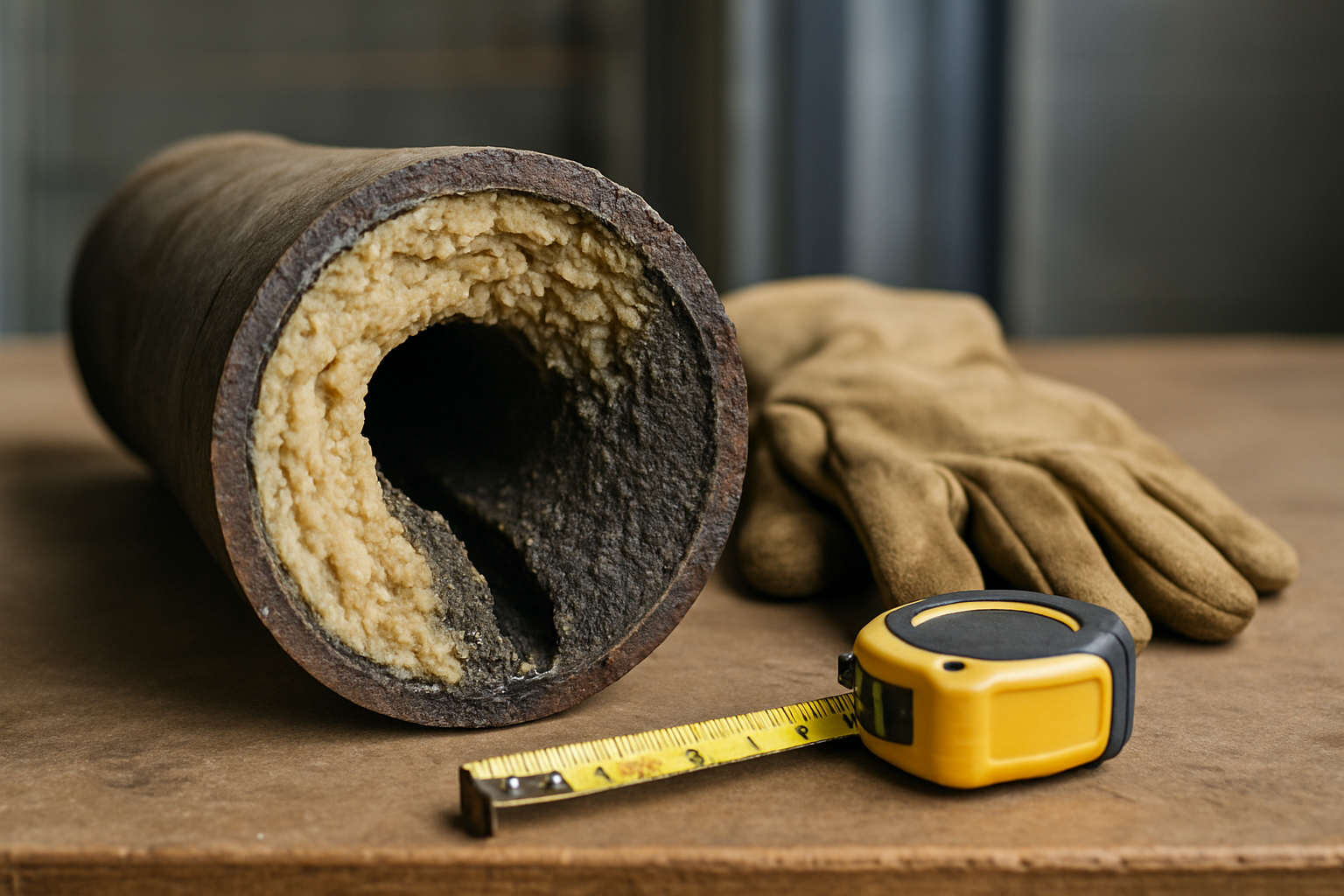
Here’s the mechanism, in plain terms. Grease leaves the sink warm and liquid, so it moves fine at first. Then it cools in the horizontal run under the floor and coats the pipe wall in layers.
Each layer narrows the opening a little more. The line keeps draining right up until it doesn’t, which is why a kitchen can go from “a little slow” to fully stopped inside one shift.
What actually sets the pace is volume of covers, not calendar time. Two restaurants on the same block can be a year apart on their real interval:
- Fryer and griddle stations push far more fat down the line than a salad-and-sandwich menu
- Dish machines dump hot, greasy water in high-temperature surges
- Long horizontal runs under a slab give grease more cool pipe wall to grab
- Older buildings often have smaller diameter or rougher cast iron waste lines
The EPA points to grease as a leading cause of sewer line blockages, and commercial kitchens are where it concentrates.
Why Salinas Water Chemistry Shortens the Interval
This is the part most operators never account for. Our water is hard, and hard water changes how fast a kitchen line fouls.
Cal Water has reported average hardness around 254 ppm in its Salinas system, and the Salinas Hills system came in near 320 ppm. The utility itself classifies anything above 300 ppm as very hard.
Mineral scale builds on the inside of the pipe and leaves a rough, gritty surface. Cooling grease grips that surface instead of sliding past it.
So a kitchen line in Salinas and a kitchen line in a soft water town do not foul at the same rate, even with identical menus and identical covers. That is a concrete reason a maintenance schedule pulled off a national blog runs short here.
If you manage properties across the Monterey Peninsula too, the same logic applies. Older buildings in Monterey, Pacific Grove, and Carmel often combine hard water with original cast iron waste lines, which is the fastest-fouling combination we see.
Typical Clearing Intervals by Kitchen Type
These are field averages, not guarantees. A camera look inside your specific line is what sets the real number.
| Type of kitchen | Typical clearing interval | What drives it |
|---|---|---|
| Home kitchen drain line | Every 1 to 2 years | One sink, low grease volume, short runs |
| Coffee shop or limited menu cafe | Around every 12 months | Dairy, syrups, light food prep |
| Full-service restaurant | Every 6 to 12 months | Fryers, griddles, dish machine surges |
| High-volume kitchen, hotel banquet, cafeteria | Every 6 months or sooner | Heavy fat load, long daily service hours |
| Any of the above in a hard water area | Shorten by a few months | Scale gives cooling grease something to grip |
The Local Calendar That Decides What This Costs You
Drainage stress in Monterey County is seasonal, and so are kitchen line failures. This is how the year actually plays out.
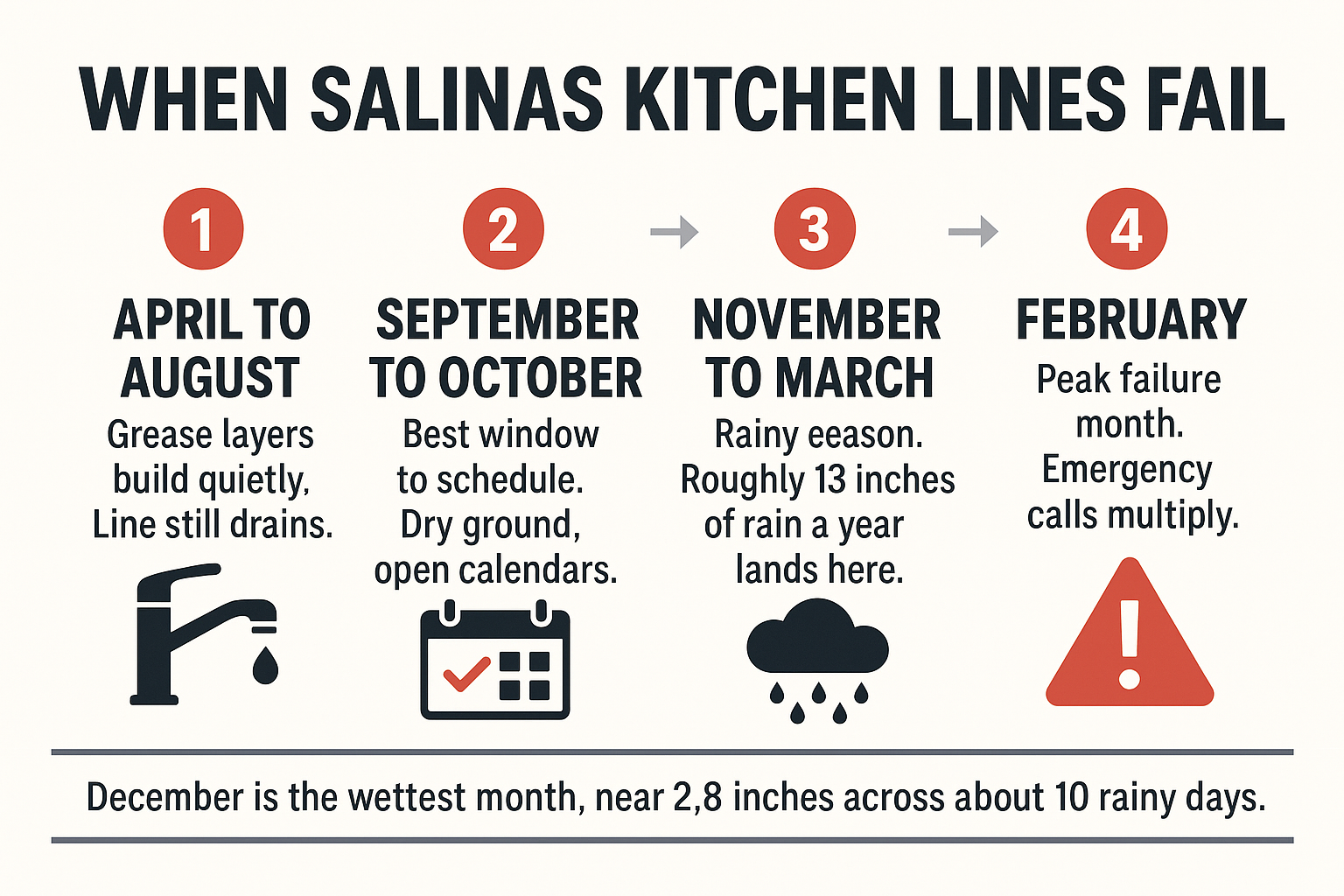
September and October Are the Cheap Months. February Is the Expensive One.
Salinas averages roughly 13 inches of rain a year, with December the wettest month near 2.8 inches across about 10 rainy days. Monterey peaks a little higher. Nearly the entire year’s drainage stress lands between November and March.
A kitchen line already narrowed by a summer of grease has no reserve capacity left when the rain arrives. Groundwater rises, older laterals take on infiltration, and roots start pushing toward the moisture in the pipe.
Local search behavior tells the same story from the other side. Drain and sewer searches across the Monterey-Salinas area run flat all summer, then multiply several times over by February.
That spike is the sound of lines failing all at once. And when everyone’s line fails in the same two weeks, you’re competing for the same after-hours crews.
The practical takeaway for an operator or a facilities coordinator:
- September and October are the calm months to schedule clearing
- November through March is when a marginal line turns into a closed kitchen
- A look at the sewer line before the first real rain catches root intrusion and cracks while there’s still time to plan the repair
Why It Backed Up Again Three Months After Somebody Cleared It
We hear a version of this constantly. One caller put it simply: the previous plumber couldn’t fix it.
Usually nothing went wrong. A cable or snake punches an opening through the grease plug and flow comes back that afternoon. But the hardened buildup on the pipe wall is still there.
The opening just closes back down at the same rate it did the first time. That’s why a snake on a grease line buys months, not a year. We’ve written more on why the same drain keeps clogging after it’s been cleared.
There’s also a symptom pattern worth knowing, because it tells you whether you have a main line problem or a single fixture problem.
One fixture slow usually means that fixture’s branch. Everything slow in the same shift means the trouble is downstream of all of them.
Call it a main line if you see:
- The three-compartment sink, the dish machine drain, and a floor drain all slowing or backing up together
- Water surfacing at the lowest drain in the building, often a floor drain, when something upstream runs
- Gurgling from drains when the dish machine discharges
- Sewer odor near a cleanout or floor drain
If you’re on the residential side of this, the same logic applies to a kitchen sink that won’t drain.
Method and Cost: Why the Camera Goes In First
High-pressure water jetting is the standard for grease. It runs up to about 4,000 PSI and scours the pipe wall back to bare material without chemicals, which is what actually resets the clock. The difference between jetting and snaking is the difference between cleaning the pipe and poking a hole through the clog.
But pipe condition has to be checked first. Older cast iron waste lines in long-standing Salinas and Monterey buildings can be thin enough that aggressive jetting is the wrong call, and a gentler method is appropriate.
A video camera inspection takes 30 to 60 minutes and is what turns a guess into a real quote. It shows pipe material, wall condition, how far the buildup extends, and whether there’s a crack or root intrusion hiding behind the grease.
On price, stay skeptical of anyone quoting over the phone. Costs in this area vary widely, and jetting work locally tends to fall somewhere from a few hundred dollars into the high hundreds, driven by:
- Pipe diameter and total run length
- How far the buildup extends down the line
- Cleanout access, or whether one has to be opened up
- Pipe material and condition
- Whether the visit is scheduled or after-hours emergency
The only honest number comes after someone looks inside the line. Ask for the footage.
What Commercial Readers Are Really Buying: Uptime
A kitchen line failing mid dinner service isn’t a plumbing problem. It’s lost covers, a health department exposure, and a staff that goes home early.
The difference between a two hour interruption and a two day closure is almost always whether the work was scheduled or reactive.
A few things matter more to a facilities coordinator or property manager than to an owner-operator:
- Scheduled clearing can be booked before open or after close, so service isn’t touched
- Camera footage and written documentation give you something concrete to attach to a work order
- One licensed, insured, and bonded local contractor who can inspect, clear, and pull permits when a repair is needed beats coordinating three vendors across three invoices
- Recurring intervals can be set on the calendar instead of waiting for a tenant complaint
For operators tracking the cost side, note that Salinas sewer rates have been climbing, and the private lateral on your side of the connection is still your responsibility either way.
Frequently Asked Questions About Commercial Kitchen Line Clearing
Can the work be done outside service hours?
Yes. Scheduled kitchen line clearing is routinely done before open or after close, which is the whole point of scheduling it instead of waiting for a failure. Emergency calls are a different story, and those tend to happen at the worst possible hour.
Doesn’t a grease interceptor mean my line stays clean?
It helps a lot, but it doesn’t eliminate the need. Interceptors capture the bulk of the fat, not all of it, and they only work as well as their pumping schedule. Plenty of the fouled lines we camera in Salinas are downstream of a working interceptor that was overdue for service.
How long does jetting a commercial kitchen line take?
Most straightforward jobs run a couple of hours, including the camera work. Long runs, poor cleanout access, or heavy scale can push it longer, which is another reason the inspection comes first.
Is the interval different for a hotel or a cafeteria than for a restaurant?
The math is the same, the volume isn’t. Hotel banquet kitchens and institutional cafeterias run long service hours with heavy fat loads, so they often land at 6 months or sooner. A limited-menu cafe can usually stretch toward 12 months.
Do you need to be there when a plumber works on a commercial property?
Not necessarily. Property managers and facilities contacts often coordinate access and let the work happen independently, then review the camera footage and invoice afterward. Having a documented before-and-after is what makes that workable.
Thinking About Your Kitchen’s Clearing Schedule?
If you run or manage a kitchen in Salinas, Monterey, Seaside, or Watsonville, the useful next step is knowing what your line actually looks like inside before the rainy season decides for you. Alvarez Plumbing has been working local kitchens since 1988, answers the phone around the clock, and holds a 4.94-star average across 224-plus Google reviews. The number is (831) 757-5465 if you want to talk through an interval that fits your volume.
