
Direct Answer: Salinas hard water deposits mineral scale inside your water heater over time, forcing it to work harder and shortening its life. Annual flushing and anode rod maintenance are the main ways to slow that damage.
Most homeowners in Salinas, CA do not think about their water heater until it stops working. By then, the mineral scale that has been building up inside the tank for years has already done its damage, reduced efficiency, a shorter lifespan, and a repair or replacement bill that could have been delayed or avoided.
Salinas sits in one of the harder water regions in California. According to California Water Service’s published water quality data, the Salinas district averages around 271 parts per million of hardness. Water is classified as hard starting at roughly 120 ppm. At 271 ppm, you are dealing with more than double that threshold, and your water heater is absorbing every bit of it.
This article covers what hard water actually does inside a tank, which maintenance tasks can extend the life of your unit, and where the line is between a job a homeowner can handle and one that needs a licensed plumber.
What Hard Water Does Inside Your Water Heater Tank
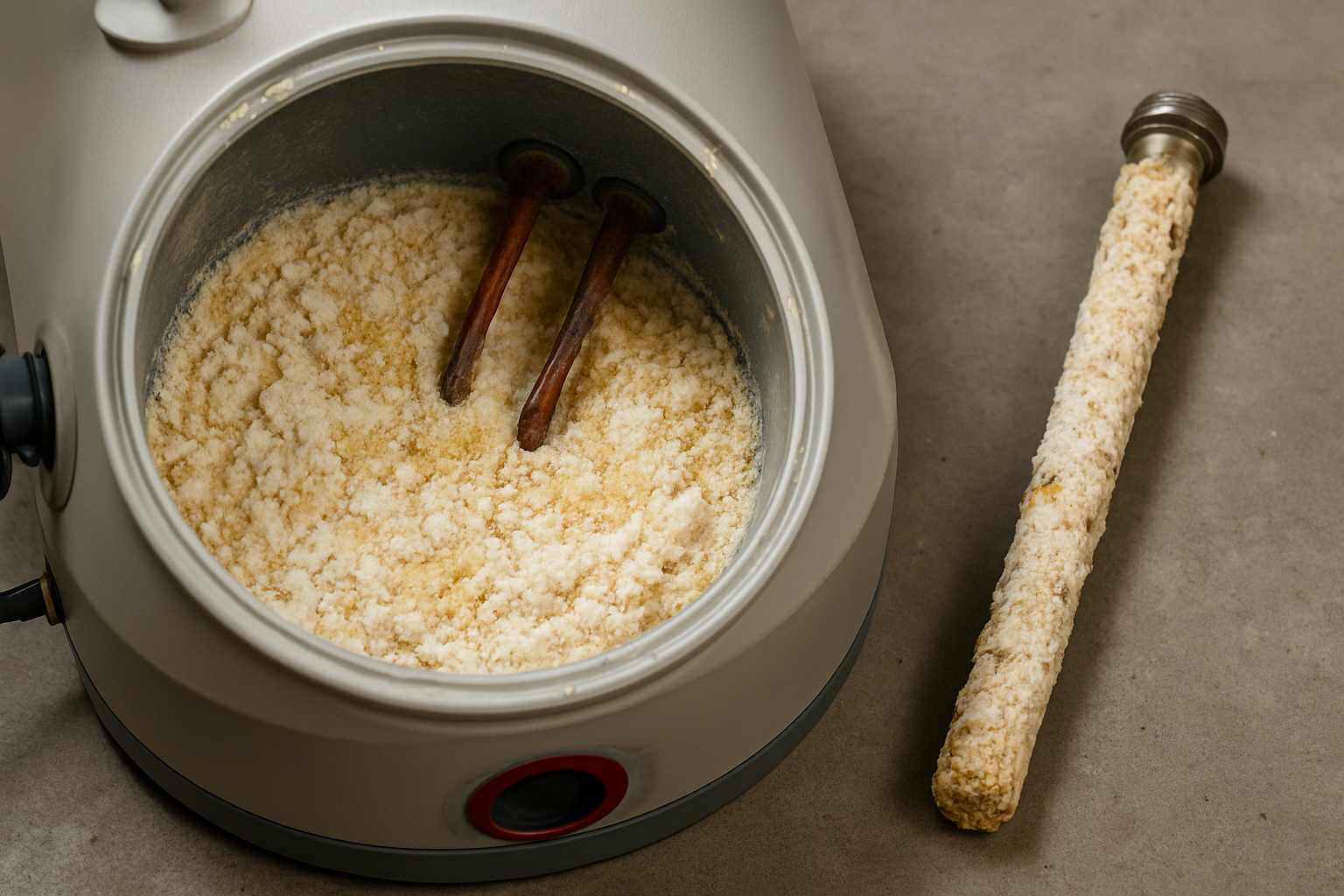
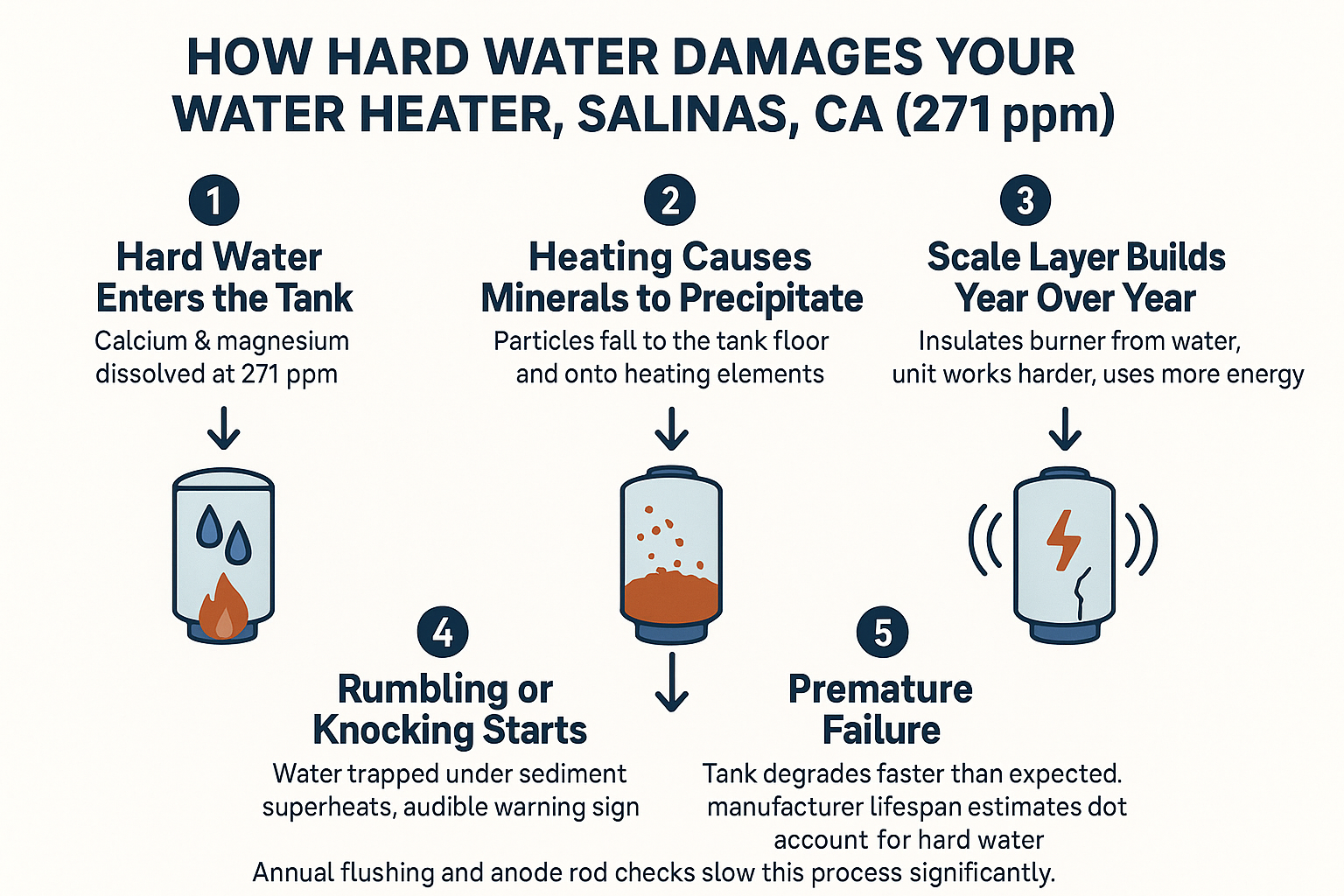
The process is straightforward. When water is heated, dissolved calcium and magnesium fall out of suspension and settle on whatever surface they land on. Inside a tank water heater, that means the tank floor and the heating elements.
Over time, that mineral deposit builds into a layer of sediment scale that sits between the burner and the water. The burner has to work harder and run longer to heat the same volume of water through that insulating layer. Energy use climbs. The bottom of the tank experiences higher localized heat than it was designed for. And the tank itself ages faster because of it.
The sound homeowners often describe as their water heater “knocking” or “rumbling” is a direct symptom of this. Water gets trapped beneath the sediment layer, superheats, and forces its way through. It is not a dangerous explosion risk, but it is your water heater telling you something has been building up for a while.
At 271 ppm, Salinas water deposits scale significantly faster than the manufacturer’s usage assumptions account for. A unit that might reach 12 years in a soft-water city could be struggling at 8 or 9 years here, not because it was a bad unit, but because it was never maintained for local water conditions. For a realistic look at what lifespan actually means here, How Long Should a Water Heater Last in the Monterey Bay Climate? breaks that down further.
The Two Maintenance Tasks That Actually Extend Tank Life
There are two things that directly counter hard water damage in a storage tank water heater: flushing the tank to clear accumulated sediment, and inspecting or replacing the anode rod.
The anode rod is a sacrificial metal rod, usually magnesium or aluminum, that attracts corrosive minerals so they attack it instead of the tank lining. It is one of the most effective and overlooked parts of a water heater. In soft-water areas, a manufacturer might suggest checking it every four to six years. In Salinas, that schedule is too slow. The rod depletes faster here, and a depleted rod leaves the tank lining exposed.
One homeowner who reached out had a seven-year-old unit that had never been flushed and was starting to produce slightly smelly hot water. That sulfur odor from a water heater is usually a sign of a depleted anode rod reacting with sulfate-reducing bacteria in the tank, not a sign the unit needs to be replaced. A flush and rod inspection often resolves it completely. Your Water Heater Is Telling You Something, Are You Listening? covers other early warning signs worth knowing.
What a homeowner can reasonably do:
– Turn the heater to pilot or the lowest setting and let it cool
– Connect a garden hose to the drain valve and run it to a floor drain or the exterior
– Open the drain valve and let sediment flush out with the water
– Close, refill, and restore the heater to normal operation
What typically needs a licensed plumber:
– Replacing the anode rod, the location and access difficulty vary by unit, and many homeowners strip the hex fitting trying to remove it without the right tools
– Sediment that has hardened into solid scale rather than loose particles, flushing alone will not remove it
– Inspecting the pressure relief valve and expansion tank, which are safety components that should be checked at the same time
– Any unit where the drain valve is stuck or shows signs of corrosion
In California, water heater maintenance that does not involve disconnecting the unit or altering gas or water supply lines is generally not permit-required. But if a technician discovers a failed relief valve or a compromised tank, any replacement work in Salinas does require a permit. We handle that permitting in-house, which takes that off your plate entirely.
How Hard Water Damages a Water Heater Over Time
This infographic shows the step-by-step progression from normal water heater operation to sediment-related failure in a hard water area like Salinas.
How to Think About Maintenance Timing in a Hard Water Area
The standard advice for water heater maintenance is to flush the tank annually and check the anode rod every three to five years. In Salinas, annual flushing is worth doing, and the anode rod should be on a two to three year inspection cycle rather than the softer schedule manufacturers print in their manuals.
Manufacturers write those schedules for average conditions. Salinas is not average. A unit that has been consistently maintained here can realistically reach the upper end of its expected lifespan. A unit that has never been flushed in seven or eight years may have sediment that has compacted into something a simple drain cannot clear.
The honest framing: the manufacturer’s stated lifespan is closer to an optimistic ceiling than a reliable baseline in hard water territory. Regular maintenance is what actually gets a unit there. Skipping it is not neutral, it is quietly accelerating wear every season.
For homeowners trying to decide whether a unit is worth maintaining or whether it is time to replace, Repair or Replace Your Water Heater? A Realistic Way to Think It Through walks through that decision with specifics. And if the unit does need replacing, California’s New Water Heater Rules: What Salinas Homeowners Need to Know covers the 2025 regulatory changes that now affect what can be installed.
Hard Water Maintenance Schedule: Salinas vs. Soft Water Areas
This table compares the standard manufacturer maintenance schedule against what makes more sense given Salinas water conditions at 271 ppm.
| Maintenance Task | Standard Manufacturer Schedule | Recommended in Salinas (271 ppm) |
|---|---|---|
| Tank flush / sediment drain | Every 1-2 years | Annually |
| Anode rod inspection | Every 4-6 years | Every 2-3 years |
| Pressure relief valve test | Annually | Annually |
| Full plumber inspection | Every 3-5 years | Every 2-3 years, or if knocking starts |
| Anode rod replacement | When inspected and depleted | Expect depletion earlier than the manual assumes |
What This Costs, and What It Saves
Water heater maintenance is not free, but it is a fraction of what a premature replacement costs. In the Salinas and Monterey Bay area, the general market range for a professional tank flush and inspection, including an anode rod check, tends to run somewhere in the range many homeowners describe as a routine service call. Exact pricing depends on the unit, access, and what the inspection turns up, so it is worth calling for a quote specific to your setup.
A full water heater replacement in Salinas, CA, by contrast, is a significantly larger investment. Based on calls we see regularly, many homeowners are looking at something in the $1,900 to $2,100 range for a standard tank replacement, depending on the unit size, location, and whether the job involves permit work. Maintenance that delays that by even two or three years has obvious value.
There is also the efficiency angle. A water heater working against a thick layer of scale uses more gas or electricity to produce the same amount of hot water. That cost is invisible, it just shows up on your utility bill as normal variation, but it compounds every month the sediment sits there. Salinas homeowners dealing with already-high utility costs do not need an inefficient water heater quietly adding to the tab. If you have questions about warning signs that might mean something bigger is going on, When a Small Plumbing Issue Turns Into a Big Repair Bill is worth a read.
Frequently Asked Questions About Hard Water and Water Heater Sediment in Salinas
My water heater is making a rumbling or popping sound. Does that mean it needs to be replaced?
Not necessarily. That sound is almost always sediment, water getting trapped under the scale layer and superheating. If the unit is otherwise functioning and is not leaking, a professional flush and inspection is the right first step. Whether it makes sense to maintain or replace depends on the unit’s age and overall condition. Repair or Replace Your Water Heater? A Realistic Way to Think It Through helps work through that decision.
My hot water has a slight sulfur smell. Is that a hard water problem?
It is often an anode rod problem. When the rod depletes, sulfate-reducing bacteria in the tank can react with the remaining rod material and produce a hydrogen sulfide odor, that rotten egg smell. In Salinas, anode rods deplete faster than the manufacturer’s schedule assumes, so a seven or eight year old unit that has never had service is a likely candidate. A flush and rod replacement often clears this without needing to replace the unit.
Can I flush my own water heater, or do I need a plumber?
A basic partial flush, turning off the heater, connecting a hose to the drain valve, and draining out sediment, is something many homeowners can do on a newer unit in good condition. But if the drain valve is stuck, if the sediment has hardened into solid scale, or if you have not done it in several years, a plumber should do the inspection. Anode rod replacement, pressure relief valve testing, and any gas line work require a licensed contractor in California.
How often should I have my water heater serviced in Salinas?
Given Salinas water running around 271 ppm, annual flushing is a reasonable target. Anode rod inspection every two to three years makes sense here, sooner than most manufacturer manuals recommend, because local water chemistry depletes the rod faster than average conditions.
Does a water heater replacement in Salinas require a permit?
Yes. California requires a permit for water heater replacement, and Salinas has specific requirements tied to the 2025 California Building Energy Efficiency Standards. We handle the City of Salinas permitting in-house, so homeowners do not have to track that process themselves. For more detail, Yes, You Need a Permit to Replace Your Water Heater in Salinas. Here’s Why It Matters. covers exactly what that involves.
Ready to Find Out What’s Happening Inside Your Tank?
If your water heater is more than four or five years old and has never been serviced, Salinas water conditions mean sediment is almost certainly a factor. Alvarez Plumbing has been serving Salinas and the Monterey Bay Area since 1988, and we are available 24 hours a day, seven days a week for both scheduled service and emergencies. Call us at (831) 757-5465 or schedule service online at alvarezplumbingsalinas.com.