
Direct Answer: The repairs Monterey homeowners delay most — slow drains, dripping faucets, and aging water heaters — almost always cost significantly more to fix once they’ve been ignored for months.
Most plumbing problems don’t announce themselves with a flood. They start small — a drain that’s a little sluggish, a faucet that drips only at night, a water heater that takes an extra minute to warm up. And because nothing is broken yet, it’s easy to put it off.
In Salinas and across the Monterey Peninsula, we see the same pattern repeat itself constantly. Homes throughout this area — many of them built between the 1950s and 1980s — have aging pipes, hard mineral-rich water, and years of use behind them. That combination means small plumbing issues tend to move faster toward serious ones than homeowners expect.
These are the repairs that get delayed most often, and what actually happens when they are.
Slow Drains: The Repair That Almost Never Stays Slow
A drain that takes 30 extra seconds to clear doesn’t feel urgent. But a slow drain is almost always a sign that something is building up inside the line — grease, soap residue, hair, or in older Salinas homes, early-stage root intrusion from the large trees common to established neighborhoods like Alisal and East Market Street.
Left alone, a slow drain doesn’t stabilize. It gets slower, then it backs up, and then you’re dealing with a full blockage — or worse, a backup that pushes sewage into a lower fixture.
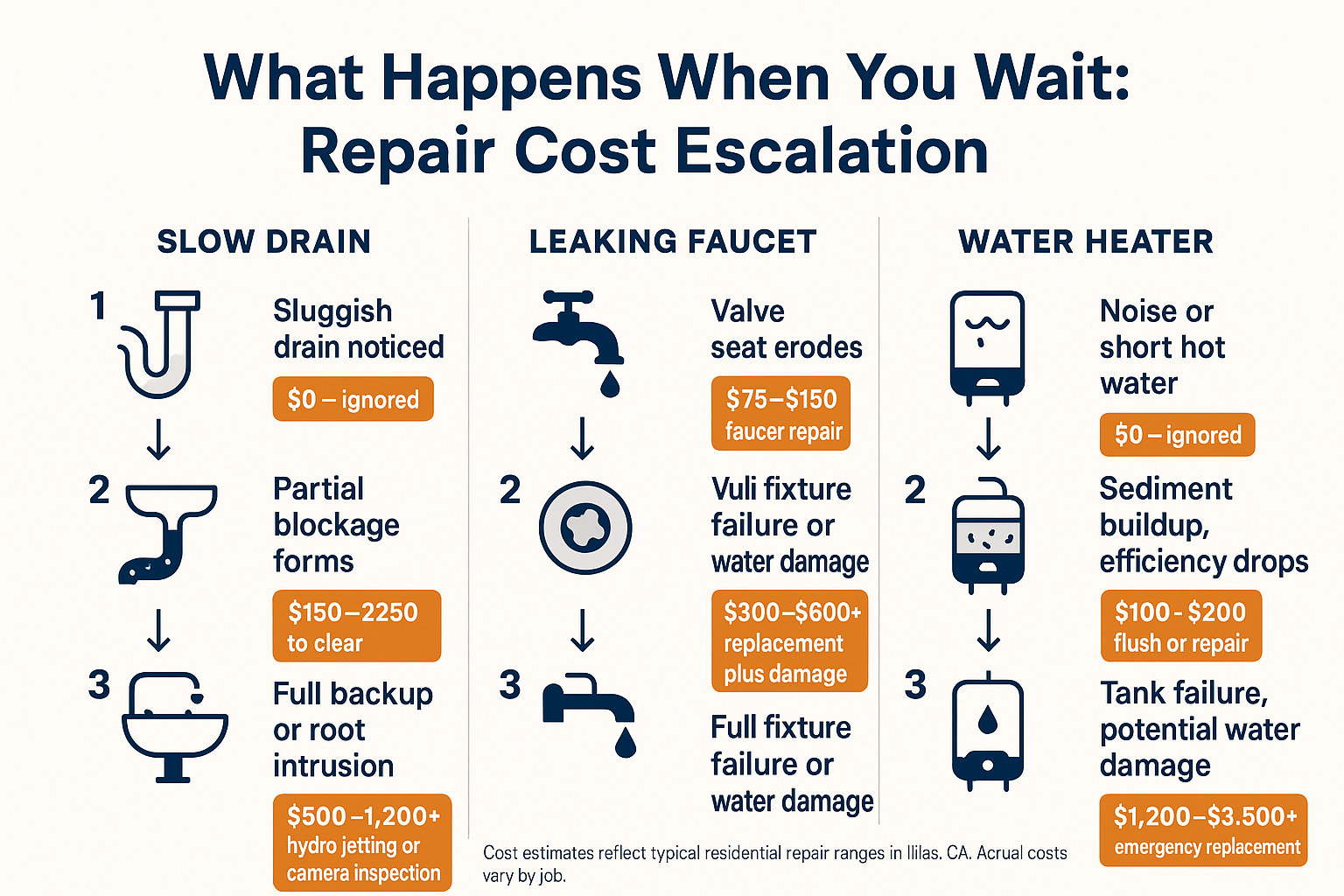
What typically starts as a $150–$250 drain cleaning can turn into a $500–$1,200 hydro jetting job if the clog hardens and adheres to the pipe walls. If roots are the cause and they’ve had time to expand, a camera inspection and possible sewer line cleanout may be needed before water moves freely again.
The decision most homeowners face is simple: clear it now when it’s easy, or clear it later when it isn’t. What kinds of clogs actually require hydro jetting depends on how far the buildup has progressed — and that window closes faster than most people realize.

Water Heater Warning Signs That Get Ignored for Months
A water heater that’s running short on hot water, making popping or rumbling noises, or leaving rust-colored water in the tap is not having a bad week. It’s telling you something is wrong — and in most cases, that problem has already been developing for a while.
In the Monterey Bay Area, the combination of hard water and coastal mineral content accelerates sediment buildup inside tank-style heaters. Salinas water, sourced largely from the Salinas Valley groundwater basin, runs hard enough that mineral deposits inside a tank can cut efficiency noticeably within a few years without regular flushing.
Homeowners who recognize water heater warning signs early often have options: a flush, a repair, or a planned replacement on their own timeline. Homeowners who wait until it fails typically don’t. A tank that fails overnight means no hot water, possible water damage from a leaking base, and an emergency call that costs more than a scheduled one.
The age question matters here, too. If your unit is 10 years or older, it’s worth understanding how long water heaters realistically last in this climate before assuming it has years left. Many don’t.
How a Small Plumbing Problem Becomes a Big Bill
This shows how three common repairs escalate in cost when homeowners delay — with typical price ranges at each stage.
Faucet Drips and Toilet Leaks: The Repairs That Cost Money Every Month You Wait
A faucet that drips once per second wastes roughly 3,000 gallons of water per year. In Monterey County, where water costs and conservation rules are both real factors, that’s not a minor annoyance — it’s a line item on your water bill.
The same applies to a toilet that runs after flushing. A faulty flapper or fill valve can waste 200 gallons a day without making enough noise to notice. Most homeowners only find out when their bill spikes.
What makes these repairs particularly frustrating to delay is that they’re usually inexpensive to fix when caught early:
- A dripping faucet repair typically runs $75–$150 in labor, depending on fixture type and access
- A toilet flapper or fill valve replacement is often $100 or less
- A running toilet that’s been ignored for months may have damaged the flush valve seat, pushing the repair into $200–$350 territory
If there’s a slow leak behind a wall — the kind that’s easy to miss — finding and repairing a water leak pipe early can be the difference between a minor fix and significant drywall, framing, or mold remediation work. That’s a category of damage that no plumbing repair budget accounts for easily.
What Common Delayed Repairs Actually Cost in Salinas
These are realistic cost ranges we see in the field across Salinas and the Monterey Peninsula — broken out by when the repair gets made.
| Repair Type | Fixed Early | Fixed After Delay |
|---|---|---|
| Slow or clogged drain | $150–$250 | $500–$1,200+ |
| Dripping faucet | $75–$150 | $200–$400+ |
| Running toilet | $75–$150 | $200–$350 |
| Water heater flush / tune-up | $100–$175 | $1,200–$3,500 (replacement) |
| Minor leak detection | $150–$300 | $500–$2,000+ (water damage repair not included) |
Why Monterey Bay Homes Are Especially Prone to These Problems
This region’s housing stock is older than most homeowners realize. A large share of homes in Salinas, Seaside, and Pacific Grove were built before 1975 — which means original galvanized steel or early copper pipe is still in place in many of them. Plumbing problems in Monterey homes tend to show up in patterns that are directly tied to pipe age and the local water chemistry.
Galvanized pipe corrodes from the inside out. The first sign is usually reduced water pressure at fixtures — but by the time pressure drops noticeably, the interior of the pipe is often heavily scaled. That buildup also creates rough surfaces where debris catches and clogs form faster.
There are also seasonal factors at play. Monterey’s wet winters — especially during heavy rain years like 2023 — raise groundwater levels and increase hydrostatic pressure on sewer and drain lines. Roots find cracks more easily when soil is saturated. And homes that see reduced water use during dry summer months may develop sediment settling in pipes that shows up as a clog when usage picks back up.
None of this means disaster is inevitable. But it does mean that the usual advice — “wait and see” — tends to work against homeowners here more than in drier, newer housing markets.
Frequently Asked Questions About Delayed Plumbing Repairs
How do I know if a slow drain is just a clog or something more serious?
If only one fixture drains slowly, it’s likely a localized clog. If multiple drains in your home are slow at the same time — especially on the same side of the house or the same floor — that usually points to a shared line or main sewer issue. A video camera pipe inspection can confirm what’s happening inside the line without any guesswork.
My water heater is 9 years old and still works fine. Should I be worried?
Nine years is right at the edge of the typical lifespan for a tank-style heater in this area — hard water and coastal mineral content tend to shorten that window. If it’s working without issues, a professional flush and inspection is worth doing now. That tells you the condition of the anode rod and the inside of the tank, and gives you an honest read on how much life is left.
Is a dripping faucet really worth calling a plumber for?
If it’s a straightforward washer replacement on a simple faucet, some homeowners handle it themselves. But if the faucet is older, the valve seat is worn, or you’re not sure what’s causing the drip, calling a plumber saves you from turning a $100 fix into a $400 fixture replacement. And if the drip is coming from a faucet connected to aging supply lines, a licensed plumber can check the condition of those lines while they’re in there.
What counts as a plumbing emergency versus something that can wait a few days?
Active water where it shouldn’t be — a burst pipe, a flooding toilet, a water heater actively leaking onto the floor — is an emergency. A slow drain or a dripping faucet is not, but it shouldn’t wait more than a week or two. Knowing what counts as a plumbing emergency helps you avoid both panic calls and neglected problems.
Can I use chemical drain cleaners to buy more time on a slow drain?
Store-bought drain cleaners can clear a fresh, light clog. But they don’t remove the underlying buildup — they just eat through part of it. And on older galvanized or cast iron pipe, which is common in Salinas homes built before the 1970s, repeated chemical treatment can accelerate corrosion. If a drain has been slow for more than a few weeks, a mechanical cleaning is a better call.
Have a Repair You’ve Been Putting Off?
If something in your home has been on your mental list for a while — a drain that’s not quite right, a water heater that’s older than it should be, a faucet that drips every night — Alvarez Plumbing serves homeowners throughout Salinas, Monterey, Seaside, and the surrounding Monterey Bay Area, seven days a week including 24-hour emergency service. Call us at (831) 757-5465 or schedule online at alvarezplumbingsalinas.com whenever you’re ready to get it handled.