Direct Answer: Monterey Bay homes see plumbing problems cluster together because of hard water buildup, aging pipe materials, and coastal moisture — conditions that stress multiple systems at once rather than one at a time.
If you’ve lived in Salinas or anywhere on the Monterey Peninsula for a while, you may have noticed something frustrating: plumbing problems rarely travel alone. You fix a drain, and a month later a water heater starts failing. You replace a faucet, and suddenly there’s a leak under the sink you never noticed before.
This isn’t bad luck. There are real, local reasons why plumbing issues tend to cluster — and understanding them helps you get ahead of the next problem before it becomes an emergency.
We’ve been working on homes across the Salinas Valley and Monterey Bay Area since 1988, and we see the same patterns repeat across neighborhoods, housing eras, and property types. This article explains the three most common ones.
Hard Water Is the Common Thread in Most Monterey Bay Plumbing Issues
The water that comes out of your tap in Salinas, Seaside, and most of the Monterey Bay Area is hard water — meaning it carries elevated levels of dissolved calcium and magnesium. Salinas Valley groundwater is some of the hardest in California, often testing above 200 mg/L of total dissolved solids depending on the source.
That hardness matters because calcium scale builds up inside pipes, water heaters, and fixtures over time. It doesn’t happen all at once. It accumulates slowly, narrowing flow paths and stressing equipment that was already working harder than it should.
Here’s why this creates patterns: scale doesn’t just affect one fixture. It deposits throughout your entire plumbing system at roughly the same rate. So if your water heater is showing signs of sediment buildup — like running out of hot water faster than it used to — there’s a good chance your showerheads, aerators, and supply lines are dealing with the same accumulation.
The practical result: when one thing fails from scale, others are usually not far behind. Common hard water failure points include:
- Water heater anode rods (depleted faster than average)
- Tankless water heater heat exchangers (scaling reduces efficiency before outright failure)
- Shut-off valves under sinks (mineral deposits freeze the valve stem in place)
- Washing machine inlet hoses and screens
- Pressure regulators on the main supply line
We often find that homes where the water heater is 10 or more years old also have corroded shut-off valves throughout the house. Both problems trace back to the same water chemistry.
Older Pipe Materials Create Whole-House Risk, Not Just Spot Failures
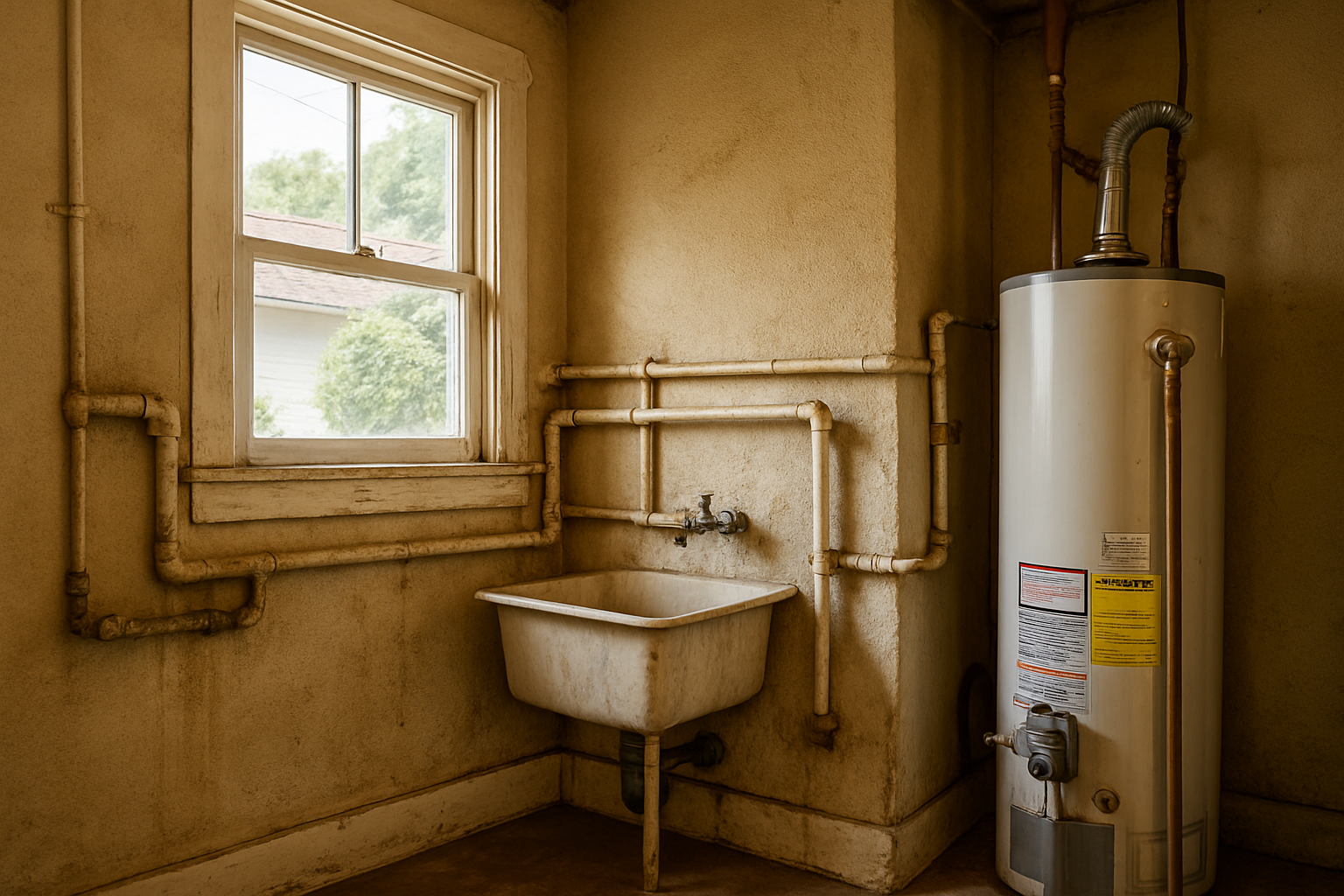
A large portion of the housing stock in Salinas was built between the 1940s and 1980s. Many of those homes were originally plumbed with galvanized steel supply lines or, in some cases, older copper that has thinned over decades of use and hard water exposure.
Galvanized pipe corrodes from the inside out. By the time you see a leak at the surface, the interior of the pipe has often been narrowed by rust and scale for years. The tricky part is that galvanized failures rarely happen at just one spot — the whole run is aging at the same pace.
This is why we often have a candid conversation with homeowners when we’re called to fix a single section of galvanized pipe in an older home. Patching one spot while leaving the rest in place can mean another call within six to eighteen months. Understanding what’s actually involved in repiping a California home helps homeowners make that decision with clear eyes rather than just reacting to the next leak.
For homes in the Oldtown Salinas and Del Monte neighborhoods, we see this pattern constantly. The architecture is beautiful, but the original plumbing hasn’t aged as gracefully.
Signs that pipe age is the root cause of your repeating problems:
- Discolored water (brown or orange tint, especially after the system sits unused)
- Low pressure throughout the house, not just at one fixture
- Multiple slow leaks appearing at fittings within a short timeframe
- A history of pinhole leaks in copper lines
- Visible corrosion at exposed pipe joints in the garage or crawl space
If two or more of those apply, the issue isn’t a single bad fitting — it’s the system itself telling you something.
The Three Conditions That Drive Repeating Plumbing Problems in Monterey Bay Homes
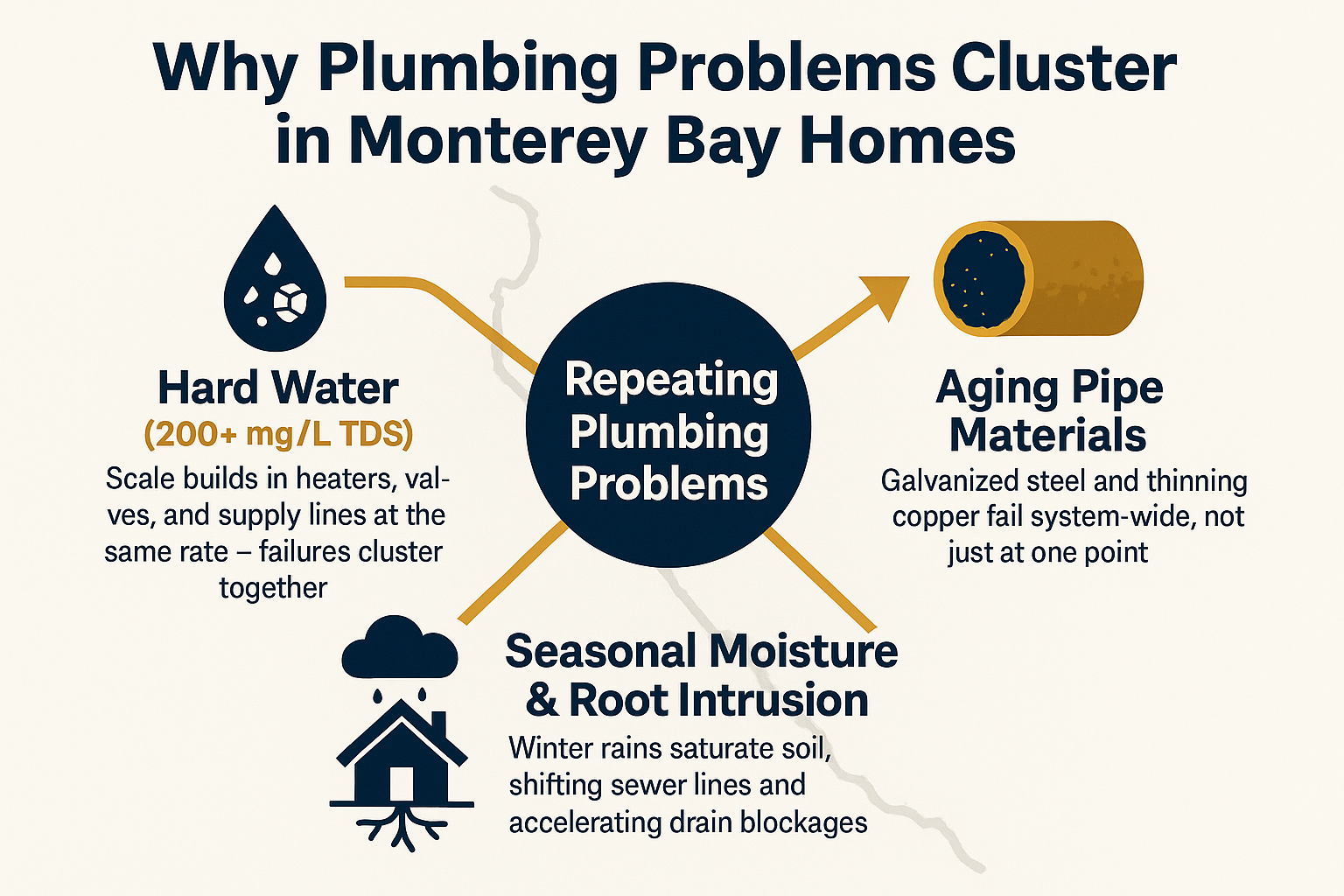
This infographic summarizes the three root conditions we see most often causing plumbing problems to cluster in local homes.
Seasonal Rainfall and Root Intrusion: Why Winter Brings Drain and Sewer Problems in Groups
The Monterey Bay Area gets most of its annual rainfall between November and March. For homeowners, that season comes with a predictable uptick in drain issues — and there are two reasons they tend to stack up at the same time.
First, heavy rain saturates the soil around your sewer and drain lines. That soil movement shifts pipe joints, especially in older clay or cast iron sewer mains that weren’t designed for modern ground conditions. A joint that was barely holding together in October may open up by January.
Second, tree roots follow moisture. The same winter rains that cause soil movement are drawing roots toward your sewer line. Roots get in through small cracks, then grow. By the time you have a full blockage, the root intrusion has typically been building for one to three years — you just didn’t see it until it caused a backup.
We use video camera pipe inspections to identify exactly where and how severe these intrusions are before recommending a repair approach. In many cases, a thorough hydro jetting service can clear root debris and restore full flow — but if the pipe itself is damaged, that’s a different conversation.
The pattern we see every winter in Salinas and the surrounding communities: a homeowner calls about one slow drain, and during the inspection we find two or three lateral lines showing root intrusion at different stages. It’s the same seasonal pressure hitting every vulnerable point in the system simultaneously.
Common Plumbing Patterns in Monterey Bay Homes — Root Cause and What to Expect
Use this as a quick reference for matching symptoms to the likely underlying condition driving the pattern.
| Symptom Pattern | Most Likely Root Cause | Typical Next Step |
|---|---|---|
| Water heater failing + frozen shut-off valves + low fixture pressure | Hard water scale buildup throughout system | Flush water heater, inspect and replace shut-off valves, evaluate water softener |
| Multiple slow leaks at fittings in homes built before 1985 | Aging galvanized or thinning copper pipes | Full-system pipe inspection; repiping evaluation |
| Drain backups spiking every winter, multiple fixtures affected | Root intrusion in sewer lateral, seasonal soil shift | Video camera inspection, hydro jetting or sewer line repair |
| Discolored water + reduced pressure throughout house | Interior pipe corrosion from galvanized deterioration | Pipe inspection, likely repiping conversation |
| Water heater short cycling + scale on fixtures + high utility bills | Hard water compounding heater wear | Flush and inspect heater, test water hardness, consider softener or filtration |
What to Do When You Recognize the Pattern
The most expensive plumbing mistake we see homeowners make is treating each problem as isolated. You pay to fix one thing, then pay again six months later to fix the next symptom of the same underlying condition.
A better approach is to ask — when a problem shows up — whether it’s a one-off or a signal. A licensed plumber can usually tell you within the first visit whether what you’re seeing is an isolated failure or part of a larger pattern. That diagnosis changes everything about how you budget and plan.
For homes in the Monterey Bay Area with water heaters older than 10 years, we almost always do a quick visual on the surrounding supply lines and shut-off valves during a service visit. It takes a few minutes and often surfaces problems the homeowner didn’t know existed. If you’re seeing warning signs from your water heater alongside other plumbing symptoms, those two things are probably connected.
If you’ve recently moved to the area, understanding what makes local plumbing different can help you ask better questions and catch problems before they turn into emergencies. And if something has already crossed that line, knowing what actually counts as a plumbing emergency helps you make the right call without overreacting or waiting too long.
Frequently Asked Questions About Plumbing Patterns in Monterey Bay Homes
Is hard water in Salinas bad enough to actually damage my plumbing?
Yes — Salinas Valley water is genuinely hard by California standards, often testing above 200 milligrams per liter of dissolved solids. Over time, that level of hardness deposits scale inside water heaters, corrodes shut-off valves, and narrows supply lines. It doesn’t destroy a system overnight, but it absolutely accelerates wear across multiple components at the same pace — which is why failures tend to cluster.
My house was built in 1972. Should I be worried about my pipes?
It depends on the material. Homes from that era in Salinas were typically plumbed with galvanized steel or copper. Galvanized corrodes from the inside, and after 50 years, it’s often significantly narrowed internally even if it hasn’t visibly leaked yet. Copper holds up better but can develop pinhole leaks from prolonged hard water exposure. A visual inspection of exposed pipes in your garage or crawl space is a good starting point. If you see rust-colored buildup at joints or reduced pressure throughout the house, that’s worth having a licensed plumber look at.
Why do my drains always seem to back up in January or February?
That’s a very common pattern in this region. Winter rains saturate the soil around your sewer lines, which shifts pipe joints and draws tree roots toward moisture sources. If your sewer lateral has any existing cracks or weak points — which is common in homes more than 30 years old — roots and soil movement exploit them right around the same time every year. A video camera inspection during dry season can show you what’s building before it becomes a backup.
If I fix one plumbing problem, how do I know if more are coming?
Ask the plumber during the visit. A good contractor should be able to tell you whether the failure looks isolated or whether the surrounding pipes and fixtures show the same stress indicators. It’s not always possible to predict exactly what will fail next, but the root causes we described — hard water, pipe age, seasonal root intrusion — do give a clear enough picture to make an educated call on what needs monitoring.
Can I do anything to slow down hard water damage on my own?
Flushing your water heater tank annually removes sediment before it hardens and reduces efficiency. Cleaning aerators and showerheads a couple of times a year prevents scale from restricting flow. Beyond that, a whole-house water softener or filter is the most effective long-term solution, though that’s an investment that needs to be sized correctly for your household. For homes on Salinas municipal water, softening the supply makes a measurable difference in how long fixtures and appliances last.
See a Pattern in Your Own Home’s Plumbing?
If something in this article matched what you’ve been experiencing — repeated drain issues, aging pipes, or a water heater that’s part of a bigger picture — we’re happy to take a look. Alvarez Plumbing has been serving Salinas and the Monterey Bay Area since 1988, and our team is available 24/7 for both emergency calls and scheduled inspections. Reach us at (831) 757-5465 or schedule online at alvarezplumbingsalinas.com.