
Direct Answer: Monterey Bay Area homes often have older pipes, hard water, and unique permit rules. Knowing what to inspect before or right after you move in can save you from expensive surprises.
Relocating to the Monterey Bay Area is exciting — the coastline, the weather, the proximity to Carmel and Pacific Grove. But once the moving truck is gone and you’re settling into a home that was probably built between 1950 and 1985, the plumbing questions start showing up fast.
This region has some specific conditions that catch new homeowners off guard: hard water from the Salinas Valley aquifer, an older housing stock with pipes that haven’t been touched in decades, and California permit rules that apply to almost every major plumbing replacement. None of these are dealbreakers — but they’re worth understanding before something breaks.
This guide focuses on the two or three things that actually matter most when you’re new to the area: what’s likely already aging inside your walls, what hard water does to your plumbing over time, and what the local permit process looks like when repairs or replacements come up.
The Aging Pipe Problem Most New Homeowners Don’t See Coming
A large share of the residential housing stock in Salinas, Seaside, and older Monterey neighborhoods was built before 1980. That matters because the pipe materials used in those homes are now at or past the end of their expected lifespan.
If your new home was built before 1970, there’s a real chance it still has galvanized steel supply lines. Galvanized pipe corrodes from the inside out over 40–60 years, and by the time you notice reduced water pressure or rust-colored water, the interior walls of the pipe are already severely narrowed or compromised. Replacing it isn’t a minor repair — it’s a full repiping project.
Homes built in the 1970s and early 1980s more commonly have copper supply lines, which hold up much better — but even copper develops pinhole leaks over time, especially when combined with the region’s hard water chemistry. Drain and waste lines from this era are typically ABS plastic or cast iron, both of which can develop cracks, root intrusion, or joint failures after 40+ years.
Before you fully settle in, it’s worth pulling out the inspection report from your home purchase and looking closely at what the inspector noted about pipe materials and water heater age. If that report is vague or older than a year, a video camera pipe inspection gives you a clear picture of what’s actually inside your drain lines — no guessing required.
Signs that warrant a closer look:
– Rust-colored or discolored water, especially first thing in the morning
– Low water pressure at multiple fixtures simultaneously
– Slow drains throughout the house, not just one fixture
– A water heater that’s 10 years old or older
– Any visible corrosion or green staining on exposed pipes under sinks or in a crawl space

Hard Water in the Salinas Valley: What It Does to Your Plumbing
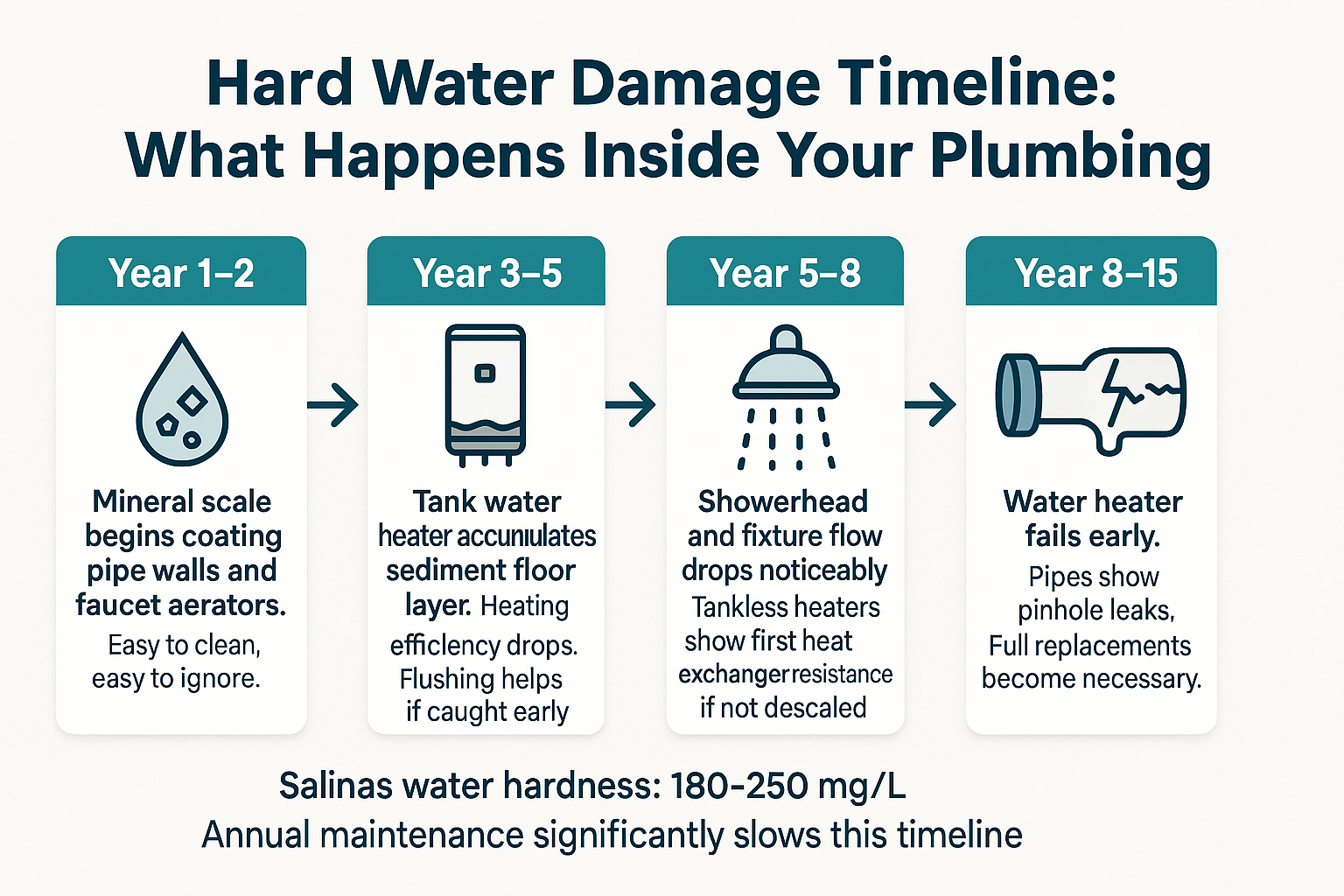
The Salinas Valley aquifer supplies most of the region’s municipal water, and it carries a measurably high mineral load — primarily calcium and magnesium. Water hardness in Salinas typically runs between 180 and 250 milligrams per liter, which puts it solidly in the “hard” to “very hard” category by EPA standards.
For new homeowners, that number has real consequences. Hard water deposits scale on the interior walls of pipes and fixtures over time. Water heater tanks accumulate mineral sediment on the tank floor, which reduces heating efficiency and shortens the unit’s life. Tankless water heaters, if not descaled on a regular schedule, can develop heat exchanger blockages within just a few years in this water supply.
If you’re running out of hot water faster than expected, sediment buildup inside the tank is one of the most common causes in this area — and it’s more likely to be an issue if the previous homeowner never flushed the tank annually.
Hard water also eats through faucet aerators and showerhead flow restrictors. These are inexpensive to replace, but they’re an early warning sign of scale buildup happening deeper in your system at the same time.
A few things worth knowing if you’re new to hard water:
– Whole-house water softeners cost roughly $1,500–$3,000 installed in the Salinas area and can meaningfully extend the life of your water heater and appliances
– Tankless water heater descaling should happen every 12–18 months in this water supply, not just once in a while
– Tank-style water heaters should be flushed annually — here’s a look at how to turn on and manage a water heater after service
– Discolored or foul-smelling water is a separate issue from hardness and may indicate a failing anode rod inside the tank
How Hard Water Affects Your Plumbing Over Time
This infographic shows the timeline of hard water damage in a typical Salinas-area home, from early buildup to major system failures.
Permits, California Rules, and What That Means for Your First Big Repair
One thing that surprises a lot of new residents from other states: California requires permits for most major plumbing work, and those rules apply equally whether you’re in Salinas, Monterey, or Carmel. This isn’t bureaucratic noise — it’s a consumer protection layer that also affects your homeowner’s insurance and future resale.
The most common permitted job a new homeowner runs into is a water heater replacement. Under the 2025 California Building Energy Efficiency Standards, replacing a water heater requires a permit, and the replacement unit must meet specific efficiency ratings. If a plumber installs a new water heater without pulling a permit, the installation is technically unpermitted work — which can create problems when you go to sell the home or file an insurance claim.
For work in Salinas specifically, permits are pulled through the City of Salinas Building & Safety Division. The turnaround for residential plumbing permits is typically 3–7 business days for standard jobs, though that can vary by workload. A licensed plumbing contractor can handle the permit application on your behalf — and should.
Other jobs that commonly require permits in this area:
– Full or partial repiping of supply lines
– Sewer line replacement or significant repair
– Gas line work, including new appliance connections
– Backflow prevention device installation where required by the water district
If you’re buying a home and the seller mentions recent plumbing work — ask to see the permit and inspection sign-off. Unpermitted plumbing work is more common in this region’s older housing stock than most buyers realize, and it’s worth flagging before closing. You can read more about what Monterey homeowners look for when choosing a plumber to get a better sense of what due diligence looks like here.
Common First-Year Plumbing Costs for Monterey Bay Area Homeowners
These are realistic cost ranges for the plumbing work new homeowners in Salinas and surrounding cities most commonly face in the first 12–24 months of ownership.
| Job | Typical Cost Range | Notes |
|---|---|---|
| Water heater replacement (tank, 40–50 gal) | $1,200–$1,800 installed | Includes permit; labor + unit cost |
| Tankless water heater installation | $2,500–$4,500 installed | Higher range if gas line upgrade needed |
| Video camera pipe inspection | $200–$400 | Strongly recommended for pre-1985 homes |
| Hydro jetting (main drain line) | $350–$600 | Clears roots, grease, and hard-water scale |
| Full house repipe (copper or PEX) | $8,000–$18,000+ | Varies by home size and access difficulty |
| Sewer line repair or spot replacement | $1,500–$6,000 | Trenchless options available where applicable |
| Whole-house water softener (installed) | $1,500–$3,000 | Recommended for homes on Salinas municipal supply |
What to Do If Something Goes Wrong Right After You Move In
Plumbing problems have a way of showing up during the first few weeks in a new home — when you’re running appliances for the first time, filling bathtubs, and generally stressing the system more than it’s been stressed in a while.
If you have an active leak, a burst pipe, or a sewage backup, those situations don’t wait for business hours. Understanding what counts as a plumbing emergency before something happens is genuinely useful — it helps you stay calm and make a faster call.
For non-emergency issues like slow drains or a toilet that runs constantly, the first step is identifying whether the problem is isolated to one fixture or showing up throughout the house. A single slow drain is usually a localized clog. Slow drains in multiple rooms, or a drain that backs up when you run water elsewhere, typically points to a main line issue — which is worth addressing sooner rather than later to avoid a much messier backup situation down the road.
One practical tip for any new homeowner in the area: locate your main water shutoff valve before you need it. In most Salinas homes, it’s either in the front yard near the meter or on an exterior wall near the garage. Knowing where it is and confirming it actually turns off the water supply takes about five minutes and can prevent thousands of dollars in water damage if a pipe fails at 2 a.m.
Frequently Asked Questions About Plumbing in the Monterey Bay Area
Do I really need a permit to replace a water heater in Salinas?
Yes. Under California state law and 2025 Building Energy Efficiency Standards, a water heater replacement requires a permit pulled through the City of Salinas. A licensed contractor should handle this for you — it’s not a step you can skip without creating problems for future sales or insurance claims.
My home inspector mentioned galvanized pipes. How urgent is that?
It depends on the condition and age. Galvanized pipe in homes built before 1965 is often near or past the point of reliable service. If you’re seeing reduced pressure at multiple fixtures, rust-tinted water, or any visible corrosion, get a plumber to assess the system sooner rather than later. A video camera inspection of the drain lines is a good first step — it shows you exactly what you’re dealing with without tearing anything open.
Is hard water in Salinas actually bad enough to need a softener?
For most homes, yes — especially if you have a water heater that’s less than 5 years old that you want to protect. At 180–250 mg/L, the local water supply is hard enough to noticeably shorten appliance life and build up scale in fixtures within a few years. A softener isn’t mandatory, but it’s a reasonable investment if you’re planning to stay in the home long-term.
We moved from out of state and our drains are already slow. Is that normal?
It’s common in older homes, but not something to ignore. Slow drains in a home you just moved into usually mean the previous occupants had a buildup problem that was never addressed. Hydro jetting the main drain line is the most effective way to reset it — standard drain snaking moves the clog, but jetting actually clears the pipe walls. Expect to pay $350–$600 for a main line hydro jetting job in this area.
What’s the best way to find a plumber I can trust when I’m new to the area?
Look for a licensed, insured, and bonded contractor who pulls permits for required work — that alone eliminates a lot of unreliable operators. Google reviews are useful, but look at the volume and recency, not just the star rating. We’ve put together a more detailed breakdown of how Monterey homeowners vet local plumbers if you want the full picture.
Questions About Your New Home’s Plumbing?
We’ve been serving Salinas and the Monterey Bay Area since 1988, and we work in the same older homes you’re moving into every single week. If you’re not sure what you’ve got inside your walls — or something already isn’t right — give Alvarez Plumbing a call at (831) 757-5465. We’re available 24 hours a day, seven days a week, and you can also schedule online at alvarezplumbingsalinas.com.