Direct Answer: A crossover is confirmed by closing the cold supply into the tankless unit and opening a hot tap. If water keeps flowing, cold is entering the hot line elsewhere in the house.
Your tankless unit throws a code on the display. The shower runs lukewarm, pressure feels soft, and some mornings the burner never fires at all. You called the manufacturer’s tech line and they pointed at a hot and cold crossover somewhere in the house instead of a bad heater.
That is usually a good lead. What the help line cannot tell you is what a crossover looks like inside a real Salinas house, or how anyone proves it before money gets spent on parts.
This article covers three things: what a crossover actually is in plain terms, the isolation test that confirms it, and where these things tend to start in homes on the Salinas side of the Monterey Bay. One homeowner who contacted us described this exact situation, code and all, and asked for diagnosis before any repair. That is the right instinct.
What a Hot and Cold Crossover Is, and Why It Makes a Tankless Unit Act Broken
A crossover means your hot and cold lines are connected somewhere besides the spout of a fixture. Cold water, which usually sits at slightly higher pressure, pushes through that connection and into the hot line.
Now think about what the heater sees. Water it never heated is mixing into the hot side downstream, so the tap delivers lukewarm water even though the unit may be firing correctly.
Tankless units make this worse in a specific way. They need a minimum flow rate, often somewhere around half a gallon per minute, before the burner will light at all. When cold is bleeding into the hot line, flow through the heater drops below that threshold and the unit either refuses to ignite or short cycles on and off.
The symptom pattern usually looks like this:
- Weak or lukewarm hot water at several fixtures, not just one
- An error or fault code that shows up at low flow and clears at high flow
- The burner failing to ignite on some draws and working fine on others
- Hot water that disappears much faster than the household’s usage explains
- Cold taps that run warm after someone has used hot water
None of that means the unit is defective. It means the unit is reacting to water conditions created somewhere else in the plumbing.
The Isolation Test That Confirms It
The confirmation test is simple and repeatable, which is exactly why it is worth understanding before anyone orders a part.
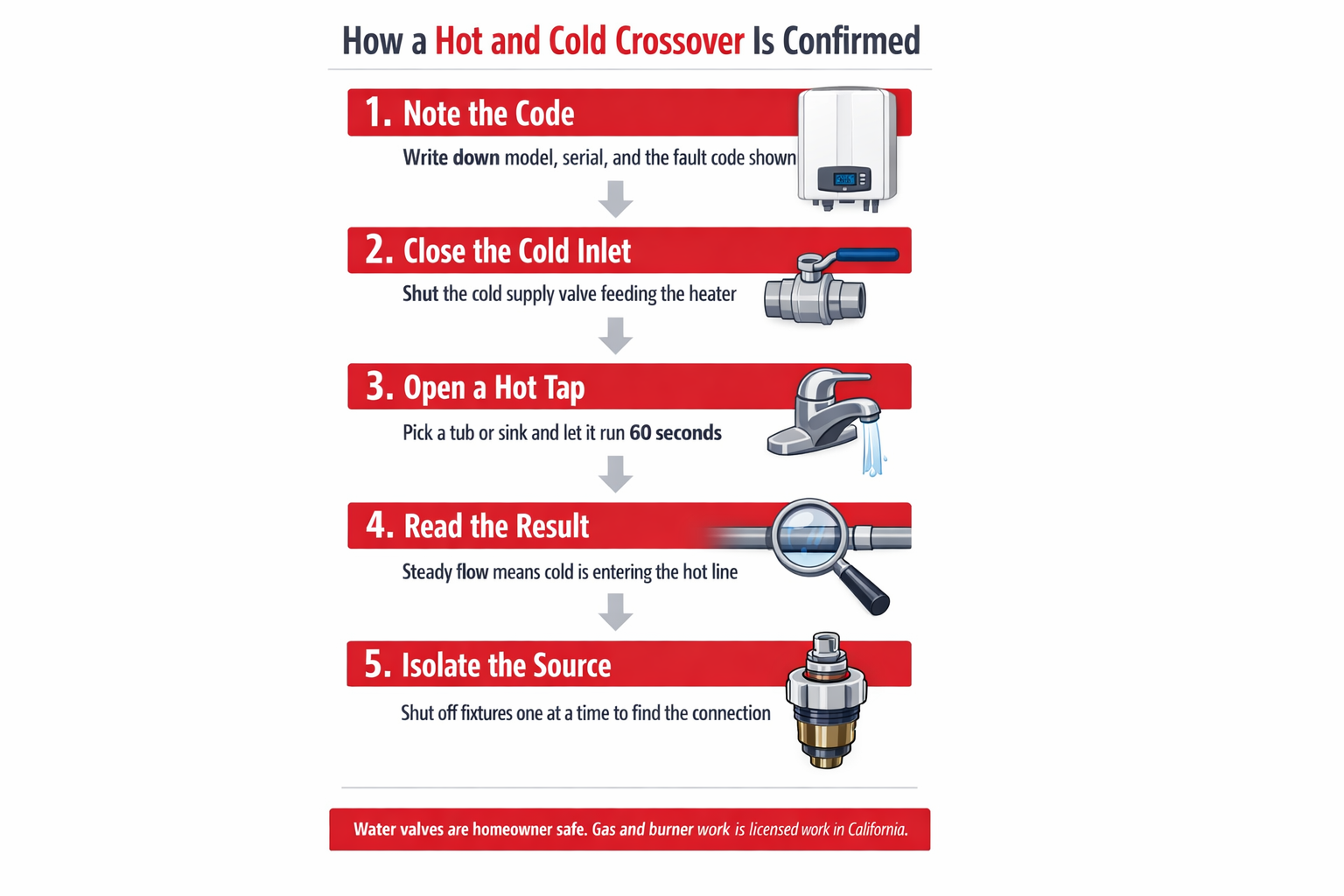
Close the cold water supply valve feeding the tankless unit. With that valve shut, no new water can enter the heater, so the hot side of the house should go dead within a few seconds.
Then open a hot tap somewhere in the house and watch. If water keeps running steadily after the hot line drains down, that water is not coming from the heater. It is cold water crossing into the hot side somewhere else.
A few notes on reading the result honestly:
- Let the tap run for 60 seconds or so. A brief trickle is just the hot line emptying.
- Steady, continuous flow is the tell. It will usually feel cold within a few seconds.
- Test more than one hot tap so you are not chasing a single bad fixture when the loop is the issue.
Crossover is not a theory someone invented to avoid warranty work. Research presented in the ACEEE Summer Study buildings proceedings documented crossover as a measurable, testable condition in multifamily plumbing systems, and as a frequent reason working water heaters get blamed for a problem they did not cause.
One boundary matters here. Closing a water supply valve is homeowner territory. Anything touching the gas side, the burner, or the sealed combustion assembly is licensed contractor work in California, and that includes pulling the front cover to probe components.
The Crossover Confirmation Test at a Glance
Here is the same test laid out in the order a technician would run it at the unit.
Where Crossovers Usually Start in Salinas Homes
Once the test confirms a crossover, the job becomes a search. The good news is that the list of likely culprits is short, and a homeowner who is willing to shut off supply valves fixture by fixture can narrow it down fast.
Start with these, roughly in order of how often they turn up:
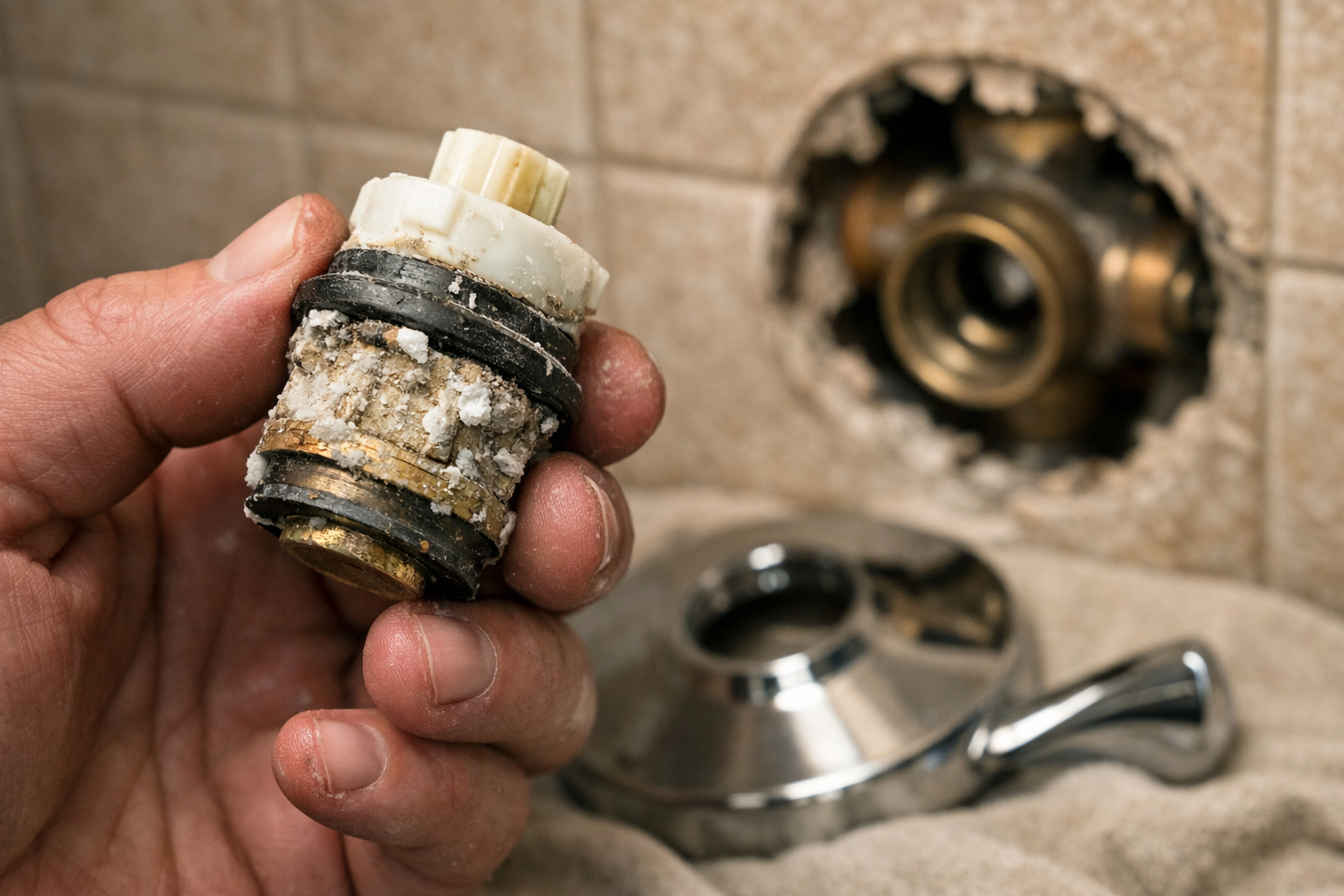
- Tub and shower valve cartridges. Single handle valves blend hot and cold inside one body. When the internal seal wears, the two sides talk to each other even with the handle off.
- A failed check valve on a recirculation loop. If the house has a pump, the return line becomes a direct path between hot and cold once that valve stops seating. If you are already seeing drips there, a leaking recirculation pump is a separate issue worth sorting out at the same time.
- A mixing or tempering valve that no longer seals, either at the heater or serving a fixture group.
- Laundry and utility connections, where a single hose setup or a Y-fitting ties hot and cold together behind the machine.
Local conditions push this along. Cal Water has reported average hardness around 254 ppm in its Salinas system and roughly 320 ppm in the Salinas Hills system, both above the utility’s own very hard threshold. Mineral buildup is hard on the rubber and ceramic seals inside mixing valves, which is part of why hard water comes up constantly in Salinas plumbing and why skipping a yearly flush on a water heater shortens equipment life here.
Age matters too. The median Salinas home was built around 1976, and more than one in ten local homes predate 1950, so original valve bodies and decades of mixed-era fixture work are common. As one customer put it in a review: “Dealing with 70 year old fixtures complicated the problem.” – Connie Q.
Crossover Sources and How Each One Gets Ruled Out
This is the shortlist a technician works through, and the same order makes sense if you want to isolate fixtures yourself before anyone comes out.
| Likely Source | What You Might Notice | How It Gets Isolated |
|---|---|---|
| Single-handle tub or shower valve | Lukewarm hot water house-wide, cold tap runs warm | Shut both angle stops or the valve stops for that fixture, rerun the test |
| Recirculation loop check valve | Problem is constant, worse when the pump runs | Unplug or valve off the pump and return line, then retest |
| Mixing or tempering valve | Hot never gets fully hot even at high flow | Isolate the valve at its ports and compare tap temperature |
| Laundry or utility hose connection | Started after a washer, hose bib, or utility sink change | Close both laundry valves and retest the nearest hot tap |
| Recent fixture or faucet work | Symptoms began within days of the install | Inspect that fixture’s supply connections first |
Why the Part on Your Counter Should Wait
A common version of this story: the manufacturer ships a flow sensor or a thermistor based on a phone description, and the homeowner calls to get it installed. We have received that exact request, part already in hand.
The part may even be fine. The problem is sequence. If a crossover is feeding cold water into the hot side, swapping a sensor leaves the real fault untouched, and the code comes back the same week.
That is two labor charges for one problem. A targeted diagnostic protects the money you are about to spend rather than adding to it.
There is a related trap worth knowing. Low hot water pressure is not always a heater issue at all, and a failing pressure regulator can produce complaints that look similar from the tap. Confirming which system is actually misbehaving comes first.
What a diagnostic visit costs depends on the fixture count, whether the house has a recirculation loop, and how much access the equipment has. Local rates vary by contractor and by time of day, so it is worth asking what a visit covers before scheduling.
What to Write Down Before You Call or Email
A vague hot water complaint turns into a long visit. A written description with specifics turns into a short one.
Have these ready:
- Model and serial number off the data plate on the side of the unit
- The exact code shown on the display, letter and number
- Whether the code appears on every draw or only at low flow
- Whether the house has a recirculation pump, and if so, whether it runs on a timer
- Which fixtures, faucets, or valves have been worked on recently
- Whether the isolation test produced steady flow, and at which tap
If you would rather handle this in writing than over the phone, that is a normal way to do it. Several readers each quarter send a typed description with model numbers attached and ask for an answer by email, and that is often a faster path to a useful reply than a phone conversation.
Combination boilers that handle both domestic hot water and radiant heat fall into the same category. Send the model number and the symptom, and the answer you get back will be specific instead of a generic troubleshooting script.
Frequently Asked Questions About Tankless Codes and Crossovers
Can a crossover damage my tankless water heater?
It usually does not damage the unit, but it makes it work badly and short cycle, which is hard on ignition components over time. The bigger cost is energy. The heater keeps firing to warm water that is being diluted before it reaches you.
Is the isolation test something I can do myself?
Closing a cold water supply valve and opening a hot tap is safe homeowner territory. Do not open the heater’s front cover or touch anything on the gas side. In California that is licensed contractor work, and the sealed combustion assembly is not a DIY area.
My manufacturer already told me it is a crossover. Do I still need a plumber?
The manufacturer gave you the category. They cannot tell you which of the twelve fixtures in your house is the connection point. Finding the source means isolating fixtures and valves one at a time, and that is the part that gets done on site.
Why does the code only show up when I run a small amount of hot water?
Tankless units need a minimum flow rate before the burner lights. A crossover eats into the flow that reaches the heater, so at low draw the unit falls under its threshold and faults. Open a tap wide and the flow climbs back over the line, which is why the code can seem to come and go.
Does a water heater replacement require a permit in Salinas?
Yes. A changeout falls under the City of Salinas residential plumbing replacement permit, and the permit covers the inspection on the finished work. If a diagnostic ends in replacement rather than repair, the permitting should be filed as part of the job, not left to the homeowner.
Working Through a Tankless Code in Salinas?
Diagnostics on tankless and combination systems are handled locally, here in Salinas and across Monterey, Seaside, Pacific Grove, and Watsonville, by a family-run contractor that has been licensed, insured, and bonded since 1988 and holds a 4.94 star Google rating across 224 plus reviews. If a repair turns into a changeout, Alvarez Plumbing files City of Salinas permitting in house. Questions with a model number and a code attached can be sent in writing, and the line at (831) 757-5465 is staffed around the clock.
