
Direct Answer: Before an El Nino winter, have your sewer line camera inspected, clear slow drains, check water heater elevation and connections, and confirm where your main shutoff and cleanout are.
NOAA’s Climate Prediction Center has moved to an El Nino Advisory, and its August 13, 2026 discussion put the odds of a very strong event during fall and winter 2026-27 at greater than 90 percent. Several forecast groups are calling it one of the strongest on record.
For the Central Coast, that usually means a storm track shifted south and more rain reaching us. Salinas averages roughly 13 inches of rain a year, with December the wettest month at about 2.8 inches spread over 10 rainy days. Monterey runs a little wetter at around 3.1 inches in December. The problem was never the total. It is that nearly all of it lands between November and March.
This checklist walks through where home plumbing tends to give out first in a wet winter, in the order it makes sense to deal with them. Work through it in September or October and you get a calm calendar. Wait, and you are calling during the first real storm along with everyone else.
1. Read the Forecast as a Scheduling Signal, Not a Headline
A strong El Nino does not create plumbing problems. It exposes the ones already sitting in your line.
The forecast matters because it tells you how much slack you have. NOAA’s Climate Prediction Center reports El Nino is strengthening with a greater than 90 percent chance of a very strong event through this fall and winter. That is a long enough runway to fix something on your schedule instead of at 11pm.
What that looks like in practice:
- September and October are the quiet months for inspections and non urgent drain work
- Late November through February is when regional demand for emergency plumbing climbs sharply
- A saturated ground water table pushes groundwater into cracked lines, so small defects start acting like big ones
If your house had any slow drain, gurgle, or odd smell over the summer, that is your signal. Those symptoms rarely fix themselves, and heavy rain is what turns a slow drain into a backup.
2. Learn the Difference Between a Fixture Clog and a Main Line Problem
This is the single most useful thing you can learn before the rain starts, because it changes who you call and what they bring.
Callers describe it the same way every winter. One Salinas homeowner submitted a request that read simply, “Toilets and showers backed up. Need the main line snaked.” That person already had the diagnosis right, and they got faster help because of it.
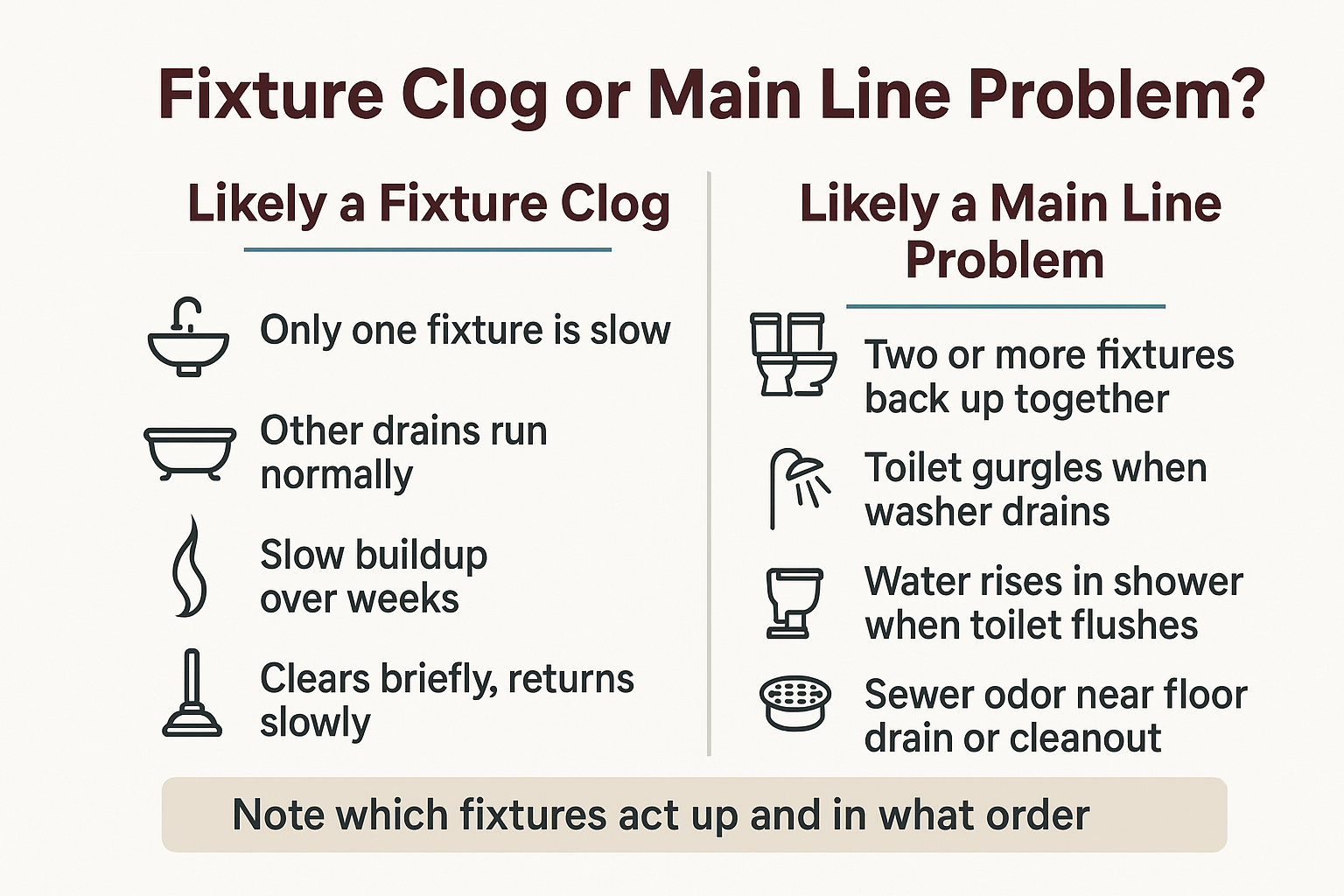
Here is the rule. One fixture acting up on its own is usually a fixture problem. Two or more backing up at the same time is one blockage downstream of both.
Watch for these main line signals:
- Toilets in two different bathrooms backing up together
- A toilet that gurgles when the washing machine drains
- Water rising in a shower when a toilet is flushed
- Sewer smell near a floor drain or the outdoor cleanout
Write down which fixtures act up and in what order. That pattern is the fastest information you can hand a plumber over the phone, and it is often the difference between a snake and a camera showing up in the truck. Our guide on what counts as a plumbing emergency and what can wait goes deeper on that call.
3. Get a Camera Down the Line Before Roots Make the Decision for You
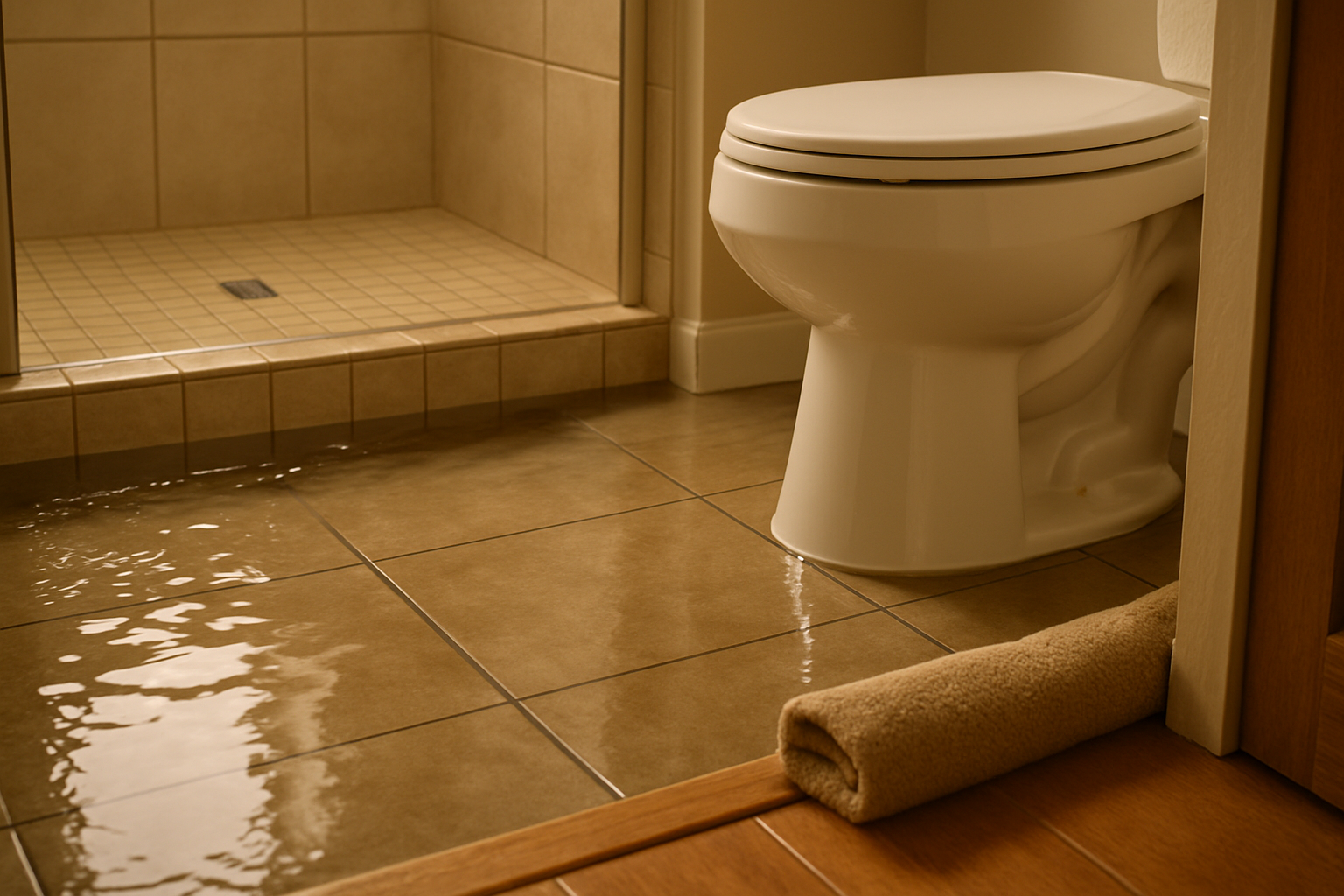
Root intrusion is why a drain that limped along all summer quits in December. Roots grow toward moisture, find a hairline crack or a loose joint, and slowly fill the pipe. Add storm volume and the line finally gives up.
Salinas homeowners carry more of this risk than most realize. The City of Salinas takes the position that tree root infiltration into a building sewer lateral is presumed to result from improper installation, which puts the repair on the property owner rather than the city. That lands during a five year sewer rate increase residents are already paying into.
A video camera inspection is how you find out whose side of the line the problem is on before anyone digs. It takes roughly 30 to 60 minutes, and the camera head locator marks the depth and spot of the defect so excavation stays small if it comes to that.
Costs vary with line length and access, but sewer camera inspections in Monterey County generally land in a wide range and we quote yours after seeing the property. The timing point matters more than the price: October is a much easier month to schedule this than January. Before the first rain hits, your sewer line deserves a look.
4. Set an Honest Drain Maintenance Interval
Most homeowners guess at this, so here is a straight answer.
For a typical Salinas home, a thorough clearing or hydro jetting every 1 to 2 years is a reasonable baseline. Restaurants and commercial kitchens along Alisal Street and in downtown Monterey usually need it every 6 to 12 months because of grease load. Properties with a history of backups sit at the short end of both ranges.
Hydro jetting uses water at up to 4,000 PSI to scour grease, sludge, hard water scale, and sediment off the pipe wall. A snake punches a hole through a clog. Jetting cleans the pipe. That difference is why a snaked line often backs up again within a season.
Pricing in this market commonly runs in the several hundred dollar range depending on pipe diameter, line length, and how bad the buildup is. A camera look first is what turns that into a real number instead of a guess.
One safety caveat for older neighborhoods. The median local home was built around 1976, and roughly 11 percent of the housing stock predates 1950. Cast iron and clay lines get inspected before anyone puts high pressure water through them.
Drain and Sewer Service Intervals by Property Type
These are baselines, not rules. Line condition and past backup history move them.
| Property Type | Reasonable Interval | What Usually Drives It |
|---|---|---|
| Single family home, no backup history | Every 1 to 2 years | Normal soap, hair, and food waste buildup |
| Home with mature trees near the lateral | Yearly, before the rainy season | Root intrusion at joints and cracks |
| Rental or multi unit property | Yearly, plus camera after any backup | Higher fixture load, tenant turnover |
| Restaurant or commercial kitchen | Every 6 to 12 months | Grease volume and grease interceptor load |
| Home built before 1950 | Yearly inspection, method decided after camera | Cast iron or clay pipe condition |
Fixture Clog or Main Line? A Quick Read
Use this to sort what you are dealing with before you pick up the phone.
5. Give the Water Heater Its Own Storm Season Checkpoint
Water heaters sitting in garages, crawlspaces, and exterior closets are the ones that get hit when water finds its way in during a storm. Before November, walk out and look at three things.
- Elevation and placement. Is the unit up off the slab, and does the floor around it drain anywhere?
- Seismic strapping. California requires tanks to be strapped. Check that both straps are intact and anchored.
- Flex connectors. Look for corrosion, kinking, or white crust at the fittings.
Local water makes this worse than the manufacturer’s manual assumes. Cal Water reported average hardness around 254 ppm in its Salinas system and 320 ppm in the Salinas Hills system. Anything above 300 ppm is classified as very hard, and sediment builds faster in that water.
That sediment is what causes the rumbling and popping people hear from the garage. It also insulates the burner from the water, so the unit works harder for less hot water.
The classic winter combination is holiday guest load plus a cold snap on a tank that was already marginal in October. If yours has never been flushed, this is the month to deal with it. Our piece on Salinas water testing around 254 ppm hard covers where a softener fits into that picture.
6. If You Manage Rentals, Sort the Phone Tree Out in September
Fewer than half of Salinas housing units are owner occupied. That means the person standing in a flooded hallway and the person authorizing the repair are usually two different people, and winter is a bad time to figure out how that works.
Before the season starts, confirm three things for every property you manage:
- Who the tenant is allowed to call at 11pm, in writing, and whether they can authorize work up to a dollar limit
- Where the main water shutoff and the sewer cleanout are, with a photo saved to the property file
- Whether last winter’s backup was ever documented with a camera, or just cleared and forgotten
That third one comes up constantly. A line that backed up in February and got snaked is a line nobody has actually looked inside. If it backs up again, you are paying twice for the same night.
Property managers and short term rental operators also tend to need documentation, not just a fix. Ask for the camera footage and the invoice detail up front. For rentals where patching keeps repeating, when patching stops making financial sense is worth a read before winter.
7. Know What Round the Clock Coverage Actually Looks Like in a Wet Winter
During a real storm week, the calls stack up. What matters then is how fast someone answers, how clearly they tell you when a truck can be there, and whether the rate is explained before anyone shows up.
About a fifth of the calls we take ask some version of the same question: can someone come today, and what does after hours cost compared to regular hours. Both are fair questions and both should get a straight answer on the phone. If you want the breakdown ahead of time, we wrote about what after hours plumbing rates actually cover.
We have worked Monterey Bay storm seasons since 1988 as a family run shop, licensed, insured, and bonded, with a 4.94 star average across 224 plus Google reviews and permit handling done in house when a job requires it. Response speed is the theme that shows up over and over in local feedback.
One Salinas customer put it this way: “Got help within hours and service done the next day. Great communication and service. We will be using their service again” – Regina R.
It also helps to know what to do in the first 15 minutes while you wait.
Frequently Asked Questions About El Nino Storm Plumbing Prep
How early should I schedule a pre-storm inspection?
September or October is the sweet spot. Regional demand for emergency plumbing climbs from late fall into February, so you get a calmer calendar and more scheduling options before the first real storm.
My drains are fine right now. Do I still need a camera inspection?
Not necessarily. It makes the most sense if you have mature trees near the lateral, a home built before 1950, or any backup history in the last few winters. A line that has never given trouble in a house with newer pipe can usually wait.
Is hydro jetting safe for old pipes?
It depends entirely on pipe condition, which is why we camera the line first. Corroded cast iron or cracked clay can call for a gentler method. Roughly 11 percent of local housing predates 1950, so this comes up more here than in newer markets.
Two toilets backed up at once. Can I just plunge it?
Two fixtures backing up at the same time points to one blockage downstream, not two separate clogs. Plunging a fixture will not reach it. Stop using water in the house and get the main line looked at.
Does a water heater replacement need a permit in Salinas?
Yes. Water heater changeouts require a residential plumbing replacement permit through City of Salinas Community Development. We file and manage that paperwork in house rather than handing it to the homeowner.
Working Through Your Storm Checklist?
If you want a set of eyes on a sewer line, a slow drain, or a water heater sitting in a Salinas garage, pre-storm inspections are far easier to book before the rain starts than during it. We answer the phone at (831) 757-5465 around the clock, every day of the week, for the winters when that timing does not work out.
