
Direct Answer: After a PG&E shut-off, a licensed plumber repairs your house-side gas piping, pressure tests it, passes City of Salinas inspection if required, then a qualified pro restores service and relights pilots.
You smell gas. Ten minutes later a utility tech is in your side yard, a tag goes on the meter, and the house goes quiet. No hot water, no stove, and if it’s a cold week in the Salinas Valley, no heat either.
Then comes the part nobody explains. The utility found the leak, shut the meter down, and left without fixing anything. Most people don’t know whether that’s normal or whether they just got abandoned.
It’s normal. And the reason has nothing to do with service quality and everything to do with who owns which pipe. Below is the honest order of events, what each step is for, and what actually determines how many days you go without hot water.
The First Ten Minutes: Who You Actually Call
We have had people call our office trying to reach PG&E while standing in a house that smelled like gas. We understand the instinct. But a plumbing contractor is not the first call, and that confusion costs time you don’t have.
Here is the sequence that matters:
- Get everyone outside first. People and pets, out the door, away from the building.
- Call 911 and PG&E from a safe distance. Outside, down the sidewalk, not from the kitchen.
- Leave the door open if you can do it without going back inside for anything.
- Do not go looking for the leak. No lighter, no phone flashlight, no flipping on the garage light to see better. A light switch is an ignition source.
- Do not start your car if it’s parked in an attached garage.
Only after the utility has responded and the meter is secured does a licensed plumber enter the picture. That order is not a formality. The utility has the gear to confirm a leak and the authority to shut the supply down, and the house needs to be safe before anyone starts cutting pipe. If you are getting warning signs but no clear emergency, these are the signs of a gas line problem you shouldn’t wait on.
Where PG&E’s Responsibility Ends and Yours Begins
This is the single fact that clears up most of the confusion, and almost nobody knows it until the day they need to.
The utility maintains its gas piping up to the service delivery point. In most Salinas homes that point sits right at the meter, where the utility’s tee connects to the pipe running toward the building. Everything past that connection belongs to the property owner.
That includes:
- The buried run from the meter to the house, garage, pool heater, or ADU
- The piping inside walls, attics, and crawlspaces
- Every drop and connector at every gas appliance
So a tech can stand in your yard, confirm a leak, lock the meter, write it up, and drive off without touching the pipe. The leak is on your side of the line. That is the whole explanation, and it is why gas line repair in Salinas lands on a licensed contractor rather than the utility.
Who Maintains What on a Salinas Gas System
A rough map of the dividing line. Exact configurations vary by property, so confirm yours on site.
| Part of the system | Who maintains it | What that means for you |
|---|---|---|
| Street main and service line to the meter | PG&E | Utility handles repairs on its own piping |
| The meter and its shut-off valve | PG&E | After a tagged shut-off, you should not reopen it yourself |
| Buried line from meter to house, garage, or ADU | Property owner | Licensed contractor work, and 811 will not mark it |
| Piping in walls, attic, and crawlspace | Property owner | Needs location, repair, and a witnessed pressure test |
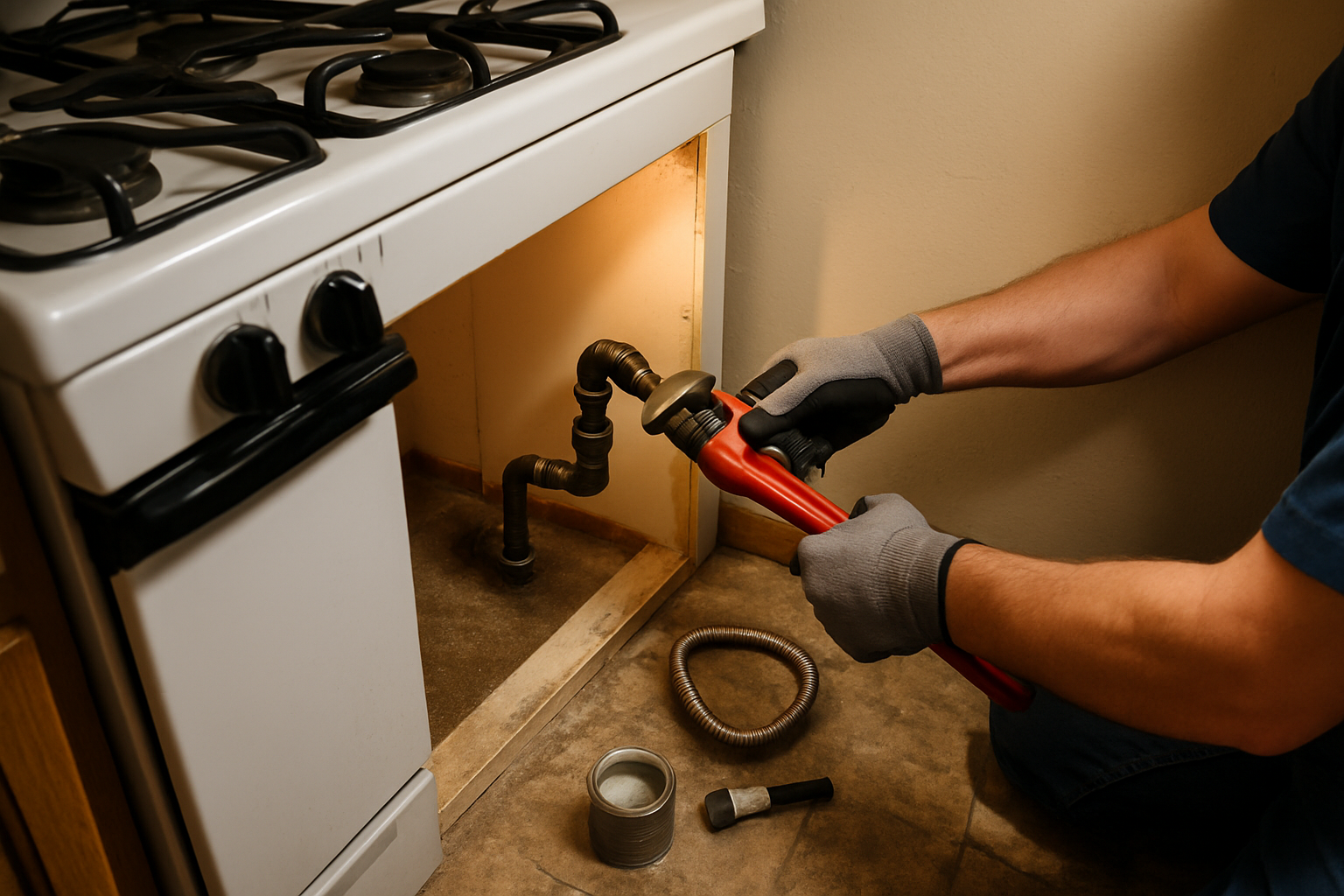
| Flex connectors at range, furnace, water heater, dryer | Property owner | The most common failure point we find |
What Has to Happen Before the Meter Comes Back On
This is the part that determines how long your household lives without hot water, a stove, and heat. It runs in a fixed order, and skipping ahead isn’t an option.
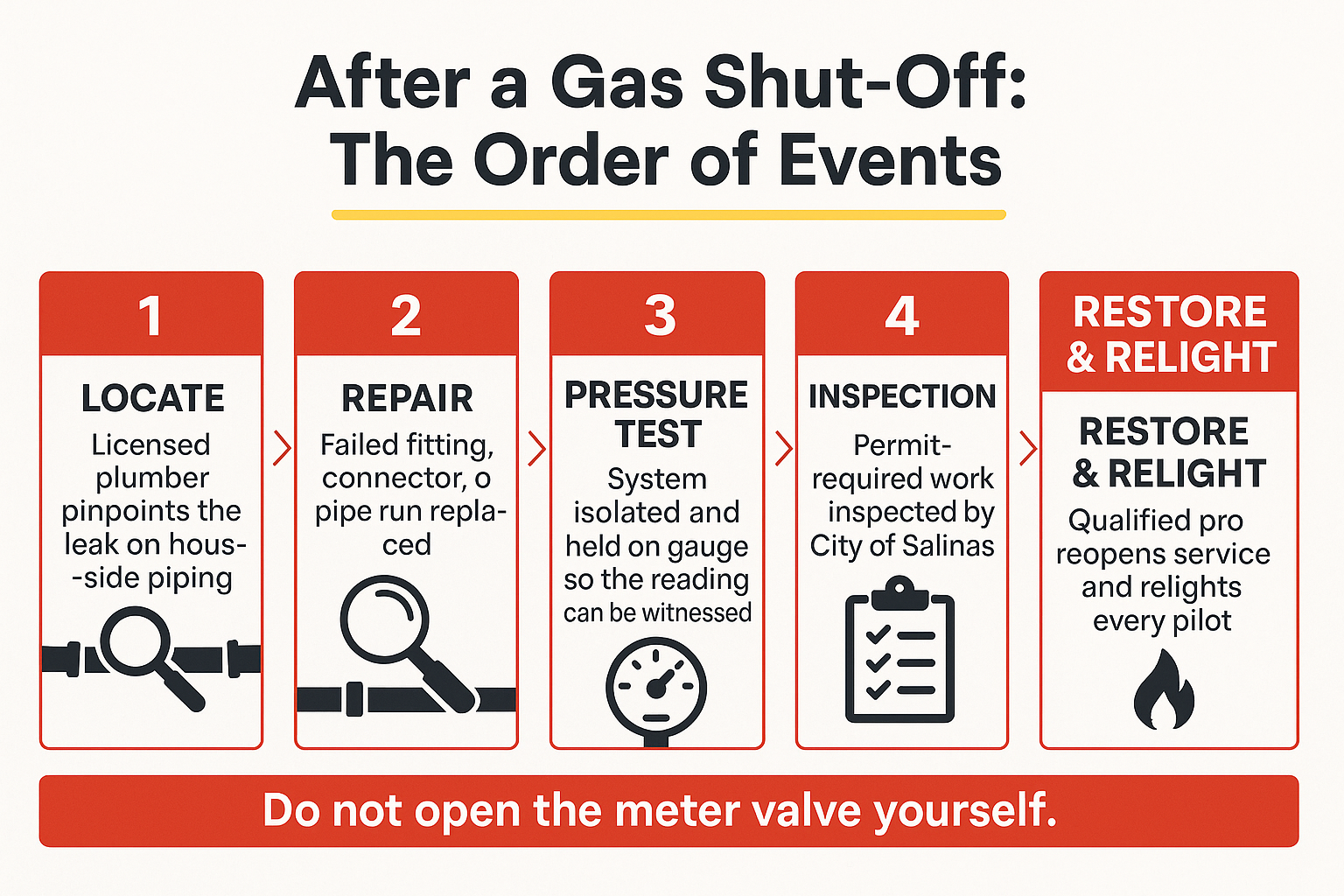
1. Locate the leak. The utility may flag the general area. Pinpointing the actual failure on house-side piping is the contractor’s job, and buried lines take longer than an exposed fitting behind a stove.
2. Repair or replace the failed section. A single fitting is a short visit. A corroded buried run is a different job.
3. Pressure test the repaired system. The line gets isolated, pressurized, and held on a gauge so the reading can be witnessed. A system that holds pressure over time is the proof, not a visual once-over.
4. Inspection on permit-required work. That goes through City of Salinas Community Development, and the timing of that inspection often sets your calendar more than the repair itself.
5. Restoration and relight by a qualified professional. PG&E’s own guidance on gas outages tells customers not to turn the gas back on themselves and to have a qualified professional perform a safety check, restore service, and relight appliance pilots.
Do not open that meter valve yourself, even if the repair looks finished and the house smells fine.
And budget patience for the relight. An older Salinas home with a wall furnace, a tank water heater, and a gas range has three separate pilots to bring back, each one checked individually. That’s why the last visit takes longer than people expect.
The Order of Events After a Gas Shut-Off
Five steps stand between a tagged meter and hot water again. They happen in this order every time.
Where These Leaks Actually Show Up Around Monterey Bay
After decades of this work in Salinas and across the Peninsula, the failures fall into two clear patterns.
Pattern one: the appliance connection. By a wide margin, the most common leak is a bad connection or an aged flexible connector right at the appliance. One Salinas homeowner wrote in asking to have the gas fittings behind their stove redone and sealed after finding a small leak there. That is a textbook example, and it is often a contained repair.
Pattern two: corroded buried steel. The run between the meter and the house sits in damp ground. Coastal air on the Monterey side, irrigation overspray along the sides of houses, and Salinas Valley soil moisture all speed up corrosion on buried black iron and galvanized pipe.
Now tie that to housing age. The median Salinas home dates to around the mid 1970s, and roughly one in nine predates 1950. A lot of the gas piping in this market is well past middle age, which is exactly when corrosion and tired threaded joints start showing up.
One Fitting or the Whole Run? What Moves the Cost
There is no single price for gas line repair in Salinas, and anyone quoting one over the phone is guessing. What we can do is tell you honestly what drives the number.
- Length of the affected run. A drop behind a range is not the same job as 60 feet from the meter to the house.
- Buried versus accessible. Buried line means locating and excavating before any repair starts.
- Number of appliances on the line. More drops, more connections, more testing.
- Existing material. Aged black iron behaves differently than newer flexible CSST, and sometimes the condition of the pipe pushes the job from spot repair into a partial repipe.
For general market context, our own service pages put gas line re-piping somewhere in the range of roughly $800 to $3,000, with the spread driven entirely by the factors above. Treat that as context, not a quote. An on-site look is the only way to land on a real figure.
One more thing worth raising before you sign off on a repair: sizing. Adding a tankless unit, a larger range, or a second furnace can push demand past what the existing line can carry. An undersized line is its own problem, separate from the leak, and it is worth sorting out while the pipe is already open. If a water heater decision is part of this, repair or replace your water heater walks through that side of it.
Why This Isn’t a Weekend Project in California
Set the safety issue aside for a second, because it stands on its own. Gas piping is licensed contractor work in California, and it is permit and inspection territory.
An unpermitted gas repair tends to resurface later, usually at the worst time: during a home sale, or in the middle of an insurance claim after something else goes wrong. The paperwork is cheap compared to that conversation.
One practical detail people miss: calling 811 before you dig only marks utility-owned lines. A customer-owned buried gas line feeding a garage, pool heater, or ADU will not be marked. It has to be located by the contractor doing the work, which is another reason that run belongs to someone with the equipment to find it.
Landlords and Property Managers: Get the Paper the Same Day
Fewer than half of Salinas housing units are owner-occupied, which means the person who smells gas is often not the person authorizing the repair. That gap costs hours.
A tagged meter also means no hot water, and that turns a plumbing problem into a habitability problem fast. Response speed matters here as much as the repair itself, and same-day plumbing scheduling works differently than most people assume.
When you’re coordinating tenant access, ask for three things in writing while the tech is still on site:
- What was found, including location and cause
- What was repaired and pressure tested, with the test result noted
- The permit and inspection record for anything that required one
Asking at the time of service takes two minutes. Reconstructing it eight months later, for an insurance adjuster or a buyer’s agent, takes a lot more than that. We handle City of Salinas permitting in-house rather than handing that paperwork back to the owner, which keeps the record in one place.
Frequently Asked Questions About Gas Shut-Offs and Repairs in Salinas
Can I turn the gas back on myself once the repair looks done?
No. Do not open a tagged meter valve. PG&E’s own guidance is to have a qualified professional perform a safety check, restore service, and relight appliance pilots. Reopening it yourself can push gas into a system that hasn’t been verified, and it skips the pressure test that proves the repair actually holds.
How long will my house be without gas?
It depends almost entirely on what has to happen between repair and relight. An exposed fitting behind a stove can sometimes be handled in a single visit. A buried line that needs locating, excavation, a permit, and an inspection by City of Salinas Community Development stretches across multiple days, with the inspection schedule usually being the long pole.
Why didn’t PG&E just fix the leak while they were here?
Because the leak was past the service delivery point, which is typically right at the meter. The utility maintains its piping up to that connection. Everything beyond it, including the buried run to the house and every appliance connector, belongs to the property owner and is licensed contractor work.
Does every gas repair need a permit?
Not every single one, but a lot more of them do than homeowners expect, and the answer depends on the scope of work. Replacing a run of pipe is a different situation than tightening one connection. The safer assumption is that permit and inspection apply, and that it gets confirmed before work starts rather than after.
What if the shut-off happens at 11pm or on a Sunday?
That’s when a lot of them happen. Our crews run 24 hours a day, seven days a week, because a house with no heat and no hot water doesn’t wait for Monday. Call volume and crew location affect timing, so the honest answer on arrival window comes from the dispatcher, not a web page.
Facing a Tagged Meter in Salinas?
Gas shut-offs rarely happen at a convenient hour, which is why our crews run 24 hours a day, seven days a week, and why we file City of Salinas permits in-house instead of handing that paperwork back to the homeowner. Family-run here since 1988, licensed, insured, and bonded, with a 4.94-star rating across 224+ Google reviews. One Salinas customer put it simply: “We had a gas leak and it was taken care of right away!” If you want to talk through a shut-off or a gas line question, Alvarez Plumbing can be reached at (831) 757-5465.
