
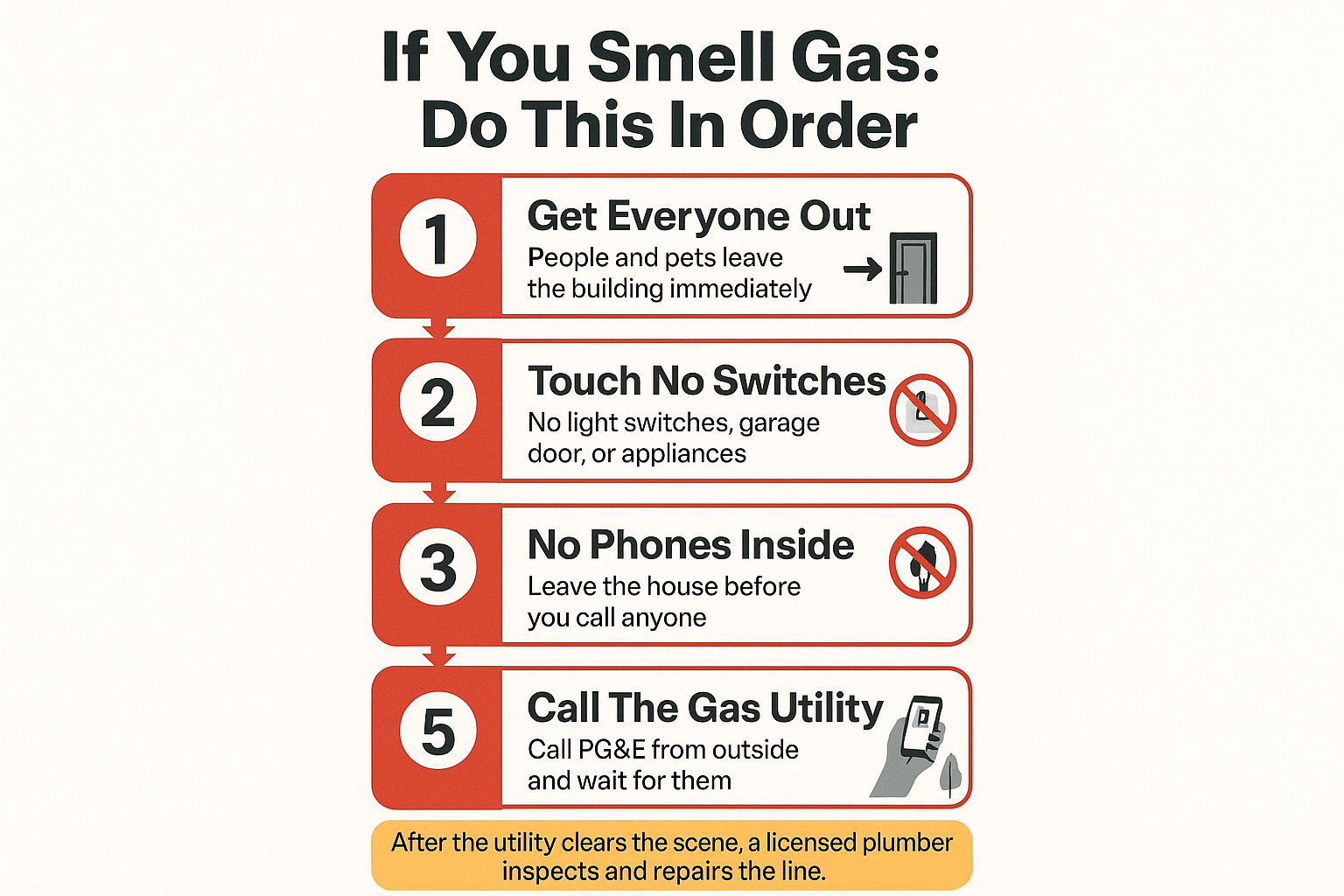
Direct Answer: Any gas odor inside your home is an emergency. Leave the building, avoid light switches and phones inside, and call PG&E from outside. A licensed plumber repairs the line afterward.
You catch something near the stove that smells like rotten eggs. It fades, then comes back an hour later. And now you are standing in the kitchen wondering if this is a real problem or just a quirk of an older house.
We get this call often in Salinas, and the honest answer is short. Any gas odor you can smell inside your home gets treated as an emergency, not a wait-and-see. One reviewer put it plainly after we came out for a gas leak: it “was taken care of right away.”
Below are the warning signs worth knowing, in the order you are most likely to notice them. We also walk through exactly what to do first, because the goal here is a calm plan, not panic.
1. A Rotten Egg or Sulfur Smell Anywhere Inside the House
Natural gas has no odor on its own. Utilities add a sulfur-based chemical so people can smell a leak before it becomes dangerous, which is why a leak smells like rotten eggs or a struck match.
That smell is the single clearest sign, and it does not need to be strong to matter. A faint whiff near the range, the water heater, the dryer, or the wall furnace closet is enough to act on.
Here is where homeowners get it wrong. They start hunting for the source, sniffing along the pipe, opening cabinets, and sometimes lighting a burner to “test” it.
- Do not try to trace the smell room by room
- Do not light a match, a burner, or a candle
- Do not assume it is safe because it comes and goes
A smell that appears and disappears usually means a small leak moving with air flow, not a leak that fixed itself. If you are trying to sort out what needs an immediate response and what can hold until morning, our guide on what counts as a plumbing emergency covers that line clearly. Gas is always on the immediate side of it.
2. A Hissing or Whistling Sound Near an Appliance or the Meter
Gas lines run under pressure. When a fitting loosens or a flexible connector fails, that pressure escapes with a soft hiss or a thin whistle you can hear in a quiet room.
The spots to listen are predictable:
- Behind the range, where the flex connector meets the shutoff valve
- At the gas dryer connection in the laundry area
- Near the water heater’s gas control valve
- Outside at the meter set on the side of the house
Check by standing still and listening with the TV and fans off. That is as far as your involvement should go.
A hissing sound with no smell still counts. Some people lose the ability to detect the odorant, and heavy cooking smells can mask it. One homeowner reached out to us after noticing a small leak at their stove fittings, which is a common failure point in kitchens where the range gets pulled out for cleaning.
Never try to tighten a gas fitting yourself. Overtightening a threaded joint can crack it and turn a slow leak into a fast one.
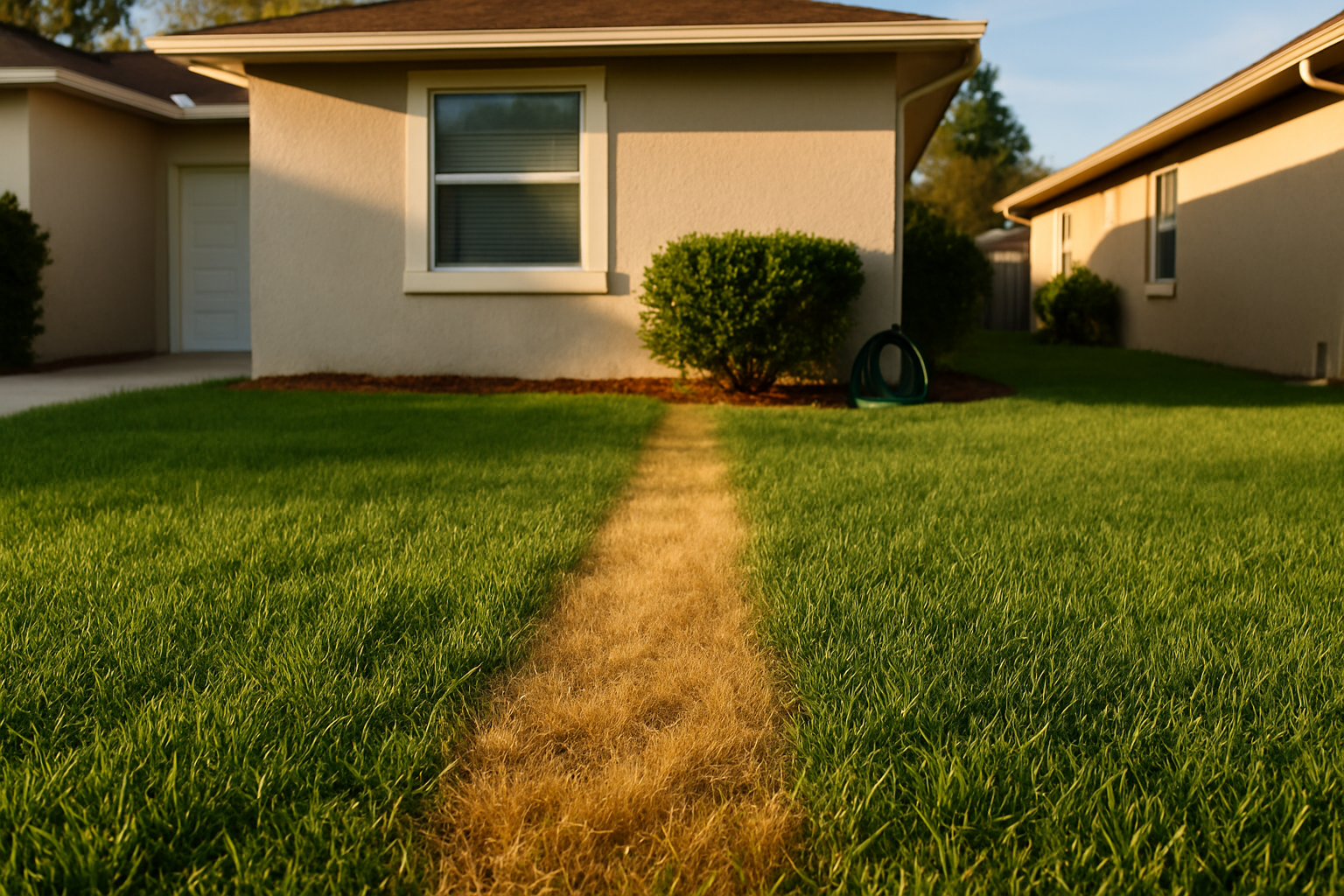
3. Dead Grass or Plants in a Line Across the Yard
Buried gas lines fail too, and the yard usually tells you before your nose does. Gas escaping underground pushes oxygen out of the soil, and the roots above it die.
The pattern matters more than the patch. A round brown spot is usually irrigation. A narrow strip of dead grass running in a straight line, often pointing toward the meter or an outbuilding, is worth taking seriously.
What to look for in a Salinas or Monterey yard:
- A strip of yellowed or bare grass in an otherwise green lawn
- A shrub or small tree dying on one side with no other explanation
- Soil that looks dry along a line even after a good rain
Buried water lines can create their own patterns in the yard, and the two are easy to confuse. If you are not sure which utility you are looking at, our post on how to tell if the water under your yard is your line walks through the differences. Either way, keep kids and pets off the area until it is checked.
4. Bubbling in Standing Water or Damp Soil
This one shows up most in winter, when Central Coast storms leave puddles sitting in yards and side setbacks for days. Gas escaping from a buried line rises through wet soil and breaks the surface as a steady stream of small bubbles.
The key word is steady. Rainwater soaking into dry ground can release a burst of air bubbles that stops after a minute. A spot that keeps bubbling in the same place for several minutes is not normal.
You can see the same thing in:
- A puddle over a lawn or planting bed
- A low spot near the foundation
- Standing water in a driveway seam or along a fence line
Do not stand over it, and do not dig. Note the location, back away, and report it. Homes across Salinas and Watsonville with older buried service piping are the ones we see this on most, especially after a stretch of heavy rain saturates the soil around the pipe.
5. A Gas Bill That Climbed With No Change in How You Live
Small leaks do not always announce themselves. Sometimes the only evidence is a bill that jumped 20 or 30 percent while your habits stayed exactly the same.
Before you assume a leak, rule out the obvious. Compare the bill to the same month last year, not last month, since a cold snap in the Salinas Valley can move a heating bill on its own.
Ask yourself:
- Did anyone move in, or did guests stay for a stretch?
- Did the furnace or water heater start running longer than usual?
- Was there a rate change on the statement?
If none of that explains it, an inspection of the gas piping is reasonable. This mirrors what we see with water service, where a quiet underground failure shows up on the statement long before anyone sees a drop. Our post on what to do when your water bill jumps covers that same logic on the water side.
A billing clue alone is not an emergency. Paired with any smell or sound, it is.
What To Do the Moment You Smell Gas
The order of these steps matters. Getting people out comes first, and everything else waits until you are outside.
6. Older Black Iron Piping in a Pre-1980 Home
Plenty of homes around Salinas, Seaside, and Pacific Grove were piped with black iron before 1980, and that material has a specific weakness. It corrodes from the outside in, so the pipe can look fine on the surface while the wall thins where it meets moisture.
The risk spots are the ones people rarely look at:
- Pipe in contact with garage slab or crawlspace soil
- Runs through damp crawlspaces near the coast
- Threaded joints, where the wall is thinnest by design
- Sections buried without proper coating or sleeving
Age alone is not a reason to replace a gas line. But if your home is that vintage and you are already seeing any other sign on this list, an inspection of the full run makes more sense than chasing one fitting.
When a repipe is the right answer, the materials used today are black iron or CSST, depending on the layout and the run. Costs vary a lot with length, access, and how much wall or slab has to be opened, and a residential gas repipe often lands somewhere in the low four figures locally. An on-site look is the only way to get a real number. Gas lines are also on the short list of repairs homeowners tend to put off too long.
7. Recent Digging or Landscaping Near the House
This is the one nobody connects. A new irrigation trench, a fence post, a tree planted along the side yard, or a patio footing dug last spring can all nick a buried gas line without anyone noticing at the time.
Damage from a shovel or auger often does not leak right away. The coating gets scraped, corrosion starts at that spot, and the failure shows up a year or two later.
If work was done near your home recently, keep an eye on:
- The path between the meter and the house
- Any area where soil was moved or re-graded
- Ground around new posts, footings, or planting holes
Anyone digging on your property should call 811 before breaking ground so utilities are marked first. It is free, it is required for a reason, and it takes a few business days. If a crew skipped it and you have any doubt about what is under your yard, say so before the next project starts.
Gas Line Warning Signs and How Fast to Act
Not every sign carries the same urgency. This is how we sort them when a homeowner calls in.
| What You Notice | What It Often Points To | How Fast to Act |
|---|---|---|
| Rotten egg or sulfur smell indoors | Leaking fitting, connector, or appliance valve | Leave now, call the utility from outside |
| Hissing near an appliance or the meter | Pressurized leak at a joint or flex line | Leave now, call the utility from outside |
| Dead grass in a line across the yard | Corroded or damaged buried line | Same day, keep people and pets off it |
| Steady bubbles in standing water | Gas escaping through saturated soil | Same day |
| Gas bill up with no change in usage | Small ongoing leak or an appliance running poorly | Within a few days, have lines inspected |
| Headache or nausea that clears outside | Possible gas or combustion byproduct exposure | Leave now, then call 911 |
Who Handles What After You Call It In
The sequence trips people up, so here it is plainly. The gas utility responds first, finds and stops the immediate hazard, and may shut off service at the meter.
What the utility does not do is repair the piping inside your home or the line on your side of the meter. That work belongs to a licensed contractor, and in California gas piping is not homeowner DIY territory.
From there, a licensed plumber:
- Pressure tests the system to find where it is failing
- Repairs the section, or repipes the run if the pipe is past saving
- Pulls the permit and coordinates inspection when the work requires it
That last piece matters more than people expect. A contractor who handles permitting in-house keeps the paperwork moving instead of handing it back to you, which is how our team works on City of Salinas jobs. If you are weighing who to call, we wrote about what Salinas homeowners actually expect from a local plumber and what to verify before anyone touches your gas system.
Frequently Asked Questions About Gas Line Leaks
I smell gas but only sometimes. Do I still have to leave the house?
Yes. An intermittent smell usually means a small leak that shifts with air movement, not a leak that resolved itself. Leave the building and call the utility from outside. If it turns out to be nothing, you have lost twenty minutes.
Should I shut off the gas at the meter myself?
Only if you can reach it safely from outside and you know where the valve is. Never go back inside for a wrench. Most of the time the better move is to get out, call the utility, and let their responder handle the shutoff.
How much does a gas line repair cost in Salinas?
It depends heavily on what is failing. A single fitting or a flexible connector at an appliance is a much smaller job than replacing a buried run or repiping the house.
Locally, a residential gas repipe often falls somewhere in the low four figures, but length, access, and how much wall or concrete has to be opened move that number a lot. The only accurate number comes from someone looking at your actual system.
Is a gas leak covered by 24 hour emergency service?
Gas calls are exactly the kind of thing after-hours service exists for. Once the utility has made the scene safe, a plumber can be dispatched at any hour to inspect and repair. We run 24/7 emergency plumbing across Salinas and the Monterey Bay Area for this reason.
Can a plumber test my gas lines even if nothing is obviously wrong?
Yes. A pressure test on the gas piping is a reasonable step if your home is older, your bill climbed with no explanation, or you had digging done near the house. It is far easier than chasing a problem after it becomes urgent.
Questions About a Gas Line at Your Salinas Home?
Once the utility has cleared the scene, gas line inspection, repair, and full repipe are work a licensed contractor takes from there, including any permit and inspection the job requires. Alvarez Plumbing has handled that work for Salinas and Monterey Bay Area homeowners since 1988, with 24 hour availability every day of the week. If you want a straight answer about something you are seeing, the number is (831) 757-5465.
