Direct Answer: Drano can soften hair and soap sitting in the trap near the fixture. It does little to cooled grease farther down the branch line and nothing at all to roots in a main.
A homeowner here in Salinas wrote to us about a kitchen sink that had been holding water for two days. Before reaching out, they had already tried Drano, baking soda and vinegar, dish soap with hot water, a hand snake, and pulling the pipes apart under the sink.
That ladder is the normal story. Almost nobody calls a plumber first, and almost everybody tries the same four or five things in roughly the same order.
So instead of telling you not to use those products, we want to explain what each one actually does once it goes down the drain, what it physically cannot reach, and why the sink is still full of standing water afterward. The answer usually comes down to where the clog is sitting, not what you poured on it.
Does Drano Work on Clogged Drains? Location Decides Everything
Store-bought drain products fall into two camps. Caustic cleaners use lye and generate heat. Acid cleaners are harsher and usually sold for tougher jobs.
Both work the same general way: they heat up and chemically break down soft organic material they are in direct contact with. Hair, soap scum, and thin biofilm in the first foot or two of pipe are fair targets.
Here is the part that gets left out of the label. A pour-in product only works on what it touches, and in a sink full of standing water it gets diluted long before it reaches the blockage.
What that means in practice:
- Hair and soap in a bathroom sink or tub trap: a product has a reasonable shot, because the clog is close and soft.
- Cooled, hardened grease in a kitchen branch line: much less likely, because the grease is downstream, cold, and often coating the pipe wall rather than plugging the center.
- Tree roots in a main sewer line: no chance at all, and the product just sits in the line.
Kitchen clogs in older Salinas homes usually sit past the trap, out in the horizontal branch line heading toward the stack. That is well beyond where a cup of liquid poured into a flooded basin is going to do anything useful. We walk through that whole path in more detail in why your kitchen sink still won’t drain.
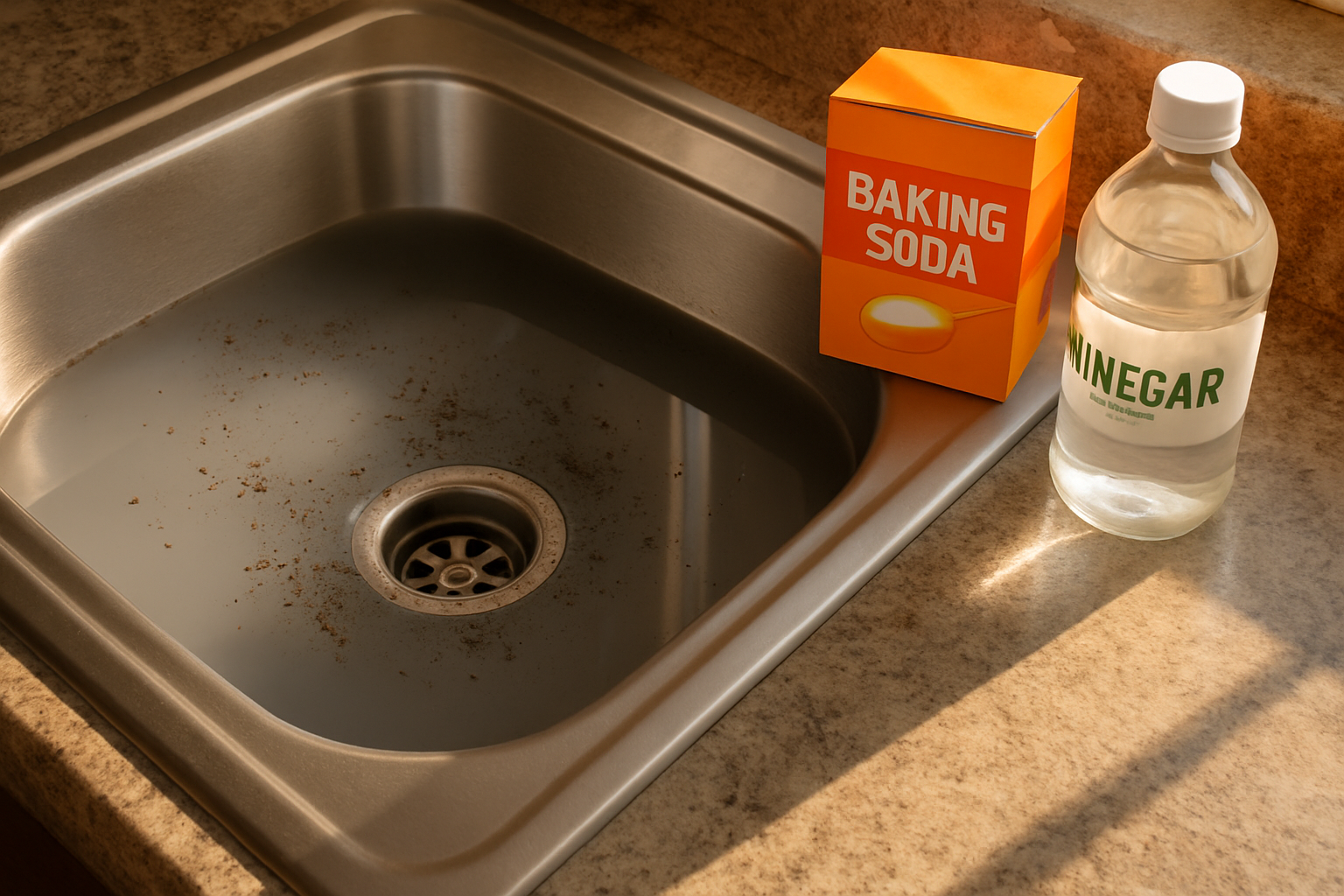
Baking Soda and Vinegar Mostly Cancel Each Other Out
This one deserves a plain answer because the internet has oversold it for years.
Baking soda is a base. Vinegar is an acid. When you combine them, they neutralize each other and produce carbon dioxide gas, water, and a little sodium acetate. The fizz you see is the reaction finishing itself off in your sink basin.
That fizzing can lift light film and loosen a bit of soap residue right at the drain opening. It is fine as routine freshening on a drain that still flows.
What it does not have is force. There is no pressure behind it, no scrubbing action, and almost nothing left by the time any of it makes the bend of the trap. A grease plug six feet out in a branch line never even knows it happened.
The hot water chaser people add afterward is doing more of the work than the fizz is, and even that only helps with grease that has not fully set.
What Each Home Remedy Actually Does
This is the same ladder most homeowners climb before calling. Here is what each rung is really doing inside the pipe.
| Method | What it actually does | Where it falls short |
|---|---|---|
| Baking soda and vinegar | Neutralizes into water, gas, and fizz; lifts light film at the drain opening | No force past the trap bend; useless on a real blockage |
| Caustic (lye) drain product | Generates heat, softens hair and soap scum it directly touches | Dilutes in standing water; barely affects cooled grease downstream |
| Acid drain product | Stronger reaction on organic material near the opening | Harsh on older metal pipe; can pool for hours in a dead line |
| Dish soap and hot water | Can emulsify grease that has not fully hardened | Water cools fast in the line and grease re-sets farther down |
| Hand snake from the sink | Can punch through a soft clog within a few feet | Often coils in the trap and never reaches the branch line |
| Pulling the P-trap | Clears the one spot you can see and reach | Confirms the clog is downstream when the trap comes out clean |
Old Salinas Pipe Is the Part Nobody Warns You About
The median Salinas home was built around 1976, and roughly 11 percent of the city’s housing stock predates 1950. That means galvanized steel and cast iron drain lines are still in daily service in older neighborhoods around Alisal, the Central Area, and across parts of the Monterey Peninsula.
Those pipes corrode from the inside out. The wall gets pitted and rough, and the inside diameter shrinks year after year.
Now add a chemical product to a line that will not move. It does not pass through and flush away. It pools in the low spots and sits there for hours, sometimes overnight, against metal that is already thin.
That is also why we look at pipe condition before we pick a clearing method. High-pressure jetting runs up to 4,000 PSI, which is the right tool for grease and scale in a sound line and the wrong tool for a corroded, thin-walled one. A camera look first tells us which situation we are in.
If your home has original cast iron underground, that decision matters even more. We covered the options in whether a cast iron sewer line can be saved without digging.
Hard Water Gives the Clog Something to Grab
Salinas water is hard, and that is measurable rather than a talking point. Cal Water’s recent annual reports put average hardness on the Salinas system around 254 ppm, with the Salinas Hills system testing closer to 320 ppm. Anything above 300 ppm lands in the very hard category by the utility’s own scale, and the USGS uses a similar hardness classification.
Mineral scale builds on the inside wall of a drain line and narrows it. It also leaves a rough surface, and grease and food solids grab onto rough surfaces far more easily than smooth ones.
So when a chemical product melts a narrow channel straight through the middle of a clog, the drain seems to work again for a week or two. The buildup is still sitting on the walls, waiting.
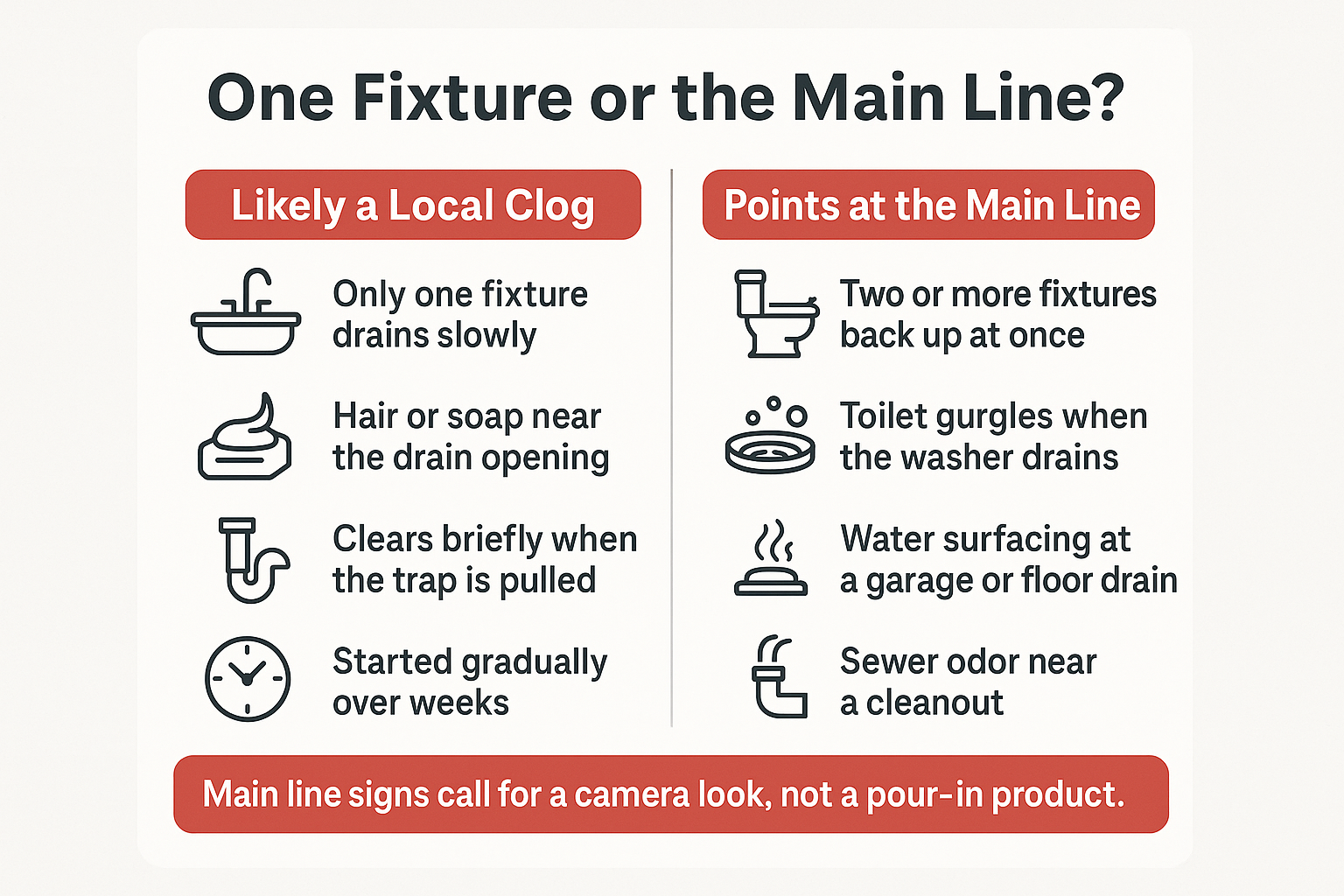
One Slow Fixture or a Main Line Problem?
These two situations look similar from the kitchen but mean very different things inside the pipe.
Tell Whoever Shows Up What You Poured In
This is the safety piece, and it is rarely written down anywhere.
When a drain will not move, whatever you poured in is still in there. The next person who opens that trap, pulls a cleanout cap, or runs a snake is going to meet it face first.
A few things to keep in mind:
- Say what you used and roughly how much before anyone starts work. It changes how we approach the job and what protection we wear.
- Do not mix two different products. A caustic and an acid in the same line is a genuinely bad combination.
- Do not run a garbage disposal with chemical sitting in the basin. That splashes it onto skin, counters, and cabinet faces.
- Skip the second dose. If the first one did not move it, the clog is somewhere the product cannot reach.
One homeowner wrote in with a broken disposal and a clogged kitchen sink at the same time. That pairing is common, and it is exactly the scenario where pouring something in is the wrong first move, because the disposal chamber holds the chemical right where you have to reach in.
When a Store-Bought Product Is Beside the Point
A single slow fixture is one problem. Several fixtures acting up together is a different problem entirely.
Watch for these patterns:
- Two or more fixtures backing up at the same time
- A toilet gurgling when the washing machine drains
- Water surfacing at a garage drain or floor drain
- Sewer odor near a cleanout
- Water backing up through the cleanout itself
Those point at the main line, and no amount of product poured into a sink is going to touch them. The honest next step is looking inside the pipe instead of guessing. Two related reads: when the washer drains and the garage sink overflows and why toilets and showers back up together.
For general market context, drain and sewer line camera inspections in the Salinas and Monterey County area commonly land somewhere in the low to mid hundreds, and the exact number depends on access, line length, and whether a cleanout already exists.
Jetting is normally quoted only after someone has actually seen the condition of the line, which is why a real number is a conversation with the office rather than a figure on a website.
Frequently Asked Questions About Drain Cleaners and Home Remedies
Will Drano damage my pipes?
In a newer ABS or PVC system that is still flowing, an occasional dose is unlikely to cause harm. The risk goes up sharply in older galvanized steel or cast iron lines, which are common in Salinas homes built before the 1960s, and it goes up again when the drain is fully blocked and the product pools in one spot for hours.
Is baking soda and vinegar safe for drains?
Yes, it is harmless. It is also not doing much. The two ingredients neutralize each other into mostly water and gas, so there is no force behind it to move an actual blockage past the trap.
My sink drained after using a chemical, so why did it clog again two weeks later?
The product likely melted a narrow channel through the middle of the buildup instead of clearing the pipe wall. With hard water scale giving grease a rough surface to stick to, that channel closes back up fast. A re-clog on a short cycle usually means the line needs to be mechanically cleared and looked at, not treated again.
Can I just snake it myself?
A hand snake can work on a soft clog within a few feet of the fixture. The common frustration is the cable coiling up inside the P-trap and never making the turn into the branch line, which is why so many people end up pulling the trap apart next and finding it clean.
What if I already poured something in and it did not work?
Stop there rather than adding a second product. Let whoever comes out know what went down the drain and about how much, so they can open the trap safely.
Still Holding Water After Everything You Tried?
We have been clearing drains for Salinas and the Monterey Bay Area since 1988 as a family-run, licensed, insured, and bonded shop, and the thing customers mention most is a tech who clears the line and then explains what he saw inside the pipe. As one Salinas customer put it, “Tony came out and in less than 30 mins later he had unclogged our drain.” Someone answers the phone around the clock at (831) 757-5465 if a drain is actively backing up, and the office is happy to talk through what you have already poured in before anyone comes out.
