Direct Answer: Check whether one fixture is affected or several. One fixture usually means a local clog. Multiple fixtures, or water rising at a floor drain or clean-out, points to the building’s main line.
It is the middle of a shift. A restroom is out of service, a mop bucket is already losing the fight, and somebody is standing at the door turning customers away.
The question everyone jumps to is how fast can a plumber get here. But there is a better question to answer first, and it takes about two minutes: is this one fixture or the whole building line?
That answer changes the repair, the equipment that needs to roll up, the time on site, and whether you lose a wing of the building for an hour or for the rest of the day. We have been working on Salinas buildings since 1988, and this is the part almost nobody explains before the phone call.
One Fixture or the Whole Line? The Two-Minute Check
Before anyone arrives, walk the area. You are looking for a pattern, not a cause.
Here is what to check:
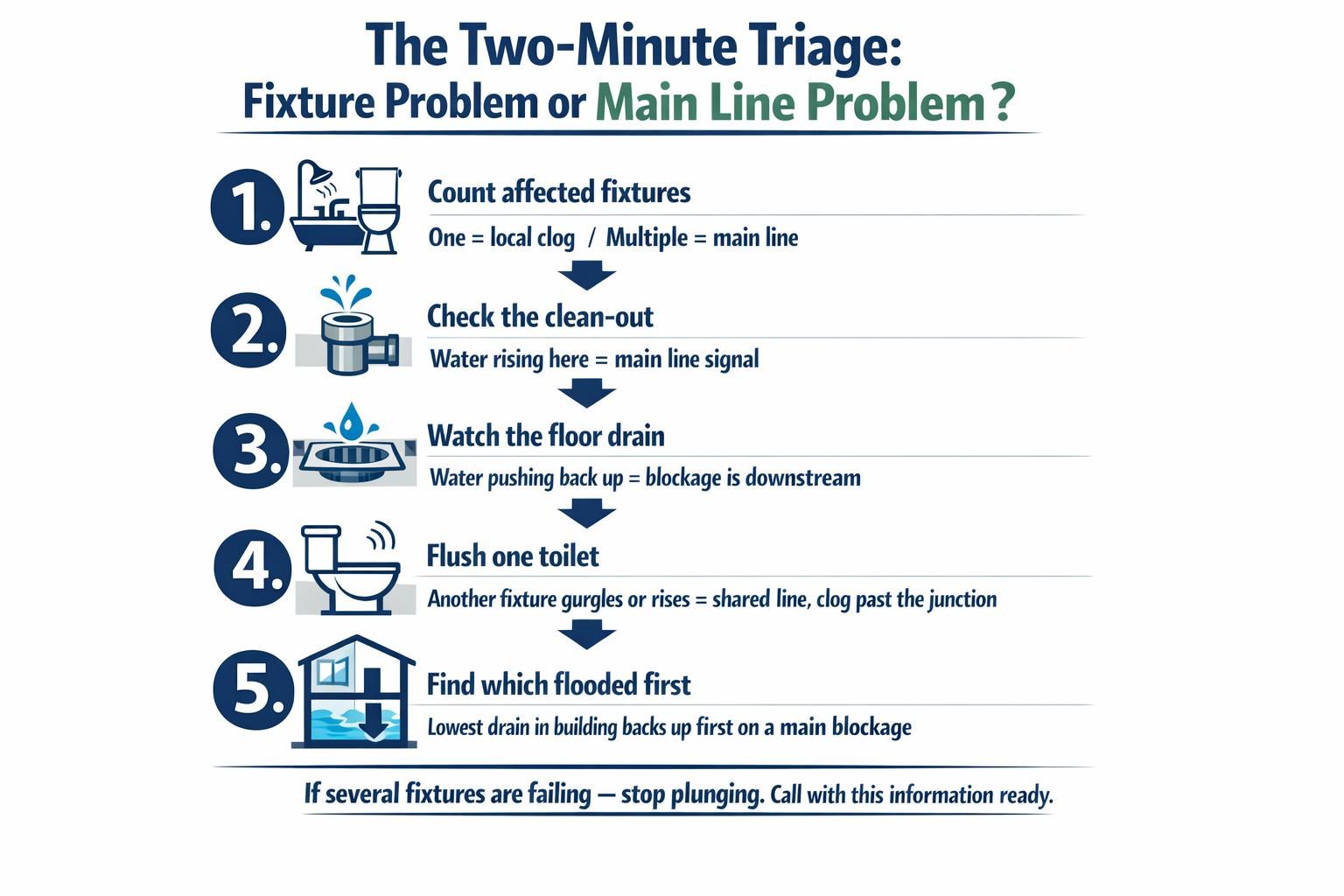
- How many fixtures are affected. One toilet acting up on its own is a local problem. Two toilets, a urinal, and a sink all slow at once is a main line problem.
- Whether water is rising somewhere it should not be. Callers describe this to us word for word: “the water is backing up through the clean-out.” That is a main line signal, not a fixture signal.
- What the floor drain is doing. If the floor drain in the restroom or the mop sink is pushing water back up, the blockage is downstream of everything.
- What happens when you flush. If flushing one toilet makes a different fixture gurgle or rise, those two share a line and the clog is past the point where they meet.
- Which fixture flooded first. The lowest drain in the building almost always goes first when the main is blocked. In a two-story office or restaurant, that is usually a ground floor restroom or a kitchen floor drain.
If several fixtures are failing at the same time, stop plunging. You are not going to clear a main line from a restroom, and running more water through the building makes the mess bigger. Residential buildings behave the same way, which we covered in why your toilets and shower back up at the same time.
What to Say on the Phone So the Right Truck Shows Up
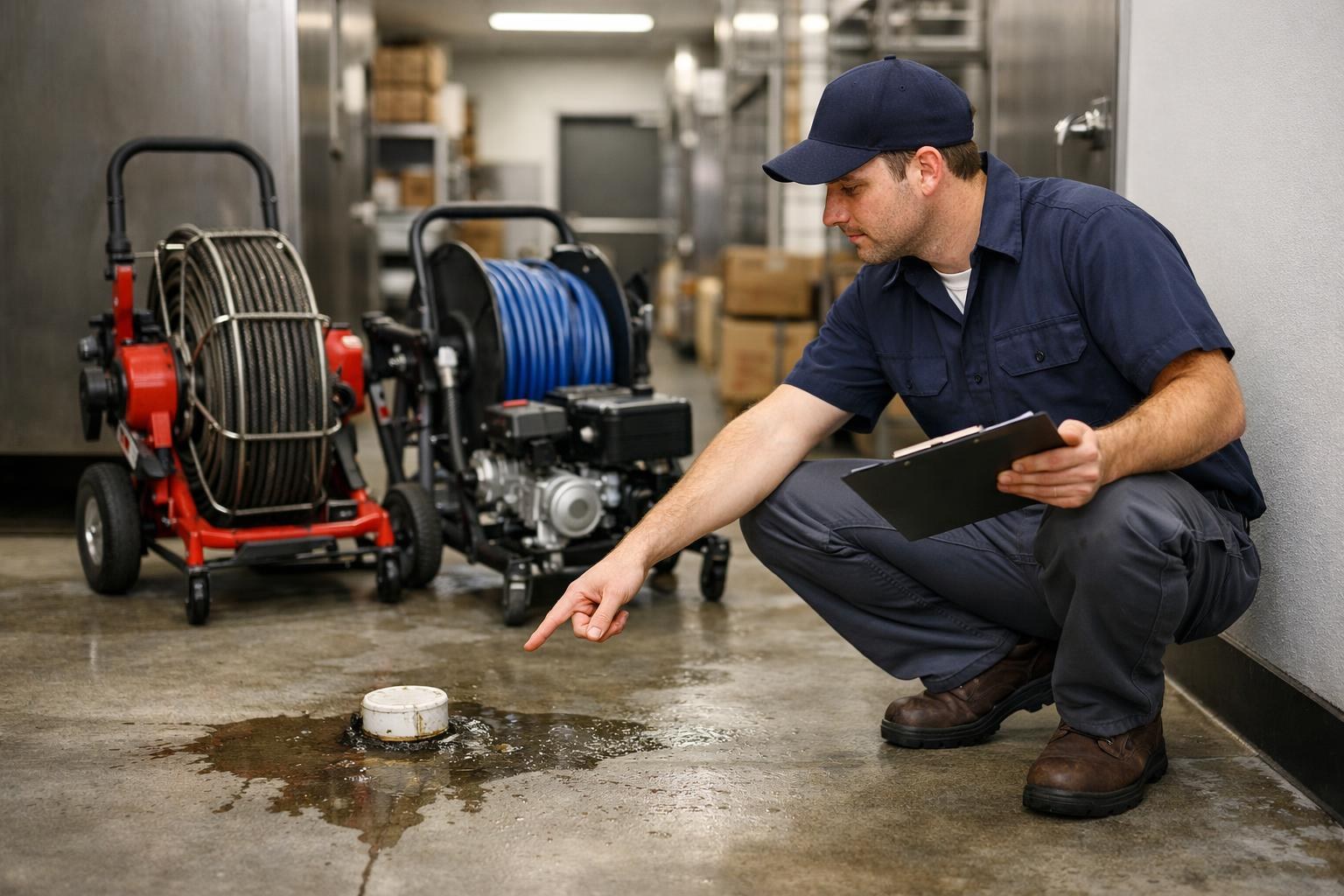
A sharper description on the first call often means the right equipment arrives the first time instead of the second. A truck set up for a simple cable job is not carrying a jetter and a camera reel.
Give whoever answers these details in this order:
- The address and suite number, plus how to get to the affected area after hours if the building is locked.
- How many fixtures are affected and which ones. “Both men’s room toilets and the mop sink” tells us more than “the restroom is clogged.”
- Whether a floor drain or clean-out is pushing water back.
- What the building does. A restaurant, a dealership service bay, and a dental office each produce very different debris in the line.
- Whether this has happened before, and roughly when. Repeat backups change the plan completely.
- Whether the building is open and whether a wing can be shut down.
That last one matters more than people expect. If the answer is “we are serving customers until nine,” the work gets staged differently than if the building clears at five.
Cable, Jetting, and Camera: What You Are Actually Authorizing
These three show up on work orders constantly, and they are not interchangeable. Here is the plain version of what each one does.
| Method | What it actually does | When it makes sense |
|---|---|---|
| Cabling (snaking) | Spins a steel cable through the line and punches an opening through the blockage. The pipe wall stays coated. | A fast restore when the building needs a restroom back now and the line has no history of repeat calls. |
| Hydro jetting | High pressure water, up to 4,000 PSI, scours grease, scale, and sludge off the pipe wall and flushes it out. No chemicals. | Grease-heavy kitchen lines, repeat backups, and buildings on a maintenance interval. |
| Video camera inspection | A waterproof camera runs the line and a locator marks depth and position of the problem. | Any commercial building with a second backup, or before approving a dig or a jetting job on older pipe. |
Why the Camera Usually Comes First on a Commercial Building
A cable can punch a hole through a grease plug and buy you a week. Jetting scours the pipe wall so the opening is the full diameter again.
On a building with a history of repeat calls, the camera is what keeps you from paying twice. It tells you whether you are dealing with grease, scale, roots, a belly in the line, or a cracked section that is going to keep catching debris no matter how many times it gets cleared.
The camera also protects the pipe. We check pipe condition before jetting, because corroded or weak lines may call for a gentler method. On a 1970s cast iron lateral, that check is not a formality.
A few things worth knowing about jetting in a commercial setting:
- Maintenance interval matters. Restaurants and commercial kitchens generally do well on a 6 to 12 month cycle. Most homes run 1 to 2 years.
- Cost is driven by pipe length, pipe size, and how bad the blockage is. Jetting in this area commonly lands somewhere in the low to mid hundreds and climbs from there, so treat any phone number as a guess until someone has looked at the line.
- A quote after a camera look is a real quote. Before that, it is an estimate built on a description.
If roots are the recurring culprit, the clearing schedule is its own conversation. We walked through that in how often a root-prone sewer line should be cleared.
The Two-Minute Triage Before You Call
A quick walk-through that tells a plumber whether this is a fixture job or a main line job.
Mid-Shift Now, or First Thing Tomorrow? The Honest Trade Off
About one in ten calls we take asks some version of “can someone come today.” For a business, the real cost of a backup is usually lost operating hours, not the invoice.
After hours and weekend rates are higher. That is true everywhere, and some callers decide to wait until morning rather than pay them. That can be a reasonable call, depending on the math:
- Call now if the backup closes a restroom you are required to keep open, affects a kitchen, or is spreading water into areas customers use.
- Call now if a camera has never been run on the line and you have had this problem before. You want it documented while it is actively failing.
- Wait until first thing if the building has a second restroom you can run on, the water is contained, and nothing is draining toward food prep or electrical.
When you call, ask for specifics instead of accepting a vague window. Ask what time the technician is expected, what the rate is for the hours you are booking, whether a travel fee applies to your address and how it is handled, and whether a camera and a jetter will be on the truck.
A clear answer to those four questions is how you tell the difference between a real arrival window and a shrug. Restaurants juggling both drain problems and hot water that drops during the dinner rush should ask the same way.
The Paperwork Part Nobody Writes About
For a facilities coordinator, the job is not finished when the water goes down. It is finished when the documentation lands in the right inbox.
Have this ready when you call:
- Site address and suite number, plus the gate or alarm code if one applies
- Work order or PO number, or confirmation that one is coming
- Who authorizes spend, and what dollar threshold needs a second approval
- Who can unlock the area and what hours they are on site
- Billing contact, which is often not the person standing in the restroom
Afterward, a clean service record should include more than a line item that says “cleared drain.” Ask that it contains what was found, what method was used, the footage where the blockage sat, and the camera findings if a camera was run.
That record is what keeps the next person who inherits the building from starting at zero. It is also what settles a landlord and tenant disagreement later without anyone guessing.
Why the Same Building Keeps Backing Up
When a commercial property backs up two or three times in a year, the cause is usually the line itself, not what anyone flushed.
Salinas has a lot of older building stock. Much of the commercial property around Oldtown and the Alisal corridor dates to the 1970s or earlier, with clay and cast iron drainage still in the ground. Clay joints let roots in. Cast iron scales and narrows from the inside.
Hard water makes it worse. Cal Water has reported hardness in its Salinas system around 254 ppm, and that mineral load builds scale on the pipe wall year after year. Add kitchen grease and you have a line that catches everything.
There is also the ownership question, which matters before anyone approves a repair. The City of Salinas is direct about it: in the city’s own sewer system management plan, sewer laterals are owned, operated and maintained by individual property owners from the wye connection at the sewer main back to each building.
So the city handles the main in the street. Everything from the wye back to your building belongs to the property owner. A camera report is the least expensive way to prove which side of that line the problem is sitting on.
And timing matters here too. Lines that are already narrowed tend to fail when the first heavy rain pushes groundwater and debris through the system, which is why we recommend a look at the sewer line before the first rain.
A Note on Who Handles Commercial Accounts Around Here
We are a family-run Salinas shop that has been working on local buildings since 1988, fully licensed, insured, and bonded, running 24 hours a day including nights and weekends for businesses that cannot sit on a problem until Monday, and we handle City of Salinas permitting in house when a job calls for it. One customer put the response side plainly in a review: “Alvarez plumbing was the only company that provided immediate emergency service out of the 6 I contacted.” We work with commercial accounts across Salinas, Monterey, Seaside, and Watsonville.
Frequently Asked Questions About Commercial Restroom Backups
Water is coming up through the clean-out. What does that mean?
It means the blockage is in your building’s main line or lateral, downstream of every fixture inside. The clean-out is doing its job by relieving pressure outside instead of inside. Stop running water in the building and describe exactly that on the phone so a camera and a jetter come out on the first trip.
Should we snake it or jet it?
If this is a first-time backup and you need the restroom open now, cabling often restores service quickly. If the line has backed up before, or the building has a kitchen, jetting is what actually cleans the pipe wall. On older cast iron, pipe condition gets checked first, because a weak line may call for a gentler method.
Is the city responsible for the clog or are we?
The city maintains the sewer main in the street. The lateral running from the wye connection at that main back to your building is the property owner’s responsibility. If you lease the space, your lease decides whether that falls to you or the landlord, and a camera report is usually what settles the argument.
How often should a restaurant have its lines jetted?
Commercial kitchens generally do best on a 6 to 12 month interval, compared with 1 to 2 years for a typical home. Grease volume and line length move that number in either direction.
Will after-hours service cost more than waiting until morning?
The hourly rate is higher after hours and on weekends, yes. But for a business the comparison is not rate versus rate, it is rate versus lost operating hours. If the backup closes a restroom you have to keep open or touches a kitchen, waiting usually costs more than the rate difference.
Working Through a Backup at Your Salinas Property?
If you manage a building in Salinas, Monterey, Seaside, or Watsonville and you are trying to sort out whether you have a fixture problem or a main line problem, a short conversation usually narrows it down fast. Alvarez Plumbing answers the phone at (831) 757-5465 around the clock, and service can also be requested at alvarezplumbingsalinas.com. Bring your work order or PO number and the two-minute check above, and the call will go a lot faster.
