Direct Answer: A commercial water heater that drops below 120 degrees only during peak hours is usually a recovery and sizing problem, not a failed unit. Measure at the faucet during the rush, then log it.
It is 6:40 on a Friday. The dish pit is backed up, a server is waiting on sanitized glassware, and someone holds a thermometer under the warewashing faucet and watches it settle at 112 degrees.
That number is not a comfort preference. California’s Retail Food Code requires hot water at a minimum of 120 degrees measured at the faucet, and Monterey County health inspectors check it with a thermometer during routine visits. A reading that slides during service is the difference between a normal shift and a conversation you do not want to have.
Here is what we see on these calls across Salinas, Monterey, and Watsonville kitchens: the unit is usually working. It just cannot produce hot water as fast as the building is pulling it. That distinction changes everything about the fix.
Measure at the Faucet, During the Rush
The most common mistake is checking the wrong place at the wrong time. A reading taken at the tank outlet at 2pm tells you almost nothing about what the dish pit sees at 7pm.
Take the reading where the code cares about it, at the fixture, while the kitchen is loaded:
- The warewashing faucet at the three compartment sink
- Every hand sink, including the one farthest from the water heater
- The mop sink, which is often the longest run in the building
- The dish machine inlet, if your machine is a hot water sanitizing model
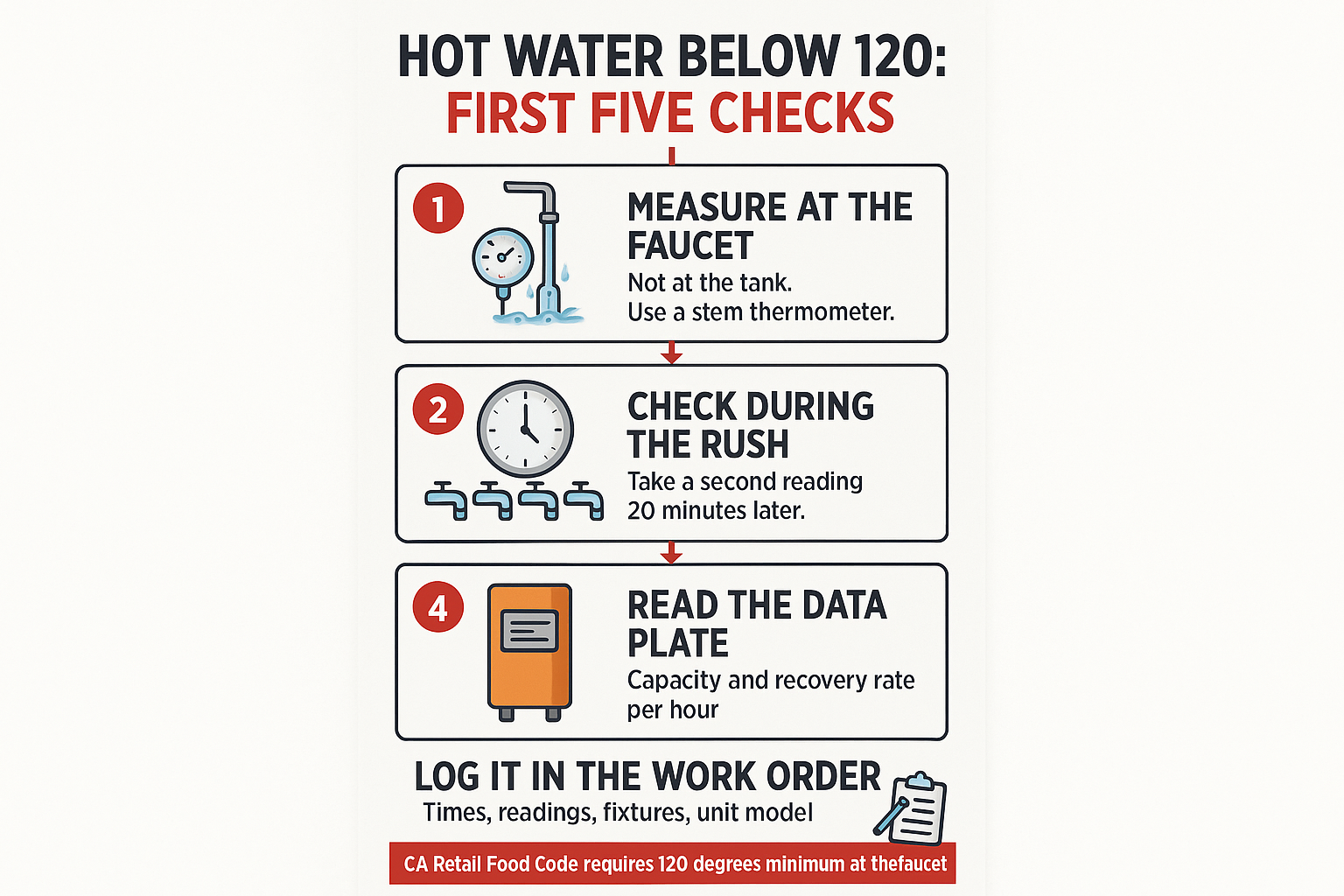
Write down the reading and the exact time. Then take a second reading twenty minutes later while the same fixtures are still running.
If the first reading passes and the second one fails, you do not have a broken water heater. You have a supply that runs out under load. If the water never gets hot at any hour, that is a different problem, usually a failed part, a pilot or ignition issue, or a thermostat that has drifted.
Those two patterns get diagnosed differently, which is why that time stamped log is the single most useful thing a manager can hand a plumber.
Most of These Calls Are a Recovery Problem, Not a Broken Heater
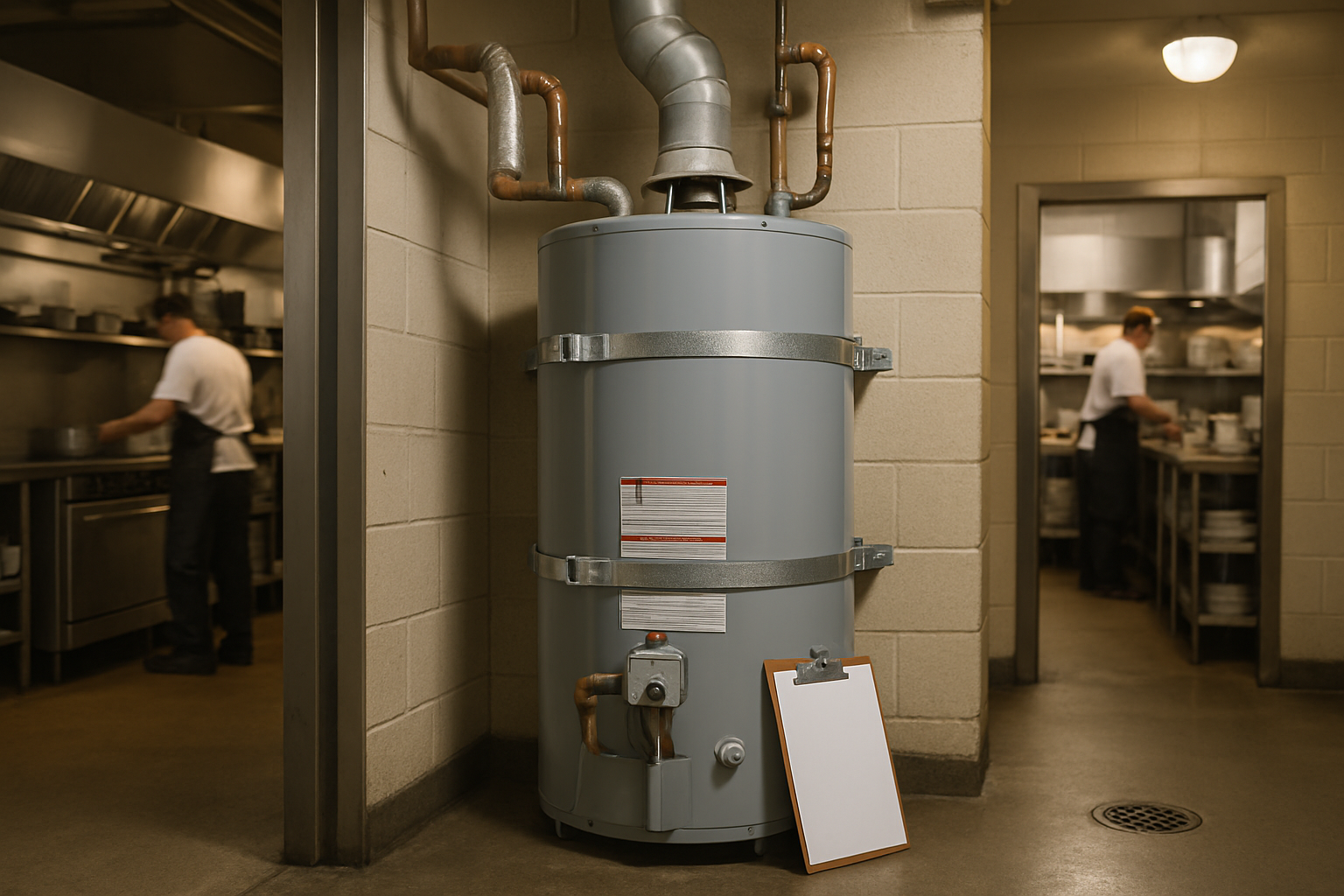
Recovery rate is how many gallons of hot water a unit can produce in an hour at a given temperature rise. Capacity is just what is sitting in the tank. During a rush, recovery is the number that decides whether you pass a thermometer check.
The California Conference of Directors of Environmental Health water heater sizing guidelines spell out what a food facility actually needs:
- A recovery rate equal to or greater than 100 percent of computed hourly hot water demand for facilities washing multiservice utensils
- Tankless units must deliver at least 2 gallons per minute of 120 degree water to each warewashing faucet
- A booster heater that raises incoming 120 degree water to at least 180 degrees when you run a hot water sanitizing dish machine
Now do the arithmetic for your own kitchen. Add up what runs at the same time at 7pm: the three compartment sink, two or three hand sinks, the dish machine, the mop sink, and the prep sink. Compare that hourly total to what the data plate on your unit says it can produce.
This is where a lot of Salinas kitchens come up short. If you added seating, swapped in a higher volume dish machine, or built out a second prep station after the water heater went in, the shortfall was designed into the building years ago.
And that is exactly why a like for like swap sometimes fixes nothing. Same output, same problem, new invoice.
What the Thermometer Is Actually Telling You
Three readings, three different conversations. Use this to decide what to put in the work order.
| What you see at the faucet | What it usually points to | What to log before you call |
|---|---|---|
| Passes at open, slides under 120 during the rush | Recovery or sizing shortfall, or scale cutting output | Time of reading, which fixtures were running, unit capacity from the data plate |
| Never reaches 120 at any hour | Failed part, thermostat drift, ignition or burner issue | Error code if displayed, age of unit, whether anything changed recently |
| Dish machine fails sanitizing temp but faucets pass 120 | Booster heater problem, not the main water heater | Dish machine make and model, booster location, final rinse reading |
| Hot at one fixture, lukewarm at a far one | Crossover, mixing valve, or a long uninsulated run | Which fixtures pass and which fail, by location |
The First Five Checks When Hot Water Drops
A short sequence any manager or lead can run before the plumber arrives, no tools beyond a thermometer.
Hard Water Turns a Correctly Sized Unit Into an Undersized One
This is the local piece, and it matters more here than in most of California. Cal Water reported average hardness around 254 ppm for its Salinas system in its 2024 report, and 320 ppm for the Salinas Hills system in 2025. Both sit above the utility’s own threshold for very hard water.
That mineral load does not announce itself with a leak. It plates onto the burner surface of a tank unit or inside the heat exchanger of a tankless one, and it acts like insulation between the flame and the water.
The result is a quiet slide. Recovery drops a little each quarter, and nobody notices until the kitchen that used to coast through a Saturday starts failing a thermometer check at 7pm.
Two things are worth logging before it becomes a Friday night failure:
- Popping or rumbling from the unit, which is sediment cooking against the bottom of the tank
- A slow decline in recovery over several months, where hot water runs out earlier in the shift than it used to
A commercial unit in a Salinas or Monterey Peninsula kitchen moves many times the daily volume of a house on the same water. So a descale and flush schedule is a service level decision, not an upsell. We already publish that logic for drains, where restaurant kitchen lines need clearing every 6 to 12 months versus every one to two years for a house. Hot water deserves the same treatment, and hard water sediment is the reason why.
The Real Question: Can This Get Fixed Without Closing?
Most managers calling about hot water are not worried about the equipment. They are worried about a restroom closure at noon or a kitchen that cannot sanitize at 7pm.
Commercial work gets scheduled around the business, not the other way around. For a restaurant that often means before open, between lunch and dinner, or after close. For an office building or apartment complex it usually means a low traffic weekday window.
Have these four things ready when you call. It cuts a day off the back and forth:
- The unit’s data plate: make, model, capacity, and recovery rate
- The dish machine model, plus whether it sanitizes with hot water or chemically
- Your work order or purchase order number, if your company requires one
- The actual hours the space is available, not the hours you wish it were
One caller this year asked us a question so plainly it is worth repeating: “Can you handle commercial or restaurant locations?” The answer is yes, and roughly a quarter of our monthly call volume comes from restaurants, hotels, apartment complexes, and facilities coordinators.
On billing, be direct with whoever you hire. A written scope and a clean invoice trail matter as much as the repair when you are the one answering to a corporate office. In this market, first time commercial accounts commonly start with payment at time of service, with net terms set up afterward once the account is established.
One customer put the standard this way in a review: “Johnny was on time, polite, completed our line cleaning quickly. Explained the costs and payment, clearly before arriving. Well done!” That is the bar, and it applies to a hot water call the same as a drain call.
Repair, Replace, and Why the Permit Shapes Your Timeline
On the residential side, our published guidance is that a typical repair runs somewhere in the $200 to $400 range, and a tank replacement installed generally lands in a published range we quote on site. Commercial is a different animal, and we are not going to print a number that pretends otherwise.
What drives commercial cost:
- Capacity and recovery rate needed to cover your actual peak demand
- Fuel type and gas supply sizing, since a bigger burner may need a bigger gas line
- Venting, which often has to be reworked for a higher input unit
- Code upgrades at the connection, including seismic strapping and expansion control
- Booster heater work, if your dish machine sanitizes with hot water
A changeout in California is licensed contractor work, not a maintenance staff task. In Salinas, a water heater replacement requires a permit through the City’s Community Development department, and the inspection is part of the job, not an afterthought.
That matters on the back end. A permitted and inspected changeout gives you documentation if an insurer or a health inspector asks about the work later. At Alvarez Plumbing we file and manage that permitting in house, which keeps the paperwork off a manager’s desk.
If you are weighing the decision on a unit that is still fairly young, our repair or replace walkthrough covers the same logic in more detail, and the flush and maintenance guide explains what neglect actually costs over time.
Frequently Asked Questions About Commercial Hot Water Shortfalls
Does the 120 degree requirement apply at the tank or at the sink?
At the faucet. California’s Retail Food Code sets the minimum at 120 degrees measured at the fixture, which is also where a Monterey County inspector will put their thermometer. A unit set to 140 at the tank can still fail at a hand sink 80 feet away.
We replaced the water heater two years ago and we still run out. Why?
Usually because the replacement matched the old unit instead of matching the kitchen’s current demand. If seating, a dish machine, or a prep sink was added at any point after the original install, the sizing was already behind. A recovery calculation against your actual peak load will tell you which it is.
Can a tankless unit handle a commercial kitchen?
It can, but the sizing rules are strict. State guidance for food facilities calls for at least 2 gallons per minute of 120 degree water to each warewashing faucet, and hard water here makes heat exchanger descaling a regular item rather than an occasional one.
Our dish machine fails its sanitizing temperature but the sinks are fine. What is that?
That usually points at the booster heater, not the main water heater. A hot water sanitizing machine needs a booster that takes incoming 120 degree water up to at least 180 degrees for the final rinse.
Do you need a permit to replace a commercial water heater in Salinas?
Yes. Water heater changeouts are permitted work under City of Salinas municipal code, and the inspection is part of closing it out. It adds a step to the timeline, but it also gives you a verified record of the work if anyone asks later.
What if the hot water fails at 7pm on a Saturday?
Call it in. We run 24 hour service, every day, specifically because kitchens and apartment buildings do not fail on a Tuesday morning schedule.
Hot Water Falling Short in Your Kitchen?
We are a family run shop that has worked Salinas and Monterey Bay Area buildings since 1988, licensed, insured, and bonded, with technicians available around the clock for the nights a kitchen loses hot water at 7pm. Our average sits at 4.94 stars across more than 224 Google reviews, which is the quiet version of what we do. If you want a recovery check or a straight answer on a commercial unit, the office line is (831) 757-5465.
