
Direct Answer: On a line with confirmed root intrusion, most Salinas homes need clearing every 1 to 2 years. Camera footage of the damaged joint is what sets your exact interval.
You already know what the gurgling means. The tubs drain slow, the toilet burps when the washer runs, and somewhere in the back of your mind you’re counting the months since the last time someone cleared the line.
One longtime customer in the area wrote in and said it better than we could: her pipes were making noises, and she already knew that meant the hydro jetting was due because of her trees. She even had the date of her last service on hand.
That’s the right way to think about it. A sewer line with root intrusion is not a one time repair, it’s a cycle. This article covers how often that cycle comes around in Salinas, who actually owns the pipe the roots are breaking into, and why the smart time to schedule is before the first real storm, not during it.
Roots Don’t Get Removed. They Get Set Back.
Here is the part most homeowners don’t hear clearly the first time. Clearing a root intruded line removes the roots that are in the pipe right now. It does not remove the crack or the open joint that let them in.
Roots follow moisture and nutrients. Once a tree has found a wet seam in your lateral, it grows straight back toward that same spot, and the regrowth is usually faster the second time because the root system is already established nearby.
So the useful question isn’t “is the clog gone.” It’s how long until they’re back. On a residential line with confirmed root intrusion, a clearing interval of every 1 to 2 years is a reasonable working baseline. For restaurants and commercial kitchens, where grease rides on top of the root problem, every 6 to 12 months is closer to reality.
What moves you toward the short end of that range:
- Mature trees with aggressive root systems planted within about 10 feet of the line
- Clay or cast iron pipe, common in older Salinas and Monterey Peninsula homes built before the 1970s
- A joint that’s already visibly separated rather than hairline cracked
- A history of two or more backups in the same spot
When you treat it as a scheduled cost instead of a surprise, the whole thing gets a lot less stressful. Planned clearing on a known interval is a budgeting decision.
Before You Spend Money: Whose Pipe Is It?
This trips up a lot of landlords and property managers, and it’s worth settling before anyone quotes you a repair.
The City of Salinas maintains the sanitary sewer main in the street. That system is big: the City’s public works department reports maintaining nearly 275 miles of sanitary sewer pipeline plus 11 lift stations.
The building sewer lateral, the pipe running from your structure out to that main, belongs to the property owner. And the City’s published guidance treats root infiltration in a lateral as a condition the owner is responsible for repairing, on the reasoning that a properly installed, properly sealed pipe shouldn’t be letting roots in.
So your monthly sewer bill pays for the main, the lift stations, and treatment. It does not pay for the 40 feet of clay pipe under your front lawn. That distinction matters more right now because Salinas is working through a multiyear sewer rate increase adopted after a 2024 rate study, with a payment assistance discount available for qualifying income levels. We wrote more about that in our breakdown of what the Salinas sewer rate increase means for your private line.
A camera inspection is the cheapest way to find out which side of that line your problem sits on, before anyone starts talking about excavation.
The Camera Is What Sets the Interval
Two properties can both have “roots in the line” and need completely different schedules. The footage is what tells them apart.
Hairline root entry at one clay joint, with the rest of the run clean, points to a longer cycle and a watch-and-clear approach. A section holding standing water, a belly, or a partially collapsed length of pipe points to a short cycle and an eventual repair conversation.
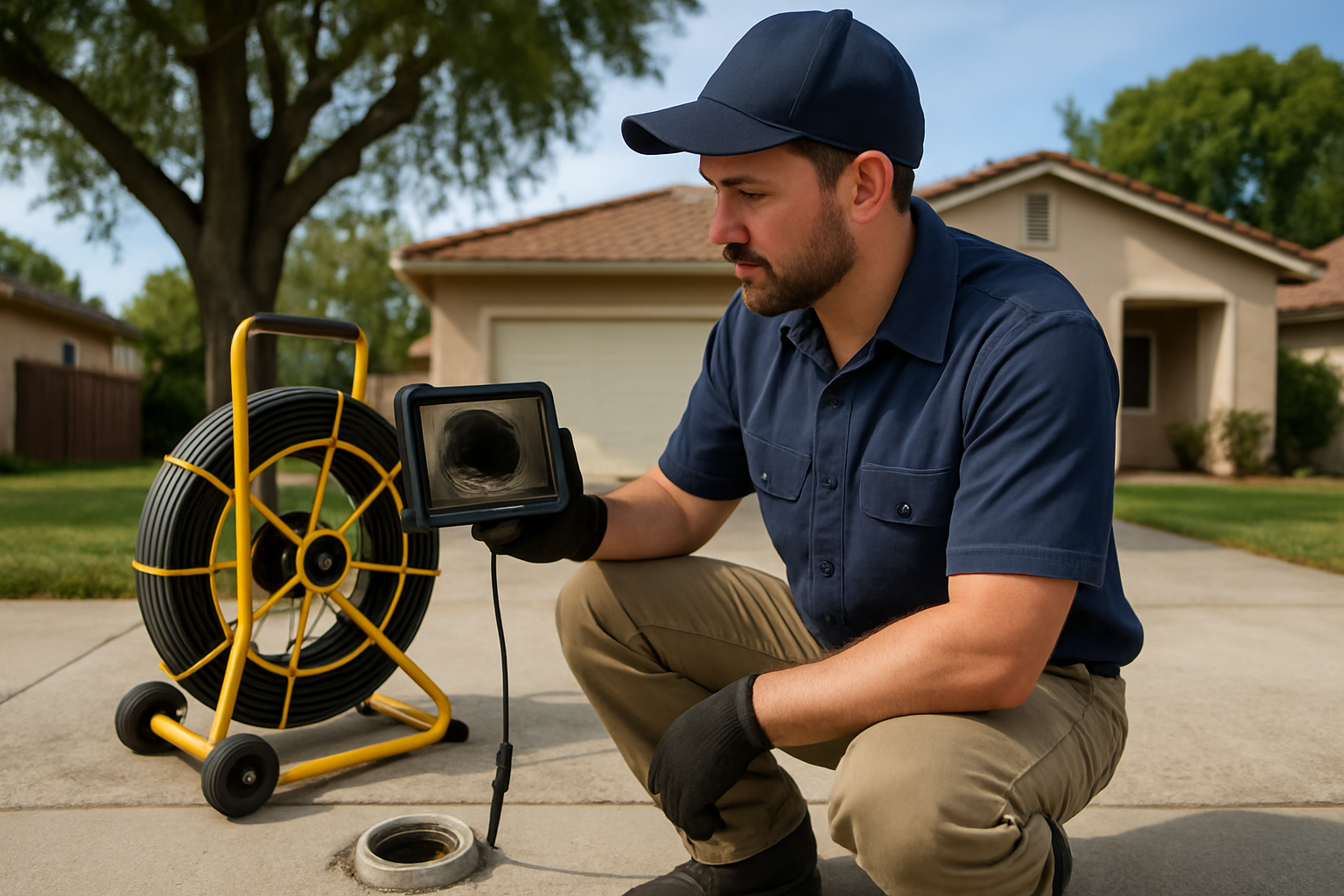
A camera run with a locator also pins down exact depth and location, which keeps digging to a minimum if repair ever happens. Most inspections take 30 to 60 minutes.
On cost, treat any number you read online as context, not a quote. In the Salinas and Monterey County market, sewer line camera inspections span a wide range depending on the job, with local averages for drain line inspections landing well under the top end of that spread. Hydro jetting in this area commonly runs somewhere in the $300 to $800 neighborhood. The real drivers are:
- Pipe diameter and the total length of the run
- How severe the blockage is and whether roots are mature
- Cleanout access, or the lack of one
- Pipe condition, since corroded or weakened pipe may call for a gentler method than full pressure jetting
That last point is not a formality. We check pipe condition before jetting because 4,000 PSI through a failing clay line can turn a clearing job into a repair job.
The footage and the written notes are the asset you keep. Two years from now, you’ll want to know exactly where the roots came in and how far down.
What Pushes Your Clearing Interval Shorter or Longer
Use this as a rough read on your own property before the camera goes in. The footage confirms it.
| Factor | Points to a shorter cycle | Points to a longer cycle |
|---|---|---|
| Trees near the run | Mature shade trees or willows within about 10 feet | Small ornamentals, or nothing planted over the line |
| Pipe material | Clay or cast iron with mortared joints | ABS, PVC, or a replaced section with sealed joints |
| Camera findings | Separated joint, belly holding water, multiple entry points | One hairline entry, otherwise clean run |
| Property use | Restaurant, commercial kitchen, multi-unit rental | Single family home with normal usage |
| Backup history | Two or more backups at the same spot | First known event, no prior record |
A Year-Round Plan for a Root-Prone Line
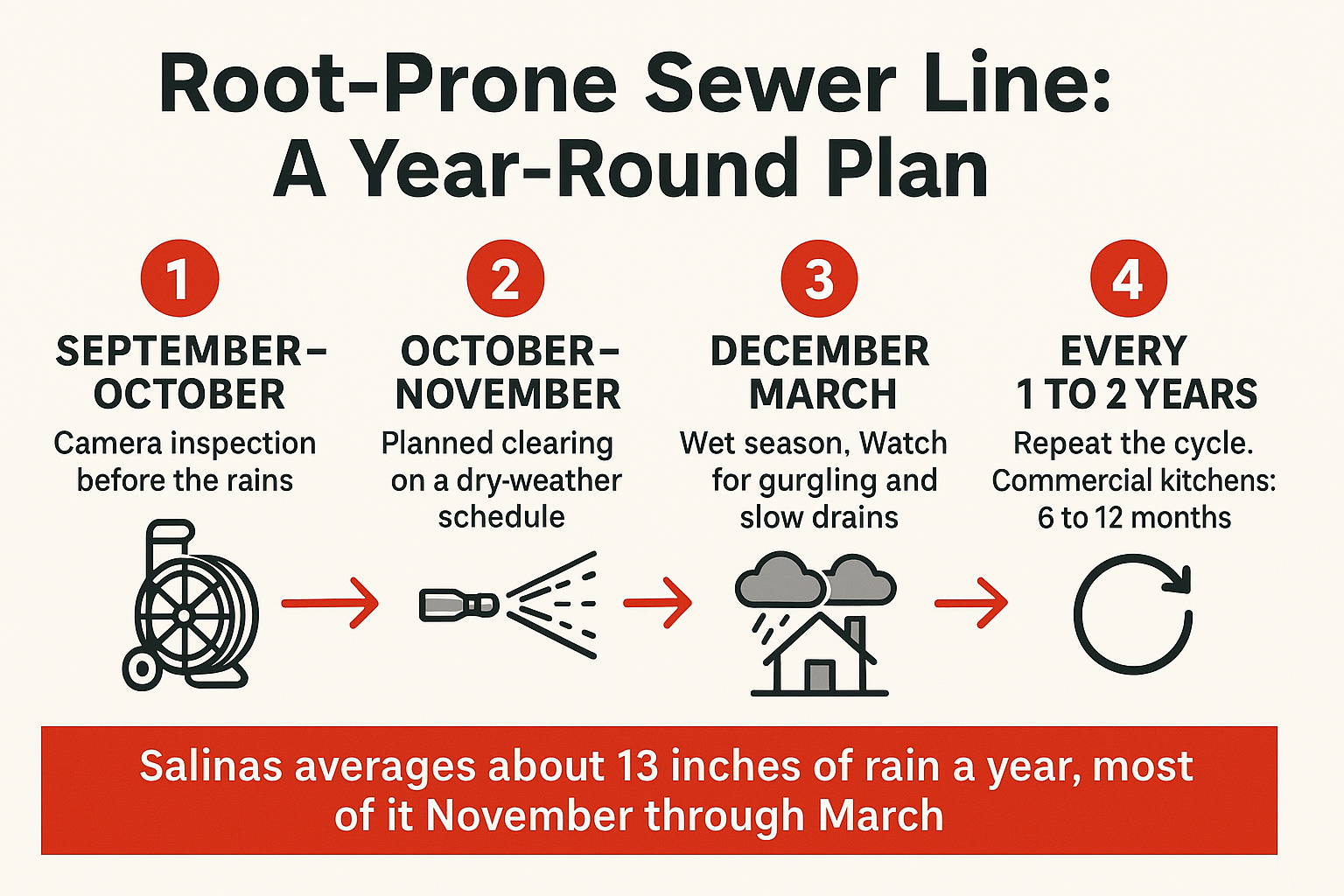
Here’s what a predictable maintenance cycle looks like on a Salinas property with trees over the lateral.
Schedule It in October, Not February
Root damaged lines fail when the rain shows up. A cracked joint that lets roots in also lets groundwater infiltration in, so the line gets asked to carry storm water on top of normal household flow.
That’s why a line that limped through a dry summer backs up during the first real storm. Salinas averages roughly 13 inches of precipitation a year, with December typically the wettest month at close to 2.8 inches spread over about 10 rainy days. Monterey runs slightly higher. Almost all of the year’s drainage stress lands in a November through March window.
Our own call pattern follows the weather. Gurgling drains, sewer odors near floor drains, and toilets and showers backing up at the same time cluster with wet weather almost every year.
So give yourself a calendar instead of a warning:
- September or October: camera the line if the property has known trees or past backups
- Before the first storms: schedule the clearing, during daytime hours
- During the season: treat new gurgling as a signal, not background noise
We answer the phone around the clock, and plenty of these calls come in at 9pm on a Saturday. But a daytime appointment in October is easier on everyone, including your tenant. More on that in our guide to giving your sewer line a look before the first rain.
What the Visit Looks Like When You’re Not On Site
Most owners we work with on recurring root jobs aren’t there for the appointment. Some are managing a property from out of state. Here’s the order of operations so you can forward it to a tenant.
- Access: the crew needs the exterior cleanout, or interior access to a tub or floor drain if there’s no cleanout. Gate codes and dog arrangements matter more than anything else.
- Tenant presence: not usually required if the work is all exterior and the cleanout is reachable. Interior access means someone needs to be home.
- Water off: for jetting and clearing, fixtures should stay unused during the work, typically a couple of hours start to finish depending on the run.
- Afterward: camera findings, what was cleared, pipe condition notes, and the invoice, which can be kept separate from the tenant entirely.
That documentation is the point. Reviewers tell us the communication is what they remember, like one customer who wrote, “Hector kept in touch and kept me informed of everything he was doing.”
If the same drain keeps giving you trouble between visits, our piece on why a drain keeps clogging after it’s been cleared covers what that usually means.
Frequently Asked Questions About Tree Roots in Sewer Lines
Can’t I just use a root killer from the hardware store?
Foaming root treatments can slow regrowth at a joint that’s already been mechanically cleared. They won’t open a line that’s already blocked, and they don’t repair the crack. Think of them as a way to stretch the interval, not replace it.
Is snaking or hydro jetting better for roots?
A cable with a cutting head punches a hole through the root mass and restores flow fast, which is often the right call during an active backup. Hydro jetting scours the full pipe wall and takes the roots back closer to the entry point, so the line usually stays clear longer. Pipe condition decides which one is appropriate, and that’s why we camera first on a line we don’t know.
If roots keep coming back, should I just replace the line?
Sometimes. If the camera shows one compromised joint, spot repair or a maintenance cycle usually pencils out better. If it shows multiple separated joints, a belly, or a collapsing section, you’re paying to clear a pipe that’s going to fail anyway. The footage is what makes that call, not the number of times you’ve been cleared.
Does the City of Salinas cover root removal in my lateral?
No. The City maintains the main in the street and the lift stations. The lateral from your building to that main is the property owner’s, and root infiltration in a lateral is treated as an owner repair.
How do I know whether it’s my line or the city main?
A camera inspection run from your cleanout out toward the street answers it in 30 to 60 minutes. If the obstruction is inside your lateral, you’ll see exactly where. If flow is clear all the way to the connection, that’s a different conversation, and you’ll have footage to back it up.
Putting a Root-Prone Line on a Schedule
Owners of root-prone properties in Salinas often keep the same line on the same cycle for decades, and a few of them still ask for the same technician by name years later. Alvarez Plumbing has been family run in the Salinas Valley since 1988, licensed, insured, and bonded, with a 4.94 star average across 224 plus Google reviews. Help with camera inspections and planned clearing is available in Salinas, Monterey, Seaside, Pacific Grove, Carmel, and Watsonville, with someone reachable at (831) 757-5465 around the clock when a line backs up outside business hours.
