
Direct Answer: An unflushed water heater in Salinas accumulates hard-water sediment that raises energy costs, shortens tank life, and can cause sulfur odors. Annual flushing by a licensed plumber slows that damage.
Most homeowners in Salinas never think about their water heater until something goes wrong. The tank sits in a closet or garage, does its job quietly, and gets ignored for years. But “ignored” is doing real damage when your water supply averages around 271 parts per million of hardness, which puts Salinas squarely in hard-water territory.
We hear from homeowners who haven’t flushed their tank in seven, ten, or even fifteen years. One Salinas homeowner reached out last spring noting his unit was about seven years old and had never been serviced, and that his wife had started noticing a smell in the hot water. That detail, the smell, is actually one of the most telling signs that sediment buildup has gone far enough to cause a real problem inside the tank.
This article covers two things in depth: what is actually happening inside an unflushed tank in a hard-water city like Salinas, and how to think honestly about whether a flush is the right call or whether your money is better spent on a replacement conversation.
What Hard Water Does Inside Your Tank Over Time
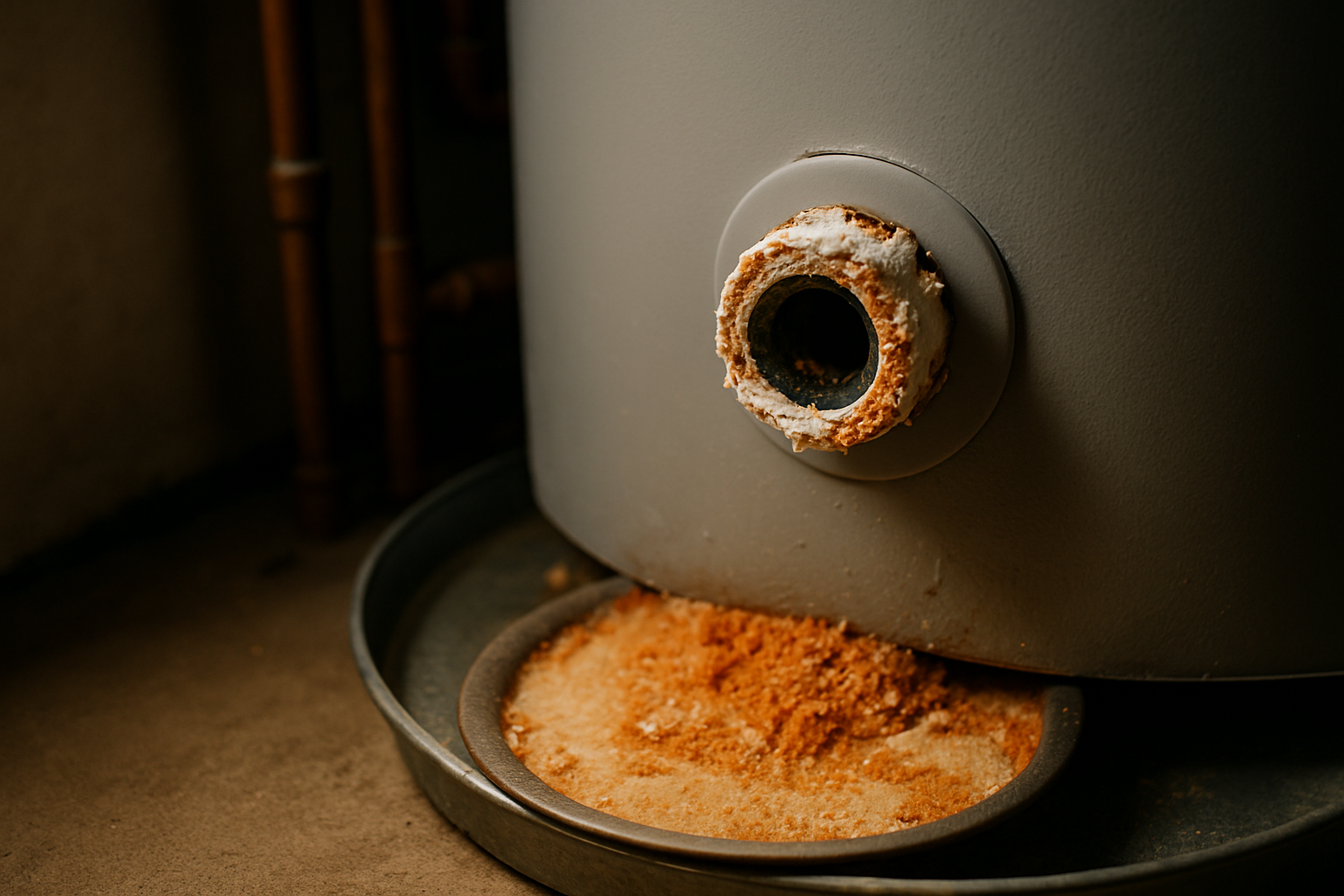
When Salinas tap water heats up, the dissolved minerals, primarily calcium and magnesium, precipitate out and settle at the bottom of the tank. This isn’t a slow, even coating. Over years without a flush, it accumulates into a compacted layer of sediment that sits directly between the heating element or gas burner and the water above it.
That layer does two specific things that shorten your water heater’s life:
- Insulates the heat source, so the burner or element works longer and harder to bring water to temperature, which raises your energy bill and accelerates wear
- Holds moisture against the tank lining, which promotes corrosion from the inside out, in a place you can’t see or inspect without draining the tank
Salinas water’s hardness level means this process runs faster here than it would in a softer-water city. A tank rated for 12 to 15 years can realistically start showing stress closer to the 8 to 10-year mark if it has never been maintained. The hard water and water heater sediment connection is something we see confirmed in the field on almost every older service call in this area.
The sulfur or rotten-egg smell that some homeowners notice in their hot water is a separate but related issue. It happens when bacteria in the tank interact with a degraded anode rod, producing hydrogen sulfide gas. The anode rod is a sacrificial magnesium or aluminum rod designed to corrode instead of the tank lining. When it breaks down fully and isn’t replaced, the smell follows, and the tank lining itself becomes the next thing the chemistry attacks.
What a Professional Water Heater Flush Actually Involves
A professional flush is not the same thing as running a garden hose off the drain valve for a few minutes, which is what most DIY guides describe. That approach can move loose sediment, but it almost never dislodges the compacted layer at the bottom of a tank that has been sitting for years.
A proper service visit covers several things beyond just draining:
- Draining the tank fully to pull out suspended and settled sediment, not just a partial flush
- Inspecting and testing the anode rod to determine whether it has enough material left to protect the tank or needs replacement
- Checking the pressure relief valve, which is a safety component that is often seized or corroded on tanks that have never been serviced
- Looking for early signs of corrosion at the base of the tank, around fittings, and at connection points
- Noting element or thermostat condition on electric units, or burner performance on gas units
The anode rod inspection alone is worth a service call for any homeowner noticing a sulfur smell. A depleted rod is the single most common cause of that odor, and replacing it before the tank lining is compromised is a much cheaper fix than replacing the unit entirely.
For accurate context on what this type of service typically runs in the Salinas and Monterey Bay Area, the best step is to contact a licensed plumber directly for a quote, since costs vary based on tank age, condition, and what the inspection turns up. You can also review the repair or replace decision framework before your appointment so you know what questions to ask.
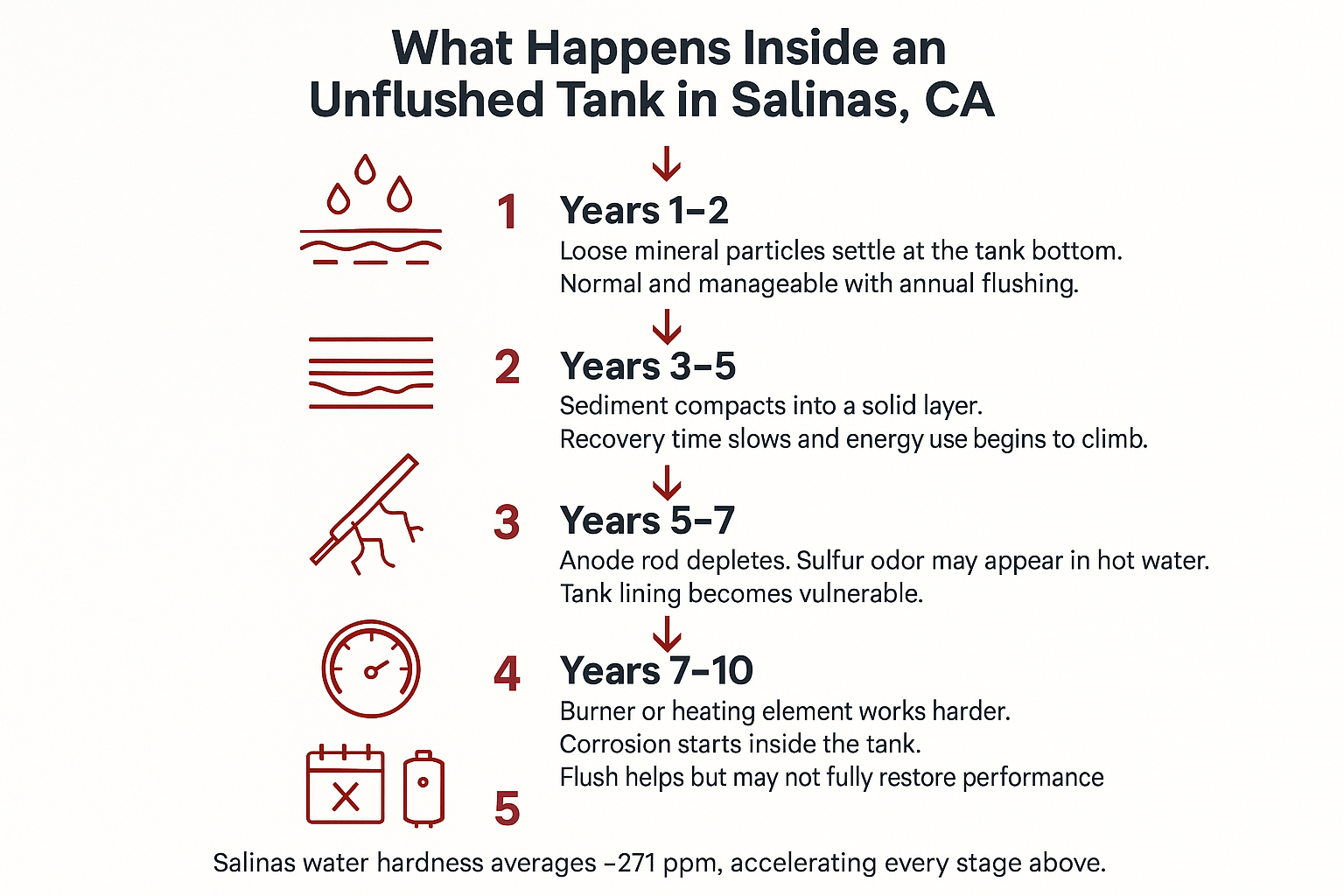
The Sediment Buildup Timeline in a Hard-Water Area
This step-by-step timeline shows what happens inside an unflushed water heater in Salinas over a typical ownership period, and when each problem tends to appear.
Flush or Replace? A Simple Age and Symptom Guide
This is not a diagnostic tool, but it gives you a starting framework before you call a plumber. A licensed technician will always make the final call after seeing the unit in person.
| Tank Age | Current Symptoms | Likely Next Step |
|---|---|---|
| Under 7 years | Smell in hot water, slower recovery | Flush + anode rod inspection or replacement |
| 7-10 years | Smell, rumbling noises, rising energy bill | Flush + full inspection, watch for corrosion signs |
| 10-12 years | Multiple symptoms, possibly rusty water | Inspection first, replacement may be the better value |
| 12+ years (hard-water area) | Any symptoms, or no symptoms | Replacement conversation is warranted regardless of flush history |
| Any age | Leak at the base of the tank | Do not flush, call a plumber immediately |
When a Flush Is Worth It, and When It Isn’t
This is the part most plumbing content skips because it requires an honest answer instead of a simple one.
If your tank is under eight years old and has a single identifiable issue, a smell from a depleted anode rod, slightly slower recovery, a minor uptick in your gas or electric bill, a flush combined with an anode rod replacement is almost always worth the cost. You have years of usable life left in the tank, and the service puts that timeline back on track.
But if your tank is ten years old or older in Salinas, the calculus changes. A flush will remove sediment and may improve performance in the short term, but it will not undo the corrosion that has already worked into the lining. At that stage, you are paying for a service that buys you a few months rather than several years. The more honest conversation at that point is about whether repair or replacement makes better financial sense, and it is worth having that conversation before committing to a service call on a unit that is already past its prime.
We also always check for signs that the situation is more complex than a standard maintenance visit, including things like pressure issues that might point to an expansion tank or recirculation pump concern, or early warning signs that connect to bigger system questions. The warning signs your water heater sends before it fails are worth knowing before your appointment.
Summer is the most practical time to schedule this kind of maintenance in the Salinas area. Demand is high, households are full, and your water heater is working harder than it does in the cooler months. Scheduling a flush before a problem develops, rather than after a failure, is almost always cheaper and less disruptive. The U.S. Department of Energy recommends annual draining for tank water heaters to maintain efficiency and extend service life.
Frequently Asked Questions About Water Heater Maintenance in Salinas
How often should I flush my water heater if I live in Salinas?
Once a year is the general recommendation, and it applies with more urgency in Salinas than in softer-water cities. At roughly 271 ppm of hardness, the mineral load in local water means sediment accumulates faster than the averages you’ll see in national guides. If you have a unit that has gone three or more years without service, get it looked at sooner rather than later.
Why does my hot water smell like rotten eggs?
That smell is almost always hydrogen sulfide gas, produced when bacteria in the tank react with a depleted anode rod. The rod is designed to corrode in place of the tank lining, but once it is gone, the chemistry shifts and the odor follows. Replacing the anode rod usually resolves the smell. But if the tank is older and the rod has been depleted for a long time, there may be corrosion behind it that changes the conversation.
Can I flush my own water heater?
You can partially drain a tank using the drain valve and a garden hose, but this method rarely removes compacted sediment from a tank that has gone several years without service. It also does not include an anode rod inspection, pressure relief valve check, or any visual assessment of corrosion, which are the parts of the service that actually catch problems early. For a tank that has never been serviced, a professional visit gives you a real picture of what you are working with.
Will a flush fix my water heater’s slow recovery time?
It depends on how much sediment has built up and how long it has been there. In a unit that is under eight years old with moderate buildup, a flush can meaningfully improve recovery time by removing the insulating layer between the burner and the water. In an older tank with years of compacted sediment, improvement may be modest. A technician can give you a realistic read after seeing the unit.
Do I need a permit to have my water heater flushed or serviced?
No. Routine maintenance, including flushing and anode rod replacement, does not require a permit. A permit is required when the water heater itself is replaced. In Salinas, that permit is filed through the City of Salinas Community Development office, and it is required by municipal code. You can read more about why the water heater replacement permit matters before scheduling a replacement.
Ready to Find Out Where Your Water Heater Actually Stands?
If your tank in Salinas, Monterey, or anywhere in the Monterey Bay Area has never been flushed, or if you’ve noticed a smell, slower hot water, or anything that feels off, a service visit gives you a real answer instead of a guess. Alvarez Plumbing handles water heater maintenance and inspections for residential customers throughout the area, seven days a week. Call us at (831) 757-5465 or request a visit at alvarezplumbingsalinas.com.