Direct Answer: Check for a valid California contractor license, real local reviews, and proof they pull permits. Those three things separate trustworthy plumbers from risky ones.
You’re visiting Salinas, managing a rental property from out of town, or you just moved here and don’t have a plumber yet. Then something breaks. A water heater dies, a drain backs up, or a pipe starts leaking — and you have no idea who to call.
Finding a plumber you’ve never worked with before is stressful, especially when you can’t knock on a neighbor’s door or ask a coworker. The Salinas area has no shortage of contractors advertising online, but not all of them are licensed, permit-ready, or even local in any meaningful sense.
This guide covers what actually matters when you’re vetting a plumber from scratch — what to look up, what questions to ask, and what red flags to walk away from. We’ll keep it specific to California standards and the local conditions you’ll run into in the Monterey Bay Area.
Start With the License — Not the Website
A plumber’s website can say anything. A California contractor license is public record and takes about 30 seconds to verify.
Go to the CSLB website (California Contractors State License Board) at cslb.ca.gov and search by license number or business name. What you’re checking:
- License status — it should say “Active,” not expired or suspended
- License classification — look for a C-36 Plumbing Contractor license
- Bond and workers’ comp insurance — both should show as current
- Any disciplinary actions — these are visible in the public record
This matters more than Google Ads, a slick logo, or a high-ranking website. An unlicensed plumber working in Salinas is operating illegally under California Business and Professions Code, and any work they do can complicate your homeowner’s insurance and create permit problems you’ll deal with for years.
If a contractor can’t give you their CSLB license number before you hire them, stop the conversation there.

What Local Reviews Actually Tell You
A plumber with 200+ Google reviews and a 4.9-star average in Salinas tells a different story than one with 12 reviews and no pattern. Volume matters because it’s much harder to fake or sustain over time.
When you’re reading reviews as an outsider, look for these things specifically:
- Repeat customers — phrases like “used them for years” or “third time calling” signal real loyalty
- Permit mentions — reviewers who mention permits being pulled properly are giving you useful detail
- Response to bad reviews — how a contractor handles a complaint tells you more than five-star praise
- Job type variety — reviews covering water heaters, drains, repiping, and emergencies show a shop that handles real residential work, not just one type of call
Avoid putting too much weight on anonymous reviews on platforms you’ve never heard of. Stick to Google and the BBB. Both are harder to manipulate and easier to read.
Also worth checking: how long has this company been operating in the area? A plumber who has been serving Salinas since 1988 has a track record that a company registered last year simply doesn’t have. Decades of local work means they know the housing stock, the city permit process, and what problems come up repeatedly in this specific region — like the plumbing patterns that show up in Monterey-area homes.
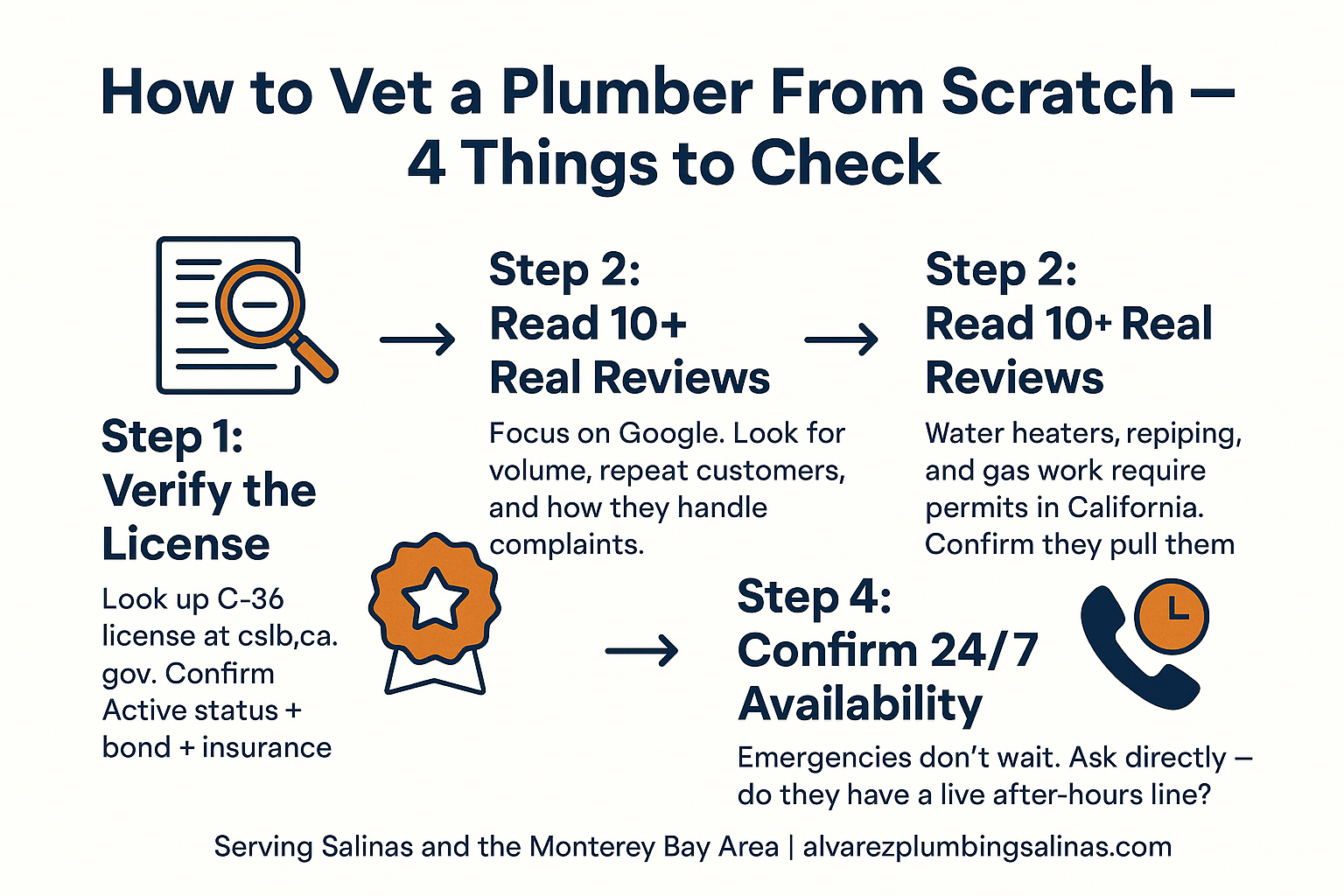
The 4-Step Checklist for Vetting a Plumber You’ve Never Used
If you’re starting from scratch, this checklist walks you through the four things to confirm before anyone starts work on your home.
Permits Are Not Optional — and Many Contractors Skip Them
This is one of the most important things to ask before anyone starts work, and it’s the question most homeowners forget.
In California, several common plumbing jobs legally require a permit — including water heater replacements, repiping, gas line work, and sewer line repair. The City of Salinas enforces this, and so do the surrounding municipalities on the Monterey Peninsula.
What happens if a contractor skips the permit?
- The work may not pass a future home inspection if you sell
- Your homeowner’s insurance may deny a related claim
- You could be held liable for code violations even though you didn’t do the work
- The city can require the work to be redone — at your expense
California adopted updated 2025 Building Energy Efficiency Standards that affect how water heater replacements are handled and documented. A permit-ready contractor handles all of that for you. One who skips permits is saving themselves time and money at your expense.
If you’re evaluating options for a water heater job specifically, understanding how long your unit should realistically last in the Monterey Bay climate is a useful place to start — because it affects whether repair or full replacement makes more sense.
When you call a plumber, ask plainly: “Will you pull the permit for this job?” If the answer is vague, that tells you something.
Jobs That Typically Require a Permit in Salinas vs. Those That Don’t
Permit requirements vary by job type. This breakdown covers the most common residential plumbing work in the City of Salinas.
| Job Type | Permit Required in Salinas? | Why It Matters |
|---|---|---|
| Water heater replacement | Yes — always | 2025 CA Energy Standards apply; must be inspected |
| Repiping (water, gas, or waste lines) | Yes | Structural and safety inspection required |
| Gas line repair or extension | Yes | Gas work requires inspection before use |
| Sewer line repair or replacement | Yes | City requires inspection before backfill |
| Drain cleaning / hydro jetting | No | Maintenance work; no permit needed |
| Faucet or toilet replacement | No | Like-for-like fixture swap; no permit needed |
| Leak repair (minor, no line replacement) | Usually no | Depends on scope; confirm with contractor |
Emergency Situations: What 24/7 Actually Means
When a pipe bursts at 11 p.m. on a Saturday or a water heater fails on a Sunday morning, “24/7 emergency plumbing” either means something or it doesn’t.
Some contractors list emergency availability on their website and then route after-hours calls to voicemail. Others have a real dispatcher or on-call tech available every single day. Before you’re in a crisis, it’s worth a quick phone call to find out which one you’re dealing with.
A few questions worth asking upfront:
- Is there a live person answering calls after hours, or is it voicemail?
- What’s the typical response time for an emergency call in Salinas?
- Is the after-hours rate different from a standard service call?
Knowing the answers before something goes wrong is worth the two minutes it takes. And if you’re already in a situation where plumbing has failed and water damage is a risk, the faster you get a licensed plumber on site, the smaller the repair bill.
For context on what actually rises to the level of an emergency versus what can wait until morning, this breakdown of plumbing emergency criteria is worth reading before you make the call.
What Makes Salinas-Area Plumbing Different From Other Markets
If you’re coming from out of the area, a few local conditions are worth knowing because they affect what problems come up and how contractors handle them.
Hard water is common throughout the Salinas Valley and the Monterey Peninsula. Water from this region has high mineral content that accelerates sediment buildup inside water heaters, shortens the lifespan of fixtures, and contributes to scale in supply lines. A plumber who knows the local water supply will factor this into their recommendations — one who doesn’t might give you advice that works fine in Sacramento but doesn’t hold up here.
Aging housing stock is another factor. Much of Salinas was built in the 1950s through 1980s, and older homes in that range often have galvanized steel pipes that are well past their service life. Galvanized pipes corrode from the inside out, which means small leaks and slow drains can signal a much larger problem that a surface repair won’t fix.
Seasonal rainfall in the Monterey Bay Area also creates drainage issues that are fairly specific to this region. After a dry summer, the first heavy rains of fall can push debris and root intrusion into sewer lines that were already compromised. A contractor who sees this pattern every year knows what to look for — one who doesn’t may miss it entirely.
Frequently Asked Questions About Finding a Plumber in Salinas
How do I know if a plumber is actually licensed in California?
Go to cslb.ca.gov and search by the contractor’s name or license number. Look for an Active status, a C-36 Plumbing classification, and current bond and insurance. Takes about 60 seconds and tells you more than any ad or website.
Do I really need a permit for a water heater replacement in Salinas?
Yes, always. California state law requires a permit for water heater replacements, and the 2025 California Building Energy Efficiency Standards added documentation requirements that apply to all new installations. A licensed contractor handles the permit and the inspection — you shouldn’t have to manage that yourself.
What should I expect to pay for a plumber in the Salinas area?
Standard service call rates in the Salinas and Monterey Bay area typically run $100–$175 for the initial visit, with hourly labor ranging from $125–$200 per hour depending on the job type. Water heater replacements, including equipment, labor, and permits, usually fall in the $1,200–$2,500 range for a standard tank unit. Emergency calls outside business hours carry a premium — typically an additional $75–$150 depending on the contractor and time of day.
I’m managing a rental property in Salinas from out of state. How do I handle a plumbing emergency remotely?
The most important thing is having a plumber’s number saved before something goes wrong. Identify a licensed, local contractor who offers 24/7 emergency service and confirm they can work directly with your tenant on access. Ask upfront whether they can send photo documentation and written work orders — that’s important for your records and for any insurance claims. Some property managers keep a standing relationship with one plumber for exactly this reason.
How do I know if a drain problem needs hydro jetting or just a standard snake?
A standard drain snake works fine for soft clogs close to the drain opening. But if a drain backs up repeatedly, multiple drains are slow at the same time, or there’s a gurgling sound coming from other fixtures when you flush — that usually points to a blockage deeper in the line or a buildup that a snake can’t fully clear. Hydro jetting is a better solution for grease buildup, root intrusion, or recurring clogs in older lines.
Is a plumber who’s been in business longer actually better?
Not automatically — but decades of local experience does matter in a specific way. A contractor who has been working in Salinas since the 1980s has seen the same types of failures repeat across the same housing stock. They know what galvanized pipes look like from the inside, how the local water affects fixtures, and how the city permit office operates. That kind of accumulated, local knowledge is genuinely useful and hard to replicate quickly.
Need a Plumber in Salinas You Can Actually Count On?
Alvarez Plumbing has been serving Salinas and the Monterey Bay Area since 1988 — licensed, insured, bonded, and available 24 hours a day, 7 days a week. Whether you’re dealing with an emergency right now or just want a reliable contractor saved in your phone before something goes wrong, you can reach us at (831) 757-5465 or schedule service online at alvarezplumbingsalinas.com.