
Quick Answer
In Salinas, residential plumbing repair often gets more complicated in homes built around 1980 because many still have aging galvanized steel supply lines and cast iron or threaded galvanized drain systems that are now at or beyond their expected service window. In practical terms, that means recurring leaks, rust-colored water, slow drains, pressure problems, and hidden sewer vent issues are often symptoms of system-wide age rather than isolated defects. The right approach is diagnostic-first: inspect the actual pipe materials, test the drain, waste, and vent system where needed, and compare spot repair against partial or full repiping based on condition, access, and code requirements. In older Salinas homes, especially where local water quality and past retrofits have stressed the system, a clear repair-versus-replace plan is what prevents repeat failures and wasted money.
If you're dealing with a leak that keeps coming back, rusty water, or drains that never seem quite right, the age of the house plays a more significant role than often assumed. Residential plumbing repair salinas and the 1980 housing factor isn't just about old pipes. It's about how those older materials behave now, after decades of use, local water exposure, and patchwork repairs.
A lot of homeowners assume each problem stands alone. In older Salinas homes, that's often the mistake that costs the most.
Why 1980s Housing Matters for Salinas Plumbing
You turn on the hall bath faucet and get rusty water for a few seconds. The kitchen still works fine. A month later, a shutoff under the sink starts dripping again after a recent repair. In a lot of Salinas homes, that pattern points to house age and original pipe material, not three unrelated problems.
That is the 1980 housing factor in practical terms. A large share of Salinas homes went up during the city’s growth years, and many of those plumbing systems are now old enough to fail in predictable ways. The issue is not just age. It is age plus local water conditions, prior remodel work, and the way older installations were tied together before current code expectations tightened up.
In the field, the same trade-off comes up over and over. A homeowner wants to fix the leak they can see. The smarter first step is to ask whether that leak is only the weak spot that showed up first. On houses from this era, that is often the case.
Salinas adds its own twist. Hard water and mineral scale shorten the distance between “working” and “problem pipe,” especially on older galvanized lines and older valves. A line can still hold pressure and still be badly restricted inside. That is why one bathroom may feel weak while another seems normal, or why water quality complaints show up before an obvious pipe break.
Code history matters too. Many homes from that period have a mix of original piping and later patches. Once a repair opens walls, changes pipe size, or replaces enough of a run, current permit and code requirements can affect what has to be brought up to standard. That is one reason a cheap spot repair sometimes turns into a larger recommendation after inspection.
A practical rule in Salinas is simple: if a house from this era has discolored water, uneven pressure, recurring angle-stop leaks, or repeat drain trouble, treat it as a system diagnosis first. Homeowners dealing with that pattern can get a clearer baseline from this guide to common plumbing problems in 40-year-old homes.
What makes this housing era different
Older homes do not all fail the same way. In many 1980s Salinas houses, the concern is the combination of original materials nearing the end of service life and decades of partial repairs layered on top.
That creates a few common real-world problems:
- One repair exposes the next weak point: Replacing a failed valve or short section can restore pressure and stress another corroded section nearby.
- Symptoms show up unevenly: Restriction, scale, and old branch lines can make one fixture look fine while another performs badly.
- Past remodels complicate diagnosis: Copper, galvanized, ABS, cast iron, and newer connectors may all be present in the same house.
- Code upgrades can attach to repair work: The bigger the repair, the more likely venting, cleanouts, strapping, shutoffs, or water-heater details need a second look.
Early signs homeowners should take seriously
Small symptoms matter more in this age range because they often show system wear, not just fixture wear.
- Brown or rust-tinted water, especially after sitting overnight
- Pressure drop at specific fixtures, often worse at far bathrooms or hot-water side fixtures
- Repeat leaks in different rooms, even if each leak seems minor on its own
- Slow drainage without a simple stoppage, which can point to internal scale, rough pipe walls, or alignment issues
- Frequent valve failures, especially at older shutoffs and stub-outs
None of that means every 1980s home needs a full repipe. It means repair decisions should be based on actual condition, access, and how much original system is still in service. That is the difference between one durable fix and a string of callbacks.
Common Materials and Typical Failure Points in 1980s Homes
What fails depends on what was installed. In older Salinas homes, the most common trouble spots are galvanized steel supply lines, early copper runs in some remodels, and cast iron or threaded galvanized drain, waste, and vent piping.

Galvanized supply lines
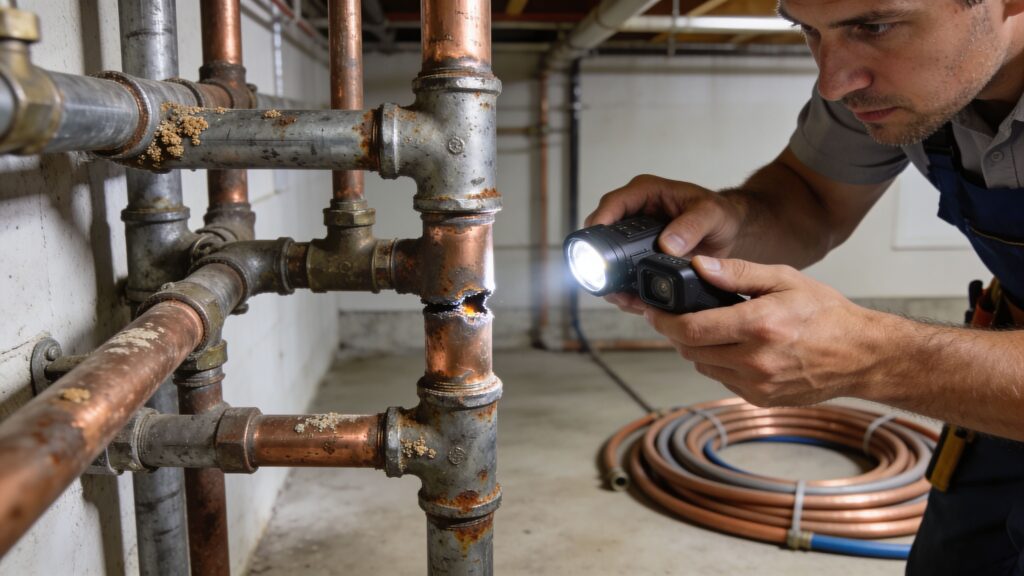
Galvanized pipe usually fails from the inside first. The inside diameter shrinks as rust and mineral scale build up, so the homeowner notices pressure loss before they notice a visible leak.
The weak points are often:
- Threaded joints
- Horizontal runs
- Stub-outs under sinks
- Transitions to newer materials
A pipe can look acceptable from the outside and still be heavily restricted inside. That's why old galvanized often fools people. It doesn't always announce itself with a burst right away.
Cast iron and older DWV lines
Drain lines age differently. Cast iron can corrode, scale up, crack at joints, or settle out of alignment over time. In homes with shifting soils or long service life, offsets and belly sections become part of the picture.
The trouble spots tend to be:
| Location | What commonly goes wrong | What you notice |
|---|---|---|
| Under sinks | Corrosion at traps, arms, or wall connections | Odor, drips, staining |
| At slab penetrations | Movement, cracking, seepage | Dampness, staining, recurring clogs |
| Main drain sections | Internal scale, offsets, root intrusion if applicable | Slow drainage across multiple fixtures |
| Vent connections | Poor venting or deterioration | Gurgling, trap issues, sewer odor |
Mixed-material systems after older remodels
Many homes no longer have one clean, original system. They have old galvanized in one wall, copper from an older repair, maybe PVC or ABS in a later drain update, and fittings joining all of it together.
That creates trade-offs. A spot repair may solve the immediate leak but leave the oldest, most restricted section in place. If you're unsure whether what you're seeing is normal aging or urgent deterioration, this guide on pipe corrosion in older homes is a useful starting point.
A repair works best when the surrounding pipe is still sound. If the material around the repair is brittle, scaled, or heavily corroded, the repair can become the strongest part of a failing run.
That isn't a sales line. It's just what happens in older systems.
Green Retrofit and Water Conservation Impacts on Old Pipes
Water-saving upgrades make sense. The problem is sequencing.
On a newer home, adding efficient fixtures and updating backflow protection is usually straightforward. On an older house, green inspections often uncover hidden leaks and mineral buildup that low-flow fixture mandates alone don't catch, especially in systems that weren't designed for today's pressure profile (PMC article on Salinas Valley housing conditions and related plumbing concerns).
Why retrofit-first can backfire
A homeowner replaces toilets and showerheads to save water. A property manager adds a backflow device or updates fixtures for compliance. Then pressure behavior changes, old restrictions show up, and weak sections start leaking.
That doesn't mean low-flow fixtures are the problem. It means the old piping may not have been healthy enough to accept the upgrade without a proper check first.
A better order of operations
For older homes, the safer sequence is usually:
- Inspect first: Look for existing leaks, pressure problems, and drain restrictions.
- Run a camera when needed: Main lines and questionable drains should be seen, not guessed at.
- Fix the infrastructure issue: Address the pipe condition before assuming a fixture swap solves anything.
- Install conservation upgrades after that: Once the system is stable, efficient fixtures make more sense.
Homeowners looking into broader green retrofitting ideas should keep that sequence in mind. Water conservation is worthwhile, but older plumbing needs to be evaluated on its own condition first.
For Salinas properties built around 1980, sustainable upgrades work better when they follow a real inspection path. This article on sustainable plumbing fixes for homes 40 years old gets into that balance.
Local Code and Permit Considerations for Aging Homes
Code questions get messy fast in older houses because the repair itself may be simple, but the existing system may not be. A small opening in a wall can expose venting, drain sizing, or material conditions that change the scope.
That’s why homeowners shouldn't rely on blanket advice from generic plumbing articles. Salinas requirements can vary by project, and older homes bring their own complications.
What matters on pre-1980 drain and vent work
HUD’s 1980 Plumbing DWV Guideline recommends testing older drain, waste, and vent systems for hydraulic integrity, and when minor rehab isn't enough, it calls for smoke or peppermint testing to identify hidden defects in the system (HUD Rehabilitation Guideline No. 7 Plumbing DWV Guideline for Residential Rehabilitation).
That matters because older drain problems aren't always visible at the fixture. A sink may drain slowly because of scale buildup, a vent issue, an offset section, or a failing connection behind the wall.
Practical code checks homeowners should ask about
When the house is older, ask direct questions:
- Will this repair expose older non-updated piping? That can affect what needs to be corrected.
- Does the venting still function properly? Older systems sometimes have sizing or configuration issues that only show up during testing.
- Is backflow protection part of the scope? In some projects, it should be reviewed as part of the repair plan.
- Do I need to verify permit requirements with the local building department? The answer depends on scope, location, and what the repair uncovers.
The City of Salinas and local building officials are the right place to verify permit requirements for your exact job. No plumber should promise that every similar repair follows the same paperwork path.
Aging homes also need a cleaner conversation around cross-connections and protection devices. This overview of backflow prevention requirements helps homeowners understand where that fits.
Older houses don't always fail code because they're old. They run into trouble because a new repair exposes an existing condition that can’t be ignored once it's opened up.
Inspection Checklist for Aging Plumbing Systems
A Salinas house built in the early 1980s can look fine at the fixtures and still have a plumbing system that is telling a different story. The useful inspection is not a hunt for one dramatic leak. It is a pattern check. Age, original materials, hard water scale, and later upgrades all leave clues.

Start with visible leak and corrosion points
Walk room by room and open every cabinet you can. Check under sinks, around toilet supply stops, behind the washer, at the water heater, and anywhere piping comes through the wall or floor.
Look for:
- Active moisture or damp surfaces: Cabinet bottoms, baseboards, and drywall can stay wet long after a small leak stops dripping.
- Staining and swelling: Yellowing, dark marks, bubbled paint, and soft wood usually mean the problem has been there longer than you think.
- Corrosion at valves and stub-outs: In older Salinas homes, these spots often show mineral buildup first, especially where original metal piping meets newer repair parts.
- Odors near fixtures: A sewer smell may point to a drain, vent, or trap problem instead of a simple clog.
Check how the system behaves under normal use
Open a faucet, then open another in a different part of the house. Flush a toilet while water is running. Turn on a shower and watch what happens to nearby fixtures.
You are checking for pressure drop, delayed hot water, sputtering, or discolored water after the line has sat. In 1980s homes, those symptoms often tell more than a static pressure reading because partially restricted pipes can look acceptable until more than one fixture runs at once.
A hose bib gauge can still help. Just do not treat one number as the whole diagnosis.
Focus on the trouble spots common in older Salinas homes
Some areas deserve a closer look because they fail in ways homeowners miss:
- Slab and wall penetrations: Check for dampness, mineral residue, or cracking where pipes enter floors and walls.
- Previous repair areas: Mixed materials, extra couplings, and patched sections often show where the system has already started a repeat-failure cycle.
- Main drain performance: If more than one fixture drains slowly, the problem may be in the branch or main line, not at the sink or tub.
- Water heater connections: Heat, age, and mineral buildup make these joints worth inspecting carefully.
- Water treatment equipment and bypass valves: Make sure valves turn, bypasses work, and no older fittings are seeping around the unit.
One symptom can be minor. Several small symptoms in different parts of the house usually mean the system needs a broader look.
Know when a basic check is no longer enough
A homeowner inspection can catch warning signs, but it cannot show pipe wall condition inside the line or confirm how far a recurring problem extends. If the house has repeat leaks, chronic low flow, or a mix of old and newer repairs, get the system inspected with diagnosis in mind, not just repair in mind.
If you are trying to decide whether the house needs another spot repair or something larger, this guide on how to tell if your house really needs repiping lays out the practical signs to weigh.
Repair and Repiping Options with Cost Ranges
A Salinas homeowner usually calls at this stage after the second or third leak, not the first. That matters, because once a 1980s system has a repair history, the job is no longer just fixing one wet spot. It is deciding whether to keep patching a material that is aging in Salinas water, or replace enough pipe to stop opening the same walls every year or two.
Cost follows scope, access, and finish repair more than any price-per-foot shortcut. A clean repair in an exposed garage wall is one job. A leak behind a tiled shower on an exterior wall is a different job entirely.
When spot repair makes sense
Spot repair is the right call when the failure is isolated and the surrounding pipe still tests out well. Good examples are a bad stub-out, a failed valve, one damaged section under a sink, or a single exposed branch with no wider pattern of corrosion or pinhole leaks.
I usually caution homeowners against repeated spot repairs when the house already has mixed patches from different decades. In many Salinas homes from the 1980s, that patchwork is the key clue. It often means the visible leak is one of several weak points, not a one-off failure.
When partial repiping is the practical middle ground
Partial repiping makes sense when one zone keeps causing trouble. That could be a bathroom group, the kitchen and laundry side, or a hot-water run with known access and known history. You replace the section with the highest failure risk, improve reliability where it matters most, and delay the cost and disruption of a whole-house job.
This approach works well in houses where the framing and access are uneven. Many homes from Salinas's 1980s growth years have additions, remodels, or tight wall cavities that make one side of the house easy to reroute and another side expensive to open. Partial repiping lets you stage the work instead of forcing everything into one large project.
When full repiping is the cleaner long-term fix
Full repiping is usually the better investment when leaks show up in multiple areas, flow has dropped at several fixtures, or the home has a long trail of previous repairs. At that point, labor starts going into drywall cuts, texture repair, and repeat troubleshooting instead of lasting pipe replacement.
A full repipe in California often lands in the broad middle thousands, but the exact number depends on layout, material choice, permit requirements, and how much finish repair is needed after the piping work. Homeowners weighing that decision can compare the warning signs in this guide on how to tell if your house really needs repiping.
Material choices and practical trade-offs
| Material | Where it often fits best | Main trade-off |
|---|---|---|
| PEX | Attics, crawlspaces, and reroutes with difficult access | Flexible and efficient to install, but layout and protection details matter |
| Copper | Owners who want a rigid, familiar system and direct replacement in visible areas | Durable, but usually costs more in labor and material |
| CPVC | Limited repair or replacement scopes where allowed and appropriate | Lower material cost, but not my first choice for every older-home retrofit |
In Salinas, material choice is not just preference. Water chemistry, sun exposure, routing path, wall access, and local code all affect what holds up and what makes sense to install. The cheapest material on paper is not always the lowest-cost repair over the next ten years.
Homeowners planning phased work should keep records of every repair, shutoff replacement, and leak location. A simple preventive maintenance checklist template can help track patterns and make the next repair decision based on history, not guesswork.
Preventative Maintenance and Emergency Response Tips
Older plumbing rewards attention. Not constant worry, just regular checks and fast action when something changes.
A small drip under a sink can stay small for a while. The damage around it usually doesn't.

Good habits that help older systems last longer
You don't need a complicated routine. You do need consistency.
- Check under sinks regularly: Catch moisture early before cabinet bottoms swell and wall cavities stay wet.
- Exercise shutoff valves: Older valves that never move often fail when you suddenly need them.
- Pay attention to drain speed: One slow fixture may be local. Several slow fixtures usually aren't.
- Schedule camera inspection before aggressive drain cleaning when the line is old: That helps avoid guessing at pipe condition.
- Keep a written maintenance log: A simple record makes repeat issues easier to spot.
If you want a simple format for staying organized, this preventive maintenance checklist template is a useful general framework.
Why sink leaks deserve quick attention
Salinas Valley research linked sink leaks and mold growth with increased rodent infestations, and those moisture-heavy conditions can lead to more pipe damage in already stressed homes. In plain terms, wet cabinets and hidden wall moisture don't just rot materials. They also create conditions that bring in pests and add another layer of damage risk.
That’s one reason an “I'll get to it later” leak under the kitchen sink can turn into a much larger repair.
What to do during an urgent leak
When a pipe lets go or a leak suddenly gets worse:
- Shut off the water at the nearest valve if that valve works.
- If not, shut off the main water supply immediately.
- Open a faucet to relieve pressure and slow continued discharge.
- Move contents away from the wet area.
- Use buckets and towels to limit cabinet and flooring damage.
- If the issue involves drains or sewer backup, stop using affected fixtures.
Don't start cutting into walls because you think you know where the leak is. In older homes, the visible water path often isn't the source.
Hydro jetting, drain cleaning, and camera inspection are useful tools, but on aging systems the sequence matters. See the pipe first when condition is uncertain, then choose the least risky method that solves the underlying problem.
Why Choose Alvarez Plumbing for Your Salinas Home
Older homes need a plumber who can tell the difference between a good repair and a temporary patch. That matters in Salinas, where homes from the 1980-era building cycle often have a mix of aging materials, past repairs, and hidden weak points that don’t show up until the system is tested properly.
Alvarez Plumbing takes a diagnostic-first approach. That means clear repair-versus-replace guidance, practical explanations, and transparent pricing instead of pushing a bigger job before the evidence is there. For homeowners trying to make a smart decision on an older house, that’s the right way to handle residential plumbing repair salinas and the 1980 housing factor.
The company also offers 24/7 emergency plumbing support, which matters when an older supply line bursts at night or a failing drain line stops working when you least expect it. With confirmed services that include plumbing repairs, repiping, hydro jetting, sewer line repair, video camera inspections, backflow prevention, and water heater work, the scope matches the problems older homes present.
FAQ
Q: How do I know if my Salinas home has the 1980 housing factor?
A: Start with the build year and the pipe materials. If the home was built around 1980 and still has original galvanized supply lines or older cast iron drains, age-related failure patterns are a real concern. Rust-colored water, uneven pressure, recurring leaks, and repeated drain issues are common warning signs.
Q: Should I repair one leak or plan for repiping?
A: It depends on the condition of the surrounding pipe. If the problem is isolated and the nearby piping is still sound, a local repair may be enough. If leaks are showing up in multiple places or pressure loss is widespread, repiping becomes the more sensible long-term option.
Q: Can I install low-flow fixtures before fixing old pipes?
A: Sometimes, but it’s safer to inspect first. Older systems can have hidden restrictions, leaks, and weak points that show up once fixture performance changes. A quick upgrade can expose bigger problems if the underlying piping is already failing.
Q: Are old drain problems always caused by clogs?
A: No. In older homes, slow drains can come from internal scale, poor venting, offset joints, or deteriorated drain piping. That’s why camera inspection and proper testing often matter more than repeated snaking.
Q: Do plumbing repairs in older homes always need permits?
A: Not always. Permit needs vary by the scope of work and what the repair uncovers once the wall or floor is opened. The safest move is to verify current requirements with the local building department for your specific project.
Q: What should I do first if a pipe bursts?
A: Shut off the nearest working valve if possible, or shut off the main water supply right away. Open a faucet to relieve pressure, protect nearby flooring and cabinets, and stop using affected fixtures until the problem is evaluated. Fast action limits water damage more than anything else.
Q: Is brown water always a water heater problem?
A: No. Brown water can also come from corrosion inside older galvanized supply piping. If it happens at multiple fixtures or shows up inconsistently, the supply lines need to be considered along with the water heater.
Alvarez Plumbing has spent decades working in Salinas and throughout Monterey County, so the team understands the difference between a straightforward repair and the kind of older-house problem that needs a bigger plan. That local experience matters when you're dealing with aging piping, mixed-material systems, and homes that need code-compliant work without guesswork.
Just as important, Alvarez Plumbing stays available when older systems fail on their own schedule. If a pipe bursts, a drain line backs up, or you need a clear answer on whether to repair or repipe, you’re working with a company that focuses on practical solutions, clear communication, and dependable 24/7 response.
If you want help with residential plumbing repair salinas and the 1980 housing factor, Alvarez Plumbing is available for estimates, inspections, and emergency service. Call 831-757-5465, visit 365 Victor St, Salinas, CA, or stop by alvarezplumbingsalinas.com. They’re open 24 hours a day, 7 days a week.
Sources
Trust Campbell. "Common Plumbing Issues for Homes Built in the Nineteen Eighties." URL: https://trustcampbell.com/blog/common-plumbing-issues-for-homes-built-in-nineteen-eighties/
HUD User. "Rehabilitation Guidelines 1980 Plumbing DWV Guideline for Residential Rehabilitation." URL: https://www.huduser.gov/portal/sites/default/files/pdf/Rehabilitation-Guidelines-1980-Plumbing-DWV-Guideline-for-Residential-Rehabilitation.pdf
National Center for Biotechnology Information. "Salinas Valley housing conditions study and related findings on leaks, mold, and infestations." URL: https://pmc.ncbi.nlm.nih.gov/articles/PMC1314924/