
Direct Answer: Most straightforward tank swaps keep the water off about 2 to 4 hours. After that, expect roughly another 30 to 90 minutes on gas, longer on electric, before the tap runs hot.
You found the puddle this morning, the tank is 12 years old, and the real question in your head is not what it costs. It is how much of today you lose, and whether anyone in your house gets a hot shower tonight.
About one in ten calls we take in early fall opens with some version of “can someone come out today.” The honest answer almost always splits into two numbers, and nobody ever tells you the second one.
Here is the position we will back up below: “same day” is not the number that matters. What matters is the water-off window and then the reheat wait, and what moves both of those is where your heater sits and what shape the old connections are in. Not the brand of the new unit.
How Long Does a Water Heater Replacement Take? Two Separate Clocks
A standard tank changeout in a Salinas garage is usually a 2 to 4 hour job with the water shut off. Then there is a second stretch where the water is back on, the plumber is gone, and the tank is still coming up to temperature.
The sequence runs roughly like this:
- Shut off the gas or the breaker, then the cold water supply
- Drain the old tank down through a hose
- Disconnect the water, gas or electrical, and vent, then haul the old unit out
- Set the new tank, level it, and strap it
- Reconnect water, gas or power, venting, and the temperature and pressure relief discharge line
- Refill the tank and purge the air out of the hot side at the fixtures
- Light it off or energize it and let it recover
That last step is its own clock. A gas tank usually gives you some usable hot water in about 30 to 45 minutes and a full tank in 60 to 90 minutes. A standard electric unit is slower, often 2 to 3 hours for a full tank, which is why the U.S. Department of Energy talks about recovery rate as a spec worth knowing before you buy.
So a job that starts at 1pm and finishes at 4pm can still mean hot showers by dinner. Just not at 4pm.
What Each Part of the Day Actually Takes
These are typical ranges for a straightforward tank-for-tank swap. A difficult access situation stretches the middle rows, not the last one.
| Phase | What’s happening | Typical time |
|---|---|---|
| Shut off and drain | Gas or power off, cold supply closed, tank drained to a hose | 20 to 60 minutes, longer with heavy sediment |
| Disconnect and remove | Water, gas, vent disconnected, old tank hauled out | 20 to 45 minutes |
| Set and reconnect | New tank placed, strapped, water, gas, vent, and relief line connected | 60 to 120 minutes |
| Fill and purge | Tank refilled, air bled from hot lines at fixtures | 15 to 30 minutes |
| Reheat to temperature | Burner or elements bring a full tank up | 30 to 90 minutes gas, 2 to 3 hours electric |
Where the Tank Sits Decides the Day
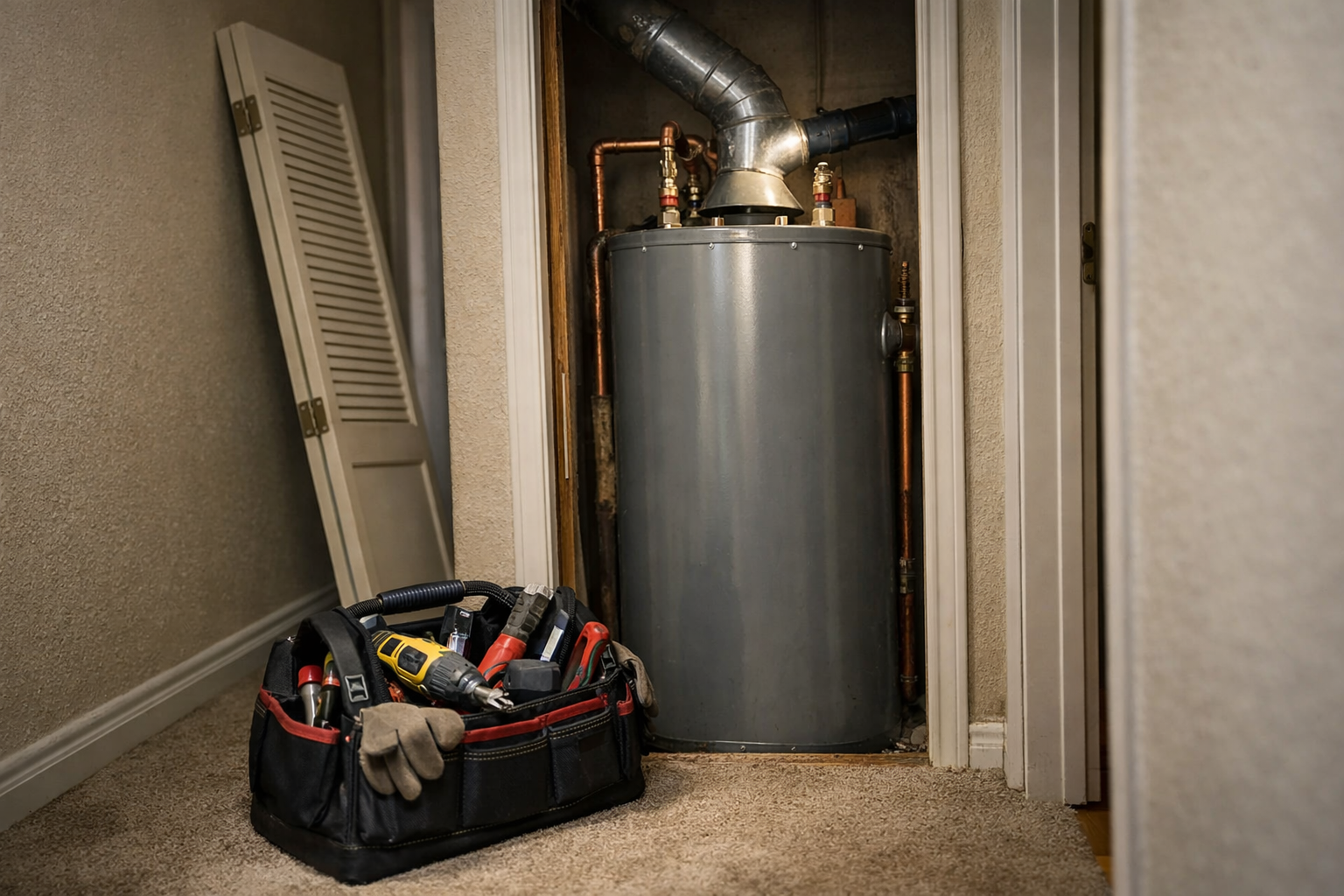
One customer put it better than we could: “My hot water heater is in a complicated spot that requires removing a door to access the tank.” That single sentence explains most of the difference between a three hour job and a six hour one.
The access problems we run into around Salinas and the Monterey Peninsula tend to repeat:
- A tank boxed into a hallway closet with a door or trim that has to come off
- A garage corner stacked with storage that has to be cleared before anything moves
- A raised platform or a crawlspace with a tight path out
- Old venting that cannot be reused and has to be rebuilt
- A corroded cold water shutoff valve that fails the moment it is turned
- Gas flex connectors and dielectric unions that are past their service life
This is common here rather than unusual. The median Salinas home dates to the mid 1970s, and roughly one in nine local homes was built before 1950. Dated connections at the heater come with that territory.
It is also why no honest plumber commits to an exact hour count over the phone. The walk-up to the unit is where the timeline really gets set, and a tech can usually tell you within a minute or two of seeing the space whether you have a simple swap or a long one.
The Quiet Part: Draining a Tank That Was Never Flushed
Cal Water publishes average hardness around 254 ppm for the Salinas system, with the Salinas Hills system testing higher, and the utility itself notes that hard water builds mineral deposits in pipes and water heaters.
After a decade of that, the bottom of a tank can hold a thick layer of sediment. A drain that should take 20 minutes slows to a trickle, and sometimes the drain valve has to be cleared before anything moves at all.
That is usually what is happening during the quiet stretch early in the visit. It also tells you something about the new unit: the same buildup that slowed today’s drain is what will shorten the life of the tank going in, which is the whole argument for an annual flush on a water heater that has never had one and part of the case homeowners weigh when they look at whether a softener makes sense in 254 ppm water.
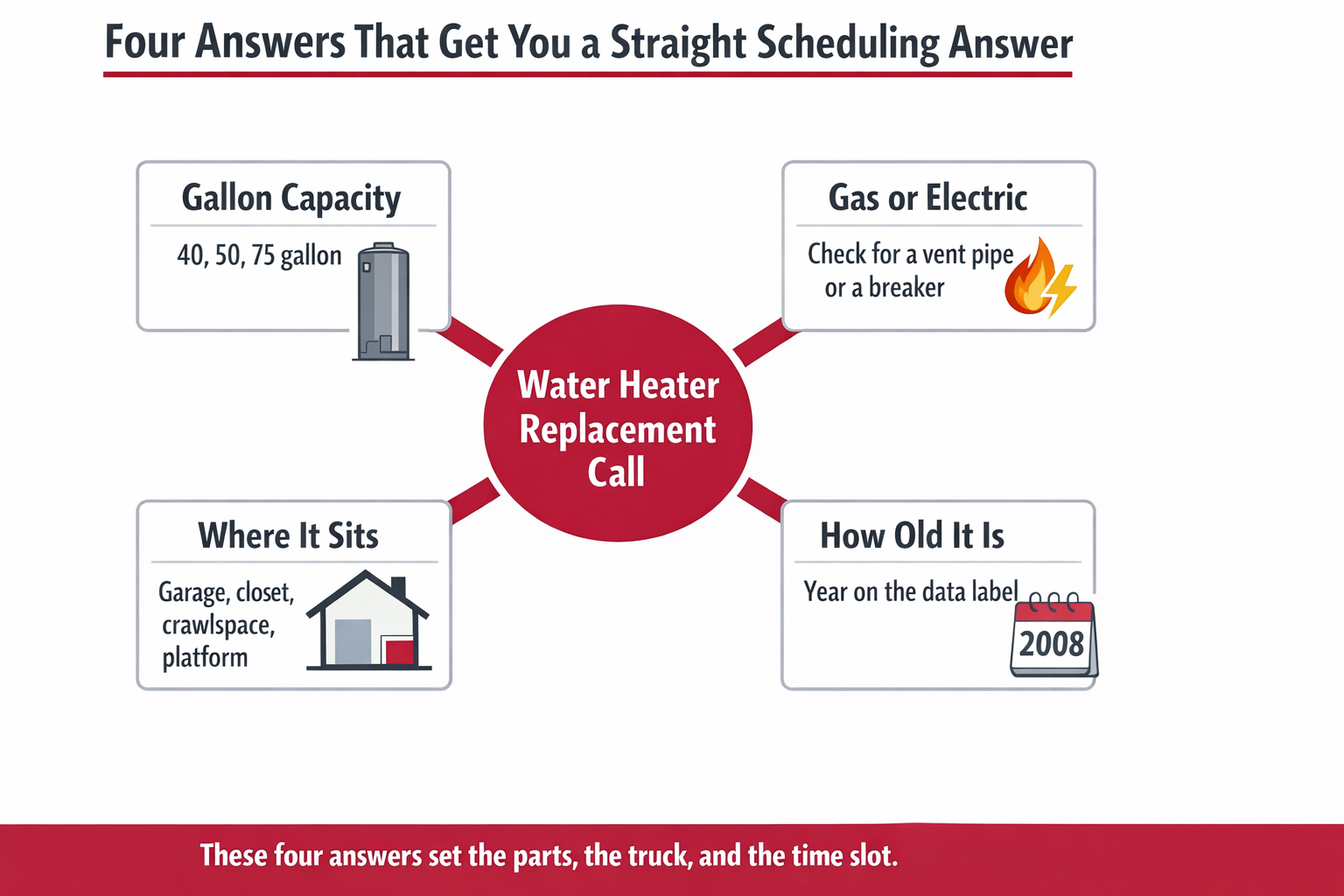
Four Answers That Let a Dispatcher Say Yes or No
When you call about a failed heater, these four details are what let someone on the phone tell you whether today is realistic.
Can It Really Happen Today? What Has to Line Up
General scheduling is a separate question, and we have covered how same-day plumbing scheduling actually works elsewhere. This is about what has to be true once a truck is in your driveway.
A same-day replacement usually needs all of these to line up:
- The new unit matches the existing fuel type, gas or electric
- The gallon capacity stays the same, or the gas line and electrical circuit support a change
- The model is in stock locally, not on a three-day order
- The venting can be reused or rebuilt with parts on the truck
- Code items that have to be brought current while the old unit is out, such as seismic strapping, a correctly routed relief discharge line, and proper venting and clearances, do not turn into a bigger project
That last line is where most same-day jobs go long. Once the old tank is out of the way, you can finally see what was behind it.
One homeowner wrote in asking whether a unit bought that morning at a big box store could go in the same day. That can work, and we have written about what changes when you supply the unit yourself, but it is worth confirming the size and fuel type match before the box is in your garage.
And if your situation is a leak rather than a dead heater, say so. A tank weeping at the base is a different conversation from one that simply stopped heating.
The Permit Does Not Hold Up Your Shower
This is the part most homeowners assume will cost them a day, and it does not.
A water heater changeout in Salinas calls for a residential plumbing replacement permit through City of Salinas Community Development. The contractor files it, and the inspection is scheduled separately on a later day, after your hot water is already back.
When the inspector does come out, the items under review are short: seismic strapping, the temperature and pressure relief discharge line and where it terminates, venting, and required clearances around the unit. California has also been moving toward remote video inspections for water heater permits, which may shorten that step further.
The reason to care is resale. A documented, permitted replacement shows up cleanly when a buyer’s inspector looks at the tank, and an undocumented one raises a question you then have to answer.
Frequently Asked Questions About Water Heater Replacement Timing
How long will my water be shut off during the replacement?
For a straightforward tank-for-tank swap, usually 2 to 4 hours, and that is only the water heater’s supply in most homes. The whole-house shutoff is typically only needed briefly at the start and end of the job.
Why does it still take time to get hot water after the plumber leaves?
Because a 50-gallon tank has to heat 50 gallons of cold water from scratch. Gas units usually give usable hot water in 30 to 45 minutes and a full tank in 60 to 90 minutes. Standard electric units commonly take 2 to 3 hours. Running a shower during that window just drains the hot you have and restarts the clock.
Does a tankless installation take longer than a tank swap?
Usually yes, often a full day or more. A first-time tankless conversion frequently involves a larger gas line, new venting, and a different mounting location, so it is a different job from a like-for-like tank replacement. If you are replacing an existing tankless unit with the same model type, the timeline tightens considerably.
My water heater is leaking at the base. Can it wait until Monday?
A tank leaking at the base is failing, and the leak rate rarely stays the same. One Salinas homeowner wrote in describing a leak in the same spot by the garage water heater several years running, which is often a sign the problem was never actually the tank. Either way, water pooling in a garage or near drywall is worth looking at sooner rather than later.
Will I be told the full cost before work starts?
You should be. Installed replacement cost in this market generally lands somewhere in the $1,895 to $2,500 range for a standard tank, but that moves with capacity, access, venting, and whatever code items have to be corrected while the old unit is out. Ask for the number in writing after someone has seen the space, not over the phone.
Planning Around a Water Heater Replacement in Salinas
One customer summed up the fear well: “I was out of town when my water heater went out and knew dealing with the larger companies would mean a huge delay.” Alvarez Plumbing has been a family-run shop doing Salinas water heater changeouts since 1988, licensed, insured, and bonded, and we file the City of Salinas permit as part of the job rather than handing it back to you. The phone at (831) 757-5465 is answered around the clock, so a failure at 7pm on a Friday is not automatically a Monday problem.
