
Direct Answer: A soft wet patch in dry weather, a whole-house pressure drop, or a high-usage alert usually points to the buried supply line. A licensed plumber confirms it with pressure testing and acoustic listening before anyone digs.
You walked out to the front yard and one spot is soggy. It hasn’t rained in weeks, the sprinklers are off, and the grass there is greener than everything around it.
We get these calls constantly in Salinas. One homeowner told us they got a high water usage alert from California Water Service and suspected a leak somewhere between the meter and the house. Another described the buried line feeding a garden hose bib giving out. A third had water seeping slowly near the curb.
This is not a rare problem here. Between our older housing stock and mineral-heavy soil, buried supply lines fail regularly across Salinas and the Monterey Peninsula. Below we walk through how to tell if the leak is actually yours, how a plumber pinpoints it without tearing up your yard, and what the repair decision really looks like.
First Question: Which Side of the Meter Is Leaking?
This matters before anything else, because it decides who pays.
The water utility owns the line up to and including the meter. You own the line from the meter to your house. If water is bubbling up right at the curb box or the meter itself, that is a call to your water provider, not a plumber.
Here is a simple check you can do in ten minutes:
- Shut off every fixture, appliance, and irrigation valve in the house.
- Open the meter box lid in the parkway strip and find the small leak indicator dial or triangle.
- Watch it for a couple of minutes. If it is still creeping, water is moving somewhere.
- Now close the main shutoff valve at your house. If the dial stops, the leak is on your side, between the meter and the shutoff.
- If the dial keeps moving with your house valve closed, the problem is likely upstream and belongs to the utility.
That one test saves a lot of guesswork. It also gives you something concrete to say when you call, which speeds up the whole visit.
The Signs Are Easy to Miss Until They Aren’t
Underground leaks rarely announce themselves. The line is buried 18 to 30 inches down, and the water usually travels sideways through soil before it ever surfaces.
Watch for these:
- A wet or spongy patch of yard in dry weather. Sometimes it is greener grass. Sometimes it is a soft spot that never firms up.
- Low pressure everywhere in the house. One weak faucet is a fixture problem. Weak pressure at every tap, hot and cold, points upstream.
- A water bill spike or a utility usage alert. Cal Water flags accounts when meter readings suggest continuous flow. For a lot of homeowners, that notice is the very first sign.
- The sound of running water when nothing is on, especially near where the line enters the house or garage.
- Sediment or cloudy water after the pressure drops, which can mean soil is being pulled into a breach.
A single sign might be something else. Two or three together, and the buried line moves to the top of the list. If your first clue was the bill rather than the yard, we cover the billing side of leaks in more detail here.
What Each Symptom Usually Points To
Symptoms overlap, but each one narrows the field. Here is how we sort them in the field.
| What You’re Seeing | Most Likely Cause | How Fast to Act |
|---|---|---|
| Wet patch in yard, no rain | Break or pinhole in the buried supply line | Within days. Soil erosion gets worse fast |
| Whole-house pressure drop | Supply line restriction, corrosion, or a failing pressure regulator | Within a week |
| High usage alert, no visible water | Slow underground leak draining into soil or a storm drain | Within days, before the next bill cycle |
| Water at the curb or meter box | Likely the utility’s side of the connection | Call the water provider first |
| Wet spot plus sinking pavers or walkway | Active washout under hardscape | Same day. Structural risk |
Galvanized Pipe Is Why This Keeps Happening in Salinas
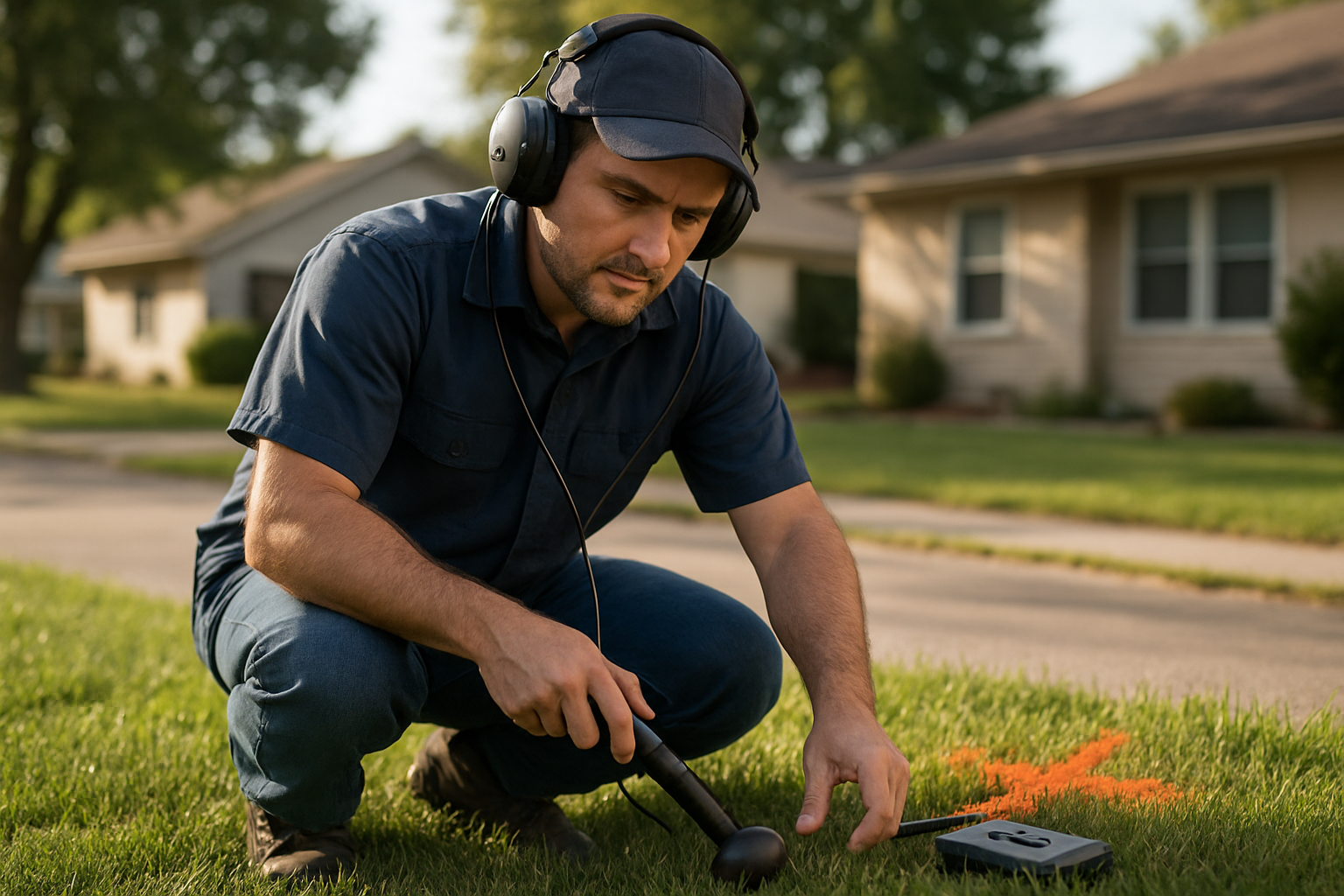
If your home was built before the 1970s, there is a solid chance the line from the meter to the house is galvanized steel. We still pull it out of yards in Alisal, Oldtown, and plenty of Monterey and Pacific Grove neighborhoods.
Galvanized pipe corrodes from two directions at once. The zinc coating wears off the inside as water passes through, and the outside sits in damp mineral-heavy soil that eats at the wall. Salinas water tests around 254 ppm hard, which does the interior no favors.
Once a pinhole opens up, the wet soil around it speeds up the corrosion on either side of the hole. That is why patching galvanized pipe is usually a short-term move. You fix one spot and another shows up eighteen months later two feet down the line.
Copper or PEX replacement is the permanent fix. Both handle our soil and water chemistry far better, and both come with real service life instead of a countdown. If you want the broader picture on how age-related failures cluster in local homes, this piece on plumbing problems showing up in patterns explains it well.
How a Plumber Actually Finds the Leak
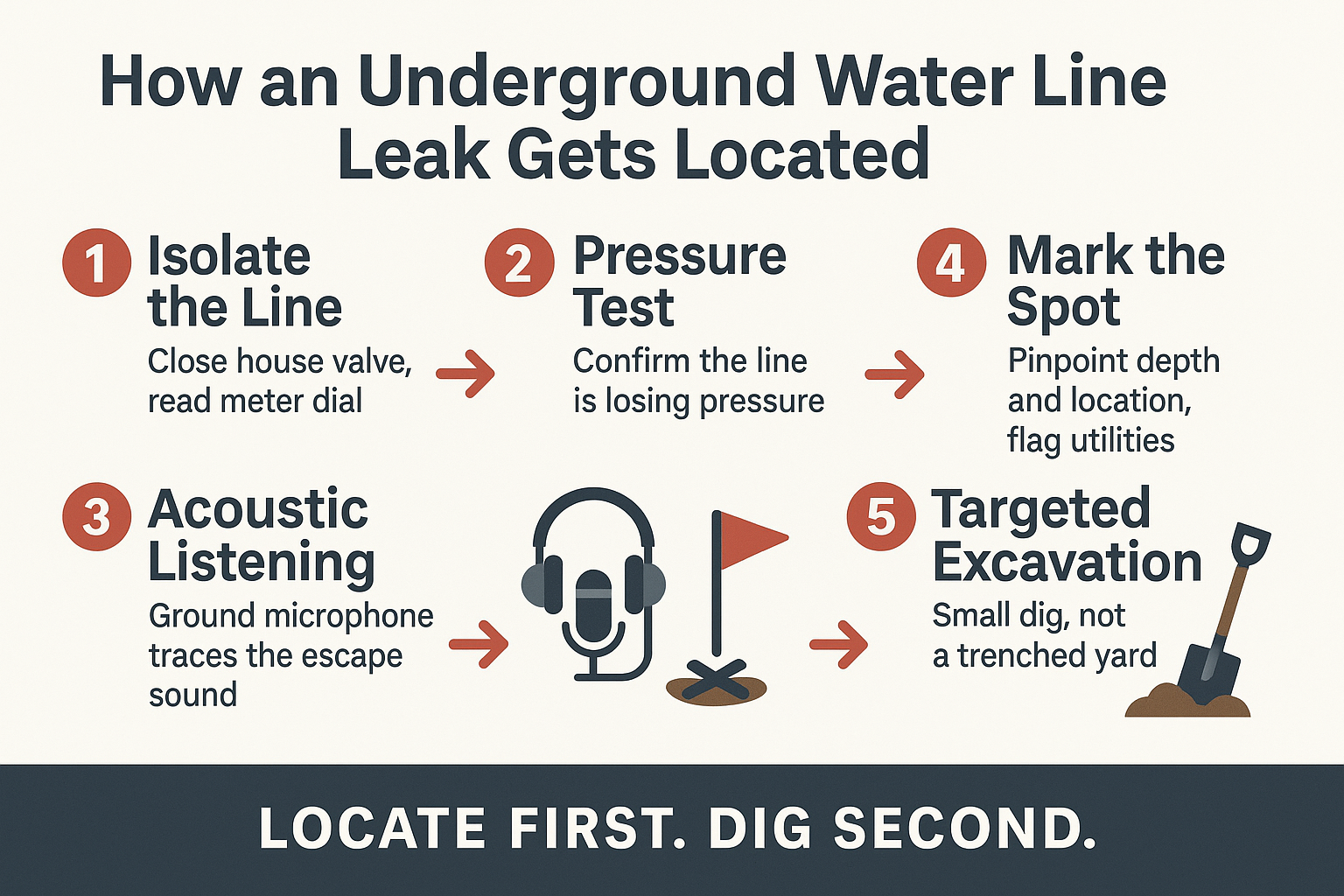
No one should be digging based on where the grass looks wet. Here is the sequence a licensed plumber follows before a shovel touches soil.
Why Precise Location Keeps the Repair Cheaper
This is the part homeowners underestimate. Excavation is the expensive half of the job, not the pipe.
Every extra foot of trench means more labor, more restoration, and more risk of clipping something that costs money to fix. In a typical Salinas yard, that buried line runs right alongside irrigation laterals, low-voltage lighting, mature root systems, and sometimes a driveway or paver walkway. On the hillside properties out toward Corral de Tierra and Toro Park, you also have footings and grade to think about.
So a plumber locates first. That means:
- Pressure testing the isolated line to confirm the loss is real and measure how fast it is dropping.
- Acoustic listening equipment run across the ground surface to trace the hiss of water escaping under pressure.
- Video camera inspection on accessible portions where the pipe layout is unclear.
- Marking depth and location before anyone cuts turf.
Get that right and the repair can be a single small pit instead of a trench across the whole front yard. Get it wrong and you pay twice, once to dig in the wrong place and again to dig in the right one. There is a reason the U.S. EPA treats household leaks as a serious water waste issue, and a buried supply leak runs 24 hours a day until it is found.
Patch It or Replace the Line? How to Think It Through
Once the leak is located, you have a real decision to make. It usually comes down to material and age.
Lean toward a spot repair when:
- The line is copper or PEX and the damage is clearly mechanical, like a shovel strike or root pressure.
- The rest of the pipe looks sound when it is exposed.
- This is the first failure you have had.
Lean toward replacing the whole run when:
- The line is galvanized steel and shows scaling or wall thinning at the dig.
- You have already had one or two repairs on the same line.
- Whole-house pressure has been declining for years, not just since the leak appeared.
On cost, it varies more than most people expect. A straightforward locate-and-repair on a short run is a very different number from replacing a long line under a mature landscape or a concrete driveway. Length, depth, soil, access, and whether hardscape has to come up drive the price more than the pipe itself does. Ask for the estimate in writing with the excavation and restoration broken out separately, and if you are gathering more than one bid, here is how to compare plumbing quotes fairly.
Frequently Asked Questions About Underground Water Line Leaks
Can I just dig it up myself and look?
We would not. Buried water lines share space with gas, electrical, and communication lines, and California requires utility marking before excavation. Beyond the safety issue, exploratory digging without a locate usually costs more than the locate would have, because you end up with several holes instead of one.
How long does leak detection take?
For most single-family properties, the locate portion is a same-visit job. Isolating the line, pressure testing, and running acoustic equipment over the suspected area typically takes under two hours. Complicated layouts or long runs under hardscape can take longer.
Is this an emergency or can it wait until Monday?
It depends on where the water is going. If it is seeping into soil in an open yard, you can usually shut the main off overnight and schedule normal service. If water is undermining a walkway, driveway, or foundation area, or you cannot shut it off, that is a same-day problem. Emergency service exists for exactly that situation.
Will my homeowners insurance cover it?
Policies differ a lot. Many cover the resulting water damage but not the pipe repair itself, and some exclude gradual leaks entirely. Call your carrier before work starts and ask specifically about buried service line coverage. Documentation from the locate helps your claim, so keep the report and photos.
How do I know the leak is fixed and not just moved?
Same test you started with. After the repair, shut off all fixtures and watch the meter dial. If it holds still, the line is tight. Also check your next billing cycle against the same month last year.
Wondering What’s Under Your Yard?
If you have a wet patch that will not dry out, a pressure drop you cannot explain, or a usage alert from your water provider, the next step is locating the leak before anyone digs. Alvarez Plumbing has been working on buried supply lines across Salinas, Monterey, Seaside, and Watsonville since 1988, and our team is licensed, insured, and bonded with 24/7 availability when a leak will not wait. You can reach us at (831) 757-5465 or at alvarezplumbingsalinas.com to talk through what you are seeing.
