
Direct Answer: Salinas sewer rate increases affect your Monterey One Water bill, but the pipe running from your home to the street is your responsibility, not the city’s, and that won’t change.
If you follow local news, you’ve probably seen the headlines. The Salinas City Council is weighing sewer rate increases that could eventually triple what residents pay on their Monterey One Water bills. A consulting firm calculated the city needs $114.8 million over the next decade just to maintain current service levels, and the public works director has noted that most of Salinas’s sewer lift stations were built in the 1960s and are reaching the end of their service life. (Source: Monterey County Now)
That’s the city’s problem to solve. But there’s a separate problem that belongs entirely to you as a homeowner, and most people don’t find out about it until something goes wrong. The pipe that connects your house to the city sewer main isn’t the city’s pipe. It’s yours.
This article explains where that line gets drawn, why Salinas properties face particular risks, and what a sewer camera inspection can tell you before a backup forces the issue.
Where the City’s Pipe Ends and Yours Begins
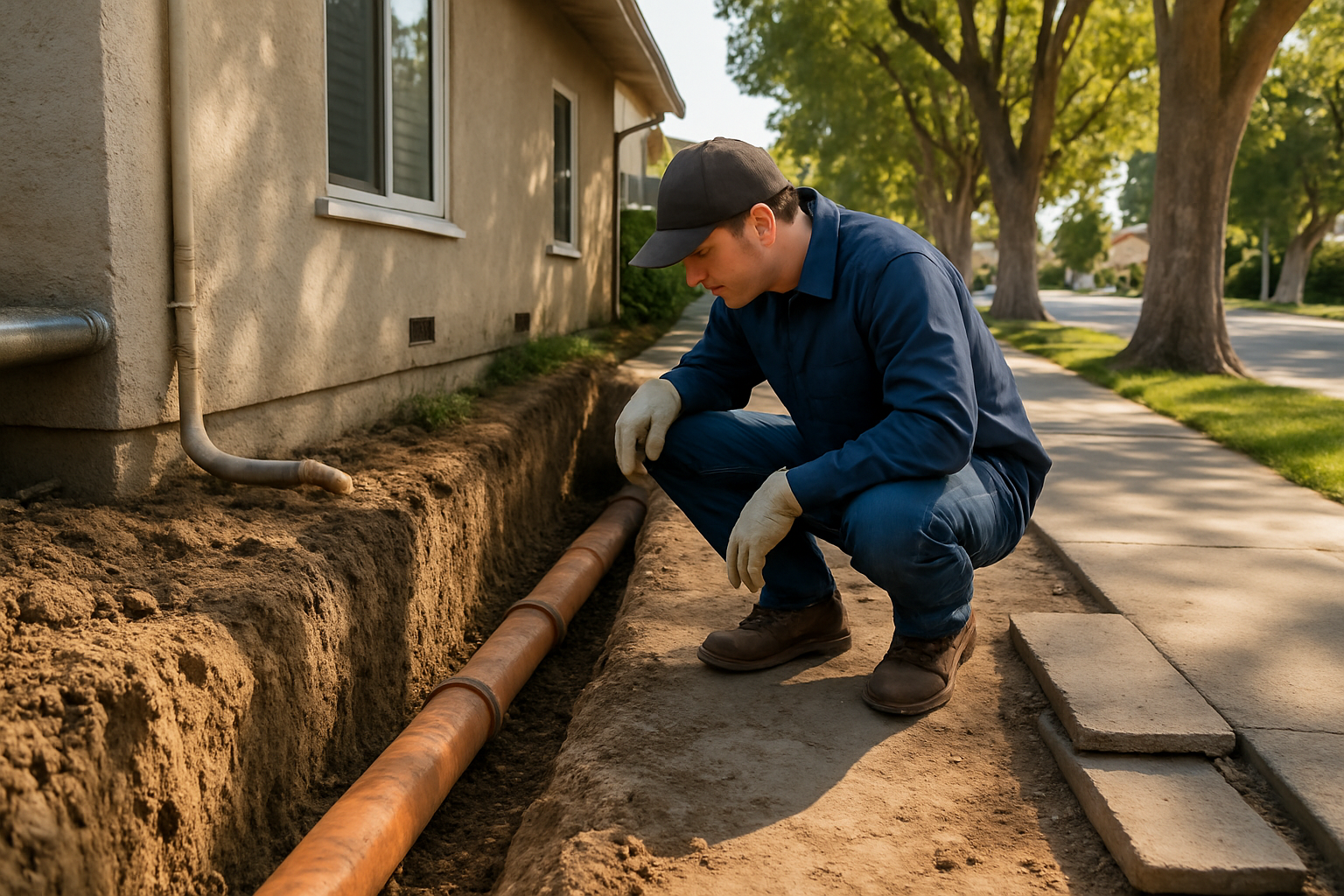
The section of pipe you own is called the sewer lateral. It runs from your home’s foundation, under your yard and sometimes under the sidewalk, all the way to the city’s main sewer line at or near the street. Everything on your side of that connection is your financial responsibility.
This means roots, cracks, low spots, and blockages inside your lateral are yours to fix, even if the damage is only a foot or two from the city main. Many Salinas homeowners don’t learn this until a backup happens and a contractor hands them a repair estimate that the city won’t cover.
The boundary can get complicated when damage sits very close to the street. We’ve seen situations where a sewer line was broken and filled with tree roots right near the city connection, and the homeowner wasn’t sure whether a city permit was required given how close the damage was to the main. That question has a real answer, but you can only get it once you know exactly where the problem is. That’s where a camera comes in.
Why Salinas Laterals Face More Risk Than Most
Salinas has a combination of factors that puts private sewer laterals under real stress.
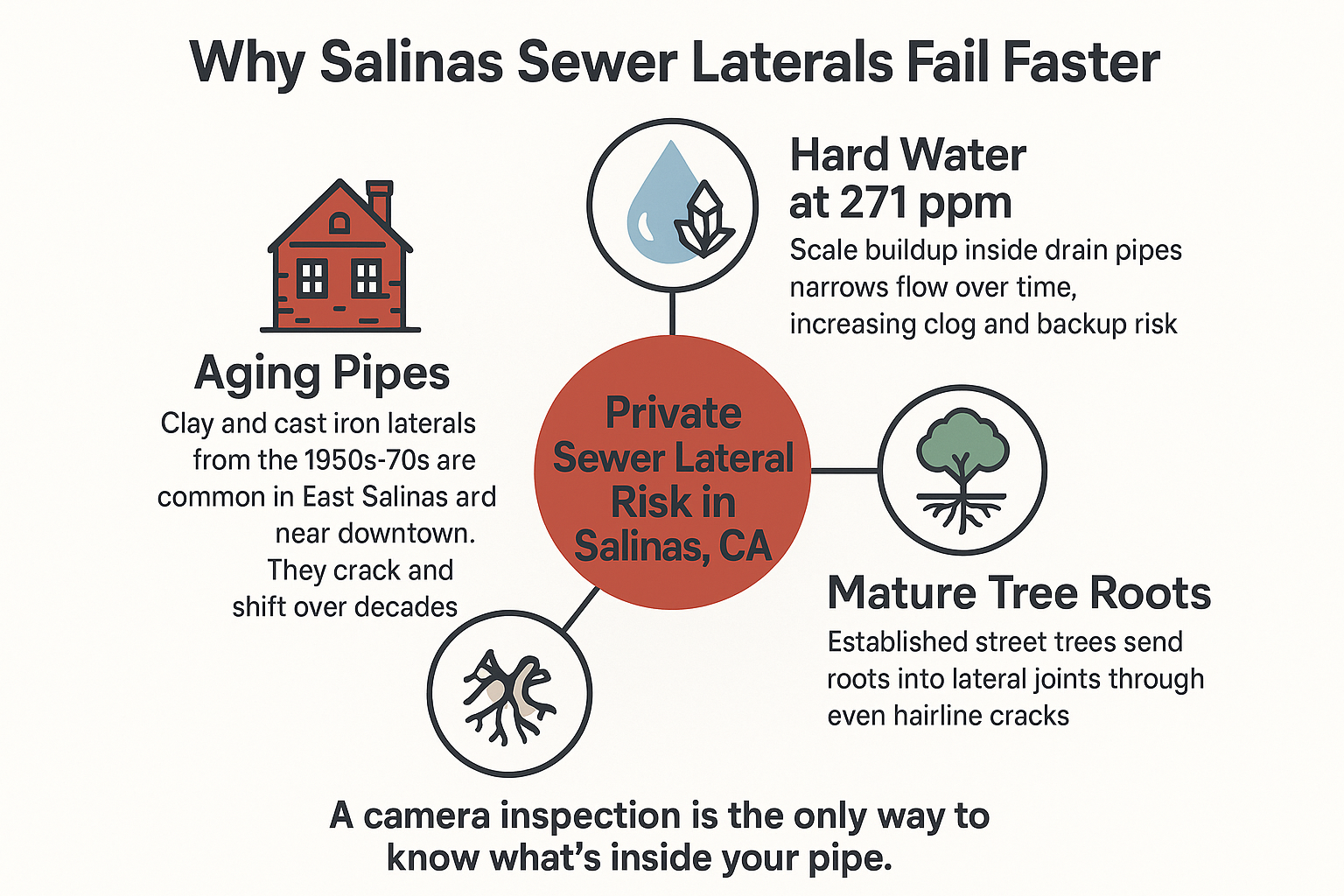
First, aging housing stock. Neighborhoods throughout East Salinas and older areas near downtown have homes built in the 1950s, 60s, and 70s. Those houses have laterals made of clay or older cast iron, materials that crack, shift, and deteriorate over time. A pipe that’s been in the ground for 60 years doesn’t have much left to give.
Second, hard water. Salinas water hardness runs around 271 parts per million, which is well into the hard range. That same mineral load that shortens water heater life in Salinas also contributes to scale buildup inside drain and sewer pipes, narrowing the effective diameter over time.
Third, mature trees. Street trees and established landscaping throughout older Salinas neighborhoods have root systems that actively seek out moisture. Sewer lateral joints are a prime target. Roots don’t need a large gap to get in, a hairline crack is enough. Once they’re inside, they grow and eventually fill the pipe.
Any one of these factors alone would warrant attention. In many Salinas neighborhoods, all three are present at once.
The Three Risk Factors Salinas Laterals Face
This infographic breaks down the three local conditions that put Salinas sewer laterals at higher risk than newer or softer-water communities.
What a Camera Inspection Actually Reveals
A simple drain snake tells you whether a pipe is passable right now. It doesn’t tell you why it keeps clogging, what else is forming inside the pipe, or whether the line can handle another year without problems. A sewer camera inspection gives you documented, visual evidence of what’s actually there.
Specifically, a camera can identify:
- Root intrusion, visible as fibrous masses inside the pipe, ranging from a few strands at a joint to a full blockage
- Pipe belly, low spots where the pipe has settled or shifted, creating pools where solids collect instead of flushing through
- Offset joints, gaps where two pipe sections no longer align, usually from ground movement over time
- Cracks and fractures, early-stage damage that hasn’t caused a backup yet but will
- Scale and grease buildup that narrows the pipe’s effective diameter
The camera head also has a locator function that pinpoints the exact depth and position of a problem from the surface. That matters when damage is near the city main connection, because knowing the precise location is what determines whether the repair requires a city permit.
For homeowners trying to understand what they’re approving before spending money, camera footage is documented proof of pipe condition. It’s the difference between guessing and knowing.
Snaking vs. Camera Inspection: What Each One Actually Tells You
These two services answer different questions. Understanding the difference helps you decide which one fits your situation.
| Drain Snaking | Camera Inspection | |
|---|---|---|
| What it does | Physically clears a blockage | Visually maps pipe interior |
| Reveals root intrusion | No, it may clear roots temporarily | Yes, shows location and severity |
| Reveals pipe belly or offset joints | No | Yes |
| Provides documented proof of condition | No | Yes, video record |
| Useful before a sewer repair or permit | No | Yes, required for accurate scope |
| Typical time | 30-60 minutes | 30-60 minutes |
| When it’s the right call | Simple clog, first occurrence | Recurring clogs, pre-repair, near city main |
A Note for Landlords and Property Managers
If you own rental properties in Salinas, particularly older units near mature trees or homes built before the 1980s, sewer lateral condition is a maintenance issue, not just an emergency response item.
A backed-up sewer lateral on a rental property can trigger habitability concerns under California law and create documentation problems, especially when the owner isn’t on-site and a tenant is reporting the issue. The rental property owners who call us after a backup often wish they had the camera report from two years earlier. A lateral inspection on a pre-1980s Salinas rental gives you documented proof of condition, which matters for your records and for any permit-required repair that comes later. Treating it as part of a regular maintenance cycle, rather than a reactive call, tends to be less expensive in the long run.
For more on what to expect when plumbing problems show up in patterns in older homes, that article is worth a read if you manage multiple units.
How Rate Increases and Aging Infrastructure Should Shape Your Thinking
The city’s $114.8 million infrastructure gap and the prospect of tripling sewer rates are real policy concerns. But they’re largely outside a homeowner’s control. What you do control is the condition of the private lateral on your own property.
As city rates rise, homeowners will naturally pay closer attention to their overall sewer-related costs. The worst version of that story is discovering a failing lateral at the same time rates increase, because lateral repairs are not covered by your sewer bill regardless of what that bill is.
The better version: you know the condition of your lateral. If the pipe is in good shape, you have peace of mind. If it has a developing problem, you can address it on your timeline, with a permit pulled properly, before a backup makes the decision for you. Understanding when a small plumbing issue turns into a big repair bill is part of thinking about your home the same way.
One practical note on permits: sewer line repairs that involve work near or at the city main connection require a City of Salinas permit. We handle all City of Salinas permitting in-house, including for sewer work, and we have an established permit history on file with the city. That’s worth mentioning because many contractors leave permit logistics to the homeowner, which adds days and confusion to a repair that’s already stressful.
Frequently Asked Questions About Salinas Sewer Rates and Private Laterals
If the city raises sewer rates, does that mean the city will fix my sewer line?
No. Sewer rate increases fund the city’s infrastructure, including the main sewer lines, lift stations, and treatment facilities. The private lateral that runs from your home to the city main is entirely your responsibility, regardless of what your Monterey One Water bill says.
How do I know if my sewer lateral has a problem before it backs up?
The honest answer is that you often can’t tell from the surface. Slow drains, gurgling sounds from toilets when other fixtures drain, and recurring clogs after clearing are all warning signs. But the only way to know what’s actually inside the pipe is a camera inspection. It takes about 30-60 minutes and gives you a video record of the pipe’s condition.
Does a sewer lateral repair require a permit in Salinas?
It depends on the scope and location of the work. Repairs that involve the connection point at or near the city main typically require a City of Salinas permit. Work within your private property may or may not, depending on what’s involved. A camera inspection helps define exactly where the problem is, which is what determines the permit requirement.
How much does a sewer camera inspection cost in Salinas?
Costs can vary based on pipe length, access conditions, and what’s found. In the Salinas and Monterey County area, many homeowners see somewhere in the range of $270 to $412 for a standard lateral inspection, though more complex situations can run higher. Contact a licensed plumber for an exact quote based on your property.
Tree roots broke my lateral right near the city connection. Who pays for that?
Most likely you do. Even if the damage is just a foot or two from the city main, anything on your side of the connection point is your responsibility. The city line begins at the main. One thing that helps in this situation is having camera footage that pinpoints the exact location of the damage, because that documentation is often needed to pull the correct permit and define the repair scope accurately.
Can I just have the line snaked instead of inspected?
Snaking clears a blockage. It doesn’t tell you why the blockage keeps coming back or what else is developing inside the pipe. If you’ve had the same drain cleared more than once, or if you’re dealing with a slow drain in a home with mature trees nearby, a camera inspection gives you information that snaking simply can’t. For a deeper look at the difference, this article on why snaking sometimes isn’t enough covers the gap.
Want to Know What’s Actually Inside Your Lateral?
Alvarez Plumbing has been serving Salinas and the Monterey Bay Area since 1988, and we handle City of Salinas permitting in-house for sewer work that requires it. If you’re in an older Salinas neighborhood, managing a rental property, or just want documented proof of your lateral’s condition before a problem forces the issue, give us a call at (831) 757-5465 or schedule online at alvarezplumbingsalinas.com. We’re available 24 hours a day, 7 days a week.