
Direct Answer: A standard home inspection doesn’t include a camera inspection of the sewer lateral. Buyers in Salinas and Monterey should schedule one separately before closing, it’s the only way to see root intrusion, cracks, or pipe deterioration inside the line.
You’ve hired a home inspector, reviewed the report, and everything checked out. The toilets flushed, the faucets ran, and the water heater had a few years left on it. But that report almost certainly didn’t include a look inside the sewer lateral, the pipe that carries all your waste from the house to the city main.
In Salinas, where a significant share of the housing stock dates back to the 1960s and 1970s, those laterals are often clay or cast iron. Decades of root intrusion, ground shifting, and seasonal rainfall can leave them cracked, bellied, or partially blocked, none of which shows up on a standard inspection. The inspector can only tell you what they can see.
A plumbing camera inspection before buying a home is one of the lowest-cost, highest-value steps a buyer can take. It costs a fraction of what a sewer lateral repair runs, and it gives you real information to negotiate with, or at minimum, to plan for.
What a Standard Home Inspection Actually Covers
A licensed home inspector does a thorough visual review. They look at the roof, the foundation, the electrical panel, the visible plumbing fixtures, and the HVAC system. On the plumbing side, they confirm that water flows and drains, check for visible leaks under sinks, and note any accessible pipes that show corrosion or damage.
What they don’t do is run a camera through the sewer lateral. That requires specialized equipment and is considered a separate, specialty inspection. A house can pass a standard inspection with a clean report and still have a sewer line that needs thousands of dollars in work.
The conditions a camera catches that an inspection misses:
- Root intrusion from trees and shrubs growing near or over the lateral
- Pipe belly, a sag in the line where waste pools instead of flowing through
- Cracks or fractures in clay or cast iron from ground movement
- Heavy buildup or scaling that’s narrowed the flow path significantly
- Offset joints where sections of pipe have shifted out of alignment
None of these show up when the toilet flushes fine. That’s the problem.
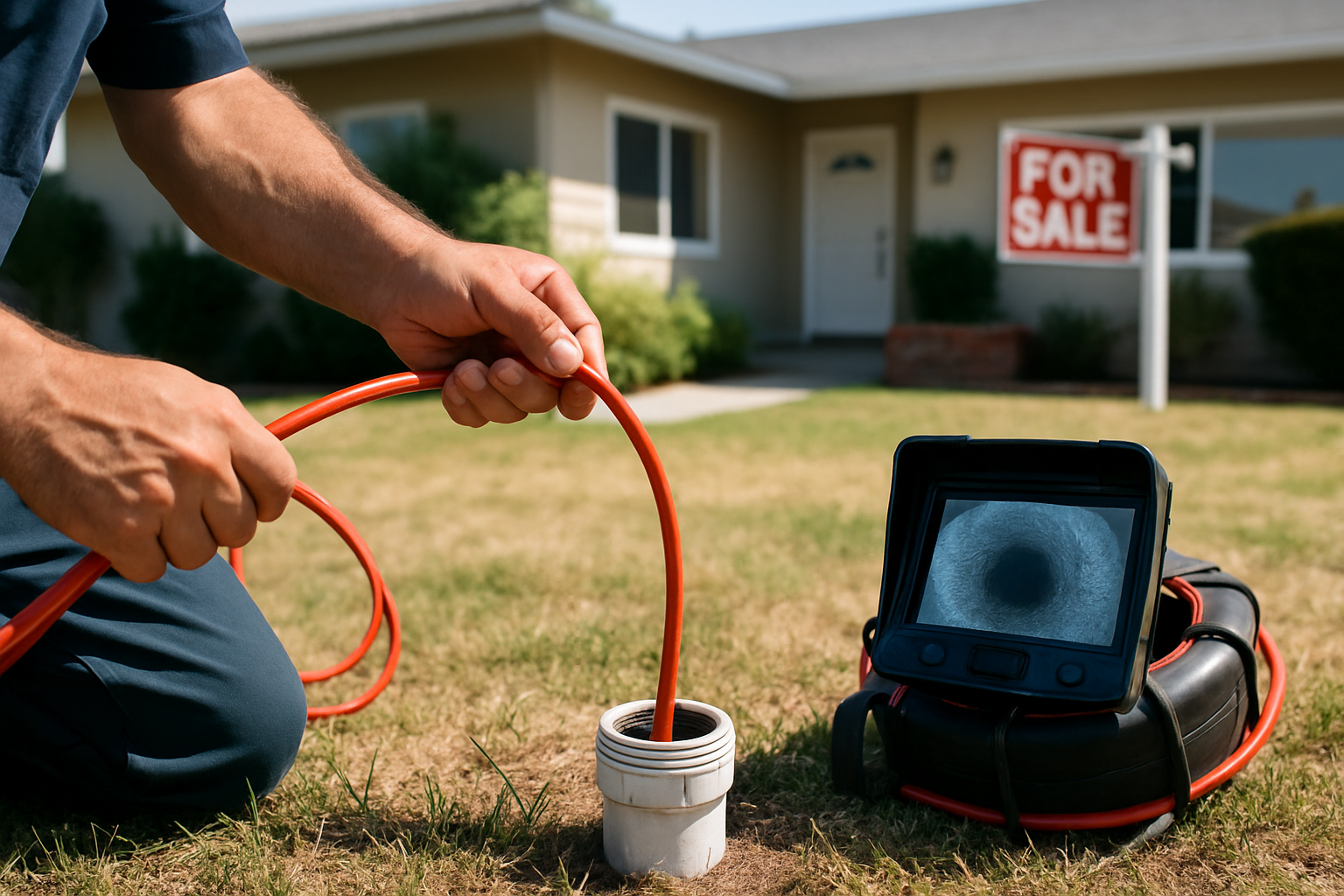
The Monterey Ordinance, and What Buyers There Must Confirm
If you’re buying in the City of Monterey, this isn’t optional. Under Monterey City Code Section 30-1.2, the city has required a mandatory Sanitary Sewer Lateral Inspection and Repair Program since January 1, 2019. Sellers must have the lateral inspected before transfer of ownership, using the city’s official form, signed off by a licensed plumbing contractor.
The Carmel Area Wastewater District has a similar ordinance in place. Buyers purchasing in either jurisdiction should ask for the documentation before closing, don’t assume it was done just because the deal is moving forward.
What to confirm before closing in Monterey or Carmel:
- The inspection was completed using the city’s official inspection form
- A licensed plumbing contractor signed off on the results
- Any required repairs were completed and re-inspected if the initial inspection found deficiencies
- You have a copy of the completed form for your records
If the seller can’t produce documentation, that’s a real problem, not a paperwork issue.
What Salinas Buyers Should Know
Salinas doesn’t currently have a mandatory pre-sale lateral inspection ordinance. But that doesn’t mean the risk goes away.
Many Salinas homes built before 1980 have original clay or cast iron laterals. These materials have a long service life under ideal conditions, but they’re vulnerable to root intrusion from the mature trees common in older Salinas neighborhoods, and they can shift or crack when the Salinas Valley’s clay-heavy soil expands and contracts with wet and dry seasons.
One caller who booked a sewer scope for a property sale, $513 total, scheduled for an 8-10am window, was doing exactly the right thing. That single inspection could either confirm the lateral is clean or reveal a problem that changes the negotiation entirely. A real estate broker in the area also reached out about sewer inspections for a property on College Drive, which reflects how common this need has become in the local market.
For any Salinas home built before 1980, a sewer camera inspection is worth scheduling as part of the buying process, not after you’ve already signed. If your inspector noted any slow drains, gurgling fixtures, or wet spots in the yard, that moves from “worth considering” to “do this before you close.”
Camera Inspection Requirements by Jurisdiction
Requirements differ depending on where the property is located. Here’s a quick reference for the Monterey Bay Area.
| Jurisdiction | Mandatory Pre-Sale Inspection? | What Buyers Should Do |
|---|---|---|
| City of Monterey | Yes, required since Jan. 1, 2019 | Request city-form documentation from seller before closing |
| Carmel Area Wastewater District | Yes, similar ordinance in effect | Confirm inspection was completed and signed by a licensed contractor |
| City of Salinas | No current ordinance | Strongly recommended for homes built before 1980, schedule independently |
| Seaside / Pacific Grove | Check with local utility | Verify with the applicable wastewater district before assuming either way |
| Watsonville | Check with local utility | Contact the Santa Cruz County Sanitation District for current requirements |
What Happens After the Camera Goes In
Once a sewer scope is complete, the findings drive a clear decision tree. This lays out the path from inspection to resolution.
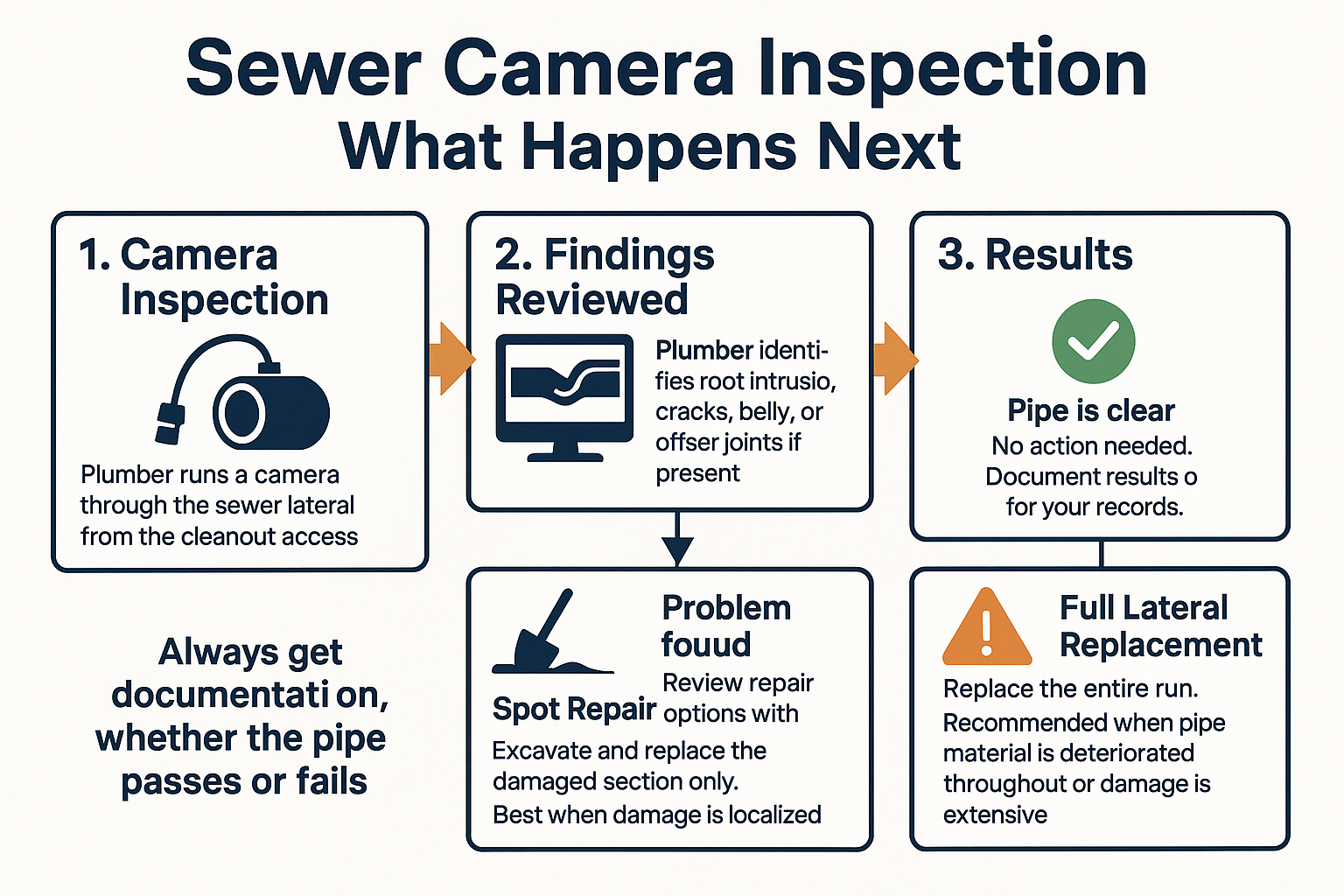
If the Camera Finds Something, Spot Repair vs. Full Replacement
Not every camera finding means the same thing. What the camera reveals determines what the repair conversation looks like.
If the damage is localized, one cracked joint, one section with root intrusion, a spot repair is often the right move. That means excavating down to that section, removing the damaged pipe, and replacing it. The rest of the lateral stays in place. This is generally less expensive and less disruptive than a full replacement.
If the pipe material is deteriorated throughout, which is common in older clay laterals that have been in the ground for 50-plus years, or if the camera reveals multiple problem areas spread across the length of the line, a full lateral replacement makes more sense. Doing spot repairs on a failing pipe often means coming back to do another one in two years.
The factors that typically drive this decision:
- Location and extent of the damage, one bad joint versus widespread deterioration
- Pipe material, clay and cast iron that are past their useful life may not be worth patching
- Access, whether the repair area is under a driveway, concrete, or landscaping affects both difficulty and cost
- Depth of the line, deeper laterals require more excavation and take longer to repair
For a realistic picture of what repairs in the Monterey Bay Area can run, the best step is to get a quote after the camera results are in hand. Costs vary based on the factors above, a straightforward spot repair on a shallow lateral is a very different job than a full replacement under a concrete driveway. We can walk you through what the camera found and what your options look like.
If you’re also thinking about what else might be aging in a home you’re buying, when a small plumbing issue turns into a big repair bill is worth a read.
Landlords and Property Managers: A Camera Inspection Is Cheaper Than an Emergency
Buyers aren’t the only ones who benefit from a camera inspection. Property managers and landlords have a strong parallel interest, especially at properties with a history of recurring drain issues or mature trees near the sewer line.
Several property managers have called us for emergency service after a main-line backup affected multiple units at once. That kind of event disrupts tenants, triggers habitability complaints, and can mean multiple service calls on the same day. A camera inspection as part of routine maintenance, not just after a problem surfaces, is practical risk management.
If a property has had the same drain cleaned more than once in a two-year window, a camera inspection is the next logical step. Why the same drain keeps clogging even after it’s been cleared explains why repeated cleaning without a camera often just delays the real problem.
Frequently Asked Questions About Plumbing Camera Inspections
Does a standard home inspection include a sewer camera inspection?
No. A standard home inspection covers visible plumbing fixtures, confirms water flow, and checks for accessible leaks. It does not include a camera inspection of the sewer lateral. That is a separate specialty service that requires different equipment and must be scheduled independently.
How much does a sewer camera inspection cost in Salinas or Monterey?
Costs vary based on access, pipe depth, and lateral length. Based on real bookings in the local market, buyers and property managers have seen costs in the range of a few hundred dollars for a standard scope. A recent property-sale inspection locally came in at $513 total. For an exact quote based on your specific property, contact a licensed plumbing contractor directly.
Is a sewer lateral inspection required when selling a home in Salinas?
Not currently. Salinas does not have a mandatory pre-sale lateral inspection ordinance in place. But for any home built before 1980, we strongly recommend one, especially given how common clay and cast iron laterals are in older Salinas neighborhoods.
What if the camera finds a problem, do I have to fix it before closing?
That depends on your purchase agreement and what you negotiate with the seller. Buyers who schedule an inspection before closing have more options: they can request a price reduction, ask the seller to complete repairs, or factor the cost into their planning. Buyers who skip the inspection and discover a problem after closing have none of those options.
How long does a sewer camera inspection take?
Most residential sewer scopes take 1-2 hours, depending on lateral length and how easily the cleanout access can be located. We provide a recorded video of the inspection so you have documentation regardless of outcome.
Can a camera inspection tell me if the pipe needs to be replaced or just repaired?
It gives us a clear picture of what’s happening inside the line, where the damage is, how extensive it is, and what pipe material is in place. From that, we can have a real conversation about spot repair versus full replacement, including what’s likely to hold long-term versus what’s just buying time. No camera inspection can give you a guaranteed answer before we see what’s there, but it gives you far better information than guessing.
Schedule a Sewer Camera Inspection Before You Close
If you’re buying a home in Salinas, Monterey, Carmel, or anywhere in the Monterey Bay Area, Alvarez Plumbing can schedule a camera inspection of the sewer lateral and walk you through what we find. We’re available seven days a week, including same-day appointments when the timeline is tight. Call us at (831) 757-5465 or schedule online at alvarezplumbingsalinas.com.