Direct Answer: Look for a plumber who is licensed, insured, and bonded in California, pulls permits for permit-required work, and has a strong track record of verified local reviews — not just a good-looking website.
When a pipe bursts under your kitchen sink at 9 p.m. or your water heater stops working on a cold January morning, you don’t have time to vet plumbers carefully. You search, you call, you hope. And that urgency is exactly when homeowners in Salinas, Monterey, and Carmel sometimes end up with the wrong person for the job.
The Monterey Bay Area has a mix of older housing stock — many homes in Salinas were built in the 1960s and 1970s — and local plumbing systems reflect that age. Galvanized pipes, undersized water heaters, and corroded fittings are common. Choosing a plumber who understands these specifics makes a real difference in whether a repair holds or fails again six months later.
This guide covers what to actually look at when choosing a plumber in this area — not a generic checklist, but the two or three things that genuinely separate a trustworthy contractor from one who will leave you with more problems than you started with.
What a California Plumbing License Actually Means
In California, anyone who does plumbing work for compensation above $500 in combined labor and materials must hold a valid contractor’s license issued by the California Contractors State License Board (CSLB). The relevant license classification for plumbing work is a C-36 specialty contractor license.
This isn’t a formality. A licensed plumber has passed a trade exam, met experience requirements, and carries the insurance California requires. If something goes wrong during unlicensed work — a flood, a gas leak, structural damage — your homeowner’s insurance may deny the claim because the work wasn’t performed by a licensed contractor.
You can verify any contractor’s license in about 60 seconds at the CSLB website. Enter the license number and confirm:
- The license is active, not expired or suspended
- The name on the license matches the company contacting you
- The license classification includes C-36 plumbing
- There are no disciplinary actions on the record
Beyond the license itself, ask if the contractor is bonded and insured. Bonding protects you if the contractor fails to complete work or causes damage they won’t pay for. These aren’t just nice-to-haves — they’re the baseline for working with any plumber in the state.

The Permit Question Most Homeowners Never Think to Ask
Permits are one of the most overlooked parts of hiring a plumber — and skipping them can cost you thousands when you sell your home or file an insurance claim.
In Salinas and across Monterey County, many plumbing jobs require a city or county permit. Water heater replacements are one of the most common examples. Under the 2025 California Building Energy Efficiency Standards, replacing a water heater isn’t just a swap-and-go job. It requires a permit, an inspection, and compliance with current energy code — and not every plumber handles that paperwork.
Some contractors leave permit logistics entirely to the homeowner. That means you’re responsible for filing, scheduling inspections, and knowing what inspectors will check. For a homeowner who’s never done this before, that’s a real burden — and mistakes can lead to failed inspections or having to redo work.
A plumber who pulls permits in-house removes all of that from your plate. They handle the filing, know what the inspector will look for, and show up ready to pass. If you’re replacing a water heater, ask directly: “Do you handle the permit, or do I?”
For older Salinas homes, permit history also matters when it’s time to sell. Unpermitted plumbing work can come up in a buyer’s inspection and delay or kill a sale. Work that was permitted and signed off by the city has documentation behind it — and that documentation has real value. You can read more about what happens before you call an emergency plumber to understand how skipped steps early on create bigger problems later.
Permit-Required Plumbing Work in the Salinas Area
These are the most common residential plumbing jobs that typically require a permit in Salinas and Monterey County. Always confirm with your plumber before work begins.
| Type of Work | Permit Required? | Who Usually Files |
|---|---|---|
| Water heater replacement | Yes — required under 2025 CA Energy Code | Licensed plumber (ideally) |
| Whole-home repipe | Yes | Licensed plumber |
| Main water line replacement | Yes | Licensed plumber |
| Sewer line repair or replacement | Yes | Licensed plumber |
| Drain cleaning or hydro jetting | No | N/A |
| Faucet or fixture replacement | No | N/A |
| Gas line work | Yes — always | Licensed plumber |
How to Read Reviews Without Getting Misled
Google reviews are useful, but only if you know what to look for. A plumber with 200+ reviews and a rating above 4.8 stars has a meaningful track record. A plumber with 12 reviews and a 5.0 is easy to game.
Volume matters because it’s hard to fake. When a contractor has served enough customers over enough years that hundreds of people have taken time to leave a review, that pattern reflects consistent work — not a good week.
When reading reviews, pay attention to:
- Whether reviewers mention specific problems that were solved, not just vague praise
- Whether there are reviews that mention permit work, inspections, or code compliance
- How the contractor responds to negative reviews — that tells you a lot about how they handle problems
- Whether the same reviewer names appear more than once (a sign of real customers, not one-time interactions)
Also check the review dates. A contractor with strong reviews from four years ago but nothing recent may have changed ownership or staff. Consistency over time is what you’re looking for.
For problems that feel urgent but aren’t clear emergencies, it helps to understand what actually counts as a plumbing emergency — knowing that can help you choose between calling at midnight or scheduling the next morning.
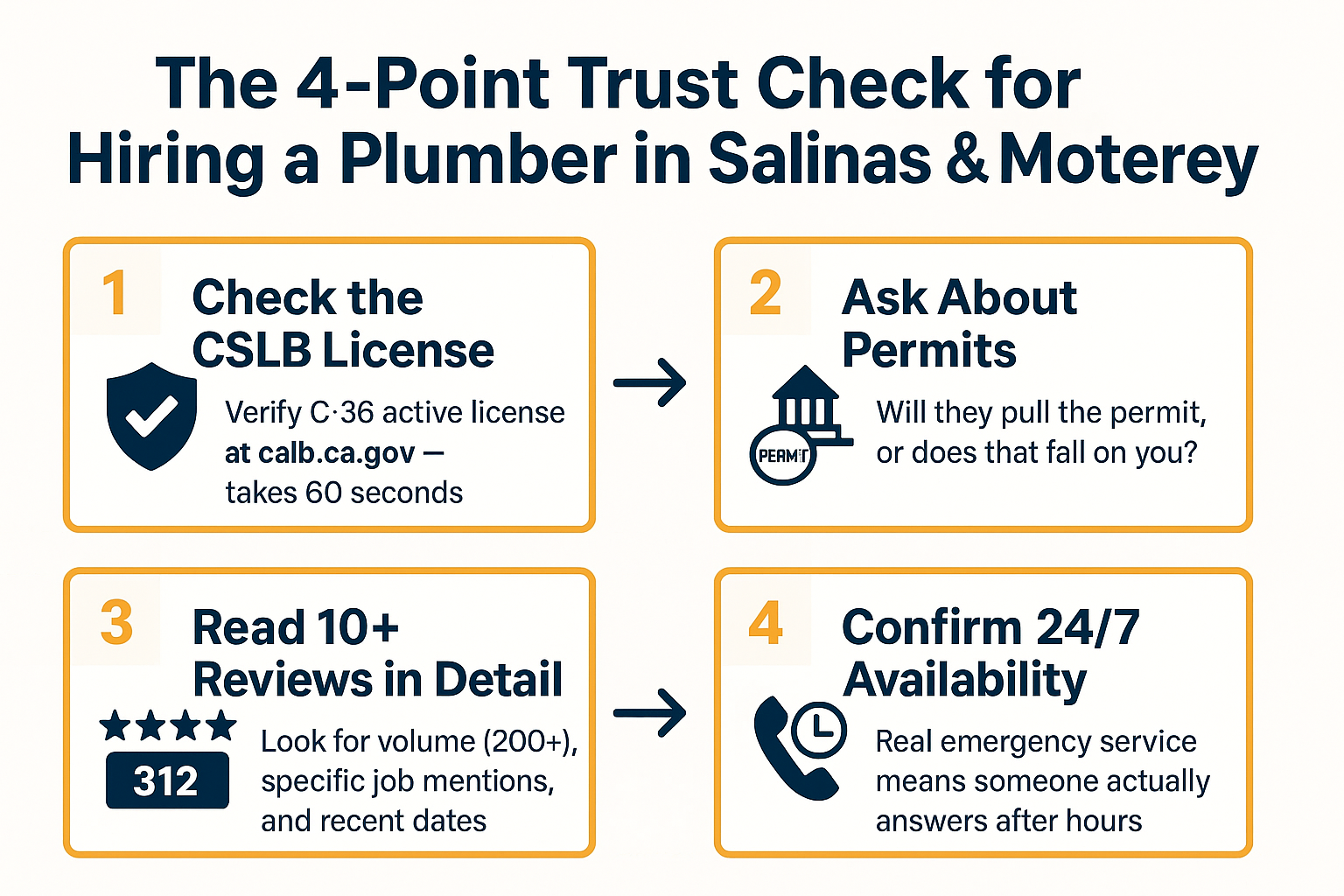
The 4-Point Trust Check for Hiring a Local Plumber
Before you hire any plumber in the Salinas or Monterey area, run through these four checkpoints. Each one takes less than five minutes.
Why 24/7 Availability Is a Real Differentiator — Not a Marketing Line
Most plumbers advertise emergency service. Fewer actually deliver it.
In the Monterey Bay Area, plumbing emergencies don’t schedule themselves. A slab leak under a Seaside home or a sewage backup in a Carmel rental unit can happen on a Sunday night or the day before Thanksgiving. What separates a true 24-hour plumber from one who claims it is whether a live person answers the phone at 2 a.m. — and whether a truck can actually show up that night.
Before you need emergency service, ask the question directly: “If I call at midnight on a Saturday, does someone actually answer?” The honest answer tells you more than any website claim.
For homeowners managing rental properties or short-term rentals along the Monterey Peninsula, this matters even more. A guest with no hot water at 11 p.m. can’t wait until Monday. Knowing your plumber answers after hours is part of responsible property management.
If you want to understand which situations genuinely can’t wait, our guide on how to tell if a plumbing problem needs immediate help walks through the clearest warning signs.
What Local Experience Actually Looks Like in the Field
A plumber who has worked in Salinas and Monterey County for decades knows things a newer contractor doesn’t. That’s not sentiment — it’s practical.
Local water quality is a good example. The Salinas Valley has notably hard water, with high mineral content that accelerates scale buildup inside water heaters, faucets, and pipes. A plumber who has replaced hundreds of water heaters in this area knows to factor that in — recommending the right tank size, flushing intervals, and anode rod replacement schedule for local conditions rather than giving generic manufacturer advice.
Soil conditions are another factor. Parts of the Salinas Valley sit on expansive clay soils that shift seasonally with rain and drought cycles. That movement stresses underground lines differently than it would in drier inland areas. A plumber with roots in this region understands how those conditions affect sewer lines and main water lines over time.
For older homes in central Salinas — many built between 1955 and 1985 — original galvanized steel pipes are still common. A local plumber who has repiped dozens of homes in those neighborhoods knows what to expect behind the walls: what materials were used originally, how they’ve aged, and what the replacement scope typically involves. That knowledge saves time and prevents surprises on a job.
If you’re dealing with an aging Salinas home and recurring drain problems, our guide on what clogs actually require hydro jetting to clear explains when snaking isn’t enough.
Frequently Asked Questions About Hiring a Plumber in the Monterey Area
How do I verify a plumber’s license in California before I hire them?
Go to the CSLB website at cslb.ca.gov and search by license number or company name. Confirm the license is active, that the C-36 classification is listed, and that there are no complaints or disciplinary actions on file. Takes about 60 seconds and it’s free.
Do I need a permit for a water heater replacement in Salinas?
Yes. Under California’s building code — and specifically the 2025 Building Energy Efficiency Standards — a water heater replacement in Salinas requires a permit from the City of Salinas and a final inspection. A plumber who handles that permitting process in-house is a real advantage. If the contractor you’re considering says permits aren’t necessary for a water heater swap, that’s a red flag.
What should I do if a plumber gives me a quote over the phone without seeing the job?
Be cautious. Some simple jobs — like a toilet repair or a faucet replacement — can be reasonably estimated by phone. But anything involving hidden pipes, slab work, or a water heater replacement needs an in-person look before a real number can be given. A plumber who quotes a firm price on a sewer repair without inspection is either guessing or setting you up for a surprise.
Is it worth paying more for a plumber with a long local history?
Usually, yes. A contractor who has been working in Salinas and the Monterey Bay Area for decades has seen the specific conditions in local homes — hard water, clay soil, older galvanized pipes — and has built relationships with city inspectors and suppliers. That translates to fewer delays, better material choices, and repairs that last longer. The savings from hiring cheap rarely survive the first callback.
What’s a fair price range for common plumbing repairs in the Salinas area?
Costs vary by job scope, but here are rough local benchmarks: a toilet repair typically runs $150–$350, a water heater replacement lands between $1,200 and $2,800 depending on type and permit costs, and a drain cleaning or hydro jetting job generally falls in the $250–$600 range. Any quote significantly below these ranges deserves a closer look at what’s actually included.
Need a Plumber You Can Actually Count On in Salinas or Monterey?
Alvarez Plumbing has been serving Salinas and the Monterey Bay Area since 1988 — licensed, insured, bonded, and available 24 hours a day, 7 days a week for emergencies. We handle all City of Salinas permitting in-house, so you don’t have to figure that out on your own. If you have a question or need service, call us at (831) 757-5465 or visit alvarezplumbingsalinas.com to schedule online.