Direct Answer: By the time most homeowners call an emergency plumber, water has already been spreading inside walls, subfloors, and cabinets for hours — causing damage that goes well beyond the original plumbing failure.
Most homeowners call a plumber when something is obviously wrong — water on the floor, a pipe that won’t stop dripping, a toilet that backed up overnight. But the real damage usually started hours or even days before that call.
In Salinas and across the Monterey Bay Area, we respond to plumbing emergencies every day of the week, around the clock. And one thing we see constantly: the plumbing failure itself is only part of the problem. The hidden damage that built up before the call is often what drives the final repair bill into the thousands.
This article walks you through what’s actually happening inside your home during a plumbing emergency — so you know what to look for, when to act, and why waiting even a few extra hours can change the outcome significantly.
Why Plumbing Emergencies Rarely Start with a Bang
Most people picture a plumbing emergency as something sudden — a pipe bursting, a water heater exploding. And yes, those things happen. But the majority of serious plumbing failures in residential homes build slowly.
A slow leak under a sink runs for two to three weeks before the cabinet floor rots through. A hairline crack in a supply line drips behind drywall for months before the mold problem shows up. A partial sewer blockage causes backups every few days before it finally stops draining entirely.
The Salinas area housing stock makes this even more common. A significant portion of homes in the city were built between the 1950s and 1980s, with original galvanized steel or copper plumbing that has had decades to degrade. If you want to understand how older pipes behave differently, residential plumbing repair in Salinas and the 1980 housing factor covers exactly that.
The short version: older pipes fail gradually. And gradual failures give damage a long head start before anyone notices.
The First Hour: What’s Happening Inside Your Walls
The moment a pipe fails or a connection lets go, water starts moving — and it doesn’t wait for you to find it.
In the first 15 to 60 minutes, water from a broken supply line can spread through a significant portion of a wall cavity. Drywall absorbs moisture almost immediately. Insulation holds water like a sponge. Wall studs begin soaking within an hour of sustained exposure.
Here’s what’s happening in sequence during that first hour:
- Subfloor materials — especially particle board, common in 1970s and 80s Salinas construction — begin absorbing water and weakening
- Drywall paper backing starts to separate, creating a surface where mold can establish itself within 24 to 48 hours
- Cabinet boxes warp and delaminate, often making them unrecoverable even after drying
- Flooring adhesive loosens under tile and vinyl, which may not show up for days
- Electrical wiring in water-contacted walls becomes a safety concern that requires separate evaluation
None of this is visible from the outside. The wall looks fine. The floor looks fine. But the damage clock is already running.

Slow Leaks vs. Sudden Failures: The Damage Is Different
Not all plumbing emergencies cause the same kind of hidden damage. A slow leak and a sudden pipe failure behave very differently — and so does the damage they leave behind.
Slow leaks — from a corroded supply line fitting, a pinhole in a copper pipe, or a failing toilet valve — tend to saturate a limited area over a long period. The wood rots. Mold grows. By the time you call, you may be dealing with a structural subfloor repair or a mold remediation job on top of the plumbing fix. In Monterey County, mold remediation for a single bathroom can run $1,500 to $4,000 depending on how far it has spread.
Sudden failures — a burst washing machine hose, a blown water heater connection, a main line break — put a high volume of water into the space fast. The damage is more visible but also more immediate. Getting to the main shutoff quickly is the most important thing a homeowner can do.
If you’ve ever wondered how homeowners can tell if a plumbing problem needs immediate help, the honest answer is: both types do — just for different reasons. Slow leaks are not safe to wait on. They just look less urgent.
Hidden Damage Timeline: What Happens and When
This is a general timeline of how water damage progresses after a plumbing failure. Real-world results vary based on pipe location, water pressure, and material types.
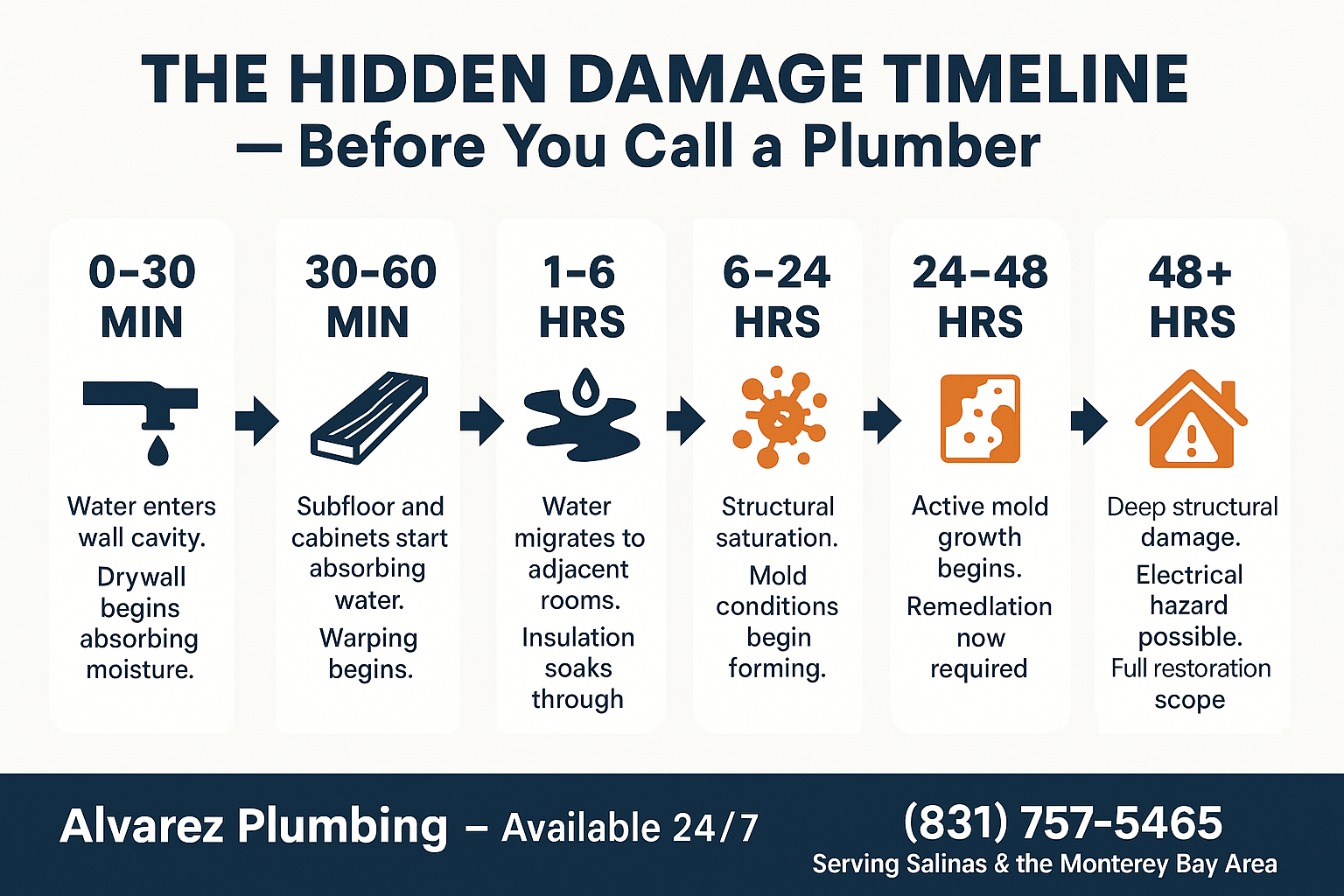
| Time After Failure | What’s Happening | Typical Repair Implication |
|---|---|---|
| 0–30 minutes | Water spreads through wall cavity, soaks drywall | Drywall likely needs replacement |
| 30–60 minutes | Subfloor begins absorbing water, cabinets swell | Flooring and cabinets may be unrecoverable |
| 1–6 hours | Water migrates to adjacent rooms, soaks insulation | Mold risk begins, insulation replacement likely |
| 6–24 hours | Structural wood saturation, possible ceiling damage below | Structural repair may be needed |
| 24–48 hours | Active mold growth begins in saturated materials | Mold remediation now required in addition to plumbing |
| 48+ hours | Deep structural damage, electrical hazard possible | Full restoration scope expands significantly |
Where Damage Hides Longest in Salinas Homes
Certain spots in a home are designed to hide moisture. Knowing where to look — or where a plumber will look — can help you act faster.
Under kitchen and bathroom sinks is the most common location for slow leaks in older homes. The enclosed cabinet traps humidity, and because the area is dark and infrequently checked, a leak can run for weeks. By the time the smell hits you, the subfloor underneath may already be soft.
Behind washing machine connections is another high-risk spot. The hoses on most residential washing machines have a service life of 5 to 7 years. Many homeowners in Salinas and Seaside have hoses that are well past that mark. A hose blowout can release several gallons per minute directly into a wall or laundry room floor.
Other locations where hidden damage accumulates:
- Slab-level supply lines in homes with post-tension slab foundations, common in newer Salinas neighborhoods
- Attic-routed water lines in older Monterey Peninsula homes, where a slow drip goes unnoticed until ceiling damage appears
- Sewer lines under the foundation, where tree root intrusion causes slow backups — video camera pipe inspection is often the only way to confirm what’s happening
- Water heater pans and drain connections, especially in garage installations common throughout the Salinas Valley
The Hidden Damage Timeline: Before You Call a Plumber
This infographic shows what’s happening inside a home during a plumbing failure — from the moment water escapes to the point where a plumber arrives.
What 24/7 Emergency Response Actually Prevents
When a plumber arrives within 1 to 2 hours of a failure, the outcome is genuinely different from a next-morning response. That’s not a sales point — it’s how water damage works.
Stopping the water source is step one. That alone halts the spread. But a licensed plumber can also assess how far the damage has traveled, check for gas line exposure if the failure is near a utility area, and document the scope for insurance purposes.
For Salinas homeowners dealing with active sewer backups, fast response also matters for a different reason: sewage exposure creates health risks that clean water damage does not. Bacteria and pathogens from a backed-up sewer line require proper handling, and the longer sewage sits in contact with flooring or subfloor materials, the more material needs to be removed.
If you’ve had recurring drain backups that seem to get worse over time, it’s worth reading about what kinds of drain clogs require hydro-jetting to clear — because a partial blockage today becomes a full backup tomorrow, and the hidden damage starts accumulating well before the emergency call.
What to Do in the Minutes Before the Plumber Arrives
There are a few things every homeowner should do immediately after discovering a plumbing failure — none of which require a contractor’s license.
First: shut off the water. Your main shutoff valve is typically located near the front of the house at the street, or inside near the water meter. If you don’t know where yours is, find it before there’s an emergency. In a failure involving a water heater, knowing how to shut down the water heater safely is also useful.
Second: reduce pressure on the system. Open a faucet at a low point in the house to drain water still sitting in the lines above the failure.
Third: document everything. Take photos and video before you touch anything, including what you can see inside cabinets or under the sink. This documentation matters for insurance claims.
What not to do:
- Do not use a shop vac on standing water if there’s any chance of electrical exposure
- Do not use fans or space heaters to dry a wall yourself — this can push moisture deeper into cavities
- Do not pour drain chemicals into a completely blocked line — if there’s a sewer backup, chemicals won’t help and may complicate the repair
- Do not assume the damage stops where you can see it
Estimated Cost Difference: Fast Response vs. Delayed Response
These are general cost ranges based on typical plumbing emergency scenarios in the Salinas and Monterey Bay area. Actual costs depend on the scope of damage and specific repair needs.
| Scenario | Response Within 2 Hours | Response After 12+ Hours |
|---|---|---|
| Supply line break (under sink) | $300–$600 plumbing repair | $600–$1,800 including cabinet and subfloor repair |
| Water heater connection failure | $400–$900 repair/replacement | $900–$2,500 with drywall and flooring damage |
| Sewer backup (partial) | $350–$700 hydro-jetting | $700–$2,000+ with sewage exposure remediation |
| Burst washing machine hose | $200–$500 hose and valve | $1,500–$4,500 with wall, floor, and insulation damage |
The Permit and Documentation Layer Most Homeowners Miss
One thing that rarely comes up in emergency situations — but matters a lot afterward — is documentation.
If your homeowner’s insurance covers the water damage, the adjuster will want evidence that the plumbing work was done by a licensed, insured, and bonded contractor. In California, unlicensed plumbing work on a permitted repair can actually void certain claims.
For non-emergency work that follows an emergency — like replacing a water heater that failed and damaged a wall — City of Salinas permits are required for the heater installation under the 2025 California Building Energy Efficiency Standards. Pulling that permit correctly matters both for code compliance and for home resale disclosure requirements.
This is worth keeping in mind when you’re stressed and tempted to take the fastest, cheapest option. A plumber who can handle the emergency call and the permit logistics saves you a step when you’re already dealing with a lot.
Frequently Asked Questions About Hidden Plumbing Damage
How long does it take for water damage to become a mold problem?
Mold can begin establishing itself in 24 to 48 hours in wet drywall, insulation, or wood. In the Monterey Bay Area’s coastal humidity, that window can be shorter. Fast response limits how much material gets wet in the first place.
Can I see hidden water damage without cutting open a wall?
Sometimes. Soft spots in drywall, paint bubbling, a musty smell, or discoloration on baseboards are all signs of hidden moisture. But the most reliable method is a moisture meter or, for pipe damage inside walls, video camera inspection — tools that a licensed plumber brings to the job.
Is a slow drip under my sink really an emergency?
It depends on how long it’s been there. A drip you noticed today is manageable. A drip that’s been running for weeks may have already damaged the subfloor, and that changes the repair scope significantly. Read more about what counts as a plumbing emergency to help you decide how fast to act.
Will my homeowner’s insurance cover water damage from a plumbing failure?
Most standard policies cover sudden and accidental water damage — like a burst pipe or blown supply line. They typically do not cover damage from slow leaks that were neglected over time. Documentation of when you discovered the problem, and prompt professional response, works in your favor with most claims.
What’s the most common source of hidden plumbing damage in Salinas homes?
In our experience, it’s under-sink supply line connections and aging toilet fill valves in homes built before 1990. These components degrade slowly, fail in enclosed spaces, and often go unnoticed until the cabinet is already saturated. Checking these once a year takes about two minutes.
Have a Plumbing Emergency in Salinas or the Monterey Bay Area?
Alvarez Plumbing responds to plumbing emergencies 24 hours a day, 7 days a week throughout Salinas, Monterey, Carmel, Seaside, Pacific Grove, and the surrounding area. If something has already let go in your home, every hour matters — call us directly at (831) 757-5465 or schedule service online at alvarezplumbingsalinas.com.