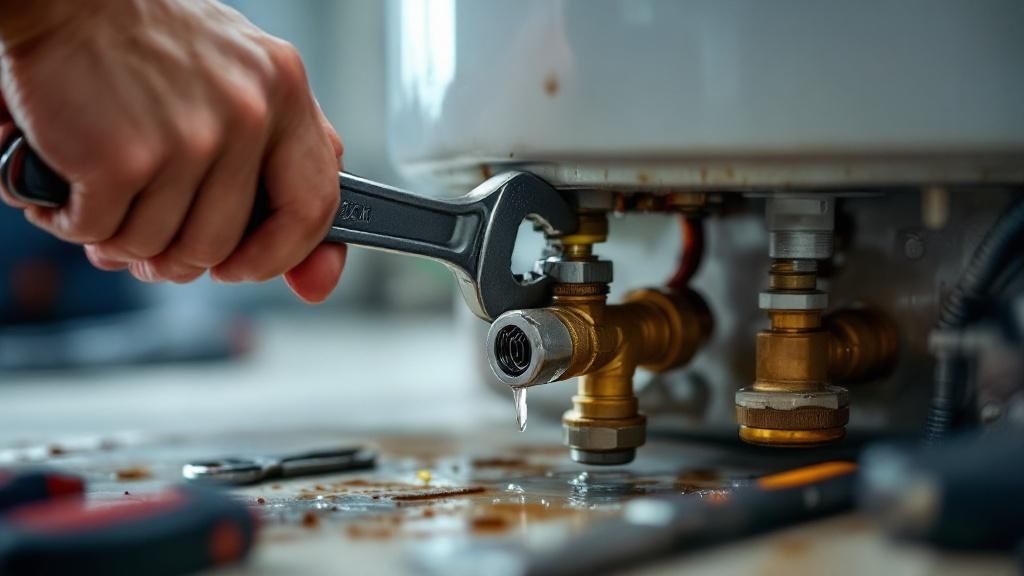
It’s a sight that makes any homeowner’s stomach drop: a puddle forming under the water heater. That discovery immediately raises questions and a good bit of stress. Seeing a water heater leaking from the bottom is a major red flag that you absolutely need to address right away.
While some drips can be simple fixes, water coming from the very base of the unit often signals the worst-case scenario: internal tank failure. This is an issue that can't be repaired and requires a professional plumber.
Getting to the Bottom of a Leak
When you see water pooling around your water heater, whether you're in Salinas or down in Carmel-by-the-Sea, that sinking feeling is completely understandable. But before you panic, it helps to know what could be going on. The source of the leak determines whether you have a minor repair on your hands or a full-blown replacement.
Sometimes, the problem isn't as catastrophic as it looks. You might just be dealing with:
- A slow drip from the drain valve at the bottom of the tank. Sometimes the valve itself is loose, or the washer inside has just worn out.
- Water discharged from the temperature and pressure (T&P) relief valve. This safety device releases water when pressure gets too high, and that water can run down the side and pool at the base.
- Simple condensation, especially during our foggy Monterey Bay mornings. It can form on the tank or pipes and drip down, making you think you have a leak.
To help you get a quick read on the situation, here’s a brief summary of the most common sources of bottom leaks. This can help you figure out what you're up against before you call us.
Quick Guide to Bottom Leak Sources
| Potential Source | What It Looks Like | Severity Level | Next Step |
|---|---|---|---|
| Drain Valve | A slow, steady drip right from the valve's nozzle or base. | Low | This valve may be loose or have a worn-out washer. Call a pro to diagnose and replace it. |
| T&P Valve | Water trickling from the overflow pipe connected to the T&P valve on the top or side of the tank. | Moderate | This could signal high pressure or a faulty valve. It's a safety issue, so call a plumber to diagnose the cause. |
| Condensation | General dampness or small puddles around the base, but no active drip. The tank or pipes feel wet. | Low | Wipe it dry and monitor. If it returns, especially on non-humid days, call us to investigate further. |
| Internal Tank | Water seeping from underneath the metal outer jacket, often appearing rusty. | CRITICAL | Shut off the water and power to the heater immediately. The tank has failed and must be replaced. |
As you can see, a leak from the tank itself is in a category of its own. It's the one that requires immediate action to avoid a much bigger problem.
The Most Common—and Most Serious—Culprit
More often than not, a leak from the bottom means the inner tank has rusted through. This is the most frequent and serious reason we see, especially in Monterey County homes where our moderately hard water can speed up this exact kind of failure.
So, what’s actually happening inside? Over many years, sediment and mineral scale from our local water supply settle at the bottom of the tank. This layer of gunk acts like an insulator, causing the bottom of the tank to overheat every time the burner or element kicks on. This constant stress eventually causes the protective inner lining to crack and the steel tank beneath it to rust.
Eventually, that corrosion eats tiny pinhole leaks straight through the steel. By the time you spot water seeping out from under the outer jacket, the internal tank's structure is already gone.
As a family-owned business serving this community since 1988, we've seen this play out countless times in homes from Seaside to Watsonville. A leak from the tank body itself isn't like a leaky faucet—it’s a clear signal that the water heater has reached the end of its life and needs to be replaced to prevent a much larger flood.
This is a critical distinction to make. While we can fix a loose valve, a corroded tank is an urgent safety issue because that damage simply cannot be repaired. At that point, replacement is the only safe and responsible solution. You can read more about how sediment impacts water heater lifespan and leads to these very issues.
Your Immediate First Steps for a Leaking Water Heater
That spreading pool of water from under your water heater is enough to make any homeowner's heart skip a beat, whether you're in Marina or Pacific Grove. It’s a moment of pure panic. But before you grab the phone, a few calm, immediate actions can save your home from some serious water damage. Think of these as damage control, not a DIY repair guide—these are the essential safety measures to take before you call in the pros at Alvarez Plumbing.
The first order of business is to cut off the source of the problem. That means shutting down the power or gas and then stopping any more water from getting into the tank.
Safely Shutting Down the Unit
You have to cut the energy supply to the heater. This prevents any further damage to the unit and, more importantly, eliminates a major safety hazard. The method is a little different depending on what kind of heater you have:
- For an electric water heater: Head to your home's main circuit breaker panel. You're looking for the breaker labeled "Water Heater." Flip it to the "OFF" position. With water on the floor, this is an absolutely critical step to prevent a dangerous electrical situation.
- For a gas water heater: Find the gas supply pipe that leads into the bottom of the heater. There will be a shutoff valve, usually with a straight, rectangular handle. Give that handle a quarter-turn until it's perpendicular to the pipe. Some models also have a dial on the gas control box right on the front of the heater that you can turn to "OFF."
With the energy source secured, your next move is to stop the water flow.
Stopping the Water Supply
Look for the cold water inlet pipe, which is almost always on top of the water heater. You'll find a shutoff valve on this line. It might have a wheel-style handle (a gate valve) or a lever (a ball valve). Turn the handle clockwise as far as it will go. This cuts off the fresh water supply, limiting the leak to whatever is already in the tank.
A Critical Reminder: These steps are all about containment, not repair. Once you've shut off the power and water, your home is safe from immediate escalation. Trying to diagnose or fix a water heater leaking from the bottom yourself is a risky proposition. The real danger here is the potential for a full tank rupture, which can unleash 40-50 gallons of water in a matter of minutes.
This image below gives you a quick look at the diagnostic process a professional plumber will follow.
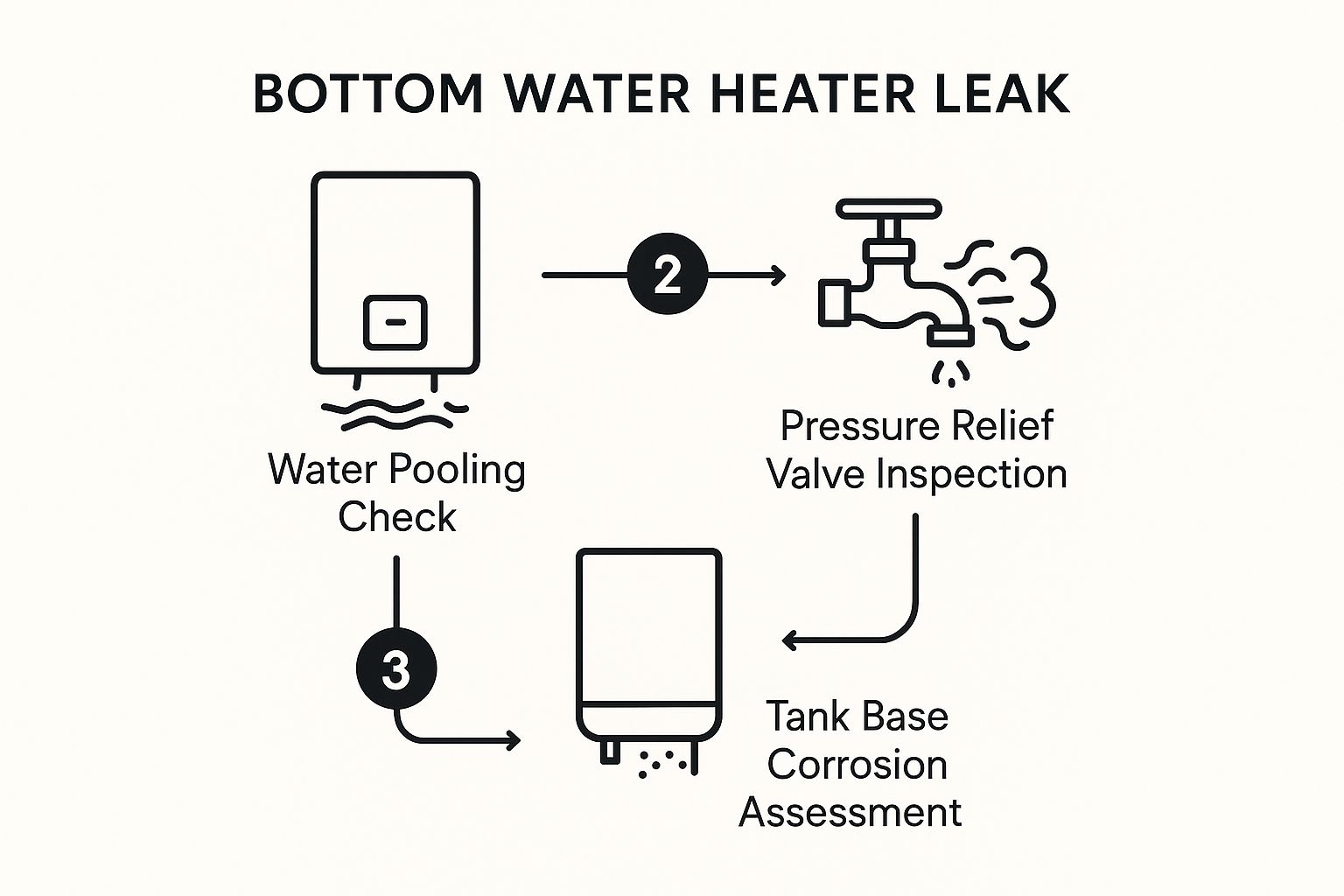
As you can see, a pro quickly moves from spotting the leak to checking key parts and figuring out if the tank itself is compromised. Your next—and only—step should be to call a licensed expert. For homeowners who need help right away, you can find out more about our professional water heater repair services in Salinas, CA and the nearby areas. Moving fast is what keeps a manageable leak from turning into a full-blown catastrophe.
Troubleshooting the Leak's True Origin
Alright, once you've safely shut off the power and water to the unit, it's time to play detective. For homeowners here in Watsonville and Prunedale, taking a few minutes to figure out exactly where the water is coming from can be incredibly helpful. It gives us a much clearer picture when you call.
This isn't about trying to fix it yourself—it's just about gathering some good intel for our team.
Grab a flashlight and get a good, close look at the base of the water heater. You're trying to trace the path of the water back to its starting point.
Pinpointing the Source
Just because there's a puddle at the bottom doesn't automatically mean the whole tank has failed. Often, the water is coming from a specific component and just running down the side, collecting at the base.
Here are the usual suspects to check:
- The Drain Valve: Look at that small, spigot-like valve near the very bottom of the tank. Is water actively dripping from its nozzle or seeping from where it screws into the tank? A leaky drain valve is a very common issue and, thankfully, a relatively straightforward fix for a pro.
- The T&P Relief Valve Pipe: Find the temperature and pressure (T&P) relief valve. It's usually on the top or side of the tank and has a pipe that runs down toward the floor. Feel along this pipe. If it's wet or you can see a trickle coming from the end, your leak is actually starting up high and just ending up at the bottom.
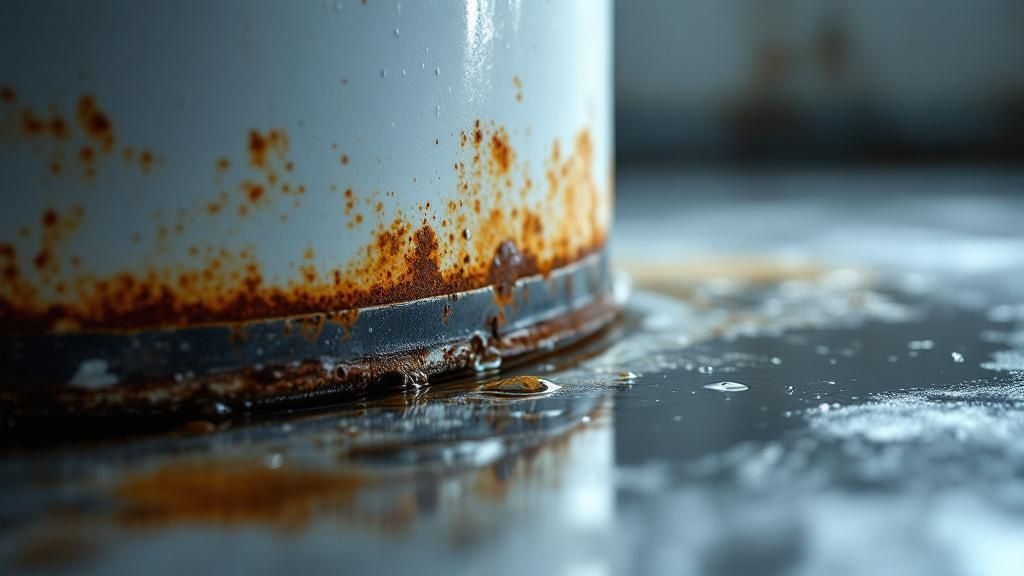
- The Tank Seam: This is the most important check. Look very carefully at the bottom edge of the water heater, right where the metal outer jacket meets the floor. Do you see water weeping directly from underneath this seam? Is the water rusty?
That last point is the real game-changer. Water dripping from a fitting is one thing; water seeping from the body of the tank is a whole different—and much more serious—problem.
What Your Findings Mean
Knowing the difference between a leaky component and a failed tank is crucial. A leaking drain valve is an inconvenience. A leaking tank is an emergency waiting to happen.
And it’s a surprisingly common emergency. Roughly 14,000 U.S. homeowners deal with a water leak disaster every single day. A tanked water heater failing from the bottom is a huge contributor because, over time, internal corrosion creates tiny pinhole leaks that quickly get worse under the tank's constant pressure. You can read more about the prevalence of these leaks to see just how frequently this happens.
Our Pro Tip: If you've wiped everything dry and you can clearly see fresh water weeping out from the seam at the base of the tank's outer jacket, the investigation is over. That's a non-negotiable, 100% certain sign of internal tank failure.
At this stage, you've done your part. You have identified a critical failure that simply cannot be patched or repaired. The tank's structural integrity is compromised, and the only safe path forward is to call a licensed plumber to get a replacement scheduled.
Why a Bottom Leak Almost Always Means Replacement
When we get a call about a water heater leaking from the bottom in Seaside or Carmel Valley, it’s a conversation we’ve had many times in our 35+ years serving Monterey County. As your friendly local experts, we believe in giving it to you straight: a leak from the base of the tank almost always means the unit is done for.
It’s the news no homeowner wants to hear, but understanding why this happens can help you see why replacement is the only safe and responsible path forward. This isn't like a dripping faucet or a loose connection; it's a sign that the heater has failed from the inside out.
The Problem From the Inside Out
A modern water heater tank is a pretty smart piece of engineering. At its core, it's a steel tank with a special glass-like lining on the inside, which is its main defense against rust. But after years of faithful service, that defense starts to wear thin.
The real enemy here is internal corrosion. It’s a slow process that happens over time, and it usually goes like this:
- Sediment Builds Up: Minerals that are naturally present in our local water supply settle at the bottom of the tank, forming a thick, sludgy layer of sediment.
- Overheating Occurs: This sediment layer acts like a blanket, trapping heat right against the bottom of the steel tank every time the burner or heating element kicks on.
- The Tank Fails: This constant cycle of overheating and cooling puts immense stress on the metal, eventually cracking the protective inner lining. As soon as water touches the raw steel underneath, rust takes hold and begins to eat away at the tank from within.
By the time you see water seeping out from under the water heater's outer jacket, the internal damage is complete. That small puddle is proof that the tank's structural integrity is gone for good.
Repairable vs. Terminal Leaks
It’s important to know the difference between this kind of leak and other, more manageable problems. A leak coming from a fitting, a valve, or a pipe connection is often a straightforward fix. We can tighten or replace the faulty component without touching the tank itself.
A dripping T&P relief valve, for instance, points to a bad part. A leak from the body of the tank, however, is a fatal diagnosis. There is simply no safe way to patch a corroded steel tank that's constantly holding back 40 or 50 gallons of hot, pressurized water. Any attempt to "fix" it would be incredibly dangerous and only delay the inevitable—a catastrophic tank burst that could flood your home.
In our experience since 1988, we can say with confidence that a leak from the tank's base is a final warning. It's the water heater's way of telling you its service life is over. The only safe, long-term solution is a full replacement to protect your home from significant water damage.
While it’s an unexpected expense, knowing your options ahead of time helps. To get a better idea of what’s involved, you can learn more about our transparent water heater replacement cost and see what goes into a professional, safe installation.
Choosing the Right New Water Heater for Your Home
Once you've come to terms with the fact that a water heater leaking from the bottom means it's time for a replacement, your focus naturally shifts. This isn’t just about swapping out a broken appliance; it’s a real opportunity to upgrade your home’s comfort and efficiency for the next decade or more.
For homeowners all across Monterey County, from Salinas to the coast, picking the right unit involves a bit more than just grabbing one off the shelf. You need a water heater that truly fits your family’s unique lifestyle.
Matching the Heater to Your Household
The first question to ask is about your daily water usage. A small household in Pacific Grove will have completely different hot water demands than a large family in a sprawling Carmel Valley home.
We help you think through the crucial factors:
- Family Size: How many people live in your home? This is the biggest driver for how much hot water you’ll need for showers, laundry, and dishes.
- Peak Demand: Do multiple people often shower around the same time in the morning? This "first-hour rating" is a critical number to look at so you don't end up with cold showers.
- Energy Goals: Are you trying to get those monthly utility bills down? High-efficiency models might cost more upfront but can deliver significant savings over their lifespan.
Exploring Your Options: Tank vs. Tankless
The water heater market is always changing, with new technologies popping up that are aimed at better performance and a longer life. The global demand for better water heaters is growing, with the market projected to jump from $23.7 billion in 2023 to over $32.1 billion by 2029. This boom is all about the push for better energy efficiency and durability.
This innovation means you have some great options:
- Traditional Tank Heaters: These are the reliable workhorses most of us grew up with. Today’s versions offer much better insulation and corrosion resistance than older models.
- Tankless Water Heaters: These on-demand units are becoming incredibly popular in places like Carmel-by-the-Sea. They provide an endless supply of hot water and save energy because they only heat water right when you need it.
As a family business that’s been serving this area since 1988, we can’t stress this enough: consider models with enhanced corrosion protection. Our local water, while perfectly safe, has minerals that can speed up sediment buildup. Choosing a unit with a better anode rod or a superior tank lining is a smart long-term investment. You can find more tips in our guide to creating a proper water heater maintenance schedule.
If your water heater replacement is part of a bigger home renovation, or if you're looking at financing options for major home repairs, there are special loans that can help. You can learn more about an FHA 203(k) Loan for renovation financing to see if it’s a good fit for your situation. Making an informed choice now ensures you get a reliable, efficient hot water solution that will serve your family well for years to come.
Your Questions About Leaking Water Heaters, Answered
A leaking water heater is never a welcome sight, and we know it brings a lot of questions and stress. After more than 35 years of helping homeowners across the Salinas Valley and Monterey Peninsula, we've pretty much heard it all. Here are some straightforward answers from a neighborly pro to the most common concerns we hear.
How Long Does a Water Heater Typically Last in the Salinas Area?
In our corner of Monterey County, the moderately hard water definitely plays a role. You can generally expect a standard tank-style water heater to give you about 8 to 12 years of service. The minerals in our water supply tend to speed up sediment buildup inside the tank, which is tough on the appliance.
You can push that lifespan closer to the 12-year mark with consistent maintenance, especially flushing the tank once a year to clear out that grit. But once your heater hits its 10th birthday, it’s a good idea to start budgeting for a replacement. The odds of a water heater leaking from the bottom because of internal rust jump significantly after a decade.
Is a Small Drip From the Bottom Really an Emergency?
Yes. Without a doubt. It might seem like a tiny, manageable problem, but that small drip from the bottom of the heater's metal jacket is the final warning sign. It’s definitive proof that the inner tank has already rusted through.
That little pinhole leak is under constant pressure. It won't stay small for long and can burst without any more warning, dumping the full 40 or 50 gallons of water onto your floor in a matter of minutes. This isn't a "wait and see" problem; it's a flood waiting to happen that needs immediate professional help.
Can I Claim a Leaking Water Heater on My Homeowners Insurance?
This is a classic "it depends" situation, and you'll need to check your specific policy. In most cases, standard homeowner's insurance will cover the resulting water damage—the cost to replace soaked flooring, ruined drywall, or damaged furniture.
The water heater itself, however, usually isn't covered. Insurance companies often view the appliance failure as a preventable maintenance issue, not a sudden, accidental event. Your best bet is always prevention and acting fast to keep the damage to a minimum. To get a better handle on whether your unit is on its last legs, our guide on when you need to replace your hot water heater can offer more insight.
What Does a Water Heater Replacement Cost in Monterey County?
The cost for a new water heater installation can vary quite a bit around here. The final price tag depends on several things:
- The type and size of the new heater
- The complexity of the installation site in your home
- Whether any of the existing plumbing or venting needs to be updated to meet current building codes, like those in Salinas or Monterey.
For instance, swapping out an old tank for a similar new one is a different job than upgrading to a high-efficiency tankless model. The only way to get a solid number for your home in Marina, Castroville, or anywhere nearby is to have a professional take a look. We always provide clear, upfront pricing so there are no surprises.
When you're staring down a water heater emergency, you need a team you can count on to act fast and do the job right. For expert advice and dependable water heater replacement, give the team at Alvarez Plumbing a call or schedule your service online today.