For homeowners in Salinas, Prunedale, or Carmel Valley, having your own private well is a fantastic perk. That independence, however, comes with a big responsibility: making sure your water is safe to drink. One of the first questions we get from well owners is, "what is the well water testing cost?"
It's a great question, and the answer isn't a single number. While a very basic test might run you under $150, a more thorough and comprehensive analysis can range anywhere from $250 to over $500. It all comes down to what, exactly, you're testing for.
Your Guide to Well Water Testing Costs in Monterey County
Living here in beautiful Monterey County means your water source is as unique as your property. The water under the rich farmlands of the Salinas Valley is different from what you'll find along the coast in Pacific Grove or Carmel-by-the-Sea. Local geology and land use have a direct impact on what's in your well.
That’s why understanding the cost of testing isn’t just about a price tag. It’s about making a smart investment in your family’s health and safety.
Breaking Down the Costs
Simply put, the price of a professional well water test is tied directly to how complex the analysis is. A basic screening is worlds apart from a deep dive into specific local concerns.
For example, a simple test for coliform bacteria and E. coli—something every single well owner should do—is the most affordable starting point. But given our region's huge agricultural footprint, many homeowners in places like Watsonville and Castroville wisely choose tests that also screen for things like nitrates and pesticides.
Think of well water testing like a health check-up for your home. A basic screening is a good start, but a more thorough panel gives you the detailed information you need for real peace of mind. After all, you can't see, taste, or smell many of the most serious contaminants.
To give you a clearer picture, here’s a breakdown of what you can generally expect to pay for professional lab testing in our area.
Estimated Well Water Testing Costs in Monterey County
This table shows typical price ranges for different levels of professional well water testing available to residents in areas like Watsonville, Seaside, and unincorporated communities.
| Test Level | Common Contaminants Tested | Estimated Cost Range (Professional Lab) |
|---|---|---|
| Basic Safety Test | Total Coliform, E. coli, Nitrates | $100 – $180 |
| Standard Test | Everything in Basic, plus pH, Hardness, Iron, Manganese, Sodium, Lead | $180 – $300 |
| Agricultural Test | Everything in Standard, plus Pesticides, Herbicides, Arsenic | $300 – $550+ |
| Comprehensive Test | Everything in Agricultural, plus Volatile Organic Compounds (VOCs), Heavy Metals | $500+ |
Remember, these are estimates. The final cost depends on the specific lab and the exact panel of contaminants you choose to screen for. It’s always best to partner with a local expert who understands the unique water challenges here in Monterey County.
At Alvarez Plumbing, a family-owned business since 1988, we've been providing trusted plumbing services in Salinas, CA, and across the county. We help countless homeowners navigate these exact issues. We don’t just hand you a lab report; we take the time to help you understand what it means for your home, your plumbing, and your family.
What Factors Determine Your Testing Price
Ever wonder why one neighbor’s well water test costs less than $100 while another’s bill creeps closer to $500? It’s not a mystery. The price comes down to a few key things that define how deep we need to dig into your water’s chemistry.
Think of it like getting your car serviced. An oil change is quick and has a set price. But if you need a full diagnostic to figure out a weird engine noise, the process is more involved and costs more. Water testing is similar—the more potential issues we screen for, the more time and specialized equipment are needed at the lab.
The Scope Of The Test
The single biggest factor driving the cost is the scope of the test. A basic screening for common bacteria like total coliform and E. coli is a smart, affordable starting point for any well owner. But if we need to run a comprehensive panel for things like heavy metals, pesticides, or Volatile Organic Compounds (VOCs), that requires a lot more work, which is reflected in the price.
This isn't just a local thing. The demand for reliable well testing is huge, with the global market valued at $7.61 billion in 2024. North America makes up almost half of that, driven by a strong focus on safe drinking water. You can see more on the global trends in this detailed industry report.
Your Unique Local Conditions
A one-size-fits-all approach to water testing is a waste of money, especially here in Monterey County. Where your home is located plays a massive role in what we should be looking for. This is where our 35+ years of local experience really come into play.
- Agricultural Runoff: If you live near the Salinas Valley or Watsonville, you’re surrounded by some of the most productive farmland in the world. That makes testing for nitrates and pesticides a high priority because of potential runoff.
- Coastal Proximity: For homes in communities like Pacific Grove, Marina, or Carmel-by-the-Sea, we absolutely need to check for saltwater intrusion. Salty water doesn't just taste bad; it can eat away at your pipes and fixtures over time.
- Geological Factors: Some parts of our region have naturally occurring elements like arsenic in the groundwater. An experienced local plumber will know if this is a known risk in your specific neighborhood.
The goal is never to run the most expensive test possible. It's to run the right test for your home. By understanding local risks, we can recommend a testing plan that saves you money on unnecessary screenings while ensuring your family is protected from relevant threats.
If you suddenly notice a strange taste, see sediment, or get an odd smell from your water, it could be a sign of a new problem. When there's an abrupt change like that, it's best to call for help right away. Our 24/7 emergency plumbing services are here to diagnose the problem before it gets worse.
Professional Lab Testing vs. DIY Kits
When it's time to check your well water, you've got two main choices: grabbing a do-it-yourself (DIY) kit from the hardware store or calling in the pros for a full lab analysis. The low price tag on a DIY kit can be mighty tempting, but it’s absolutely critical to understand what you're actually getting for that money.
Most DIY kits are pretty basic, relying on simple color-changing strips. They might give you a vague "yes" or "no" for a few common things, but they completely lack the precision you need for true peace of mind. It’s like trying to diagnose a weird noise in your car’s engine by just looking at the "check engine" light. It tells you something might be wrong, but it can't tell you what, where, or just how bad the problem is.
For something as vital as the water your family drinks every day in Marina or Castroville, this isn't a casual weekend project—it's a serious matter of health and safety.
The Limits of DIY Testing
Those at-home kits have some major drawbacks. They often can't detect contaminants at the very low levels that health standards require, and they can easily miss dangerous substances altogether. A false negative from a cheap test strip can create a dangerous—and completely false—sense of security.
The reliability and detailed insights from professional testing provide true peace of mind that a simple strip test can never offer. For your family’s well-being, it's an investment worth making.
You might also see more comprehensive water testing kits online or in specialty stores. While these are a step up from basic strips and let you do some initial screening yourself, they still don't come close to the accuracy of a certified lab.
This image shows a typical DIY kit, with all its different strips and vials.
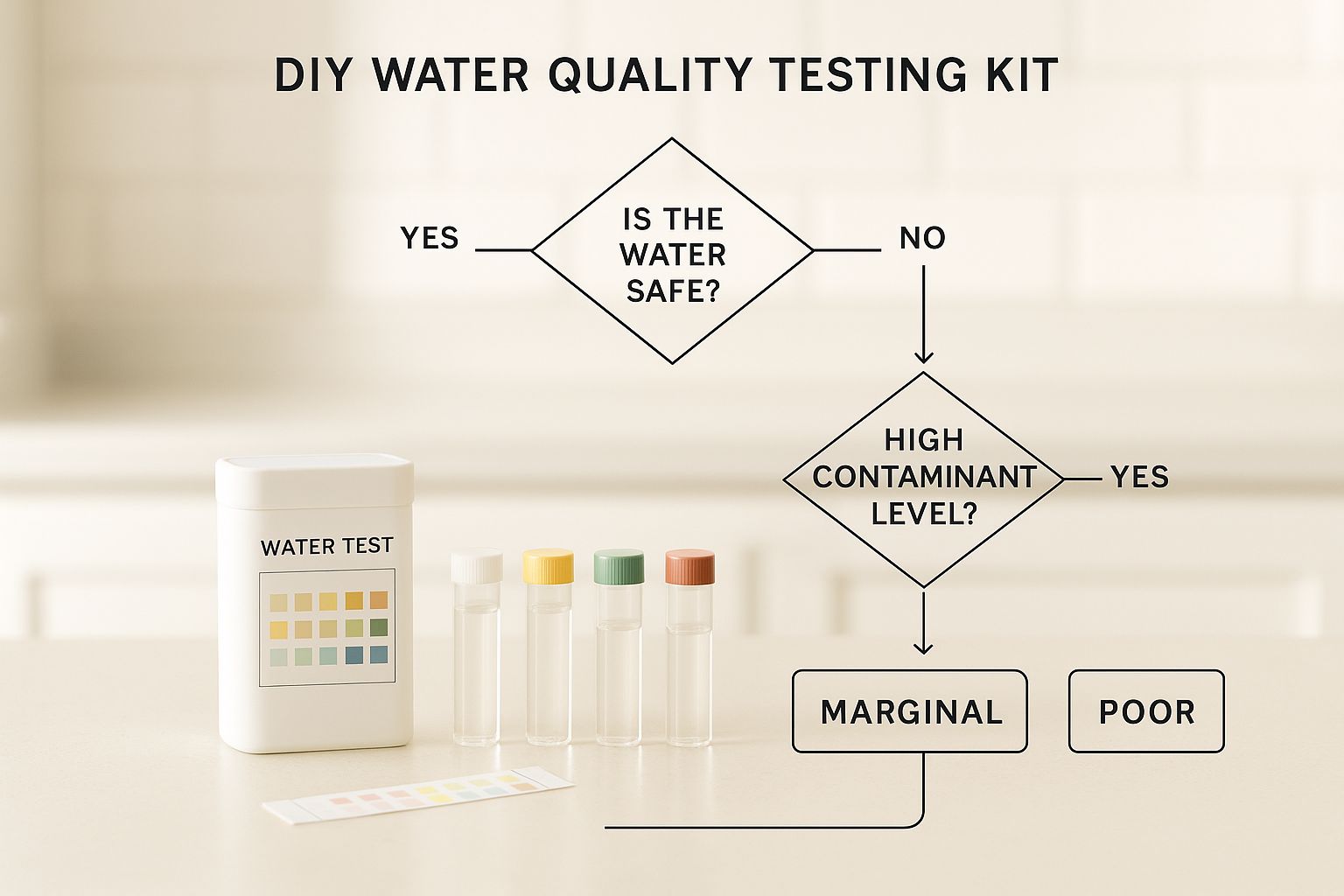
While these kits look scientific, their accuracy just can't hold a candle to the rigorous, controlled analysis performed in a professional laboratory.
Why Professional Lab Testing Is Superior
There's a reason a professional analysis from a state-certified lab is the gold standard. Here’s what you get with a professional test that a DIY kit simply can't deliver:
- Pinpoint Accuracy: Labs use sophisticated equipment to measure contaminants down to parts per billion (ppb). You get precise levels, not a color-coded guess.
- Legally Defensible Results: If you're buying or selling a home in Monterey County, or need to prove your water is safe for any official reason, only results from a certified lab are legally recognized.
- Comprehensive Screening: Professional tests can screen for a huge range of contaminants that are completely invisible to DIY kits, including pesticides, heavy metals, and volatile organic compounds (VOCs).
The U.S. Environmental Protection Agency (EPA) strongly recommends annual testing for private wells—a guideline we've followed for our clients for over 35 years. Proactive testing is the only way to be sure your water is safe from threats you can't see, taste, or smell.
When you think about the well water testing cost, try not to see it as just another expense. View it as a non-negotiable part of responsible homeownership.
Common Well Water Contaminants in Our Area
So, when we talk about the "well water testing cost," what are we actually paying to look for? It’s a great question. Here in Monterey County, our unique landscape—from the sprawling farmlands of Salinas Valley to the beautiful coastline of Carmel-by-the-Sea—creates specific challenges for well owners.
Understanding these local risks is the first step toward making sure your water is safe. Since 1988, our family-owned business has helped homeowners across the county identify and fix these very issues. This isn't just about getting a lab report; it's about protecting your family from threats you often can't see, taste, or smell.
Agricultural and Biological Concerns
The two biggest worries for nearly every well owner in our area are bacteria and nitrates, thanks in large part to our region's climate and thriving agricultural industry.
-
Coliform Bacteria and E. coli: When our heavy winter rains hit, runoff can easily overwhelm the ground's natural filtering abilities. This allows surface contaminants, often from animal waste or a neighbor's failing septic system, to seep down into the wells. While not all coliform bacteria are dangerous, their presence is a huge red flag. It means a pathway exists for harmful pathogens like E. coli to get into your water.
-
Nitrates and Nitrites: Living in the "Salad Bowl of the World" is fantastic, but it also means our groundwater is highly susceptible to contamination from agricultural fertilizers. Nitrates from farm runoff can easily find their way into the aquifers that feed private wells throughout Salinas, Prunedale, and Watsonville. High nitrate levels are a serious health risk, particularly for infants and pregnant women.
The thing about these contaminants is, you can't see them, taste them, or smell them. That's why annual testing isn't just a suggestion—it's a critical safety measure. A professional lab analysis is the only way to know for sure what’s in your water.
Geological and Coastal Issues
Beyond what's happening on the surface, our local geology and proximity to the ocean introduce other potential problems we frequently test for.
-
Arsenic: This heavy metal occurs naturally in the rock and soil in certain parts of our region. As groundwater moves through these formations, it can dissolve arsenic and carry it straight into your well. Since it’s completely odorless and tasteless, you would never know it’s there without a specific test.
-
Hardness (Calcium & Magnesium): Hard water isn't a health threat, but it's a major headache for your home's plumbing. High concentrations of minerals like calcium and magnesium cause scale buildup that clogs pipes, damages water heaters, and leaves those frustrating spots on your dishes. Over time, this buildup can even lead to low water pressure, a problem you can learn more about in our guide on how to fix low water pressure.
-
Salinity: If you live in a coastal community like Seaside, Marina, or Pacific Grove, saltwater intrusion is a real possibility. When too much groundwater is pumped from the aquifer, it can actually pull seawater inland and into your water source. This not only makes your water taste salty but can also corrode your pipes and appliances from the inside out.
By understanding these local factors, we can recommend the right set of tests for your specific property. This ensures your well water testing cost is money well spent, targeting the most relevant threats to your home and family's health.
How Often You Should Test Your Well Water

Think of testing your well water as essential maintenance for your family's health, not a one-and-done chore you can forget about. As a responsible well owner in Monterey County, setting up a regular testing schedule is one of the most important things you can do. It's also one of the smartest ways to keep your overall well water testing costs down in the long run.
The baseline recommendation from health experts is pretty simple: test your well water annually. This yearly check-up should, at the very least, screen for common culprits like coliform bacteria and nitrates. This routine helps you spot gradual changes before they become big problems, ensuring your water stays safe year after year.
But life happens, and some events should trigger an immediate call for a professional test, no matter when your last one was.
When to Test Immediately
A yearly test is a great foundation, but you need to be ready to act sooner if things change. Think of these as urgent check-ups needed to protect your home and your health.
You should get your well water tested right away if:
- You notice changes in your water. If the taste, smell, or color suddenly goes off, that's a crystal-clear sign something is wrong. Don’t wait to find out what it is.
- After heavy seasonal rains. Those powerful atmospheric rivers we get can flood the ground, washing surface contaminants right into wells, especially shallower ones in places like Carmel Valley.
- Following any well system repairs. Anytime your well cap is opened or major plumbing work is done, there’s a risk of introducing contamination into your system.
- There is a known spill nearby. If you hear about a chemical spill or a major issue with a neighbor's septic system, it’s a wise move to test your own supply.
Proactive, regular testing is far more affordable than dealing with a waterborne illness or a major plumbing failure. By staying ahead of problems, you can often find simpler, less expensive solutions.
The cost of consistent testing is a known expense, but making sure everyone does it has its own economic hurdles. A global study looking at the costs for surveillance agencies that monitor rural wells—like many in our county—found that achieving 100% testing compliance could cost over 730% more per person compared to large city systems. These numbers just go to show how much location and infrastructure impact the real cost of guaranteeing safe water for everyone. You can read the full research about water safety costs.
Being proactive doesn't just protect your family; it protects your wallet, too. For more tips on budgeting for home maintenance, check out our guide on how to save on plumbing repairs. At Alvarez Plumbing, we’re your long-term partner in home health and safety.
Answering Your Well Water Testing Questions
As your neighbors here in Monterey County, we’ve heard just about every question there is when it comes to private wells. It's completely normal to have concerns—after all, this is the water your family uses for drinking, cooking, and bathing every single day.
To help you feel more confident, we've put together straightforward answers to some of the most common questions we get from homeowners just like you.
My Water Looks and Tastes Fine. Do I Really Need to Get It Tested?
This is a great question, and one we hear all the time. The tricky thing about water quality is that many of the most dangerous contaminants are completely invisible. Things like arsenic, lead, nitrates, and even harmful bacteria like E. coli are odorless, tasteless, and have no color.
Your water could look crystal clear coming out of the tap but still contain substances that pose a serious risk to your family's health. Think of it like a routine health check-up; you go even when you feel perfectly fine just to catch potential problems before they become serious.
Especially here in an agricultural hub like the Salinas Valley, runoff from farms can introduce chemicals you would never be able to detect on your own. Regular testing is truly the only way to be absolutely certain the water you drink and bathe in is safe. It's a small investment in your peace of mind.
I Just Bought a Home in Prunedale with a Well. What Tests Should I Run First?
Congratulations on your new home! As a new well owner, the very first thing we recommend is a comprehensive informational test. This establishes a critical baseline for your water quality, giving us a complete snapshot of what’s in your water from day one.
At a bare minimum, this initial test should check for:
- Total Coliform and E. coli Bacteria to screen for any biological contamination.
- Nitrates, which are a key concern due to the widespread farming in our region.
- pH Levels to understand the acidity or alkalinity of your water.
- Total Dissolved Solids (TDS) for a general measure of overall water purity.
Given our local geology, adding a test for naturally occurring arsenic is also a very prudent step for any homeowner in Monterey County. This first, broad-spectrum analysis gives you a complete picture and helps us recommend a more targeted and cost-effective annual testing plan moving forward.
What Is Involved in the Professional Testing Process with Alvarez Plumbing?
We’ve designed our process to be as simple and stress-free for you as possible. It all starts with a phone call where we can discuss your property and any specific concerns you might have about your water.
Next, one of our licensed plumbers will visit your home—whether you're in Monterey, Carmel, Watsonville, or anywhere else in our service area. We adhere to strict, sterile sampling procedures to ensure the results are accurate and not compromised by cross-contamination. This involves using special containers and drawing the water sample directly from the correct point in your system.
The sample is then immediately transported to a state-certified laboratory for analysis. Once the results are back—usually within a few days to a week—we don’t just email you a confusing report filled with scientific jargon. We’ll personally walk you through the findings, explain what each number means in plain English, and if any issues are discovered, we’ll discuss clear, practical solutions.
These solutions can range from simple filtration systems to more advanced treatment options, all designed to keep your family safe. Sometimes, issues flagged by water tests can even point to hidden problems within your plumbing system, similar to what we might uncover during a professional drain inspection.