Making the switch to a tankless water heater is a significant decision for any homeowner or business in Monterey County. The promise of endless hot water and energy savings is tempting, but is it the right investment for your property? The unique coastal climate, water hardness in areas like Salinas, and varying household sizes across the region mean the answer isn't a simple yes or no. This guide is designed to cut through the noise and provide a clear, detailed breakdown of the most critical tankless water heater pros and cons.
We move beyond generic advice to give you specific, actionable insights tailored for our local needs. We'll examine everything from the true installation costs you can expect in Monterey to how these on-demand units perform during peak demand in a busy family home or commercial setting. This article will explore key factors such as energy efficiency, upfront investment, flow rate limitations, and maintenance requirements. By the end, you'll have a clear picture of whether a tankless system aligns with your budget, lifestyle, and long-term goals, empowering you to make a confident and informed decision for your property.
1. Pro: Superior Energy Efficiency and Lower Operating Costs
One of the most compelling arguments for upgrading is the significant reduction in energy consumption and subsequent utility bills. This is a key point in the tankless water heater pros and cons debate. Unlike traditional storage-tank heaters that constantly burn energy to keep a large reserve of water hot, tankless units operate on demand. They only activate their powerful heating elements when you turn on a hot water tap, eliminating standby heat loss entirely.
This "on-demand" approach is the core of their efficiency. For households in Monterey County with moderate hot water needs (around 41 gallons daily), this can translate to impressive energy savings of 24% to 34%. Even for larger families or commercial settings using more water, the savings remain substantial.
Real-World Savings in Monterey County
The financial benefits are not just theoretical; they are tangible for local residents and businesses. A typical family of four in Salinas, for instance, could easily save over $150 annually on their utility bills by switching to a high-efficiency gas tankless model. On the commercial side, a busy Monterey restaurant was able to slash its natural gas costs by an incredible 30% after installing multiple commercial-grade units to meet the high demands of its kitchen.
The following bar chart illustrates how your daily water usage directly impacts your potential energy savings.
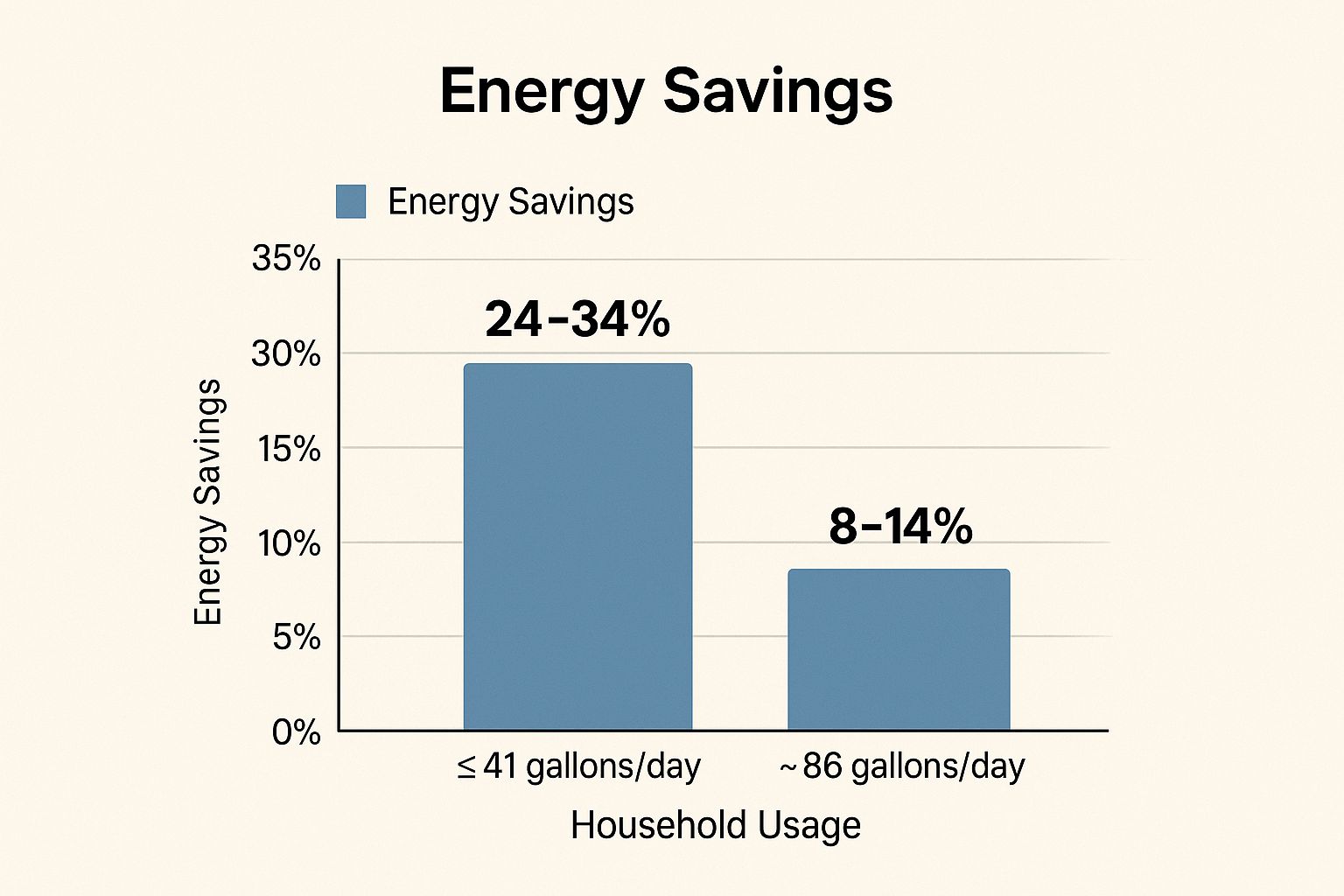
As the chart clearly shows, smaller-use households see the highest percentage of savings, but even high-use households realize significant efficiency gains by eliminating standby heat loss.
Maximizing Your Efficiency Gains
To ensure you get the most out of your investment, consider these actionable steps:
- Calculate Your Needs: Before purchasing, have a professional from Alvarez Plumbing help you perform a hot water usage audit. This will ensure you select the right size unit and can accurately project your savings.
- Choose Certified Models: Prioritize ENERGY STAR® certified models. These units are verified to meet strict efficiency standards and often qualify for local rebates, adding to your initial savings.
- Upgrade Fixtures: Pairing your new tankless water heater with low-flow faucets and showerheads throughout your home or business can amplify your energy and water savings even further.
For a deeper dive into how these systems can benefit your specific property, explore our detailed guide on tankless water heaters in Salinas & Monterey.
2. Con: High Upfront Installation Costs
While the long-term savings are attractive, the significant initial investment is a major factor in the tankless water heater pros and cons discussion. The upfront cost for a tankless unit and its installation is substantially higher than that of a conventional storage-tank heater. This is a critical hurdle that homeowners and business managers in Monterey County must budget for.
The higher price tag isn't just for the unit itself. Installation often requires extensive modifications to your property's existing infrastructure. This can include upgrading gas lines to accommodate the higher BTUs, running new dedicated electrical circuits for powerful electric models, and reconfiguring plumbing and ventilation systems. These necessary upgrades can quickly escalate the total project cost.
Real-World Cost Breakdown in Monterey County
The financial reality of this upgrade can be surprising. For example, replacing a standard $500 tank heater might involve purchasing a $1,500 tankless unit, plus an additional $2,000 in installation labor and materials. A Salinas home needing a gas line upgrade to support a new unit could see another $1,000 to $3,000 added to the bill. For commercial properties or homes opting for a large, whole-house electric model, the required electrical panel and wiring upgrades can cost an extra $2,000 to $4,000.
These figures illustrate that the total cost often ranges from $2,500 to over $6,000, a significant jump from the typical tank heater replacement.
Mitigating the Initial Financial Impact
While the initial cost is high, there are smart ways to manage it and ensure you're making a sound investment:
- Get Multiple Quotes: Always obtain detailed estimates from several certified installers. This helps you compare not just the final price but also the scope of work and materials included.
- Research Rebates: Before purchasing, investigate federal tax incentives and local utility rebates (like those from PG&E). These programs can significantly reduce your net cost.
- Evaluate Total Cost of Ownership: Don't just look at the installation price. Factor in the projected annual energy savings over the 20-plus-year lifespan of a tankless unit to understand the long-term financial benefit.
- Confirm Infrastructure Compatibility: Have a professional plumber assess your home’s gas, electrical, and plumbing systems beforehand to avoid unforeseen upgrade costs.
To better understand the specific requirements for your property, get a detailed breakdown of the tankless water heater installation process in Salinas & Monterey.
3. Pro: Unlimited Hot Water Supply
One of the most celebrated benefits in any discussion of tankless water heater pros and cons is the ability to enjoy a continuous, unending stream of hot water. Traditional tank-style heaters are limited by their storage capacity; once the 40 or 50 gallons of hot water are used up, you face a frustrating wait for the tank to refill and reheat. Tankless systems completely eliminate this problem by heating water instantly as it passes through the unit, providing hot water on demand for as long as you need it.
This on-demand capability is a game-changer for many households and businesses. Whether you have a large family with back-to-back morning showers or a commercial operation that can't afford downtime, the continuous flow ensures hot water is always ready. As long as the unit is sized correctly for your peak demand, it will never "run out" of hot water.

Real-World Applications in Monterey County
This advantage is particularly valuable in settings with high or simultaneous hot water needs. Imagine a large family in a Carmel home where the dishwasher, a load of laundry, and a shower can all run at the same time without anyone getting a blast of cold water. Similarly, a local spa or hotel in Monterey can guarantee every guest a hot shower and run its commercial laundry facilities without interruption, significantly improving customer satisfaction. This consistent supply is a luxury that quickly becomes a necessity.
Maximizing Your Continuous Flow
To ensure you can fully leverage this benefit, proper planning is key. Follow these practical steps:
- Calculate Peak Demand: The most crucial step is to determine your home or business's peak hot water usage, measured in gallons per minute (GPM). An Alvarez Plumbing professional can help you add up the flow rates of all fixtures that might run simultaneously to recommend the right size unit.
- Consider Multiple Units: For very high-demand commercial applications, like a busy restaurant kitchen or a multi-unit apartment building in Salinas, installing multiple units in parallel can provide a robust and redundant hot water supply.
- Install Pressure-Balancing Valves: To maintain consistent water temperature across all fixtures when multiple taps are open, installing pressure-balancing valves in showers and faucets is a smart addition. This prevents temperature fluctuations and scalding risks.
4. Con: Flow Rate and Temperature Fluctuation Issues
While tankless technology offers many benefits, it's not without its operational quirks. A significant consideration in the tankless water heater pros and cons discussion is how these units handle water flow and temperature consistency. Unlike tank heaters that provide a steady supply from a large reserve, tankless units have a minimum flow rate requirement to activate their heating elements. This can lead to performance issues with low-flow fixtures or fluctuating demand.
This operational demand means you might experience a "cold water sandwich," a burst of cold water when briefly turning a shower off and on again. Similarly, trying to run a second shower or major appliance simultaneously can sometimes overwhelm the unit, causing a noticeable drop in water temperature for everyone. These are common challenges that new users face.
Real-World Examples in Monterey County
These issues can manifest in various ways for local homes and businesses. A Salinas homeowner might find that their low-flow bathroom faucet doesn't draw enough water to trigger the heater, resulting in perpetually lukewarm water. In a larger Monterey home, starting a load of laundry while someone is showering could cause the shower's temperature to drop uncomfortably, as the unit struggles to meet the sudden increase in demand.
The video below explains some of the common temperature and flow challenges associated with on-demand systems.
Understanding these potential drawbacks is crucial for setting realistic expectations and ensuring your system is configured correctly for your property’s specific needs.
How to Mitigate Flow and Temperature Problems
Fortunately, these issues are often solvable with proper planning and professional installation. Here are actionable steps to ensure stable and reliable hot water:
- Select the Right Unit: Work with a professional to choose a model with a lower minimum flow rate (measured in gallons per minute, or GPM). This is especially important for homes with modern, water-conserving fixtures.
- Install a Thermostatic Mixing Valve: This device can be installed to blend hot and cold water to a precise, pre-set temperature, effectively eliminating scalding risks and smoothing out temperature fluctuations.
- Consider a Recirculation Pump: For instant hot water and to overcome flow activation issues, a recirculation pump can be integrated with your tankless system, keeping hot water primed in the lines.
- Educate Household Members: Sometimes, simply adjusting habits, like avoiding running the dishwasher and a shower at the exact same time, can prevent temperature drops.
If you are experiencing inconsistent temperatures or flow problems with your current system, professional diagnosis is key. For expert help, explore our guide on tankless water heater repair services in Monterey County.
5. Pro: Space Saving and Compact Design
Another significant advantage in the tankless water heater pros and cons discussion is their remarkably compact size. Traditional tank-style heaters are bulky, occupying a substantial footprint in your utility closet, garage, or basement. Tankless units, in contrast, are sleek and space-efficient, often no larger than a small suitcase. They mount directly to a wall, freeing up valuable floor space that can be reclaimed for storage, living area, or other uses.
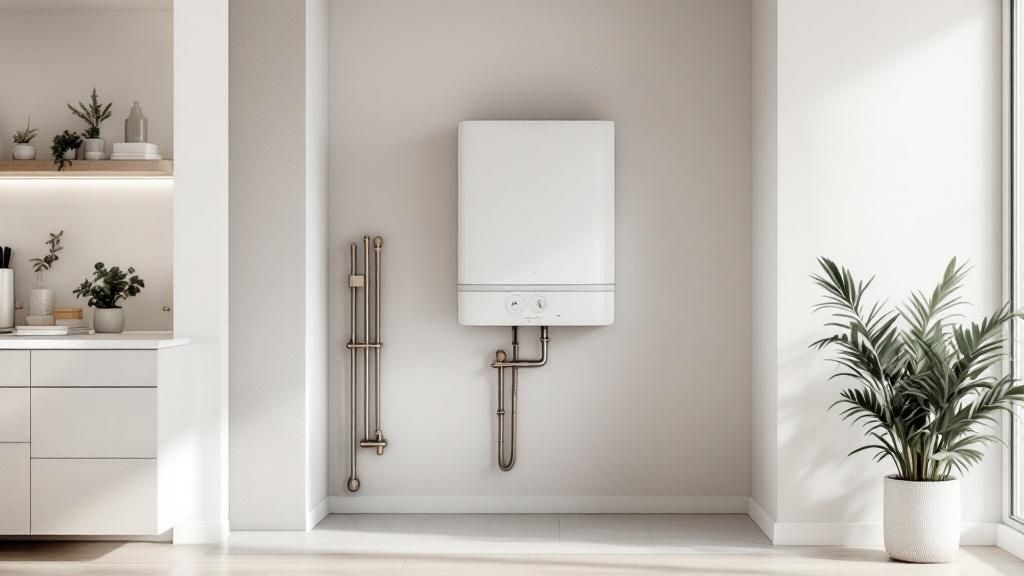
This space-saving benefit is particularly valuable in modern living situations where every square foot counts. From tiny homes to urban apartments, the ability to eliminate a large, cumbersome tank is a game-changer for interior design and functionality.
Real-World Space-Saving Scenarios in Monterey County
The practical applications of this compact design are evident across the region. In a Carmel-by-the-Sea condo with a premium on square footage, a homeowner was able to replace a closet-hogging 50-gallon tank with a wall-mounted unit, converting the old space into a much-needed pantry. Similarly, a Salinas family finished their basement, and the compact tankless model allowed them to seamlessly integrate the utility area into the new living space without sacrificing a large corner to a water tank. Commercial kitchens in Monterey also benefit by maximizing their prep and storage areas, a critical factor in a fast-paced environment.
Maximizing Your Newfound Space
To make the most of this benefit, consider these strategic tips:
- Plan for Placement: Work with a professional from Alvarez Plumbing to identify the ideal wall for installation. It must be able to support the unit’s weight and have proper clearances for service access and ventilation.
- Consider Outdoor Installation: In Monterey County’s moderate climate, installing the unit on an exterior wall is a viable option, freeing up interior space entirely. This is a popular choice for homes with limited indoor utility space.
- Reclaim and Repurpose: Before installation, plan how you will use the newly available floor space. Whether it becomes a storage area, a small workshop, or part of a larger room, having a plan ensures you capitalize on the investment.
This design innovation, pioneered by Japanese manufacturers and embraced by space-conscious movements, makes tankless heaters an intelligent choice for optimizing your home or business layout.
6. Con: Complex Installation and Maintenance Requirements
A significant consideration in the tankless water heater pros and cons discussion is the complexity and cost associated with both initial setup and ongoing upkeep. Unlike their simpler tank-based counterparts, tankless units demand professional expertise for a safe and effective installation. This often involves significant modifications to existing infrastructure, such as upgrading gas lines, enhancing electrical circuits, and installing specialized venting systems.
The intricacy of these systems means that improper installation can lead to poor performance, safety hazards, and even void the manufacturer's warranty. The technical demands are why manufacturer training programs and HVAC trade organizations strongly advocate for using certified technicians who understand the specific requirements for gas, electrical, and ventilation.
Installation and Upkeep Costs in Monterey County
The upfront investment extends beyond the unit itself. For example, a home in Salinas with a standard 1/2-inch gas line may require an upgrade to a 3/4-inch line to fuel a powerful gas tankless heater, a modification that can easily cost over $1,000. Similarly, electric models often need a new, dedicated high-amperage circuit, adding to the installation expense.
Ongoing maintenance is also non-negotiable for longevity and efficiency. Monterey County's moderately hard water necessitates annual descaling to prevent mineral buildup, a professional service that typically costs between $150 and $300. Neglecting this can lead to reduced efficiency, component failure, and costly repairs, such as a circuit board replacement that can run from $400 to $600.
Protecting Your Tankless Investment
To ensure your unit operates reliably and maintains its warranty coverage, follow these essential steps:
- Vet Your Installer: Before purchasing, thoroughly research and choose a qualified, licensed plumber with specific experience in tankless installations. Ask for proof of certification and references from local projects.
- Schedule Annual Service: Treat annual maintenance as a mandatory appointment. This proactive step is crucial for preventing scale buildup and is often a requirement to keep your warranty valid.
- Keep Meticulous Records: Retain all receipts and service records from professional maintenance appointments. This documentation is invaluable if you ever need to file a warranty claim.
- Consider a Service Contract: Many installers and manufacturers offer service contracts that bundle annual maintenance at a predictable cost, simplifying upkeep and helping you budget accordingly.
Proper care is essential for the performance and lifespan of these advanced systems. You can learn more about professional tankless water heater service in Salinas & Monterey to understand what's involved in a comprehensive maintenance plan.
7. Pro: Longer Lifespan and Durability
A significant long-term benefit in the tankless water heater pros and cons discussion is their extended operational life. Unlike storage tank heaters, which are prone to rust and sediment buildup, tankless models are built for longevity. With proper care, a quality tankless unit can last 20 years or more, easily doubling the typical 8 to 12-year lifespan of its tank-based counterpart.
This durability stems from their design. Tankless heaters lack a large reservoir of water that constantly expands and contracts, stressing the metal and leading to eventual leaks and failure. Because they have fewer parts susceptible to the corrosive effects of standing water, the risk of catastrophic tank failure and associated water damage is virtually eliminated, a fact insurance companies often recognize.
Real-World Longevity in Monterey County
The extended lifespan isn't just a manufacturer's claim; it's a proven reality. In areas like Salinas and Monterey, it's not uncommon to find early-generation gas tankless units from brands like Rinnai and Noritz, installed in the late 1990s or early 2000s, still performing reliably today. For commercial clients, such as a Carmel-by-the-Sea inn that invested in quality units, this translates to over two decades of consistent service without the need for a full system replacement. This level of durability represents a substantial return on the initial investment.
The key to achieving this longevity is consistent, professional maintenance. A well-maintained unit is far less likely to require premature or emergency services. Explore our guide on water heater repair and replacement to understand how proactive care prevents unexpected failures.
Maximizing Your Unit's Lifespan
To ensure your tankless water heater reaches or exceeds its expected 20-year lifespan, follow these actionable tips:
- Invest in Quality: Choose established brands known for their durability and parts availability. This initial investment pays dividends in long-term reliability.
- Follow the Schedule: Adhere strictly to the manufacturer's recommended maintenance schedule, including annual descaling, especially in areas with hard water.
- Install a Water Softener: If your property in Monterey County has hard water, installing a whole-house water softener is the single best thing you can do to protect the heater's internal components from mineral buildup.
- Keep Detailed Records: Maintain a file with your warranty information, installation date, and a log of all service and maintenance calls. This is invaluable for troubleshooting and warranty claims.
Tankless Water Heater Pros & Cons Comparison
| Feature | Implementation Complexity 🔄 | Resource Requirements ⚡ | Expected Outcomes 📊 | Ideal Use Cases 💡 | Key Advantages ⭐ |
|---|---|---|---|---|---|
| Energy Efficiency and Lower Operating Costs | Moderate – smart tech and modulating burners | Moderate – electricity upgrades possible | 8-34% energy savings depending on usage | Homes with ≤41 gallons/day or moderate use | Lower utility bills, reduced carbon footprint |
| High Upfront Installation Costs | High – complex plumbing, electrical upgrades | High – expensive units plus infrastructure | Long payback (10-15+ years), increased home value | Budget-conscious buyers weighing costs | Energy savings offset cost, tax credits |
| Unlimited Hot Water Supply | Moderate – proper sizing essential | Moderate – may need multiple units | Continuous hot water, no recovery time | Large families, hotels, spas | Endless hot water, no timing conflicts |
| Flow Rate and Temperature Fluctuation Issues | Moderate to High – installation & control tuning | Moderate – advanced sensors or pumps needed | Variable water temps, potential cold-water bursts | Homes with varying demand or low-flow fixtures | Improved units reduce fluctuations, tips for stability |
| Space Saving and Compact Design | Low to Moderate – wall mounting and support | Low – compact units require less space | Frees floor space, flexible installation | Small homes, condos, tiny homes | Saves space, multiple installation options |
| Complex Installation and Maintenance Requirements | High – professional installation and upkeep | High – ongoing maintenance cost and expertise | Longer lifespan if maintained, warranty compliance | Owners committed to maintenance | Safety, efficiency, prolonged unit life |
| Longer Lifespan and Durability | Moderate – maintenance needed for longevity | Moderate – investment in quality brands | 15-25+ years lifespan, fewer failures | Long-term homeowners, commercial use | Lower replacement costs, better ROI |
Your Next Step: Making the Right Choice for Your Home
Navigating the landscape of tankless water heater pros and cons reveals that the "right" choice is not universal but deeply personal. It's a significant decision that hinges on balancing immediate investment against long-term returns. For many homeowners and business managers across Monterey County, from Salinas to Carmel, the move to a tankless system is a strategic upgrade that pays dividends in efficiency and convenience for years to come.
We've explored the compelling advantages, such as substantial energy savings on your monthly utility bills and the luxury of an endless supply of hot water. The space-saving design and impressive 20-plus-year lifespan present a strong case for modernizing your property's infrastructure. However, these benefits must be weighed against the considerable upfront installation costs and the need for specialized maintenance, including regular descaling to combat our region's hard water.
Distilling the Decision: Key Takeaways
The core of your decision lies in a clear-eyed assessment of your specific situation. A tankless unit is often a perfect fit for a growing family that frequently runs out of hot water or for a business aiming to reduce its operational overhead and environmental footprint. Conversely, for a small household with low water demand or a property with older, incompatible plumbing, the high initial investment might not provide a sensible return.
The most critical insight is that a tankless water heater is not just a product; it's an integrated system. Its performance is directly tied to the specifics of your property. Factors like your home's gas line capacity, electrical panel amperage, and existing plumbing configuration are just as important as the unit's gallon-per-minute (GPM) rating.
Crucial Insight: The true value of a tankless water heater isn't just in the hardware itself, but in a professional, correctly sized installation tailored to your specific water usage patterns and your property's unique infrastructure.
Your Actionable Path Forward
Making an informed decision requires moving from general knowledge to specific analysis. The next logical step is to quantify the pros and cons as they apply directly to your home or business.
- Assess Your Hot Water Demand: Track your peak usage. Do you often run the dishwasher, washing machine, and a shower simultaneously? This will help determine the necessary GPM flow rate.
- Evaluate Your Budget: Look beyond the sticker price. Consider the full scope, including potential upgrades to your gas or electrical systems, and factor in the long-term energy savings.
- Schedule a Professional Site Assessment: This is the most vital step. Only a certified plumbing expert can inspect your existing setup, identify potential installation challenges, and provide a precise, all-inclusive quote. This professional analysis transforms the abstract list of tankless water heater pros and cons into a concrete, personalized recommendation.
Ultimately, mastering this decision means investing in a solution that brings you comfort, efficiency, and peace of mind for decades. It's about choosing the technology that best aligns with your lifestyle, financial goals, and long-term property value.
Ready to see if a tankless water heater is the right investment for your Monterey County property? The certified experts at Alvarez Plumbing specialize in evaluating home and business needs to provide a detailed cost-benefit analysis. We can help you navigate the complexities of tankless water heater pros and cons with a professional on-site consultation. Visit Alvarez Plumbing to schedule your assessment and take the first step toward endless hot water and lower energy bills.