Here’s what really separates a tankless water heater from a traditional one: it only burns energy when you actually need hot water. It’s a sprinter, not a marathon runner. While your old tank-style heater chugs along 24/7 keeping a huge reservoir of water hot, a tankless model gives you a powerful burst of heat the second you need it and then goes back to sleep. This simple difference is what eliminates so much wasted energy.
What Is Tankless Water Heater Efficiency
The core concept you need to grasp is something called standby heat loss. Think about that big, insulated tank in your basement or garage. It’s essentially a giant thermos, constantly fighting to keep 40 to 50 gallons of water hot, even while you’re at work or asleep. That constant reheating is a huge, silent drain on your energy bill.
A tankless water heater, on the other hand, works completely on demand. When you turn on your shower or kitchen faucet, cold water rushes through the compact unit. Inside, a powerful gas burner or electric element fires up instantly, heating the water as it passes through. The moment you turn the tap off, the heater shuts down completely. No tank, no standby heat loss. It's that simple.
The Real-World Impact on Your Wallet
This on-demand design translates directly into real savings. Government research shows that going tankless can make your home 24% to 34% more energy efficient than using a conventional tank heater. For most families, that works out to about $100 to $200 back in your pocket every single year. You can discover more about how these efficiencies add up over the lifetime of the unit, making it a smart long-term investment.
The true value of tankless efficiency is paying only for the hot water you actually use. You completely cut out the constant, background energy drain that comes with keeping a massive tank of water hot around the clock.
This infographic breaks down the numbers, showing the clear financial upside of a tankless system when it comes to annual energy use and operating costs.
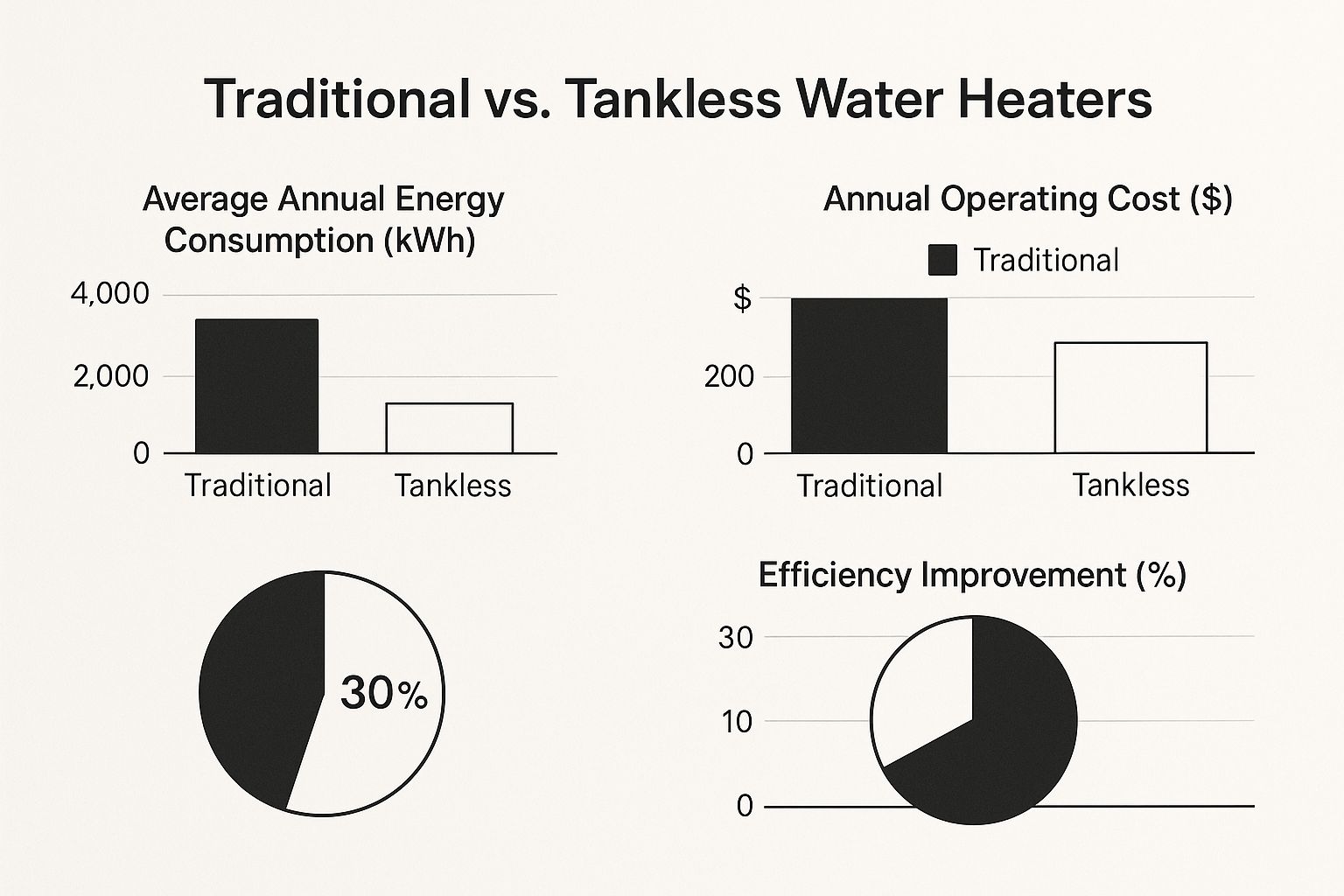
As you can see, the data doesn't lie. Tankless heaters consume less energy and cost less to run each year, which is the very definition of superior efficiency.
Tankless vs Traditional Water Heater At a Glance
Sometimes a direct comparison makes things clearest. To put it all into perspective, here’s a quick look at how the two systems really stack up against each other in the areas that matter most to homeowners.
| Feature | Tankless Water Heater | Traditional Tank Heater |
|---|---|---|
| Efficiency | High (eliminates standby loss) | Lower (constant standby loss) |
| Hot Water Supply | Endless, on-demand | Limited to tank capacity |
| Operating Cost | Lower annual costs | Higher annual costs |
| Lifespan | 20+ years | 10-15 years |
| Space Required | Compact, wall-mounted | Large, requires floor space |
The table really highlights the key trade-offs. While a traditional heater might have a lower upfront cost, a tankless model wins out on almost every other front, from long-term savings and lifespan to the sheer convenience of endless hot water.
How to Decode Heater Efficiency Ratings
Shopping for a new water heater can feel like trying to crack a secret code. You're hit with a jumble of acronyms like UEF and EF plastered all over the labels. But don't worry—understanding what these letters mean is your key to unlocking some serious long-term savings.
The most important rating you'll see today is the Uniform Energy Factor (UEF). This is the modern gold standard for measuring just how efficient a water heater really is.
Think of the UEF rating as the "miles-per-gallon" sticker for your water heater. It's a straight-up measure of how much of the energy it consumes is actually turned into hot water, versus how much gets wasted along the way. Best of all, this isn't just a lab-tested number; it’s calculated using real-world usage patterns, making it a fantastic predictor of how the unit will actually perform in your home.
What the UEF Number Really Means
The UEF is shown as a decimal, and it’s refreshingly simple to figure out. A higher number is always better.
For example, a tankless unit with a UEF of 0.96 is incredibly efficient. It means that for every dollar you spend on gas or electricity, a full 96 cents goes directly into heating your water. Only four cents are lost as exhaust—a tiny fraction compared to older, clunkier systems.
This one number gives you the power to compare different models on a true apples-to-apples basis. A heater with a 0.96 UEF is guaranteed to be cheaper to run than one with a 0.82 UEF, even if they look similar on the surface.
The Old Standard: Energy Factor (EF)
On some older models or in outdated articles, you might still bump into a rating called the Energy Factor (EF). Just like UEF, a higher EF number meant better efficiency. The problem was that the EF testing method wasn't as true-to-life and didn't really capture the different ways families use hot water.
That's why the Department of Energy brought in the UEF standard—to give you a much more accurate and useful tool. The key improvements are:
- Realism: UEF tests are based on scenarios for low, medium, and high-demand households.
- Clarity: It makes it much easier to compare totally different kinds of water heaters, whether they're gas, electric, tankless, or traditional tank models.
Because of this, you should always look for the UEF rating when making your choice. A high UEF not only leads to lower monthly bills but can also make you eligible for local utility rebates or even federal tax credits, helping to close the gap on the initial purchase price.
Of course, getting that rated efficiency depends on getting the unit installed correctly. To learn more, check out our guide on tankless water heater installation near me for local insights.
What Really Affects Your Heater’s Performance
That shiny UEF rating on the box is a fantastic starting point, but it doesn't paint the full picture. The actual tankless water heater efficiency you get in your home comes down to a handful of real-world variables. It's best to think of the UEF rating like a car's highway MPG—your results will absolutely vary based on where and how you drive.
Your heater's day-to-day performance is tied directly to your specific environment and how you use hot water. Ignoring these factors is like owning a high-performance sports car but only ever driving it in bumper-to-bumper traffic; you’ll never experience what it’s truly capable of. Getting a handle on these elements is the key to unlocking maximum energy savings.
The Critical Role of Incoming Water Temperature
One of the biggest players in your unit's efficiency is the temperature of the groundwater flowing into your home. A tankless heater has one job: to raise the water from its starting temperature up to your desired setting, which is usually around 120°F. We call this difference the "temperature rise."
Let's imagine you live in a warm place like Southern California, where the groundwater might be a comfortable 70°F. Your heater only needs to add 50 degrees of heat. Now, picture a home up in a colder northern state where the winter groundwater is a bone-chilling 40°F. That very same heater has to work much harder, adding a whopping 80 degrees to hit the same 120°F at the tap.
This extra work demands more energy, which directly hits your unit's real-world efficiency and, ultimately, your wallet. The same exact model will perform differently—and cost more to run—in a colder climate simply because it has a much bigger job to do every time you turn on the hot water.
Why Proper Sizing Is Non-Negotiable
Choosing the right size heater is probably the most important decision you'll make in this process. This isn't just about getting hot water; it’s about getting it efficiently. Sizing comes down to the maximum flow rate you'll ever need at one time, which we measure in gallons per minute (GPM).
-
Undersized Unit: A heater that's too small will constantly struggle to keep up. If you try to run the shower and the dishwasher at the same time, it might fail to deliver truly hot water to either, leaving you with a frustrating lukewarm flow. It will be forced to run at full blast more often, leading to extra wear and tear and shortening its lifespan.
-
Oversized Unit: While this is a less frustrating problem, an oversized unit isn't ideal either. You'll pay more for the unit itself, and it may cycle on and off more than necessary, using slightly more energy than a perfectly sized unit would for your daily needs. It’s like using a sledgehammer to hang a picture frame—it’s overkill that wastes money and resources.
The goal is to find that "Goldilocks" unit—one that's just right. It needs to comfortably handle your busiest hot water moments without being too powerful for normal, everyday use. A professional assessment is the only way to get this right.
The Impact of Your Fuel Source
Your choice between a natural gas and an electric model also plays a huge part in both the efficiency rating and your monthly bills. Electric heaters often brag about higher UEF ratings, sometimes reaching 0.98 or more, because almost no energy is lost as waste heat. But, the catch is that electricity is usually more expensive per unit of energy than natural gas.
On the other hand, a high-efficiency condensing gas heater might have a slightly lower UEF (around 0.96), but since natural gas is typically cheaper, it often leads to lower annual operating costs. If you feel your unit isn't living up to its promise, it might be time for a professional check-up. Sometimes, hidden issues can drag down efficiency. Getting help from a qualified tankless water heater repair service to diagnose the problem ensures your system runs just as it should, saving you money in the long run.
Advanced Technology Driving Modern Efficiency
Beyond the basic on-demand design that started it all, today's best tankless water heaters are jam-packed with smart technology. These features are all designed with one goal in mind: squeezing every last drop of value out of your energy dollar.
These aren't your grandpa's water heaters. We're talking about sophisticated appliances that actively work to boost tankless water heater efficiency and keep your utility bills down. This advanced engineering is what truly sets modern units apart from older models.
Condensing for Maximum Heat Capture
One of the biggest game-changers has been condensing technology. Think about a standard, non-condensing gas heater. Hot exhaust gases—a huge source of wasted energy—are just vented straight outside. It’s like leaving a window wide open while the furnace is running.
Condensing units are much smarter. They're built with a second heat exchanger that cleverly captures those hot exhaust gases before they can escape. It then uses that captured warmth to pre-heat the cold water coming into the unit. By recycling this otherwise wasted heat, the main burner doesn't have to fire up nearly as hard.
This one feature can boost a unit’s efficiency by a whopping 10-15%, pushing its UEF rating up to an impressive 0.96 or even higher. It's a simple, brilliant way to get more hot water from the same amount of fuel.
Precision Power with Modulating Burners
Another key piece of the puzzle is the modulating gas valve or heating element. The best way to think about it is like a dimmer switch for your lights instead of a basic on-off switch. Rather than firing at full blast every single time you turn on a tap, the heater intelligently adjusts its power to match the exact demand.
A modulating burner senses the flow rate and adjusts its intensity in real-time. If you’re just washing your hands, it uses a small flame. If the shower and dishwasher are running simultaneously, it ramps up to full power. This precision prevents energy waste and ensures consistent water temperatures.
This technology is a huge reason for the real-world efficiency gains, making sure the unit only ever uses the absolute minimum energy required for the job at hand.
These are the kinds of improvements that have fueled the market's explosive growth. Industry analysis shows the global tankless market, valued at $4.9 billion in 2024, is projected to hit $9.5 billion by 2034. This jump is being driven by homeowners demanding energy-saving features, plus modern conveniences like Wi-Fi and smart controls. You can read the full research about these market trends to see how innovation is shaping the industry.
Of course, making sure these advanced systems are installed and tuned correctly is critical. For professional help, exploring your options for local water heater repair and installation will guarantee your investment operates at peak efficiency from day one.
Actionable Tips to Maximize Your Efficiency
Just having a tankless water heater installed is a huge first step toward smarter energy use. But to really squeeze every drop of efficiency out of it, you need to go beyond the initial setup and build a few simple, powerful habits.
Think of it like buying a high-performance car. You wouldn't just drive it without ever changing the oil or getting a tune-up, right? The same logic applies here. These practical tips will help you get the most from your investment, ensuring lower utility bills and reliable hot water for years.
Perform Regular Descaling Maintenance
If you live anywhere with hard water, mineral buildup—also known as limescale—is the number one enemy of your heater's efficiency. Every time your unit fires up, minerals like calcium and magnesium cling to the internal parts, especially the delicate heat exchanger.
This crusty layer of minerals acts like insulation, forcing the heater to work much harder and burn more fuel just to get the water hot. It’s like trying to boil water in a pan caked with grime; it simply takes more time and a lot more heat.
Descaling your unit once a year is like giving your system a deep clean. This process flushes the unit with a special solution, usually vinegar-based, to dissolve all those mineral deposits. It brings your heat exchanger back to its original, super-conductive state, keeping performance at its peak.
Optimize Your Temperature Setting
Believe it or not, many heaters come from the factory set to a scalding 140°F. For most families, that's way hotter than necessary. This high setting not only makes the unit burn more fuel with every shower but also leads to more heat loss as the water sits in the pipes.
For nearly every household need, from washing dishes to taking a shower, 120°F is perfectly sufficient. Making this small adjustment is one of the easiest ways to slash your energy consumption without ever noticing a difference in comfort. Dropping the temperature by just 20 degrees can make a real dent in your monthly bills. For more ideas, check out our guide on how to get the most of your water heater.
Reduce Hot Water Consumption
The most straightforward way to boost your tankless heater's efficiency is also the most obvious: just use less hot water. A few small changes around the house can add up to significant savings, and you won't have to sacrifice a thing.
- Install Low-Flow Fixtures: Modern showerheads and faucet aerators are engineered to maintain great water pressure while cutting your hot water use by 25% or more.
- Insulate Your Pipes: Grab some foam pipe insulation from the hardware store and wrap the first few feet of hot water pipes coming out of your heater. This simple step reduces heat loss as water travels to your faucet, meaning you wait less for it to get hot and waste less in the process.
- Wash Clothes in Cold Water: Today’s laundry detergents are formulated to work just as well in cold water. Shifting this one habit can completely eliminate a major source of hot water demand in your home.
By combining these simple, actionable strategies, you can make sure your tankless system is always running at its best, delivering both the endless hot water you love and the impressive energy savings you expect.
Why Tankless Is the Smart Choice for Modern Homes
If you've noticed more and more talk about tankless water heaters, it's not just some passing fad. It’s a real shift in how we think about home appliances, driven by the way we live today. These units are a near-perfect fit for modern homes, delivering the kind of performance that lines up with our values—things like saving resources and smart, efficient design.
This is especially true for anyone living in a city. The compact, wall-mounted design is a total game-changer for apartments, condos, and smaller houses where every last square foot is precious. Instead of giving up an entire closet to a huge 50-gallon tank, you get that space back. Think about it: it's an appliance upgrade that literally gives you back part of your home.
Efficiency Meets Urban Living
This space-saving perk goes hand-in-hand with our growing desire for smarter, more efficient appliances. As more of us choose to live in cities, the demand for compact, energy-conscious solutions is no longer a "nice-to-have"—it's a necessity.
A key reason for the tankless boom is the worldwide move toward cities. The United Nations projects that 68% of the world’s population will be living in urban areas by 2050. Naturally, this means the demand for space-saving, high-efficiency appliances is through the roof.
This trend really highlights why tankless water heater efficiency is such a big deal. It perfectly meets the practical needs of city households that want to shrink both their carbon footprint and their utility bills. You can see more data on these global trends and how they're shaking up the market.
At the end of the day, picking a tankless water heater is about more than just getting endless hot water. It's a deliberate choice to build a smarter, more sustainable home that actually works for the realities of modern life.
Common Questions About Tankless Efficiency
Even after getting the hang of how these systems work, most homeowners still have a few practical questions. Let's tackle some of the most common ones we hear from folks around Salinas to clear up any confusion.
Will a Tankless Water Heater Give Me Instant Hot Water?
Not exactly, and this is a really common point of confusion. The term "instantaneous" refers to the heating process, not the delivery time to your faucet.
The unit heats water the second you turn on the tap, but that hot water still has to travel through your home's pipes to reach you. If you're looking for true, right-this-second hot water, you can pair your tankless system with a hot water recirculation system.
Is a Gas or Electric Tankless Heater More Efficient?
On paper, electric models look like the clear winner. They often have UEF ratings over 0.98 because practically no energy is lost through an exhaust vent.
However, the real story comes down to your utility bill. In most places, electricity costs more per unit than natural gas. This means a high-efficiency condensing gas heater, with a UEF of up to 0.96, is often much cheaper to run over the course of a year.
The best choice almost always comes down to your local utility rates. Compare the cost of a kilowatt-hour of electricity to a therm of natural gas to see which fuel source offers better long-term savings in your area.
How Often Should I Service My Tankless Heater?
To keep it running at peak efficiency, manufacturers recommend descaling your unit about once a year. This simple maintenance prevents mineral buildup from hard water, which can force the heater to work harder and waste energy.
If you live in an area with particularly hard water, you might need to do it every 6 to 9 months. If you ever notice a drop in performance or suspect something's not right, getting professional water heater repair in Salinas CA is the best way to diagnose and fix the issue quickly.
Ready to upgrade to endless, efficient hot water or need an expert to service your current system? Alvarez Plumbing has over 35 years of experience ensuring Salinas homeowners get the most from their investment. Schedule your service with us today!