Direct Answer: As of July 1, 2026, California requires all backflow assembly testers to hold certification from a State Water Resources Control Board-recognized program. Salinas property owners must use only approved testers and submit test results to California Water Service within 10 days.
If your property has an irrigation system, a fire sprinkler connection, or a commercial food or dental service line, California’s updated backflow testing rules now affect you directly. Starting July 1, 2026, every backflow assembly tester working in the state must hold certification from a program recognized by the State Water Resources Control Board. That’s a harder requirement than what was on the books before, and it narrows the pool of people who can legally perform your annual test.
For Salinas property owners, this lands in California Water Service territory. Cal Water has already updated its 2026 tester meeting schedule and requires testers to submit current certifications to remain on its approved list. If you’ve been using the same tester for years without checking their credentials, now is a good time to verify.
This article covers three things: what a backflow preventer actually does, which device you likely have and why it needs annual testing, and what the new documentation requirements mean for landlords and property managers who are already stretched thin on compliance paperwork.
What a Backflow Preventer Actually Does
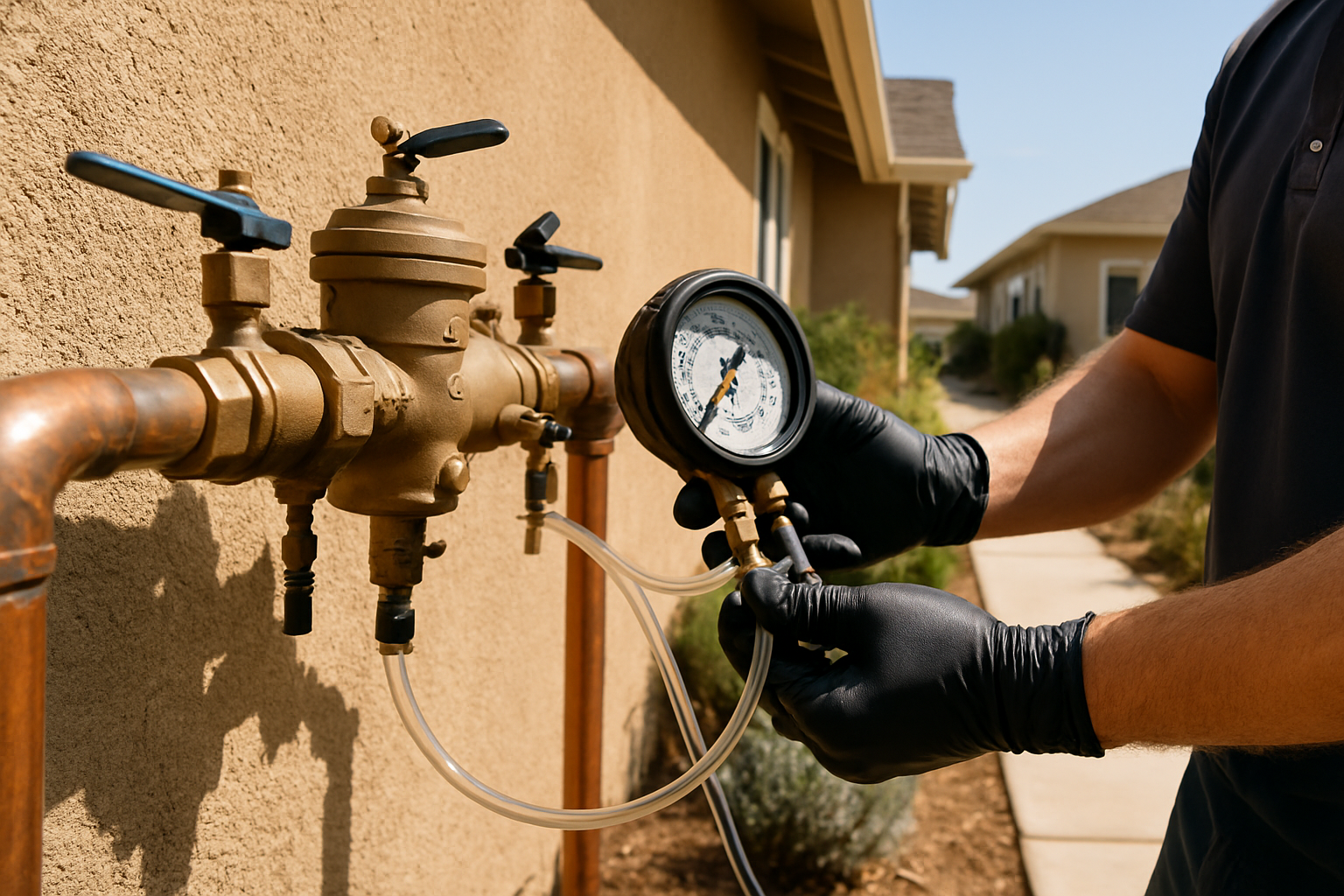
A backflow preventer is a valve that sits at the connection point between your private plumbing and the municipal water supply. Its job is simple: keep water flowing in one direction only.
The risk it protects against is called backflow, when pressure in the main line drops suddenly, contaminated water from your property can reverse course and flow back into the clean public supply. This can happen during a water main break, heavy firefighting activity nearby, or when a booster pump kicks on unexpectedly. It’s not a theoretical concern; it’s why California Code of Regulations Title 17 mandates annual testing for most testable assemblies.
The key word is testable. There are three device types you’re most likely to encounter:
- Reduced Pressure Zone (RP): The most protective option. Required for high-hazard connections like irrigation systems that use fertilizer injectors, commercial food service lines, and medical or dental office water connections.
- Double Check Valve (DC): Used for lower-hazard connections, including basic commercial irrigation and some fire sprinkler systems.
- Pressure Vacuum Breaker (PVB): Common on residential irrigation systems. Simpler design, lower cost, but only protects against back-siphonage, not backpressure scenarios.
Each type has different testing criteria and failure modes. That’s exactly why the testing has to be done by a certified technician, not a general handyman, and why California just raised the bar on what certified means.
Do You Even Have a Device That Needs Testing?
This is the question most Salinas homeowners ask first, and it’s a fair one. Not every residential property has a testable backflow assembly.
If your property has any of the following, the answer is almost certainly yes:
- A yard irrigation system connected to the municipal water supply
- A fire sprinkler line with a direct water service connection
- A boiler fill line tied into domestic water
- A commercial kitchen, dental office, or medical suite with specialty water connections
- A hose bib with a chemical injector or fertilizer system attached
A basic single-family home in Salinas without any of those connections may not have a testable assembly at all. But if you’re unsure, a licensed plumber can do a quick site assessment and confirm before you spend money on a test call. A camera inspection can reveal what’s connected and where for more complex properties where the plumbing layout isn’t obvious.
For landlords and property managers across Salinas, Seaside, and Monterey, this question multiplies across every unit. A multi-family building with shared irrigation is almost guaranteed to have at least one testable device. Missing it is not a gray area, it’s a compliance gap.
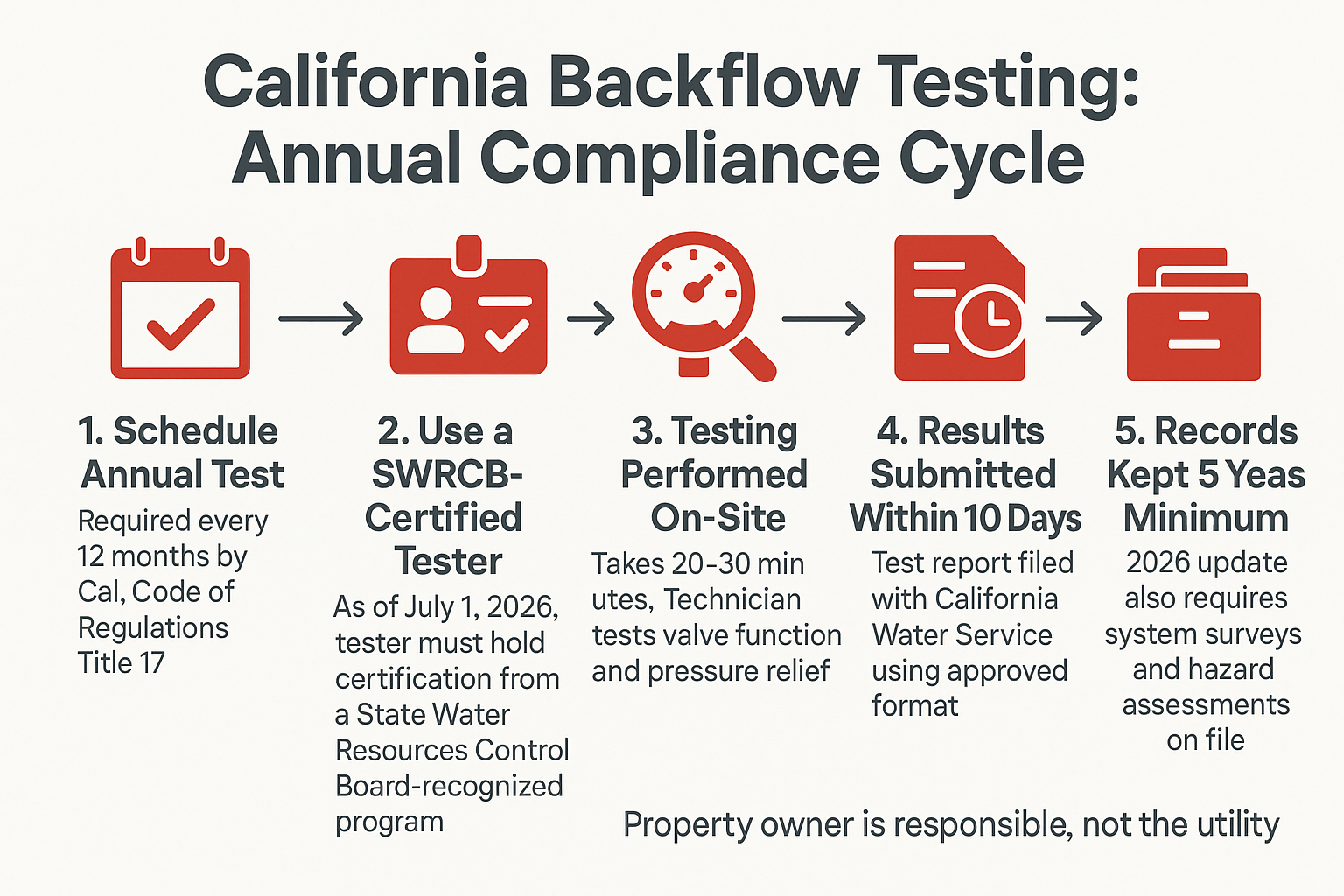
The Annual Backflow Testing Cycle in California
Here’s how the compliance timeline works from test to documentation, and where the new 2026 rules change things.
The Documentation Side Is Where Most Property Owners Get Caught
Passing the test is only half of it. The other half is the paperwork, and the 2026 update tightened those requirements significantly.
Here’s what compliance now looks like under the updated rules:
- Test results must be submitted to California Water Service within 10 days of testing, using an approved reporting format
- Records must be retained for a minimum of five years
- The 2026 update expanded record-keeping beyond simple test results to include system surveys and hazard assessments, a broader documentation burden than before
- Testers must submit their current certifications to Cal Water to remain on the approved tester resource list
According to Pacific Backflow’s 2026 regulatory update, additional ANSI-accreditation requirements for tester certification programs are coming by July 2027, so the rules are still tightening.
For a homeowner with one irrigation system, this is manageable. For a landlord managing multiple units in Salinas or along the Monterey corridor, the paper trail gets complicated fast. A missed annual test can trigger written notices from the water district, fines, and in repeated cases, potential service interruption. That last outcome is rare but documented, and it’s the kind of problem that lands in a property manager’s inbox at the worst possible time.
If you’ve let testing lapse or aren’t sure whether your current tester is on Cal Water’s approved list, it’s worth sorting that out now rather than after a notice arrives.
Common Backflow Device Types at a Glance
The device type installed on your property determines both the testing method and the hazard level it’s designed for. Here’s a quick comparison of what you’re most likely to find.
| Device Type | Typical Application | Protects Against |
|---|---|---|
| Reduced Pressure Zone (RP) | Irrigation with chemical injection, dental/medical connections, commercial food service | Backpressure and back-siphonage (high hazard) |
| Double Check Valve (DC) | Basic commercial irrigation, lower-hazard fire sprinkler connections | Backpressure and back-siphonage (low-to-moderate hazard) |
| Pressure Vacuum Breaker (PVB) | Residential irrigation systems | Back-siphonage only (not backpressure) |
What Backflow Testing Actually Costs in the Salinas Area
Backflow testing is one of the more affordable annual compliance requirements a property owner faces. Based on general market context for the Salinas and Monterey Bay Area, many property owners see costs somewhere in the $75 to $120 range per device for a standard annual test, though the actual number depends on the device type, accessibility, and whether any repairs are needed.
If a device fails the test, repair or replacement adds to that figure. A full device replacement costs more, and that price varies based on assembly size and material. Getting an exact quote before work begins is the right call.
For landlords with multiple units or devices, some plumbers offer per-device pricing that scales reasonably across a portfolio. The real cost of skipping the test, though, isn’t the testing fee, it’s the compliance exposure. When a small plumbing issue turns into a larger repair bill, the pattern almost always traces back to something that could have been caught earlier.
Frequently Asked Questions About Backflow Testing in Salinas
How do I know if my backflow tester is still approved under the new 2026 rules?
Contact California Water Service directly or ask your tester to provide their current certification documentation from a State Water Resources Control Board-recognized program. Cal Water maintains an approved tester resource list and updated it in 2026 to reflect the new certification requirement. If your tester can’t provide current documentation, they’re not compliant.
My house doesn’t have an irrigation system. Do I still need backflow testing?
Probably not, but it depends on what’s connected to your water line. Residential properties without irrigation, fire sprinkler connections, boiler fill lines, or specialty equipment generally don’t have a testable assembly. If you’re not sure, a licensed plumber can do a quick assessment of your water service connections and tell you definitively.
What happens if I miss the annual testing deadline?
California Water Service can issue a written notice of non-compliance. Repeated misses can result in fines or, in serious cases, water service interruption. The responsibility falls on the property owner, not the utility, so there’s no automatic reminder, you have to track it yourself or work with a plumber who manages the scheduling and paperwork for you.
How long does backflow testing take?
For a standard residential or small commercial device, the test itself takes about 20 to 30 minutes on-site. If repairs are needed, that adds time. The testing report still has to be submitted to Cal Water within 10 days of the test date.
I manage several rental properties in Salinas. Is there a way to handle all the testing at once?
Yes. A plumber who handles commercial and multi-property accounts can schedule all your devices in a single sweep and manage the documentation submission for each one. That’s a much cleaner approach than tracking individual test dates across a portfolio. Make sure whoever you use is on Cal Water’s approved tester list before scheduling.
Need Backflow Testing or a Site Assessment in Salinas?
We’ve been handling backflow prevention services for residential and commercial properties across Salinas and the Monterey Bay Area for more than 35 years. If you’re not sure whether your property has a testable assembly, or if your annual test is overdue, we can help you sort it out. Call Alvarez Plumbing at (831) 757-5465 or schedule online at alvarezplumbingsalinas.com, we’re available 24 hours a day, 7 days a week.