
Direct Answer: Sometimes. If the cast iron walls are still sound, descaling or relining can restore the line in place. If the pipe has collapsed, sagged, or separated, it has to be replaced.
You have had the same line cleared more than once. This time someone used the word replacement, then the word excavation, and now you are picturing a trench cut across the front lawn.
The question actually running through your head is simpler than that. Can the pipe you already have be fixed where it sits, without tearing up the yard?
Sometimes yes. But nobody can honestly answer that until they see the inside of the line, and that is the part most homeowners in Salinas skip. Below is what repair in place really means, what it can and cannot fix, and how the age of local housing stock shapes the answer.
The Three Repair-in-Place Methods People Actually Ask About
One property owner in the area wrote in and asked, by name, whether three specific services were available. Those three come up constantly once someone starts researching trenchless sewer repair in Salinas, so here they are in plain English.
- Mechanical descaling. A flexible shaft with a chain or brush head is spun down the pipe to knock decades of hardened scale and rust off the inside of cast iron, back toward bare metal. This is a cleaning method, not a structural fix.
- Epoxy pipe brushing. After the walls are cleaned, a two-part epoxy coating is brushed onto the inside surface to seal pitting and slow future corrosion. It only works on a pipe that still has real wall thickness left.
- CIPP lining. Short for cured in place pipe. A resin-soaked liner is pulled or inverted into the old line and cured, forming a new pipe inside the old one. This is the closest thing to a true no-dig rebuild.
Not every plumbing company on the Monterey Peninsula or in the Salinas Valley runs all three. If a contractor quotes you “trenchless,” ask which of the three they mean, because the cost, the prep work, and the result are different for each.
Nothing Gets Decided Until Somebody Looks Inside the Pipe
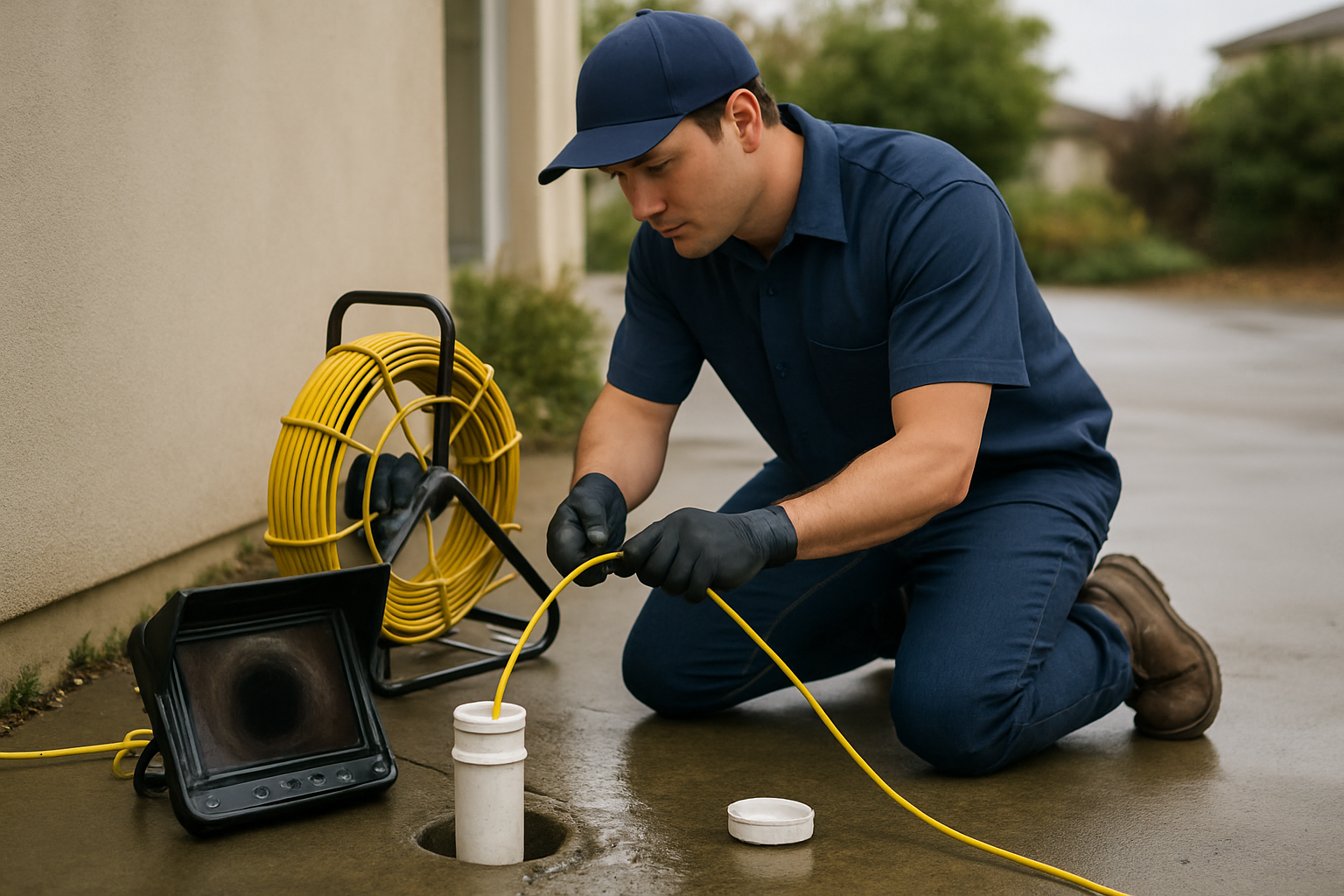
A camera inspection is the step that separates a line that is dirty from a line that is failing. Those two situations look identical from the backyard and cost wildly different amounts to fix.
The process is not a big production. A waterproof camera head goes in through a cleanout, runs the length of the lateral, and a locator marks the depth and position of anything it finds. Most residential runs take 30 to 60 minutes.
Cost varies with the length of the run, how many access points there are, and whether the line has to be cleared enough to get a camera through at all. In the Salinas and greater Monterey County market, a straightforward residential sewer or drain line inspection generally lands in the few-hundred-dollar range, with longer or more complicated runs costing more. An accurate number should come from a plumber who has seen the property, not from a phone estimate.
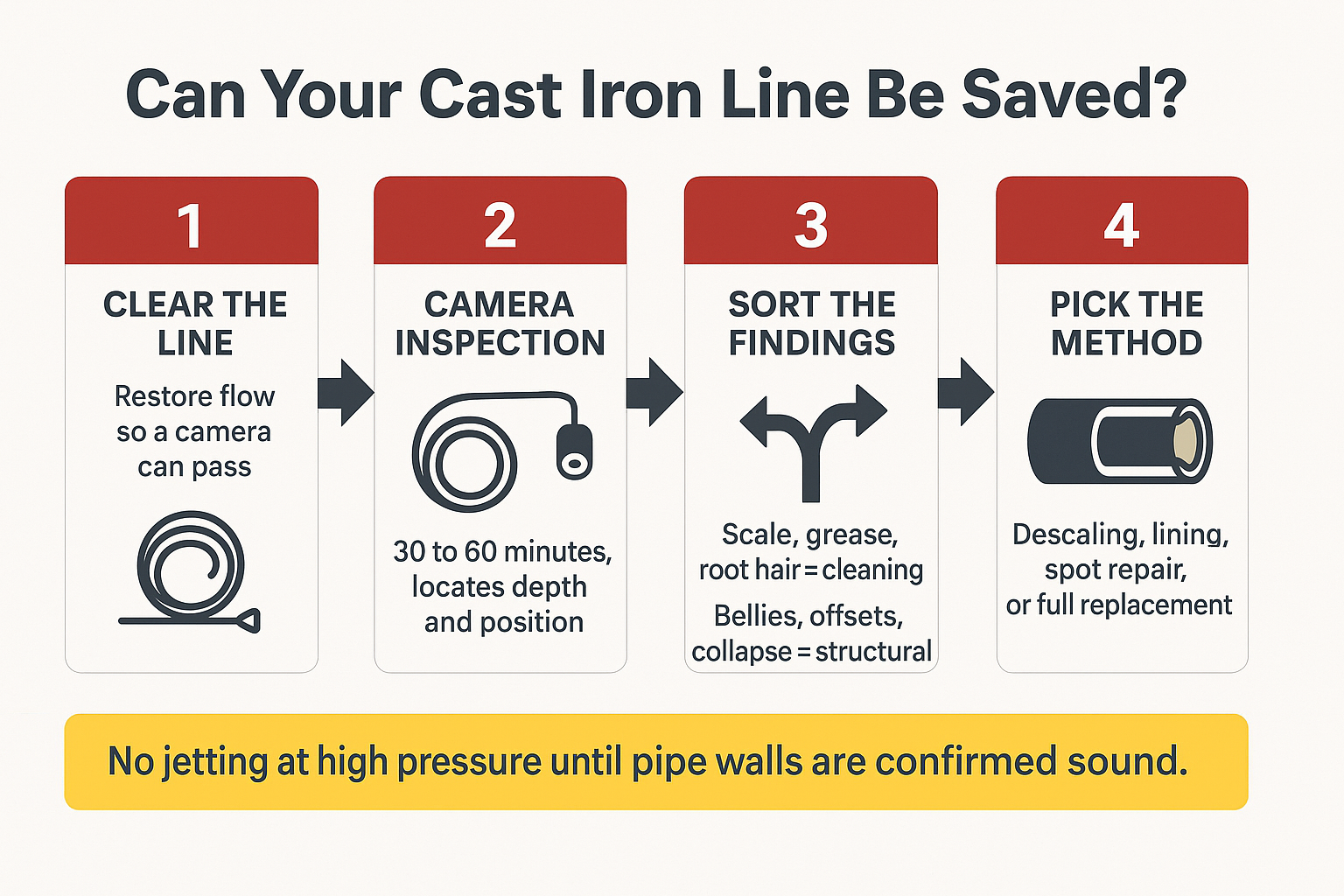
One more thing worth knowing before anyone turns on a jetter. High-pressure jetting can run up to 4,000 PSI, which is more than enough to clear grease, sludge, and scale, and also more than enough to find the weak spot in a corroded pipe. Pipe condition gets confirmed first. If the walls are thin, a gentler method is the right call.
Cleaning Problem or Structural Problem?
This is the line that decides everything. Here is how the two categories usually break down on camera.
| What the camera finds | Category | What it generally takes |
|---|---|---|
| Hard scale buildup narrowing the pipe | Cleaning | Jetting or mechanical descaling |
| Grease, sludge, and sediment | Cleaning | Hydro jetting |
| Fine root hair at a joint, pipe still round | Cleaning | Clearing, then a maintenance cadence |
| Pitting and corrosion, walls still sound | Restorable | Descaling, then a lining or coating method |
| Belly where the pipe lost its slope | Structural | Excavation and section replacement |
| Badly offset or separated joint | Structural | Excavation and section replacement |
| Collapsed section | Structural | Replacement, no cleaning will help |
| Heavy roots that pushed the pipe apart | Structural | Replacement of the affected run |
Why So Many Salinas Homes End Up in This Conversation
This is where a local answer beats a generic one. The median Salinas home was built in the mid 1970s, and roughly 11 percent of the city’s housing stock predates 1950.
That means clay and cast iron drainage lines are still in the ground across the older neighborhoods, and those are exactly the materials that scale up, crack at the joints, and invite roots in. Cast iron does not fail all at once. It thins from the inside while the outside still looks fine.
Add the trees. Older parts of Salinas and plenty of streets on the Monterey Peninsula have mature trees sitting directly over the lateral run, and roots go where the water is. A hairline crack at a joint is an invitation.
When the structural side wins, the project gets real. Whole-line replacement in an older home runs into the thousands depending on depth, length, landscaping, and whether the run goes under a driveway, and a typical residential repipe takes several days of work. That gap is why the diagnosis matters so much. It is the difference between a maintenance visit and a multi-day project, and a main line backing up at more than one fixture is usually the first hint you are near that line.
How the Repair-in-Place Decision Actually Gets Made
The path from a slow drain to a final recommendation follows the same four steps almost every time.
The Lateral Is Yours, Not the City’s
Most homeowners assume the sewer pipe is a public utility problem all the way to the house. It is not.
The City of Salinas position is that root infiltration into a building sewer lateral is presumed to result from improper installation, which makes repairing it the property owner’s responsibility. The city maintains the main in the street. The run from your house to the connection point is on you.
Meanwhile, sewer service charges are climbing. The City Council adopted a five-year rate schedule following a commissioned rate study, which also included a 15 percent residential payment assistance discount for qualifying income levels. You can read the background in the city’s own 2025 Sanitary Rate Study materials, and we broke down what rising sewer rates mean for private lines separately.
Here is the practical reason this matters to your wallet. A camera inspection is often how a homeowner finds out whether the defect sits on their side of the property line or past it, before anyone spends money digging in the wrong place.
Early Fall Is the Calm Window. January Is Not.
Nearly all of this region’s rain falls between November and March, with December typically the wettest month at around 2.8 inches in Salinas. Saturated ground is when marginal lines start backing up, because groundwater finds every crack and roots get aggressive around a wet pipe.
Calls for sewer and drain work climb sharply in January and February for exactly that reason. A line that has been a little slow all summer tends to pick the worst possible week to quit.
That makes early fall the quiet window to look inside a pipe that has been nagging you. Getting ahead of the first real rain is a lot less disruptive than finding out during a storm.
One more distinction worth keeping straight. A recurring cleaning schedule is not the same thing as a pipe that needs rebuilding. A Salinas homeowner wrote in describing a routine she already had down cold: “My pipes are making noises and I already know that means the Hydro Jett due to my trees.” That is maintenance, and a reasonable baseline is roughly every one to two years for a home with known root pressure, or every 6 to 12 months for restaurants and commercial kitchens. If that is your situation, how often roots need clearing is the real question, not whether to reline.
Why the Diagnosis Matters More Than the Method
Sewer lateral work in California is licensed contractor territory. This is not a weekend project, and it is not something to decide from a bid that skipped the camera.
The crew that owns the camera, owns the jetter, and handles the permit paperwork can tell you what the pipe needs without guessing. They are also the ones who have to stand behind the answer.
For whatever it is worth as context: Alvarez Plumbing has been working Salinas laterals since 1988, is family run, and is licensed, insured, and bonded in California, with City of Salinas permitting handled in house. One customer put it plainly after a sewer job in a review: “They replaced old sewer pipe it was a big job.” Sometimes that is the honest answer. The point is finding out which answer you have before anyone brings a shovel.
Frequently Asked Questions About Trenchless Sewer Repair in Salinas
Is trenchless repair always cheaper than digging?
Not always. Lining and descaling avoid landscaping, driveway, and hardscape restoration, which is often where excavation costs pile up. But if the pipe is collapsed or has lost its slope, lining is not an option at any price, and paying for a lining attempt first just adds cost.
Can you line a cast iron pipe that is already leaking?
It depends on how much wall is left. Lining needs a host pipe that holds its shape while the liner cures. A pipe with pitting and corrosion can often be descaled and lined. A pipe that has rotted through in sections usually cannot.
Will a camera inspection work if my line is completely blocked?
The line has to be cleared enough for the camera to pass. In practice that usually means clearing the blockage first, then running the camera to find out why it happened. That order is normal and worth expecting.
How do I know if the problem is on my side of the property line?
The camera locator marks the depth and position of the defect, and that location is compared against where the lateral connects to the city main. It is the only way to know for sure before spending money on a repair.
My drains are slow but nothing has backed up yet. Is it too early to look?
That is actually the ideal time. Slow drains throughout the house, gurgling toilets, or sewer odor near a floor drain are early signals. Looking in early fall, before the rain arrives, gives you options instead of an emergency.
Want to Know What Is Actually Going On Inside Your Line?
If a line in Salinas, Monterey, or anywhere around the bay has been cleared more than once and you want a real look before the rain starts, a camera inspection is the step that settles it. Alvarez Plumbing runs camera inspections, hydro jetting, and sewer line repair across the Monterey Bay Area, with 24/7 availability when something cannot wait. The office number is (831) 757-5465, and service can also be scheduled at alvarezplumbingsalinas.com.
