
Direct Answer: Most Salinas homes were not built to feed a second dwelling. Before ADU plumbing rough-in, a licensed plumber should check your water service line size, sewer lateral condition, and gas capacity.
You got the ADU approved. Plans are drawn, the contractor has a start date, and the garage conversion or backyard unit is finally happening. Then someone asks what size your water service line is, and nobody in the room knows.
Since California loosened ADU rules in 2020, Salinas and the rest of Monterey County have seen a steady climb in garage conversions and backyard units. But most of the homes taking these on were built decades before anyone imagined a second kitchen and bathroom on the same lot.
This guide covers the three systems that decide whether your existing plumbing can carry an ADU, what a plumber actually looks at, and why that conversation should happen before framing goes up.
The Three Systems That Decide If Your Plumbing Can Handle an ADU
An ADU is not one more bathroom. It is a full second dwelling with its own kitchen sink, dishwasher, shower, toilet, laundry hookup in many cases, and usually its own water heater.
That load lands on three systems that were sized for a single house:
- Water supply. The service line running from the meter to your home, plus the pipe size and pressure inside.
- Waste and sewer. The lateral that carries everything from your property out to the city main.
- Gas. The meter capacity and pipe sizing that has to feed a second water heater and possibly a range.
Any one of these can be the thing that stops your project or adds weeks to it. And they are almost never checked at the same time the architect is drawing plans.
Here is what we see in the field across Salinas and the Monterey Peninsula. A homeowner has an approved permit in hand, framing is scheduled, and nobody has looked at a 1950s galvanized service line feeding the whole property. That discovery on day one of rough-in is a very different conversation than the same discovery three months earlier.
The Sewer Lateral Is the Part That Catches People Off Guard
Water supply problems are usually solvable with a bigger pipe. The sewer lateral is where projects get expensive, because you cannot see it and you cannot guess at it.
Older Salinas properties often have clay or cast iron laterals that have been in the ground 50 or 60 years. Add mature trees, the Salinas Valley’s clay-heavy soil, and decades of settling, and you get cracks, bellies, offset joints, and root intrusion.
One homeowner told us their pipes start making noise every couple of years and they already know it means the main line needs jetting because of their trees. That is a line already working at its limit. Now add a second household to it.
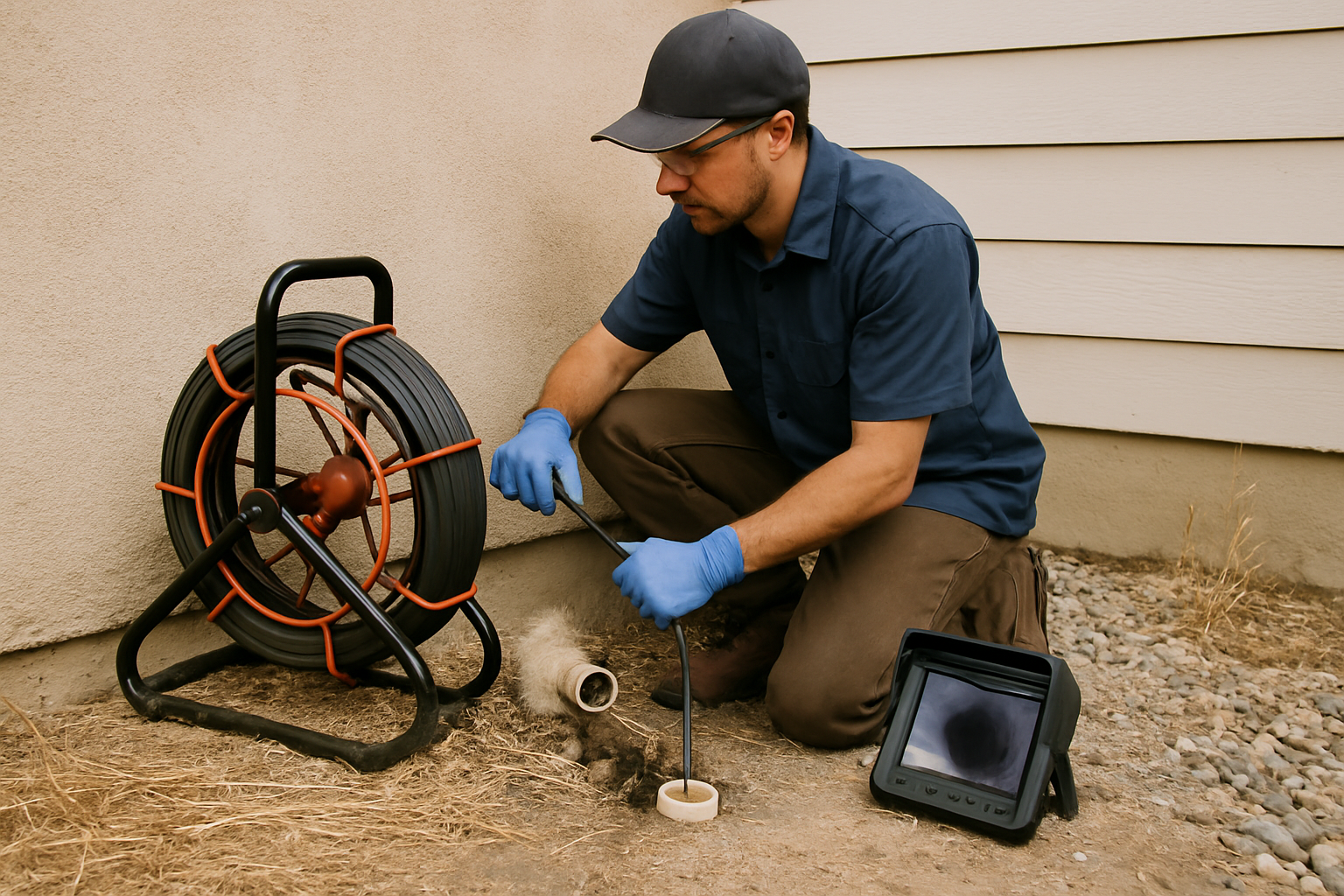
A video camera inspection is the honest starting point. We feed an HD camera through the lateral and a locator marks the exact depth and position of any problem, so nobody is digging on a hunch. That inspection usually runs 30 to 60 minutes.
Costs vary by property, but drain and sewer line camera inspections in the Salinas and Monterey County area tend to land in the low-to-mid hundreds. Wide swings happen when access is poor or the run is long, so get an actual quote for your address.
What we are looking for before an ADU ties in:
- Pipe material and remaining life
- Slope and any low spots holding water
- Root intrusion at joints
- Cracks or partial collapses
- Whether the existing line has room for the added flow
If the lateral is already marginal, the smart move is replacing or repairing it while the yard is open for ADU trenching, not after the new sod goes down. That same logic shows up in when a small plumbing issue turns into a big repair bill.
Water Supply and Gas: Sizing for a Second Kitchen
Water supply comes down to two questions. Is the service line from the meter big enough, and is the pressure at the house high enough to serve two dwellings at once?
A lot of older Salinas homes are fed by a 3/4 inch or smaller service line. That was fine for one kitchen and one or two bathrooms. Run the ADU shower while the main house dishwasher is going and you feel it immediately.
Material matters too. Galvanized steel corrodes from the inside and chokes down flow long before it ever leaks, which is why some homeowners describe weak pressure that got worse gradually rather than all at once.
Gas is the quieter one. A separate water heater in the ADU, plus a range, adds real BTU load to a line that was sized for the original house. Undersized or overly long gas runs show up as appliances that will not keep up, not as an obvious failure.
When a gas line does need work, we run black iron or CSST depending on the application. For water lines it is typically copper, PEX, or CPVC, and for waste it is ABS or PVC.
Market context on scope: full residential water re-piping in this area commonly falls in the low thousands, and gas line work is usually a smaller number, though both swing widely with the length of the run and how much wall or ground has to be opened. Your property decides the price, not an average. The same tradeoffs come up in the rental property repiping decision.
What Gets Evaluated Before ADU Rough-In
Here is a plain look at the three systems, what we actually check, and what usually triggers an upgrade.
| System | What We Check | What Often Triggers an Upgrade |
|---|---|---|
| Water supply | Service line size and material, static pressure at the house, existing pipe condition | A 3/4 inch or smaller line, or corroded galvanized pipe, feeding a second kitchen and bath |
| Waste and sewer | Lateral condition on camera, slope, pipe material, root intrusion, available capacity | Clay or cast iron lateral with cracks, bellies, or root growth at the joints |
| Gas | Meter capacity, pipe size, length of run to the ADU, total appliance BTU load | Adding a second water heater plus a range to a line already at its limit |
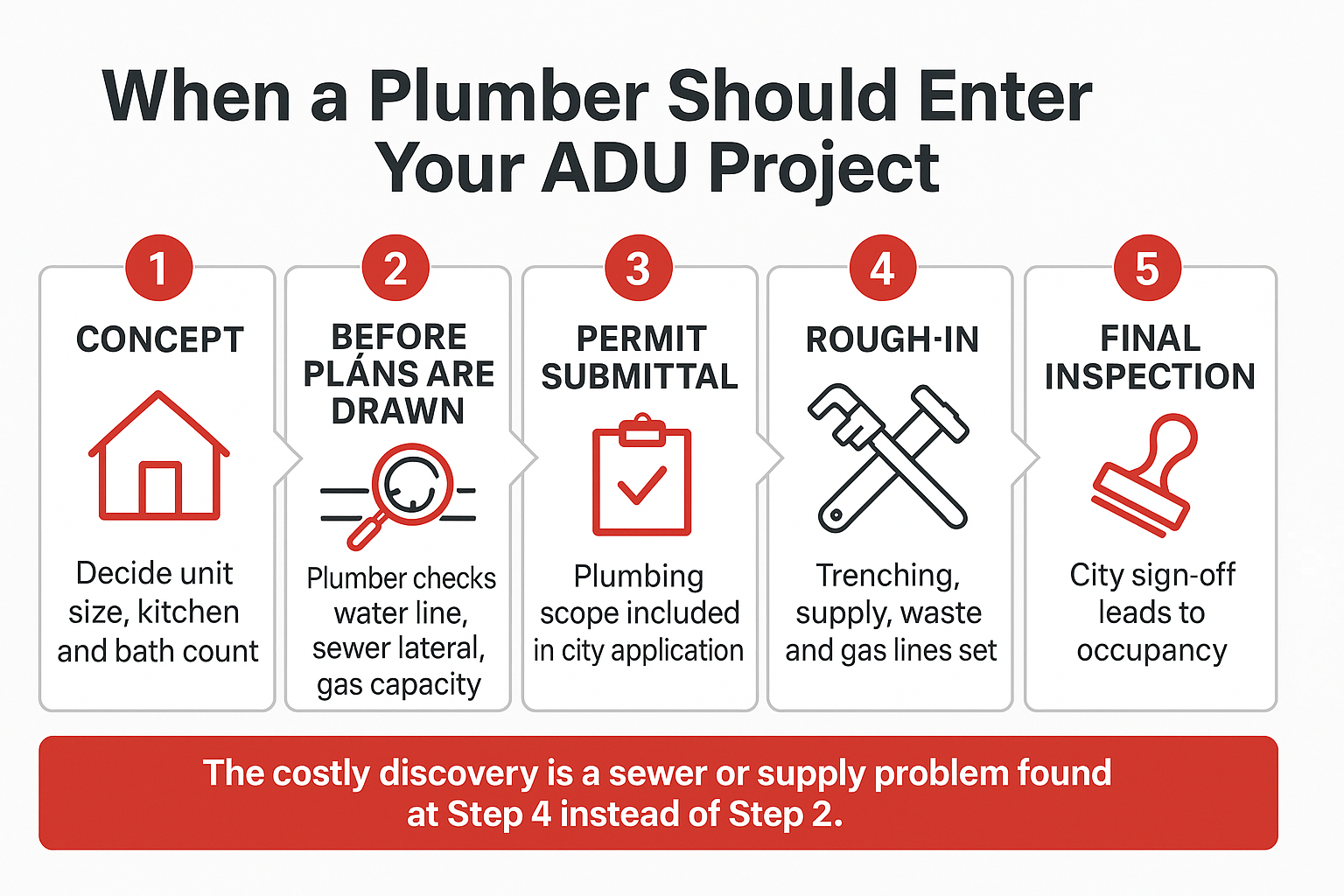
When a Plumber Should Enter Your ADU Project
Timing is the single biggest cost lever on ADU plumbing. This shows where the plumbing conversation belongs in the sequence.
Permits, Inspections, and the Water Meter Question
Permits are not optional for ADU plumbing in California. The City of Salinas requires building permits for ADU construction, and the plumbing inside that permit has to be performed by a licensed contractor and pass inspection.
That matters more than most homeowners realize. A plumbing item that fails inspection can hold up the certificate of occupancy, which means the unit cannot legally be lived in or rented yet.
We handle City of Salinas permitting in-house on the work we perform, including the residential plumbing replacement permits that come up with water heater installations. Not every plumbing contractor does that, and homeowners are often left holding the paperwork.
The other detail that surprises first-time ADU builders: California Water Service’s Salinas district may require a separate water meter for a new ADU depending on how the property and unit are configured. It is not automatic, and the answer depends on your setup.
Because it can change project scope and cost, ask the utility early, at the same time you are having the plumbing conversation. Finding out at rough-in is the expensive version of that question.
For the state-level rules that shape all of this, the California Department of Housing and Community Development maintains an ADU information page covering current standards and requirements. Local requirements sit on top of that, so the city and the utility are still the final word for your address.
One more note on estimates. When you are collecting bids for an ADU, plumbing scopes can look wildly different depending on what each contractor assumed about your existing lines. Comparing plumbing quotes line by line is worth the hour it takes.
Frequently Asked Questions About ADU Plumbing in Salinas
Do I need a separate water meter for my ADU?
Sometimes. California Water Service’s Salinas district may require one depending on how the ADU is configured and how it connects to the property. There is no universal answer, so contact the utility early in planning rather than assuming either way.
Can the ADU share the main house water heater?
Occasionally, but usually not in a way that works well. A shared tank means both dwellings compete for the same hot water, and recovery time becomes the complaint. Most ADUs get their own unit, often a tankless water heater where space is tight, which brings gas sizing back into the picture.
Is a garage conversion easier on plumbing than a new backyard unit?
Often yes, since an attached garage is usually closer to existing supply and waste lines, which shortens trenching. But garages come with their own issues, including slab work, drain slope, and water heater placement and elevation requirements. Closer does not automatically mean simpler.
How long does ADU plumbing rough-in take?
It depends on trench length, soil, and whether any existing lines need replacement at the same time. For reference, a typical residential re-pipe on its own runs roughly 2 to 5 days. ADU rough-in schedules also depend on inspection timing, which is outside any contractor’s control.
Can I do part of the ADU plumbing myself to save money?
No. Permitted plumbing work in California has to be done by a licensed contractor and pass inspection. Work that fails or was never inspected can hold up your certificate of occupancy, and unpermitted plumbing can create problems later when you sell or insure the property.
What if my sewer lateral turns out to be in bad shape?
Then you are better off knowing now. The trenching for an ADU already opens part of the yard, so repairing or replacing a failing lateral during construction usually costs less and disrupts less than doing it separately a year later.
Planning an ADU and Not Sure What Your Existing Plumbing Can Handle?
Getting the water line, sewer lateral, and gas capacity evaluated before framing is the least expensive part of an ADU project, and the part most people skip. Alvarez Plumbing has been working on Salinas and Monterey Bay Area properties since 1988, and we handle City of Salinas permitting on the plumbing work we perform. If you want a look at your existing lines while the plans are still flexible, we are reachable at (831) 757-5465.
