
Direct Answer: When a rental unit has multiple leaks in different pipe sections, falling pressure, and rusty cold water, patching is no longer cheaper. At that point repiping usually costs less over time.
The call usually comes on a weekend. A tenant says water is coming through the ceiling from the unit upstairs, or that the shower barely trickles, and you are somewhere else entirely trying to make a decision with half the information.
If that has happened to you more than twice in the same building, the question stops being how do we fix this leak and starts being how many more of these am I going to buy. That is the real question, and almost nobody answers it honestly for landlords.
A large share of Salinas rental stock was built between 1950 and 1980, which means a lot of it still runs on original galvanized steel supply lines. This guide walks through the symptoms that mean patching is finished, the actual math on repiping, and the habitability side that most owners find out about too late.
The symptoms that mean a rental is past the patching stage
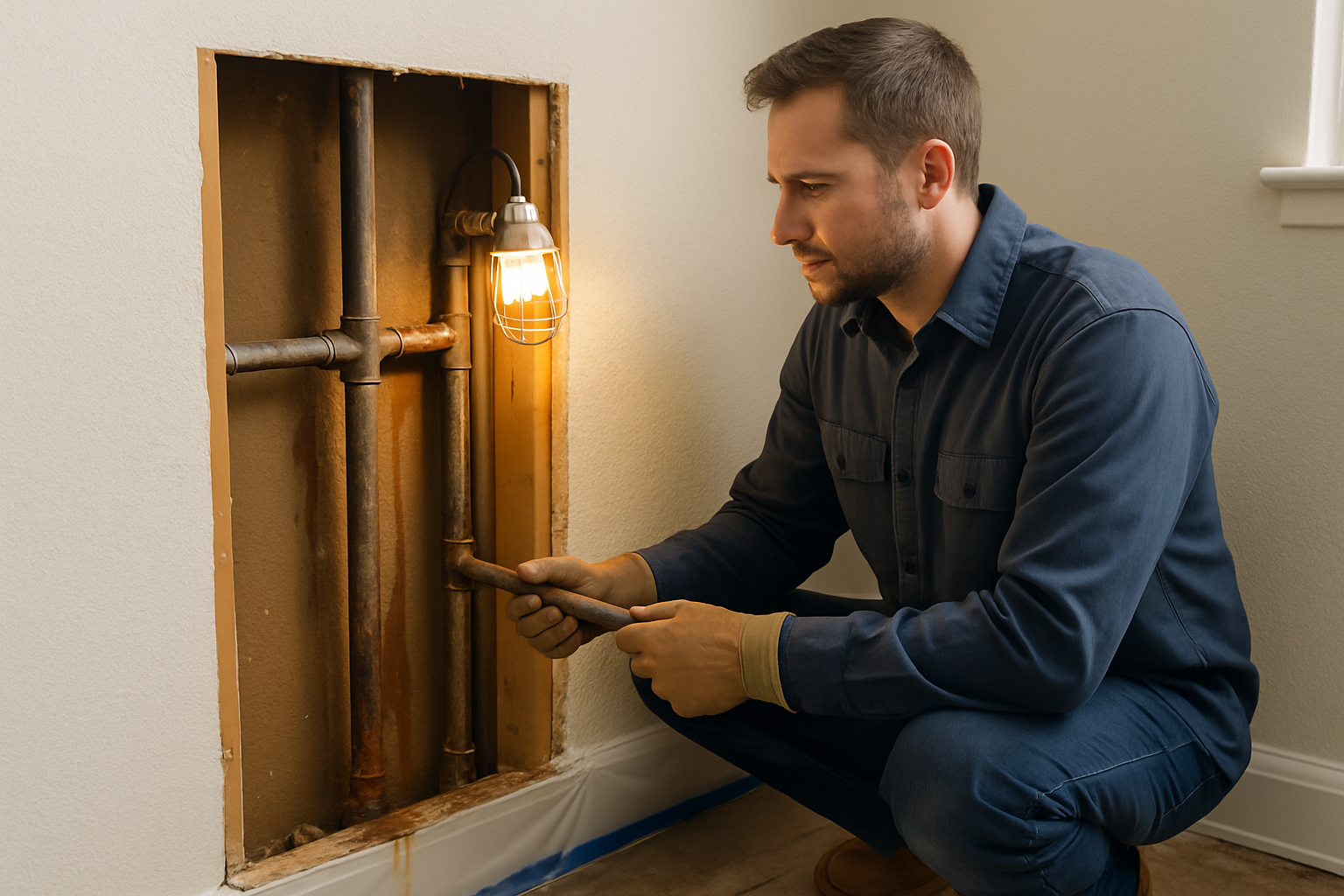
Galvanized steel pipe does not fail all at once. It corrodes from the inside out, so the pipe looks fine on the wall while the opening inside slowly closes with rust and scale.
By the time your tenant is complaining, the interior is usually too far gone to save with a spot repair. Here is what we see on rentals that have crossed the line:
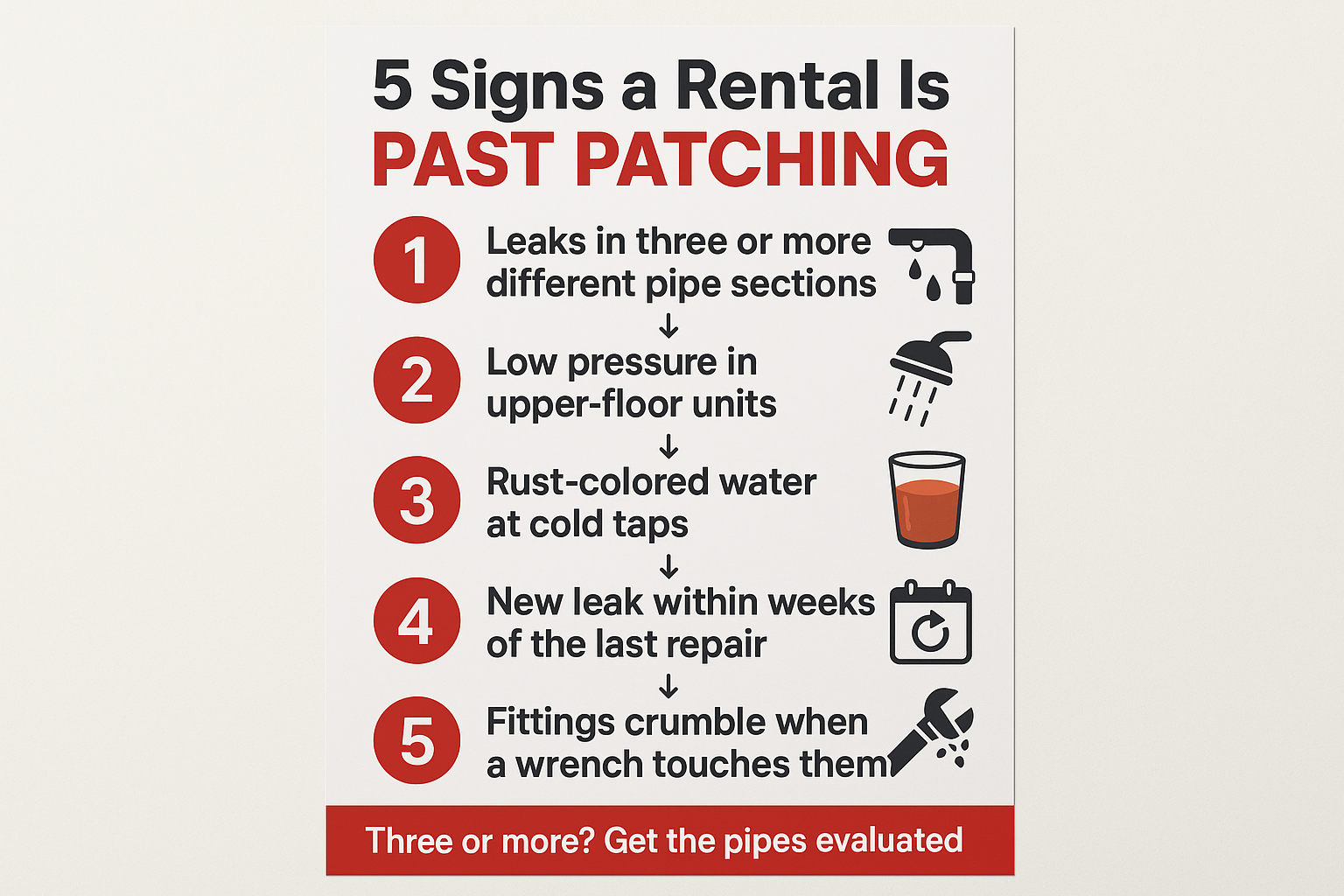
- Multiple pinhole leaks in different sections of the same building, not one repeat leak in one spot
- Chronic low pressure in upper-floor units, because rusted pipe cannot push water uphill the way it used to
- Rust-colored water at cold-water taps, especially first thing in the morning after the water has sat overnight
- Leaks that show up within weeks of the last repair, in a different room or a different wall
- Threaded joints that crumble when a plumber puts a wrench on them, which turns a 30 minute repair into a half-day job
That last one is the tell nobody expects. When pipe is thin enough that touching one fitting breaks the next one, every service call has a decent chance of creating new work. You are not buying a repair anymore, you are buying a coin flip.
Salinas Valley groundwater is hard, and that mineral load speeds up scaling inside old pipe. Plumbing problems in this region tend to show up in patterns tied to the age and material of the building, not to bad luck.
The repiping decision for rental property owners comes down to math
Most landlords we talk to are not avoiding a repipe because they think the pipes are fine. They are avoiding it because a repipe is one big invoice and a patch is one small one.
But the small invoices stack. Think about an owner who has called a plumber four times in 18 months for separate leaks in the same fourplex. Each of those calls carried a diagnostic charge, labor, and often drywall damage that somebody had to repair afterward.
Add in the ones that happened at 9 PM or on a Sunday. After-hours plumbing rates exist for real reasons, but they are not the rate you want to pay four times for the same underlying problem.
Costs vary a lot by property, but in the Salinas area a residential water line repipe commonly falls somewhere in the range of $3,000 to $6,500 per unit, and a typical residential repipe runs about 2 to 5 days. What moves that number:
- Number of bathrooms and fixtures being served
- Slab foundation versus crawlspace or basement access, which changes how much has to be opened up
- Material choice among copper, PEX, and CPVC
- Whether the unit is occupied during the work
- Wall and ceiling repair after the pipe work is done
An exact number takes an on-site look. But if you sit down and total your last two years of plumbing invoices for one building, a lot of owners find they have already spent a meaningful slice of a repipe with nothing permanent to show for it. That is the moment a small issue has already turned into a big repair bill, just paid in installments.
Repeat patching versus a full repipe, side by side
This is the comparison most landlords never actually write down. Costs shown are general market context, not a quote.
| What you are weighing | Repeat patch repairs | Full repipe |
|---|---|---|
| Cost pattern | Smaller invoices, unpredictable timing, often after-hours | One planned project, commonly $3,000 to $6,500 per unit in this area |
| Time on site | A few hours per visit, several visits per year | About 2 to 5 days, scheduled in advance |
| Tenant disruption | Repeated short outages with little warning | One longer, scheduled interruption you can notify tenants about |
| Odds it comes back | High when the pipe material itself is failing | Low for the replaced lines |
| Drywall and finish repair | Paid over and over in different rooms | Handled once as part of the project |
| Paperwork for your file | Scattered invoices across multiple visits | One documented scope of work |
Five signs a rental unit has outgrown patch repairs
If three or more of these are true in the same building, the repipe conversation is worth having before the next leak.
Habitability makes chronic plumbing failures more than a maintenance issue
There is a legal layer to this that a lot of owners only learn about during a dispute. Under California law, a rental unit has to have working hot and cold running water to be considered habitable.
The requirement lives in California Civil Code Section 1941.1, which lists water supply and plumbing in good working order among the basic conditions a landlord has to keep in place.
We are not saying one slow drain puts you at risk. But a pattern matters:
- Repeated hot water outages across several months
- Pressure so low a tenant cannot reasonably shower or wash dishes
- Discolored water that keeps coming back after each repair
- A documented history of complaints with only temporary fixes in response
A stack of small invoices can read, in hindsight, like a record of a known problem you kept patching. A repipe reads like a fix. That difference is worth thinking about when you compare the two numbers.
The part landlords actually ask about: coordination and paperwork
Roughly one in five of the calls we field come from property owners and managers, and the pattern is consistent. The tenant has the problem, the owner controls the booking, and nobody wants to play middleman over text messages.
What those owners tend to need is straightforward:
- Direct coordination with the tenant for access, so the owner is not relaying schedules
- A clear morning or next-day window rather than an open-ended promise
- Clean invoicing that matches the property and unit for their records
- Documentation of what was found and what was done, especially on recurring issues
On the diagnostic side, a video camera inspection is useful before you commit to anything on drain and sewer lines, because it shows the actual pipe condition instead of a guess. The same logic applies when an inspector cannot see inside the pipes during a purchase.
Licensed, insured, and bonded work gives you a paper trail you can keep on file. And when a job needs a permit, such as a water heater changeout, our team files and manages City of Salinas permitting in-house rather than handing that back to the owner. For multi-property owners in Salinas, Seaside, and Watsonville, that alone removes a recurring headache.
If you are collecting estimates from more than one contractor, it helps to know how to actually compare plumbing quotes so you are looking at the same scope, not just the same bottom line.
Frequently Asked Questions About Repiping Rental Property
Can I repipe one unit at a time instead of the whole building?
Often yes, depending on how the building was plumbed. Some multi-unit properties have separate supply runs per unit, which makes phasing possible. Others share risers, and in that case doing one unit means opening the same walls again later. A walkthrough tells you which situation you are in.
Do tenants have to move out during a repipe?
Usually not. A typical residential repipe takes about 2 to 5 days, and water is generally restored at the end of each work day. The bigger issue is access and noise, which is why scheduling and tenant notice matter more than anything else on an occupied unit.
Is PEX or copper better for a rental property?
Both work. Copper has a long track record and holds up well. PEX installs faster with fewer joints and handles hard water without scaling the same way, which matters in the Salinas Valley. CPVC is also used in some applications. The right pick depends on the building layout, access, and budget, and a licensed plumber should walk you through the tradeoffs before you sign anything.
Does a repipe require a permit in Salinas?
Permit requirements depend on the scope of work, and the City of Salinas Community Development department is the authority on it. Water heater replacements do require a permit. For any permitted work, we handle the filing and inspection coordination so it does not land on your desk.
How do I know a plumber is not just upselling me a repipe?
Ask them to show you the pipe. On galvanized systems, a cut section of the failing line makes the case better than any sales pitch, because you can see how little opening is left inside. Also ask what they would do if it were a single isolated leak, and listen to whether the answer changes.
Wondering whether your rental has crossed the line?
If you own or manage rentals around Salinas, Seaside, or Watsonville and you are tired of buying the same repair twice a year, it is worth having someone look at the actual pipe condition before the next call comes in. Alvarez Plumbing has been working on Monterey Bay Area properties since 1988, and our office can coordinate access directly with your tenants. Reach us at (831) 757-5465 or at alvarezplumbingsalinas.com when you want a straight read on where the plumbing stands.