
Direct Answer: Sewer backups spike with the first fall storms because low summer flow lets roots and debris build up unnoticed. A camera inspection before October rain shows whether your line needs cleaning or repair.
The call almost always sounds the same. It rained hard overnight, and now the shower drain is filling up while the washing machine runs, or the toilet gurgles every time someone flushes upstairs.
Here in Salinas, that pattern is not a coincidence. Sewer lines sit quiet through a bone dry summer, then get hit with real water volume the moment fall storms arrive. The first big rain is a stress test, and a line with a slow buildup problem tends to fail it.
This guide covers three things: why the dry-to-wet switch causes backups, how tree roots build a blockage you cannot feel yet, and how a video camera inspection tells you whether you need cleaning or an actual repair before water ends up on your floor.
Why Sewer Backups Spike With the First Real Storm in Salinas
Look at how dry our summer actually gets. Salinas averages somewhere in the range of 0.01 to 0.05 inches of rain per month from July through September. Then October climbs to roughly 0.60 inches, and November jumps again to around 1.26 inches.
For three months, your sewer lateral carries nothing but household water. Sink water, shower water, laundry. That is a slow, steady trickle compared to what the pipe was built to handle.
During that quiet stretch, a few things happen inside the pipe:
- Grease and soap sludge coat the pipe walls and harden
- Silt and grit settle along the bottom of the line
- Tree roots creep further in through joints and hairline cracks
- Partial blockages form that still let normal daily flow pass
Then the first storm arrives. Groundwater rises, saturated soil shifts, and any crack or bad joint in the line starts taking on water it was never meant to carry. The EPA notes that wet weather is one of the leading triggers for sanitary sewer overflows, and the same principle applies on a single property.
A line that was 70 percent blocked all summer suddenly gets asked to move twice the volume. That is when it stops working, usually at the worst hour.
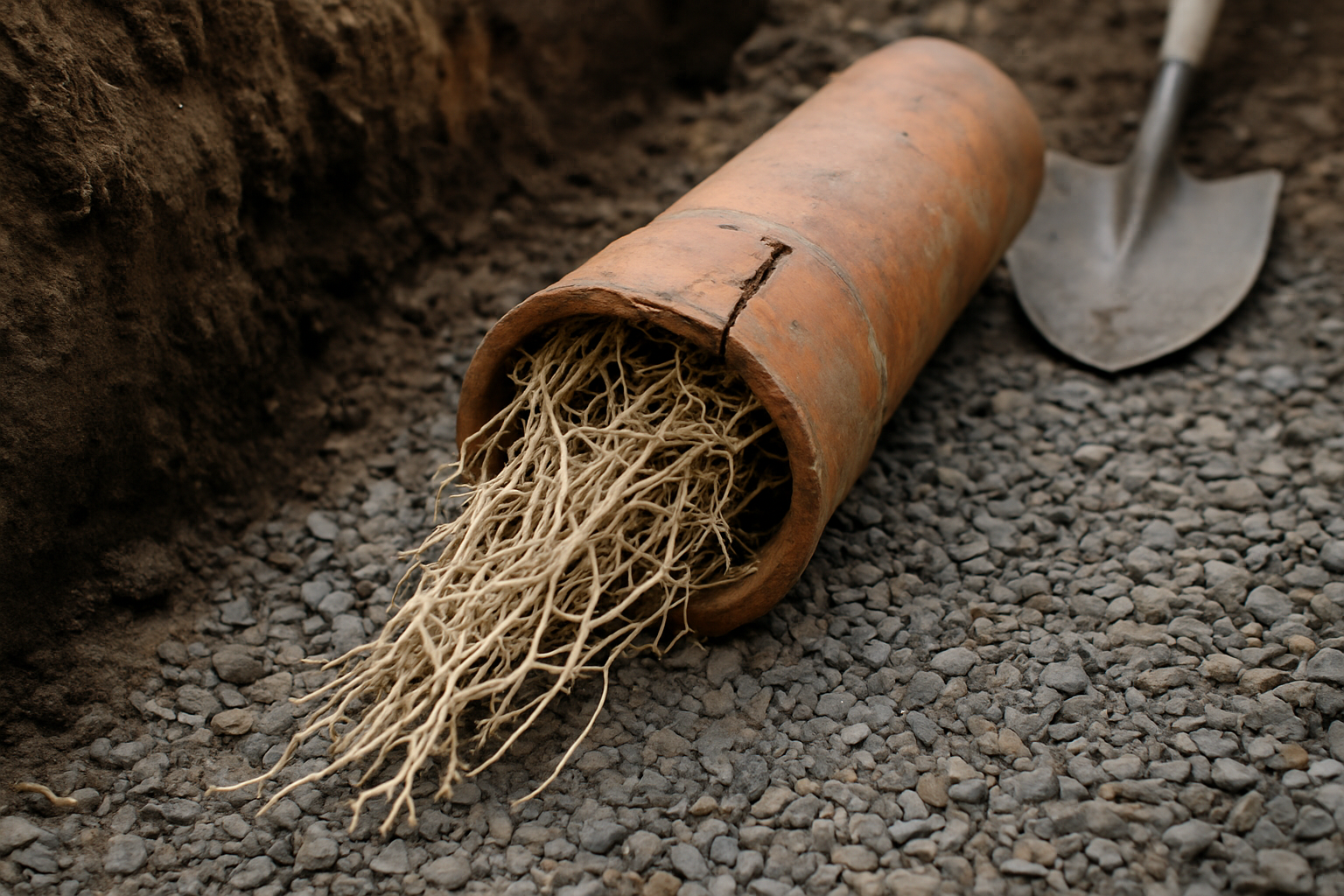
Tree Roots Are the Number One Cause, and They Work Quietly
In older Salinas neighborhoods and across the Monterey Peninsula, mature landscaping is part of the charm. Big liquidambars, pines, and privet hedges have been there for decades, and so have their root systems.
Roots chase moisture. A sewer lateral running under a lawn is a warm, humid, nutrient-rich target, and older clay tile or early ABS pipe gives them plenty of entry points at the joints.
Root intrusion usually moves through four stages:
1. Hair-thin feeder roots slip through a joint gap or hairline crack. Nothing changes for you.
2. Those roots thicken and start catching solids and paper. Flow slows a little, mostly unnoticed.
3. A root mat forms across part of the pipe. You may hear a gurgle or see a tub drain slower after laundry.
4. Volume increases with rain, the mat catches everything, and the line backs up into the lowest fixture in the house.
Here is the part homeowners find frustrating. Stages one through three can play out over two to five years with almost no symptoms, because normal daily water use squeezes right past the obstruction.
As the roots grow, they also widen the crack they came through. That is why root problems and pipe damage so often show up together on the same camera run.
What a Camera Finds and What Usually Comes Next
A sewer camera inspection takes roughly 30 to 60 minutes and shows the inside of the line in real time. Here is how common findings typically map to next steps.
| What the camera shows | Likely cause | Typical next step |
|---|---|---|
| Greasy buildup coating the pipe wall | Years of kitchen and laundry waste | Hydro jetting usually clears it fully |
| Sand and silt sitting in the pipe belly | Low flow plus hard water sediment | Jetting, then a maintenance interval |
| Fine root hairs at a joint, pipe intact | Early root intrusion | Root cutting and jetting, recheck later |
| Heavy root mass with a cracked pipe wall | Advanced root intrusion | Clear the blockage, then plan a repair |
| Offset joint or a sagging section | Ground movement or pipe age | Spot repair or sewer line replacement |
| Collapsed or crushed pipe near the street | Pipe age or heavy load above | Excavation and repair at that section |
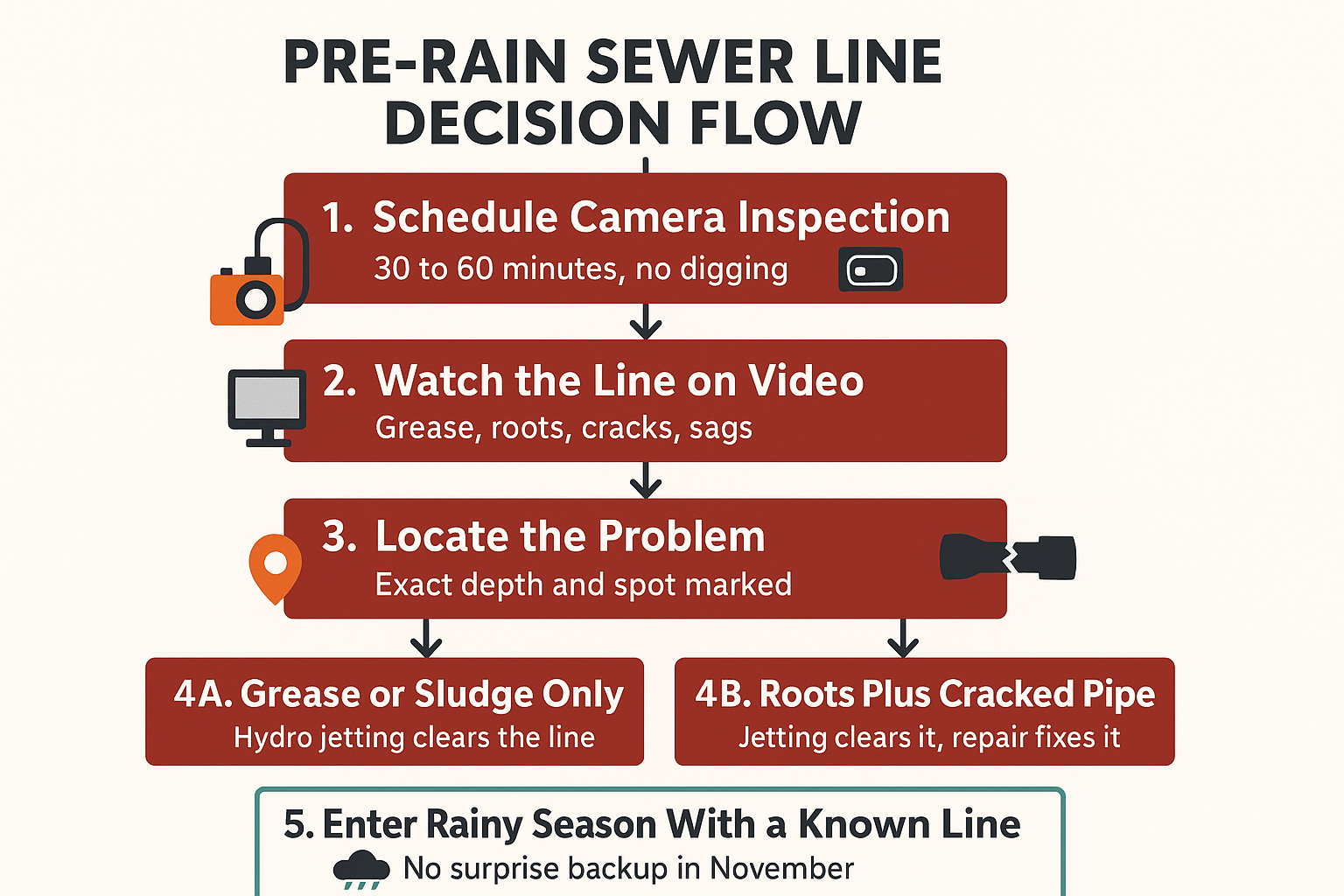
The Pre-Rain Sewer Decision, Step by Step
This flow shows how a pre-season inspection turns into a clear decision instead of a guess.
Hydro Jetting Clears the Pipe. It Does Not Rebuild It.
This is the distinction that saves people money, and it gets missed constantly.
Hydro jetting uses high pressure water, up to around 4,000 PSI, to scour the inside of the line. It strips grease, hard water scale, sludge, silt, and root hair without chemicals. When buildup is the whole problem, jetting is the complete fix.
But jetting cleans a pipe. It does not repair one. If roots got in through a crack, clearing the roots leaves the crack exactly where it was, and the roots come back.
So the order matters:
- Camera first. You find out what is actually in there and what condition the pipe wall is in.
- Jetting second, if the pipe is sound enough to take it. Corroded or fragile lines may need a gentler method instead.
- Repair third, only if the video shows structural damage worth addressing.
One local homeowner reached out specifically about a broken sewer pipe near the city connection. That is a good example of why the camera step matters, because the fix and the responsibility line are completely different depending on where the break sits. Our article on Salinas sewer rates and private sewer lines covers that ownership question in more detail.
On cost, published local figures vary quite a bit. Drain line camera inspections around Salinas and Monterey County commonly land in the mid-$300s to low-$400s, while jetting often runs somewhere in the $300 to $800 range depending on pipe size, line length, and how bad the blockage is. Your property is its own situation, so treat those as context and get a real quote after the line is looked at.
For Landlords and Property Managers, October Is the Cheap Month
A sewer backup in an owner-occupied home is miserable. A sewer backup in a rental unit is a different category of problem.
Raw sewage in a unit can mean:
- Tenant displacement and hotel costs while the unit is cleaned
- A habitability complaint you now have to answer in writing
- Emergency-rate service on a Saturday night instead of scheduled work
- Restoration, flooring, and drywall costs that dwarf the plumbing bill
- Documentation gaps if nobody inspected the line beforehand
We see this pattern with property managers and rental owners across the Salinas and Monterey corridor. The tenant calls, the owner is off-site, and everything has to be coordinated by phone while water is still on the floor.
A camera inspection in September or early October gives you a dated video record of the line condition, a clear repair plan if one is needed, and a scheduled appointment instead of an after-hours emergency. For multi-unit and commercial properties with shared laterals, the same logic applies with higher stakes, since one blocked line affects every unit tied to it.
Restaurants and commercial kitchens are their own case. Grease loads are heavy enough that jetting every 6 to 12 months is a reasonable maintenance rhythm, versus every 1 to 2 years for a typical home.
Signs Your Line Is Already Talking to You
Most people wait for a full backup. The line usually warns you first, in small ways that are easy to write off.
Watch for:
- A toilet that gurgles when the washing machine drains
- Slow drains in more than one fixture at the same time
- Water backing into a tub or shower when another drain runs
- A sewer smell in the yard or near the cleanout after rain
- Patches of grass that stay unusually green or soggy
- Repeat clogs in the same drain within a few months
One clogged kitchen sink is a kitchen sink problem. Two or more fixtures acting up together points at the main line, and that is the signal to look before the weather changes.
If you are not sure where your cleanout is or what it does, our sewer line clean out guide walks through it. And if something is already backing up right now, what to do in the first 15 minutes covers how to limit the damage while help is on the way.
Frequently Asked Questions About Sewer Backup Prevention Before the Rain
I have no symptoms at all. Is an inspection really worth it?
That depends on your pipe age and your trees. If your home was built before the 1980s and has mature landscaping within about 20 feet of the sewer line, root intrusion is common enough that a look is reasonable. If you have newer PVC and no big trees nearby, you can usually wait unless something changes.
How much does a sewer camera inspection cost around Salinas?
Published local figures range widely, with many drain line inspections in Monterey County averaging somewhere in the mid-$300s to low-$400s, and larger or more complex sewer jobs going higher. Length of the line, access, and whether locating is needed all move the number, so the honest answer is that you need a quote for your specific property.
Will hydro jetting damage an old pipe?
It can, which is exactly why pipe condition gets checked first. On a corroded clay line or brittle old ABS, a gentler clearing method is often the better call. On sound pipe, 4,000 PSI water is safe and does a far more thorough job than a cable snake.
Snaking the line worked last time. Why would I jet it instead?
A cable punches a hole through the blockage so water flows again. Jetting scours the full pipe diameter and removes what the cable left behind. If you are clearing the same drain every six months, the cable is treating the symptom while the buildup stays put.
If the pipe is broken out near the street, is that my problem or the city’s?
Generally, the lateral from your house to the connection point is the property owner’s responsibility, and the main is the city’s. Where that line falls varies, so locating the exact break with a camera matters before anyone starts digging or filing anything.
How long does the whole inspection take?
Usually 30 to 60 minutes for a standard residential lateral, assuming there is an accessible cleanout. You can watch the video as it runs and see the same thing the technician sees.
Thinking About a Look Before the Rain Starts?
The window between the last dry week and the first real storm is the calmest time of year to find out what is going on inside your line. Alvarez Plumbing has been running cameras and clearing sewer lines across Salinas and the Monterey Bay Area since 1988, and scheduling is open for pre-season inspections along with 24/7 service when something cannot wait. If you want to talk it through, the office number is (831) 757-5465.