
Direct Answer: A spinning spigot handle usually means the stem washer, packing nut, or stem itself has failed, not just the handle. Shut off the water supply first, then assess the parts underneath before buying anything.
You go to water the garden and the handle just keeps turning. The water is still running and there is nothing you can grip to stop it. That moment is frustrating, and it happens constantly in Salinas and across the Monterey Bay Area, especially on homes built before 1990 that still have their original hose bibs.
The good news is that a spinning handle is almost never just a handle problem. Once you know which part has actually failed, you can make a clear decision: replace the part yourself or call a licensed plumber. This guide walks you through exactly that process.
Before you touch a single tool, read through the full diagnosis section below. Buying the wrong part because you skipped this step is one of the most common mistakes we see homeowners make.
Why the Handle Spins, and What Actually Failed
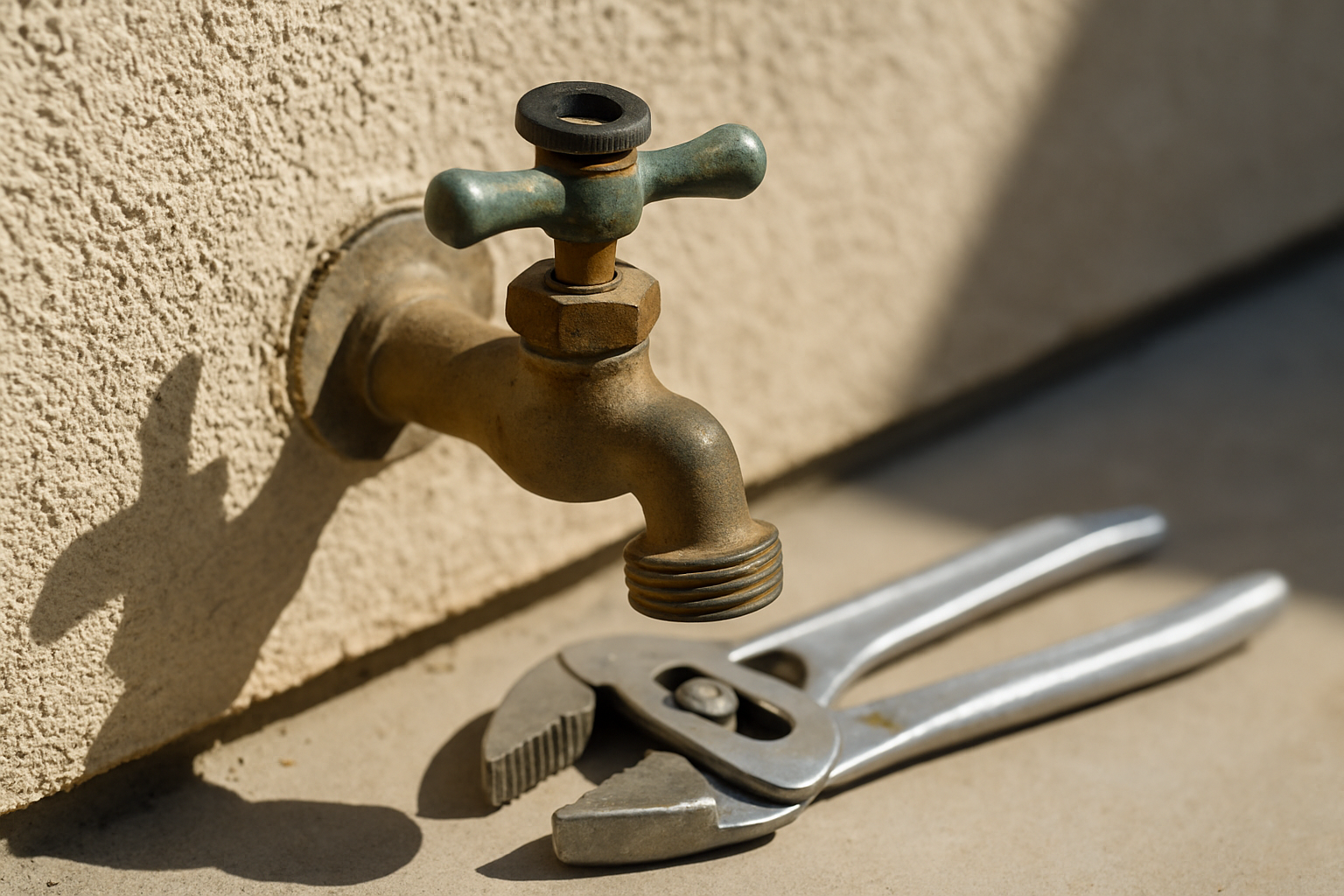
The handle itself is almost never the root problem. Underneath that handle is a stem, and wrapped around that stem is packing material held in place by a packing nut. At the bottom of the stem sits a stem washer, a small rubber disc that presses against a seat inside the valve body to stop water flow.
When any of these parts wear out, the handle loses its ability to create enough resistance to close the valve. The most common culprits, in order of frequency:
- Worn stem washer, the rubber disc has flattened, cracked, or dissolved from age and mineral buildup
- Failed packing, the soft material around the stem has dried out, leaving the stem loose inside the valve body
- Loose or stripped packing nut, the nut has backed off or the threads have given out, usually from years of overtightening
- Corroded or damaged stem, the stem itself has pitted or broken, which means the handle spins on nothing
Salinas water averages around 271 parts per million of hardness. That is roughly double what is considered moderately hard, and it accelerates mineral buildup inside the packing nut and around the stem. A handle that “suddenly” stops working often has years of calcium scale quietly working against it. The EPA’s Water Quality Standards provide context for what different hardness levels mean for household fixtures. You can also read more about how hard water shortens the life of plumbing equipment in our article on hard water and water heater sediment.
Step-by-Step: How to Diagnose Before You Buy Anything
Do not drive to the hardware store yet. Handle sizes, stem threads, and packing types vary widely by manufacturer and by the age of the fixture. Buying parts blind almost guarantees a second trip.
Step 1, Shut off the water supply. Find the dedicated shutoff valve for the outdoor faucet inside the house, usually in the garage or under a nearby sink. If there is no dedicated shutoff, use the main house shutoff. Do not skip this.
Step 2, Remove the handle screw. There is usually a small screw on top of the handle or hidden under a decorative cap. Remove it and pull the handle straight off the stem.
Step 3, Look at what you have. With the handle off, you can see the packing nut and the exposed top of the stem. Check for:
- Visible corrosion or green oxidation on the stem
- A packing nut that wobbles or feels loose when you touch it
- Mineral crust built up around the nut or stem
- A stem that is visibly bent, cracked, or broken at the top
Step 4, Try snugging the packing nut first. If the nut is loose, a quarter-turn clockwise with an adjustable wrench sometimes solves the whole problem. Turn the water back on briefly to test. If it holds, you are done.
Step 5, If that does not fix it, remove the packing nut and pull the stem. Take the entire stem to the hardware store with you. That is the only reliable way to match the washer size and thread pattern.
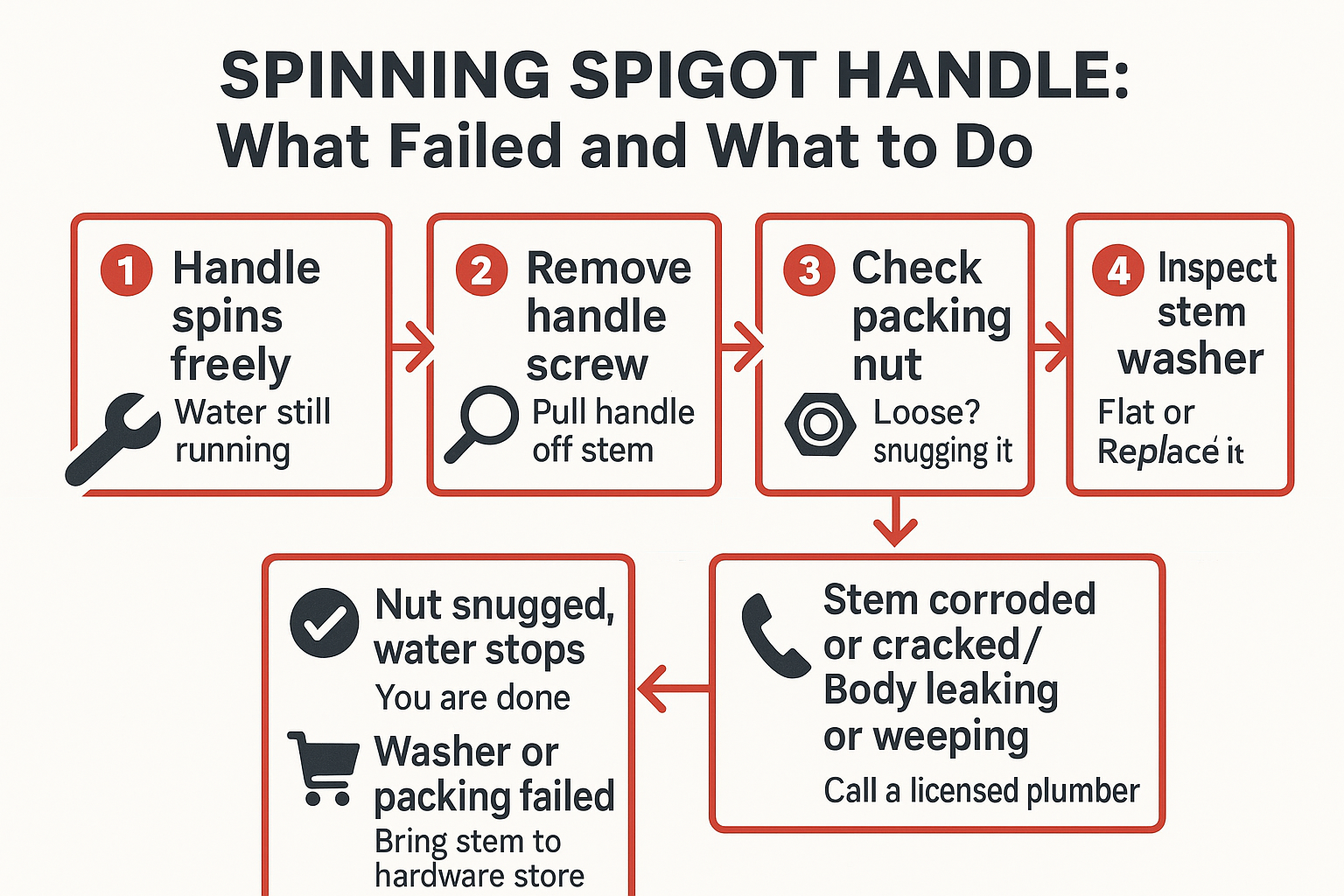
The Spinning Spigot Diagnosis at a Glance
Use this quick-reference chart to identify what failed and what the right next step is.
What You Found vs. What It Means
After you pull the handle and inspect the stem, match what you see to the right course of action.
| What You See | What It Means | Next Step |
|---|---|---|
| Packing nut is loose | Nut backed off over time | Snug nut 1/4 turn, test water |
| Stem washer is flat or cracked | Rubber seal has failed | Replace washer, match size exactly |
| Packing material is dry or missing | Stem has no grip or seal | Replace packing or full stem |
| Stem is pitted, corroded, or broken | Hard water or age damage | Call a licensed plumber |
| Water weeping from wall or body | Internal crack or supply line issue | Call a licensed plumber, do not delay |
When to Stop and Call a Licensed Plumber
Replacing a packing nut or stem washer is one of the few outdoor faucet repairs a homeowner can reasonably attempt in California. But there is a clear line, and it is important to know where it is.
Stop the DIY and call a plumber if you find any of these:
- The stem is visibly corroded, pitted, or snapped, swapping the washer on a damaged stem will not hold
- The body of the hose bib is cracked or the valve body itself feels soft or flimsy
- Water is weeping from the wall behind the faucet, which can signal a supply line issue inside the wall
- The hose bib threads are stripped and the entire fixture needs to come off the supply line
In California, any work that involves cutting into or replacing a hose bib connected to the household supply system requires a licensed contractor. This is not a technicality, it is a real protection for your home. Work done incorrectly on a supply line can cause water damage inside the wall that costs far more to fix than the original faucet call would have.
When a straightforward-looking repair reveals something bigger, that is also a good time to ask about what can happen when a small plumbing issue turns into a big repair bill.
A Note on Older Homes in Salinas
A lot of the homes we work on in the East Salinas neighborhoods and around the Alisal corridor were built in the 1960s and 1970s. Some still have original hose bibs that are 50 or more years old. At that age, the packing material has typically calcified, the stem washer has turned to powder, and the brass stem itself may be so corroded that removing the packing nut is enough to crack the valve body.
If your home was built before 1990 and the outdoor spigot has never been serviced, be prepared for the repair to reveal more than a loose nut. That is not bad advice or upselling, it is just what decades of 271 ppm hard water does to unprotected brass and rubber.
For context on how that same water chemistry affects your water heater, our article on water heater maintenance in Salinas covers it in more detail.
Frequently Asked Questions About a Spinning Outdoor Spigot Handle
Can I just replace the handle and call it done?
Usually not. A new handle placed on a worn stem or failed packing will spin just as freely as the old one. The handle is the last thing to replace, fix what is underneath it first.
The water is still running and I can’t find a shutoff. What do I do?
Go straight to the main house shutoff. In most Salinas homes, it is near the water meter at the front of the property or where the supply line enters the house. Turning off the main buys you time to assess the situation without water continuing to run. If you cannot locate it, call a plumber, because this is exactly the kind of situation where 24/7 availability matters.
How do I know if my stem washer is the right size?
Bring the old stem with you to the hardware store. Washers are measured by outside diameter and thickness, and they are not universal. Older fixtures from the 1970s and 1980s sometimes use sizes that are harder to find at big-box stores, so a plumbing supply house is a better bet for pre-1990 hose bibs.
Why is water dripping from around the packing nut even after I tightened it?
If tightening the packing nut did not stop the drip, the packing material inside has probably dried out or disintegrated. You can replace just the packing, it comes as a graphite string or pre-formed rings, without replacing the entire stem. But if the drip continues after new packing, the stem surface itself may be damaged.
Is this the same as replacing the entire hose bib?
No, and that distinction matters. This guide covers the handle, packing, and stem, which are internal parts you can access without cutting into the supply line. Replacing the full hose bib means disconnecting from the household supply, and that work requires a licensed plumber in California.
Need a Hand With That Spigot?
If you pulled the handle and found a corroded stem, a cracked valve body, or water coming from somewhere it should not be, that is the point where a licensed plumber needs to take over. We serve Salinas and the surrounding Monterey Bay Area 24 hours a day, every day of the week, for exactly these situations. Give us a call at (831) 757-5465 or schedule online at alvarezplumbingsalinas.com.