
Direct Answer: Shut off the water supply immediately — either at the affected fixture or the main valve near your curb. Then contain standing water and call a licensed emergency plumber.
Most of the damage from a plumbing emergency doesn’t happen because of the failure itself — it happens in the 20 minutes after, while water is still running and no one knows what to do. A burst pipe under a kitchen sink or a sewer line backing up into a bathroom can go from a plumber visit to a full water damage restoration job in the time it takes to search for a phone number.
Salinas homes — especially the older housing stock throughout the east side, Alisal, and the neighborhoods off North Main — often have aging supply lines and cast iron drain systems that don’t give much warning before they fail. When something does go wrong, the homeowners who come through it with the smallest repair bills are almost always the ones who knew three or four basic steps before anything happened.
This article covers what those steps actually are — in order, with enough detail to be useful when you’re stressed and standing in water at 11 PM.
Step One: Stop the Water Before You Do Anything Else
The single most important action in any plumbing emergency is cutting off the water supply. Every second water continues to flow is more damage to flooring, subfloor, drywall, insulation, and anything stored nearby.
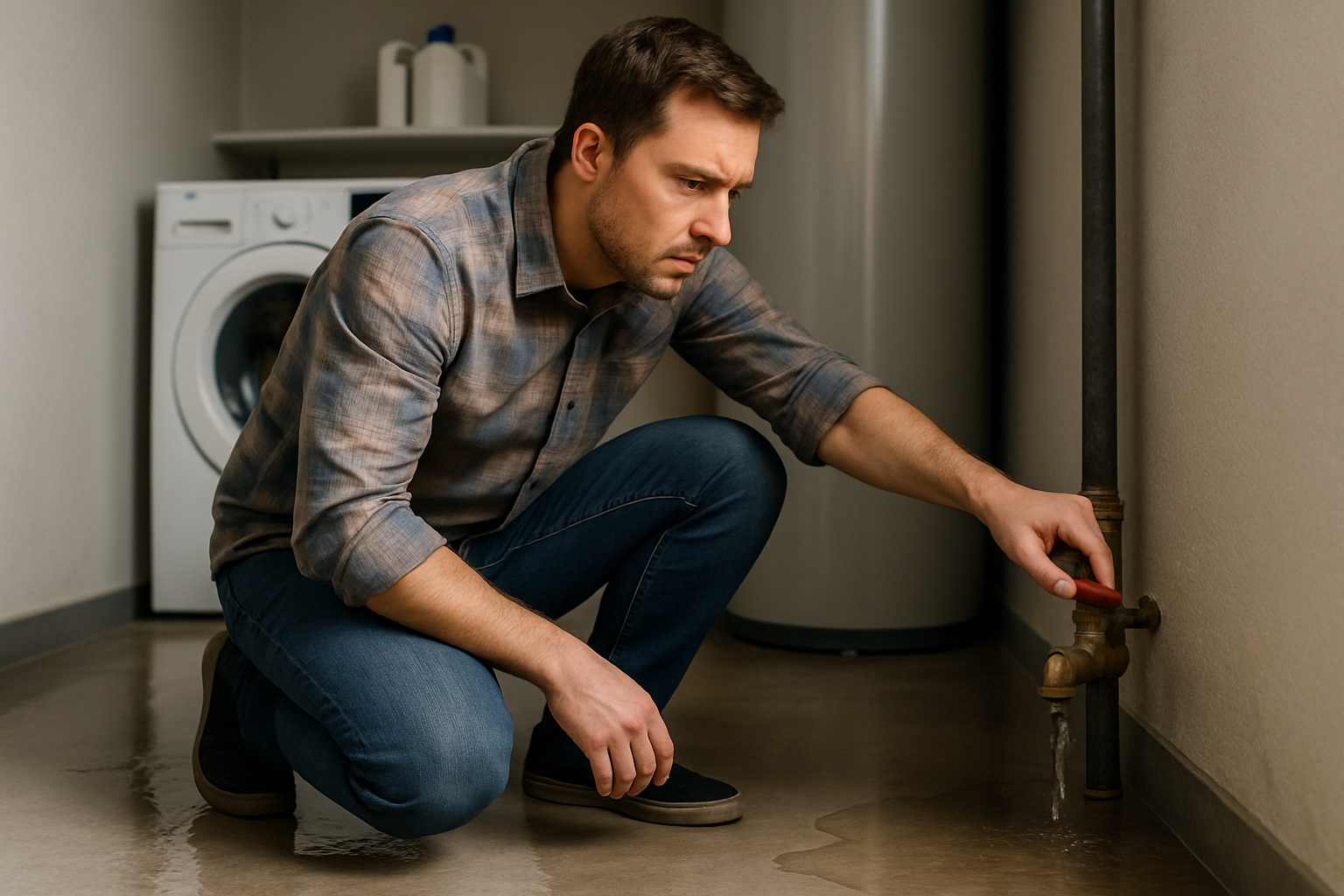
For most situations — a leaking supply line under a sink, a toilet that won’t stop running over, a busted flex connector behind a washing machine — there’s a fixture shutoff valve right at the source. It’s the small oval handle on the supply line leading to the fixture. Turn it clockwise until it stops.
If you can’t find a fixture shutoff, or if the leak is coming from inside a wall or under a slab, go straight to the main shutoff valve. In most Salinas homes, the main shutoff is near the water meter at the front of the property, often close to the curb or at the point where the supply line enters the house through the foundation. If you have never located yours, find it before an emergency — and make sure it actually turns. Valves that haven’t moved in 20 years sometimes need force, or they fail to close fully.
If there’s any doubt about whether the valve worked, check a cold-water faucet inside the house. If water stops or slows significantly after a few seconds, you’ve successfully isolated the supply. If it keeps flowing at full pressure, the valve may be failing and you may need to contact the City of Salinas Water Department to shut off at the meter — their 24-hour emergency line handles exactly this situation.
Step Two: Contain the Water That’s Already There
Once the supply is off, the water that’s already on the floor is your next problem. Moving fast here limits how much secondary damage you’re dealing with — and it gives the plumber a cleaner work environment when they arrive.
Do these things in order:
- Move rugs, towels, shoes, and anything stored on the floor out of the wet zone immediately
- Place dry towels along doorway thresholds to slow the spread to adjacent rooms
- Lift anything electrical — power strips, space heaters, small appliances — off the floor
- If water is near an electrical outlet or panel, don’t touch standing water until power to that area is off at the breaker
If the water coming up is dark, has visible debris, or smells like sewage, treat it differently. That’s likely a sewer backup — not clean water from a supply line. Don’t run any other fixtures in the house that drain to the same line (sinks, showers, laundry), open windows if possible, and keep people and pets out of the affected space until a plumber has assessed the situation. The emergency drain cleaning process for a backed-up sewer line is different from a standard drain clog, and trying to clear it yourself while sewage is active in the line usually makes things worse.
One caller described water backing up into their tub with black debris — that’s not a clog you snake at midnight. It’s a situation that warrants a call to an emergency plumber right away.
If You Smell Gas: This Is a Different Emergency
A gas smell — sulfur, rotten eggs — during or after a plumbing event is not a plumbing call first. It’s a gas utility emergency.
Do not flip any light switches. Do not use your phone inside the house. Do not open the oven or turn on any appliances. Leave the house immediately, leave the door open behind you, and call PG&E’s emergency line at 1-800-743-5000 from outside.
A licensed plumber handles the gas line repair once PG&E has shut off the supply and cleared the area. But the gas utility owns the emergency response, and calling a plumber first wastes time that matters in a gas situation. Older homes in Salinas with original galvanized or black iron gas lines — common in homes built before the 1980s — are worth having inspected periodically for this reason. If you’ve had recent plumbing or renovation work done and suddenly notice a gas odor, that’s a situation that warrants immediate evacuation.
For context on hidden damage that happens before you call, gas situations are among the most time-sensitive — the damage compounds fast and the risks go well beyond property.
The First 15 Minutes: What to Do and In What Order
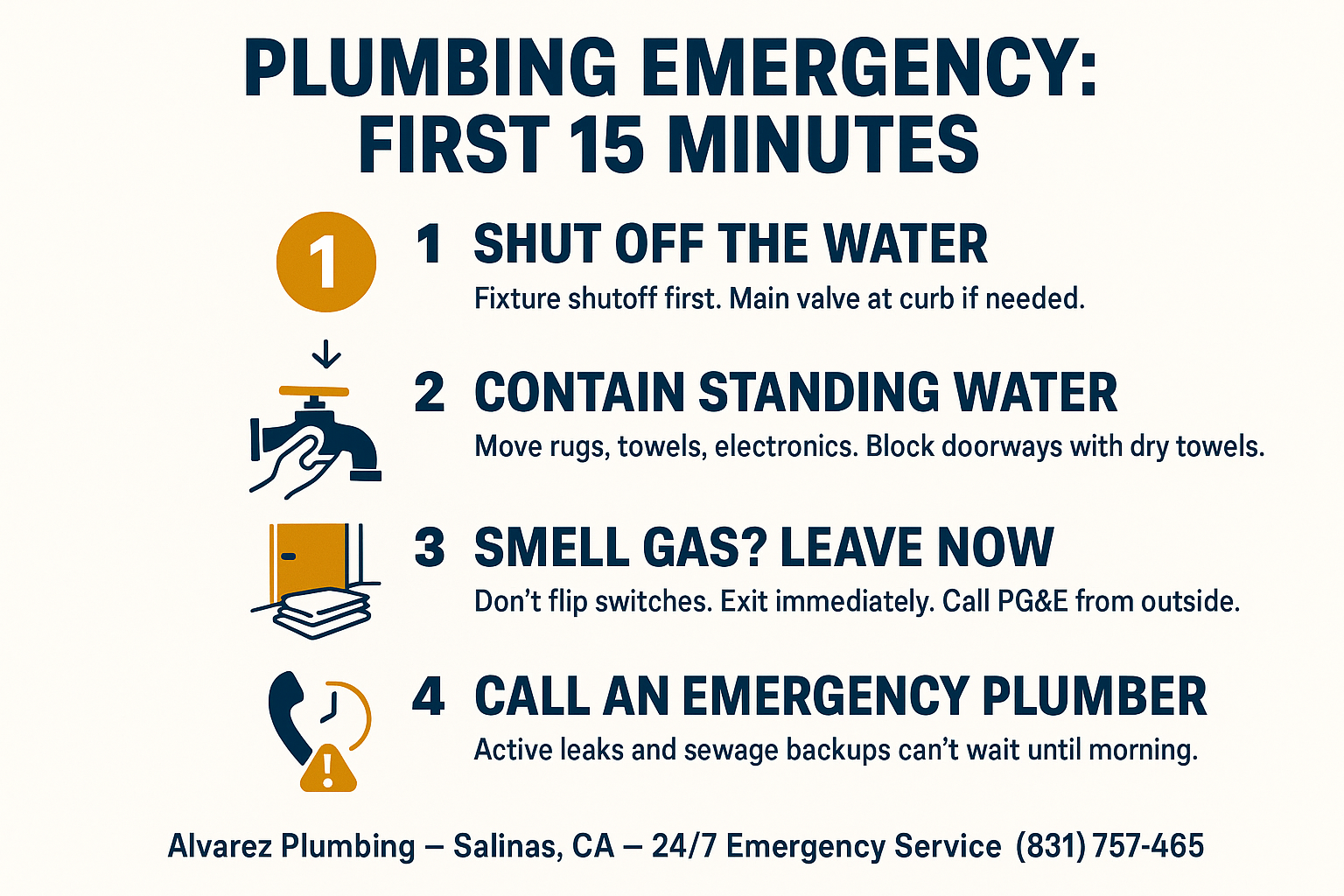
This step-by-step breakdown covers the four actions that matter most in the first 15 minutes of a plumbing emergency.
The Question Everyone Hesitates On: Is This Worth an After-Hours Call?
About one in five callers who reach us after hours asks some version of the same question: “Is this actually an emergency, or should I wait until morning?”
That hesitation is understandable. After-hours emergency plumbing rates are higher than standard daytime rates — that’s true across the Monterey Bay Area, and anyone who tells you otherwise is not being straight with you. The rate difference typically reflects the cost of dispatching a technician outside business hours, and it’s real.
But the math only works in favor of waiting if the problem is genuinely stable. Here’s a practical way to think about it:
Call now if:
– Water is actively flowing and you cannot stop it
– Sewage is backing up into living areas (tubs, floor drains, toilets)
– A gas smell is present anywhere in or near the house
– Water is near electrical panels, outlets, or subfloor framing
It can likely wait until morning if:
– The drip or slow leak is contained and not spreading
– The affected fixture is isolated and not needed overnight
– You’ve shut off the supply and the situation is stable
A slow-draining sink in a secondary bathroom is not a 2 AM emergency. A backup affecting your only bathroom in a house with four people absolutely is. The hidden damage that happens before you call an emergency plumber — soaked subfloor, saturated drywall, mold starting within 24 to 48 hours — is often what turns a repair bill into a restoration bill. That context changes the math on the after-hours rate significantly.
If you’re unsure, call and describe what you’re seeing. A real emergency plumbing line will help you make that call honestly.
Emergency vs. Can-Wait: A Quick Reference
Use this as a gut-check when you’re not sure whether to call after hours or wait for a morning appointment.
| Situation | Call Now? | Why |
|---|---|---|
| Burst pipe with active water flow | Yes — immediately | Every minute adds structural damage |
| Sewage backing up into tub or floor drains | Yes — immediately | Health hazard; don’t run any other fixtures |
| Gas smell anywhere in the home | Yes — call PG&E first, then plumber | Evacuation is the first step, not repair |
| Water near electrical panel or outlets | Yes — immediately | Combined water and electrical risk |
| Slow drip from a fixture with a shutoff valve closed | Can wait until morning | Situation is contained and stable |
| Running toilet (not overflowing) | Can wait until morning | Wasteful but not damaging structure |
| Slow drain in a non-essential bathroom | Can wait until morning | Not urgent if other bathrooms available |
What Happens When the Plumber Arrives
If you’ve shut off the water and contained the spread, you’ve already done the most important part. When a licensed plumber arrives, they’ll assess the situation, identify the source if it wasn’t immediately obvious, and lay out what the repair requires — including whether it’s something that can be resolved in one visit or needs additional equipment like a sewer camera inspection to diagnose fully.
For sewer emergencies specifically, the plumber may need to assess whether the issue is a blockage in the branch line or a problem further down in the main sewer lateral. A backup that keeps recurring — and several callers described problems that had “come back” after a prior plumber tried to clear it — often points to something more than a simple clog. What a sewer camera inspection actually tells you explains how that diagnostic process works and what it typically finds.
Having the water off, the area cleared, and the approximate location of the problem identified before the plumber arrives saves time and, in after-hours situations, can reduce how long the job takes — which directly affects the final cost.
Frequently Asked Questions About Emergency Plumbing in Salinas
Where is the main water shutoff valve in a Salinas home?
In most Salinas homes, the main shutoff is near the water meter — usually at the front of the property close to the curb, or where the main supply line enters the house through the foundation. If you’re not sure where yours is, walk the front perimeter of your property and look for a rectangular metal cover set flush with the ground near the street. The shutoff valve is usually inside or just past that box. Find it before you need it — older valves that haven’t been used in years sometimes require significant force to turn, and occasionally they need to be replaced.
Is sewage backup dangerous to touch or breathe around?
Yes. Sewage contains bacteria and pathogens that pose real health risks. If water backing up into your tub, shower, or floor drain has visible black debris or a sewage odor, don’t use that space, don’t run any fixtures that drain to the same line, and open windows to ventilate if you can do so safely. Keep children and pets out of the area until a plumber has assessed and cleared the backup.
What does after-hours emergency plumbing actually cost in Salinas?
After-hours rates vary depending on the time of call, the nature of the job, and the contractor. Many Salinas homeowners report after-hours diagnostic and repair calls ranging somewhere in the low hundreds to several hundred dollars, depending on what’s involved — but those are general market observations, not a fixed rate. The only way to get an accurate number for your specific situation is to call and describe what’s happening. What’s consistent across most licensed plumbing contractors in the area is that after-hours rates are higher than daytime rates, and that difference is typically justified when active water damage is occurring.
Can I call a plumber for a gas leak, or does it have to be PG&E?
PG&E handles the immediate emergency response — shutting off the gas supply and clearing the area. Once that’s done and the area is declared safe, a licensed plumber repairs the gas line. Don’t call the plumber first if you smell gas. Leave the house, call PG&E at 1-800-743-5000 from outside, and the plumber gets involved after the utility has responded.
I shut off the water. Is it okay to wait until morning to call a plumber?
If the water is fully off and the area is stable — no ongoing flow, no sewage exposure, no water near electrical systems — waiting until morning for a non-urgent situation is reasonable. The key word is stable. If you’re not certain the shutoff is holding, or if there’s already significant standing water soaking into flooring or walls, the clock on secondary damage is already running. Water that sits in a subfloor or wall cavity for 24 to 48 hours starts creating conditions for mold. When in doubt, call and describe the situation — a good emergency line will tell you honestly whether it can wait.
What if I can’t find my main shutoff valve and water is flowing?
Call the City of Salinas Public Works emergency line — they can dispatch someone to shut off water at the street meter. This is exactly what that service exists for. It buys you time until a plumber arrives. Don’t wait or keep searching if water is actively damaging your home.
Need an Emergency Plumber in Salinas Right Now?
We provide 24-hour emergency plumbing service every day of the week — not as a marketing line, but as an operational reality. If you’re dealing with an active leak, a sewage backup, or something that can’t wait until morning anywhere in Salinas or the greater Monterey Bay Area, call us at (831) 757-5465. You can also schedule non-emergency service online at alvarezplumbingsalinas.com.