That rotten egg smell is more than just unpleasant—it's a warning sign from your plumbing. If you've noticed a sewage smell in your Salinas or Monterey home, you're likely dealing with sewer gas that has escaped your pipes. This isn't just a nuisance; it's a problem that needs immediate attention to protect your family's health and safety.
What a Sewer Smell Means for Your Home
Walking into your house and being hit with the smell of sewage is alarming. It makes your home feel unclean and unsafe. It’s also a sure sign that something has gone wrong with your plumbing.
Your home's pipes are designed with special traps and vents to keep sewer gas safely outside. When you smell it indoors, it means one of these important barriers has failed.
As a family-owned company serving communities like Carmel-by-the-Sea and Prunedale since 1988, we've seen just about every possible cause. Sometimes, the problem is simple, like a dried-out P-trap in a guest bathroom. But more often, it points to serious issues that need a professional plumber to diagnose and fix.
Common Causes of Sewer Odors in Coastal California Homes
The unique climate and soil conditions of the Monterey Bay area can sometimes lead to specific plumbing headaches. Here are a few of the most common problems we see in local homes:
- Dried-Out P-Traps: In vacation homes or guest bathrooms that aren't used often, the water in the U-shaped pipe under the sink (the P-trap) can evaporate. This removes the water barrier that blocks sewer gas, letting it flow into the room.
- Cracked or Damaged Sewer Lines: Shifting soil, especially after our heavy winter rains, or even aggressive tree roots can crack your main sewer line. This lets gas escape and seep up through your foundation.
- Failed Toilet Seals: The wax ring at the base of your toilet is a critical seal. If that ring gets old or damaged, gas can leak directly into your bathroom.
- Clogged Plumbing Vents: Your plumbing system has vents on your roof that can get clogged with leaves or debris from coastal storms. A blocked vent disrupts drainage and can force sewer gas back into your home.
- Kitchen Drain Issues: Sometimes, a foul odor that smells like sewage is actually old food buildup in your kitchen pipes. If you think the kitchen is the source, learning more about professional garbage disposal repair can help you figure out if that’s the problem.
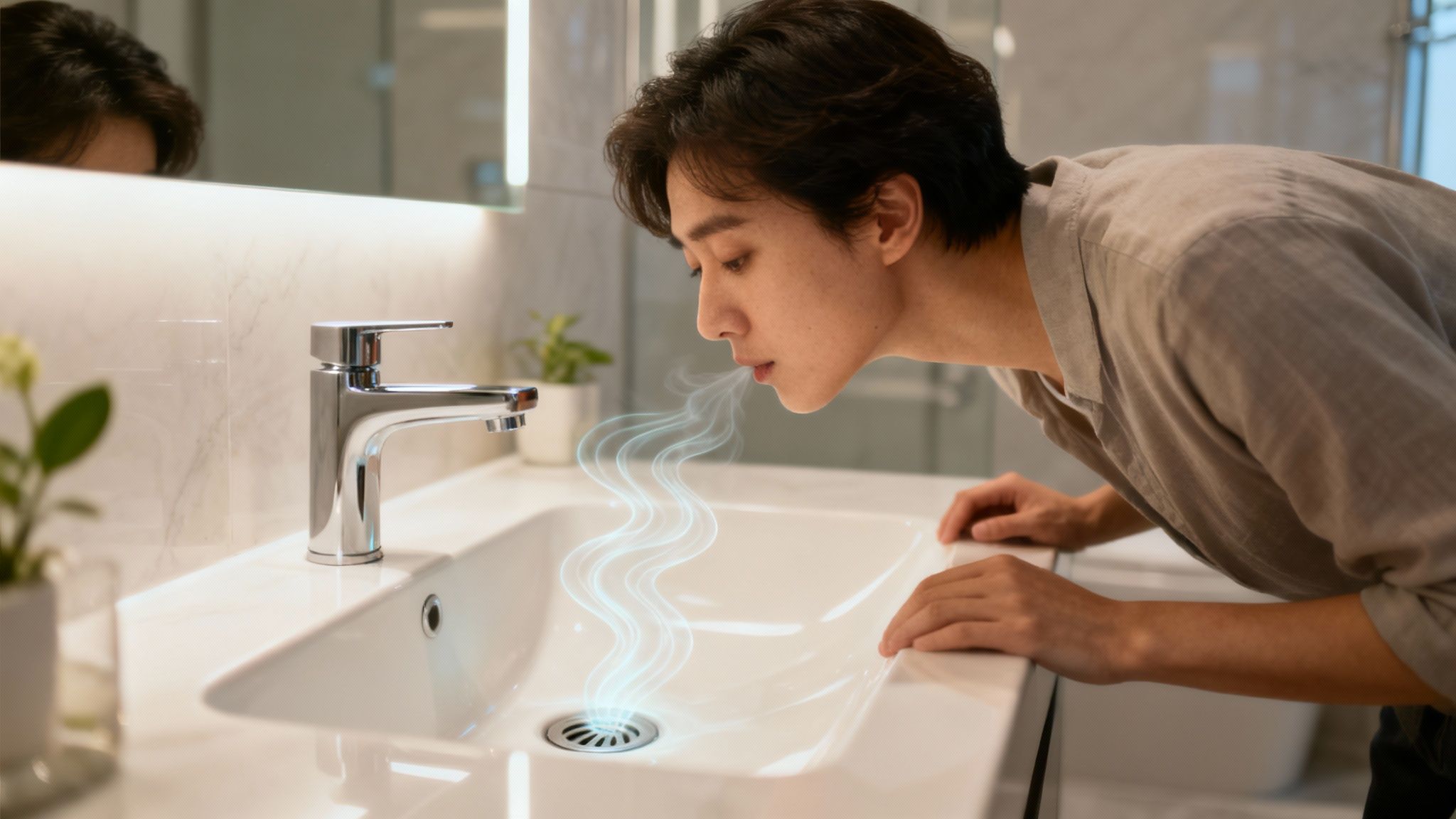
Why You're Smelling Sewer Gas: Common Plumbing Failures
Your home’s plumbing is a clever system with built-in barriers to keep unpleasant sewer gas out of your living space. When you notice that sewage smell in the house, it's a giveaway that one of these barriers has failed.
With over 35+ years of experience serving homes from Pacific Grove to Watsonville, we’ve seen it all. Think of your plumbing like a sealed road system; that smell means there's an unwanted exit.
The Most Frequent Culprits
One of the most common issues we find is a worn-out wax ring at the base of a toilet. This simple seal creates an airtight connection between the toilet and the drainpipe. When it breaks down, it allows gases like hydrogen sulfide to leak into your bathroom.
Another usual suspect is the P-trap. That's the U-shaped pipe under every sink. Its job is to hold a small amount of water, which acts as a plug to block sewer gas. If a sink isn't used often—like in a guest bathroom—this water can evaporate, leaving a path for odors.
This diagram breaks down the most common causes we see.
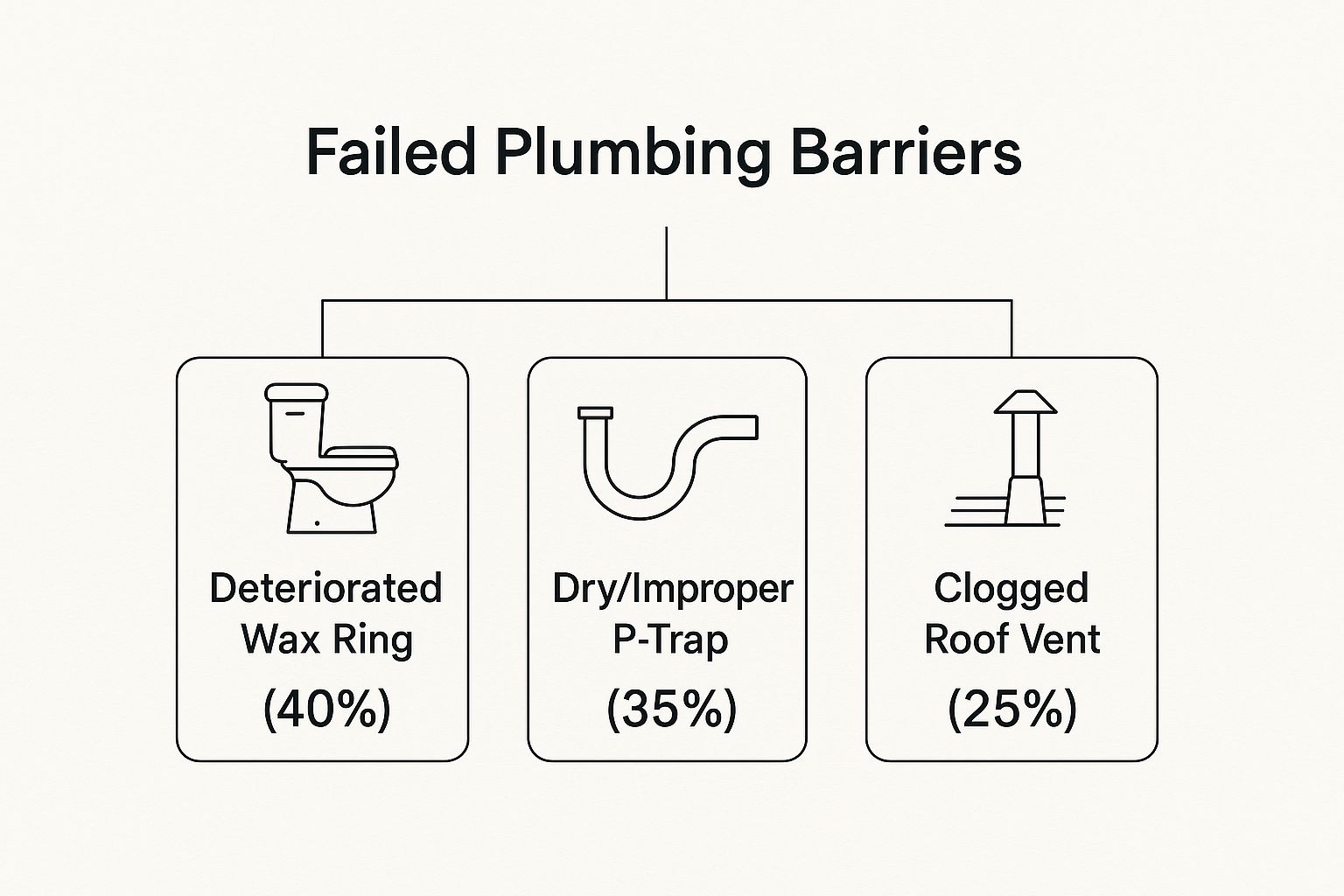
As you can see, problems with toilet seals and P-traps cause most indoor sewer gas complaints.
Vents and Plugs
Finally, don't forget your plumbing vents. These pipes run through your walls and out the roof. They let gas escape outside and help regulate air pressure in your drain lines.
Here in coastal communities like Seaside and Marina, it's not unusual for seasonal storms to clog these vents with leaves and twigs.
A clogged vent is like putting your thumb over the top of a straw—it messes up the flow. When that happens, the pressure imbalance can force sewer gas back into your home through the nearest drain.
A less common issue is a missing clean-out plug. These are capped access points to your main sewer line, often found in a crawl space. If that cap is cracked or missing, it’s a direct opening for sewer gas.
While trying to fix these issues yourself may be tempting, it's best to call a licensed plumber. Briefly running water in unused sinks can help with dry P-traps, but for anything more complex, professional help ensures the problem is fixed safely and correctly.
The Hidden Dangers and Health Risks of Sewer Gas

That sewage smell in your house is more than unpleasant—it's a warning you shouldn't ignore. The odor comes from sewer gas, a mix of compounds from decomposing waste. It’s your plumbing’s way of saying something is wrong, and waiting can put your family’s health at risk.
Trying to mask the smell with air fresheners does nothing to fix the real problem. For families living in communities from Carmel-by-the-Sea to Prunedale, taking this odor seriously is key to keeping your home safe.
What Is In Sewer Gas
The real danger is what you're breathing in. Sewer gas is a mix of harmful substances.
- Hydrogen Sulfide (H2S): This is the source of that "rotten egg" smell. At low levels, it’s an irritant, but in higher concentrations, it can be toxic.
- Ammonia: This compound can irritate your eyes, nose, and throat. Long-term exposure can lead to more severe respiratory problems.
- Methane: Methane can push oxygen out of a room. Even worse, it's highly flammable, creating a serious risk of explosion if the leak is severe.
- Carbon Dioxide: High levels of CO2 can also displace oxygen, leading to dizziness and shortness of breath.
When you smell sewer gas, you're being exposed to hazardous compounds. Hydrogen sulfide (H2S) is the most immediate concern. Understanding the potential causes of bad odors in the house can help you see why finding the source is so important.
Symptoms of Sewer Gas Exposure
If you're exposed to these gases for too long, you'll likely start to feel sick. If you notice any of these symptoms along with the foul smell, you need to act fast.
The most common signs of exposure are headaches, dizziness, fatigue, and nausea. For anyone with asthma or other respiratory conditions, sewer gas can trigger much more severe reactions.
Living with the odor can lead to long-term health issues. It's also important to remember that if the source of the gas is a broken pipe, your home's water supply could get contaminated. This can create a cross-connection problem, which may require a backflow preventer installation.
Don't wait for symptoms to show up. Treat any sewage smell as the serious warning it is.
Finding the Source with a Sewer Video Inspection
When you have a sewage smell in the house, guessing isn't a good strategy. You need a fast, accurate diagnosis. That’s why we use modern technology to get a clear look inside your pipes without disruptive digging.
Alvarez Plumbing uses state-of-the-art sewer video inspection cameras to pinpoint the exact source of the odor. A technician guides a small, high-resolution camera on a flexible cable directly into your drain lines. This gives us a real-time view of what's going on inside.
What the Camera Sees
This non-invasive approach lets us see problems hidden underground or behind your walls. It takes the guesswork out of the equation and lets us create a precise repair plan. That saves you time, stress, and money.
With the camera, we can instantly spot issues like:
- Cracks and Breaks: Even a tiny crack in a sewer line can release a lot of sewer gas.
- Stubborn Blockages: We can see what’s causing a clog—whether it’s grease buildup, a foreign object, or other debris.
- Pipe Collapse: In older homes, pipes can corrode and collapse, creating a major blockage.
- Root Intrusion: The beautiful trees common in areas like Carmel Valley and Monterey often have aggressive roots that can break into sewer lines.
This technology allows us to show you the problem on a screen, so you can see it for yourself. It’s about building trust and making sure you understand what repairs are needed and why.
Our goal is simple: find the problem quickly and fix it right the first time. Video inspections are the key to an accurate diagnosis and a fair, transparent quote.
This clear diagnostic process is part of our commitment to our customers in Salinas, Castroville, and across Monterey County. We believe an informed homeowner is a confident one.
Our Step-by-Step Repair Process
When you’re dealing with a foul sewage smell, the last thing you need is uncertainty. At Alvarez Plumbing, we’ve refined our process to be as clear and efficient as possible.
Phase 1: Diagnostics and Timeline (Typically 1-2 hours)
The moment you call us, our priority is getting an expert to your door. For emergency situations in areas like Marina and Seaside, we often provide same-day service. Our licensed plumber will listen to you and use advanced tools, like our video inspection cameras, to find the exact source of the odor. This isn't about guesswork. Based on what we find, we'll give you a clear, upfront quote and a timeline for the repair.
Phase 2: Repair and Resolution (Typically 1 hour to 1 day)
Once you approve the work, we get started. We’ll always give you a realistic timeline. A simple fix, like replacing a bad toilet wax ring, might take less than an hour. A more complex issue, like a cracked drain line under your foundation, could take a day or two. If we're dealing with a nasty clog, we'll figure out the best way to clear it. You can learn more about the differences by checking out our guide on hydro jetting vs. snaking.
Phase 3: Cleanup and Final Inspection (Typically under 1 hour)
Our job isn't done when the pipe is fixed. We are committed to leaving your property as clean as we found it. We haul away old parts and clean the work area. In cases where a sewage leak has contaminated an area, a simple cleanup isn't enough. For these situations, we recommend specialized professional sewer remediation services to ensure your home is fully sanitized and safe. Finally, we perform one last inspection to make sure the repair is secure and the odor is gone.
When the Smell Is Coming from Outside Your Home
Sometimes, you might trace a sewage smell to your house, only to realize the source isn't inside at all. If the odor gets stronger in your yard, or you notice your neighbors in Castroville smelling it too, the problem might be elsewhere.
Take a quick walk around your property. Is the smell strongest near a street drain? That could be a sign of a blockage in the municipal sewer main. This is a common issue after heavy coastal rains, which can overwhelm the system and cause backups in a whole neighborhood.
Community-Wide and Environmental Factors
Sometimes, the issue is bigger than one pipe. Problems with major infrastructure, like municipal sewer lines or nearby wastewater treatment facilities, can send smells across the Monterey Bay area.
It's a known issue. Studies show that odor is a real problem for communities near these facilities. The main culprits are usually hydrogen sulfide (that rotten egg smell) and other compounds. You can learn more about research into wastewater treatment plant odors to see how far these smells can travel.
Another source could be a clogged drain on your property, just outside the house. If the smell seems to be hanging around your yard, a blocked exterior drain is a common offender. Learning how to clean an outside drain and prevent blockages can be a good first step.
If our team inspects your home's plumbing and finds no issues, the next step is to contact your local municipal utility. This call ensures you’re not paying for repairs you don't need and helps your community find a larger problem.
As your local plumbing experts since 1988, we're committed to helping you find the true source of the problem, wherever it is.
Frequently Asked Questions About Sewer Smells
When that rotten egg odor shows up, it’s normal to have questions. As a family-owned plumbing company serving the Monterey Bay area since 1988, we've heard them all. Here are some quick answers to common questions.
Can I Pour Bleach Down the Drain to Stop the Smell?
Pouring bleach down the drain might cover up the odor for a little while, but it’s just a temporary fix. It does nothing to solve the underlying problem that’s letting sewer gas into your home.
The smell will always come back. By masking the scent, you could be ignoring a serious plumbing issue like a cracked pipe. For your family's health, it's best to have a licensed plumber find and fix the real source of the problem.
Why Does My House Smell Like Sewer Gas When It Rains?
This is an issue we see all the time, especially during the heavy winter rains around the Salinas Valley. Heavy rainfall can saturate the ground, putting extra pressure on the city's main sewer line.
This pressure can force sewer gas back up through any weak points in your plumbing, like a tiny crack in a pipe. It can also be a sign of a clogged plumbing vent on your roof. If you only notice the smell during or after a storm, that’s a clear signal your system needs a professional inspection.
Don't dismiss a rainy-day odor as a temporary quirk. It's often your plumbing's way of telling you it's struggling to handle the increased load from our coastal storms.
Is It Sewer Gas or a Dead Animal in My Walls?
Telling these two smells apart is key. Sewer gas typically has a "rotten egg" or sulfur smell because of the hydrogen sulfide it contains. It often seems to come from a specific drain or a room like a bathroom.
In contrast, the smell of a deceased animal is a decay smell that gets stronger over several days before it starts to fade. If you suspect sewer gas, don't wait—it's a potential health hazard that requires immediate attention from a professional plumber.
If a sewage smell is making you uncomfortable in your own home, don't wait for the problem to get worse. The expert team at Alvarez Plumbing has the technology and experience to find the source and fix it fast. Contact us today for a professional inspection and a lasting solution at https://alvarezplumbingsalinas.com.