Before you start digging up your yard, the quickest way to find your sewer line is to figure out where it leaves your house. This is the main artery of your home's plumbing, and it carries all the wastewater away. Pinpointing its path is the first step, whether you're planning a project or dealing with a nasty backup.
Understanding Your Home’s Sewer Connection
Think of it this way: every drain in your Salinas home—from the kitchen sink to the upstairs shower—feeds into one vital pipeline. This is your main sewer line, and it runs underground from your house to the municipal sewer system under the street.
It's really important to know the difference between your private "sewer lateral" and the city's main line. The sewer lateral is the section of pipe that’s on your property, so you’re responsible for maintaining it. The city’s responsibility starts where yours ends, usually at the property line near the street.
Knowing where your sewer lateral is located is crucial. Maybe you’re planning a backyard project, like building a deck in Prunedale or planting a new tree in your Carmel Valley yard. More urgently, you’ll need to find it if you're suddenly dealing with plumbing problems that affect your whole house.
As a family-owned business serving Monterey County since 1988, we've seen it all. When a homeowner can point us in the general direction of their sewer line, it helps us diagnose the problem much faster, which saves them time and money on the repair.
There are a few classic signs that mean you need to locate your sewer line, and fast.
- Multiple slow drains: If more than one fixture is draining slowly at the same time, the clog is almost certainly in the main line, not an individual pipe.
- Unpleasant odors: Persistent sewage smells around your home or yard are a huge red flag that something is wrong with the main line.
- Frequent backups: If toilets or floor drains are backing up, it’s a clear sign of a significant blockage that needs immediate attention from a professional.
Getting a handle on your home’s sewer connection is the first step for any effective troubleshooting. Before you start guessing or digging, knowing what you're looking for can keep a small problem from turning into a major catastrophe. A professional diagnosis is always the best path, which you can read about in our guide covering what you need to know about sewer drain inspections.
How to Start Your Search from Inside the House
Before you grab a shovel, the smartest move is to begin your search inside. This gives you a massive head start by helping you figure out where the sewer line likely exits your home. Your mission is to find the main drain stack.
This is the largest vertical pipe in your plumbing system, usually 3 to 4 inches wide. It’s the central hub that collects wastewater from every toilet, sink, and shower. The best places to look for it are in the lowest parts of your home—think basements, crawl spaces, or your garage.
Pinpointing the Exit Point
Once you've located that main stack, follow it down. You're looking for the spot where it turns and goes through your foundation wall or concrete slab. That exact point is key; it tells you where the sewer line begins its journey across your property to the city main.
Your home's foundation type can change things a bit. For instance, many newer homes in Marina are built on a concrete slab, so you'll find the pipe heading straight down through the floor. On the other hand, a lot of the classic, older homes in Carmel-by-the-Sea have raised foundations, making it much easier to spot the pipe passing through the crawl space wall.
Keep an ear out for slow drains or strange gurgling sounds. These aren't just minor annoyances; they're often early warnings of a problem brewing in the main line. Knowing its location helps a professional diagnose the real issue much faster.
Tackling sewer line issues is becoming more common as our local infrastructure ages. In fact, the global market for sewer repair hit $4.78 billion in 2021 and is still growing, which shows just how many homeowners are dealing with this. You can read more about these trends in sewer repair services if you're curious.
As you’re searching, if you notice any damp spots or water stains near where the pipe exits, that’s a red flag. It could be a sign of a leak. If you see something suspicious, it's worth learning how to find the source of hidden water leaks in our guide.
Using Property Maps for a More Accurate Location

If you’ve searched inside and still can’t spot where your sewer line leaves the building, it's time to check your paperwork. Believe it or not, the most reliable way to find your sewer line without digging might be tucked away in a file cabinet.
Your property’s plot plan or survey map is an amazing resource. These drawings often show where utility lines, including the sewer pipe, run from your foundation to the street. Check the closing documents you received when you bought your home; these plans are often included in that package.
Where to Find Local Records
Can't find your copy? No problem. Your local municipal office is the next stop. The planning and building departments for cities like Watsonville or Seaside keep these records on file and can usually provide you with a copy. Having a map is a huge advantage, whether you're planning new landscaping or trying to solve a stubborn drain issue.
A Word of Caution: While these maps are incredibly helpful, they can also be hard to read. It's easy to misinterpret a symbol or a property line, which could lead you to dig in the wrong spot—a frustrating and expensive mistake. We've been reading these plans since 1988, and that experience helps us see the full picture.
Of course, just knowing where the line is won't prevent problems. Regular upkeep is what really protects your plumbing from clogs and backups. You can learn more about how to keep your system healthy with our guide on plumbing preventative maintenance.
Ultimately, a property map gets you one big step closer to solving the puzzle. It gives you a bird's-eye view that, when combined with clues around your home, can help a professional pinpoint the exact location of your sewer line.
Searching for Outdoor Clues and the Sewer Cleanout
Once you've got a good idea of the indoor path, it’s time to head outside and play detective. Your most important discovery out here will be the sewer cleanout.
Think of the cleanout as a direct access port to your main sewer line. It's a capped pipe, usually about 3 to 4 inches wide, that gives a plumber a place to start troubleshooting. You'll typically find it close to your home's foundation, often near a bathroom or kitchen. The cap might be flush with the ground or stick up a bit. Finding this is a huge win.
Following the Path to the Street
With the cleanout as your starting point, draw an imaginary straight line from it toward the street where the city’s main sewer connection lies. This is almost always the path your sewer line follows. As you walk this line, keep your eyes peeled for subtle hints on your lawn.
Here in Monterey County, our wet winters followed by dry summers can leave clues behind. Look for things like:
- Patches of extra-green grass: A small, slow leak can act like a fertilizer, creating a lush strip of lawn that stands out from the rest.
- Slight dips or trenches: Over the years, the ground can settle along the trench where the pipe was buried. This can create a faint, linear dip in your yard that you can often see if you look from the right angle.
If you've searched near your foundation and walked the likely path to the street but still can't find that cleanout, it’s time to pause. The cleanout might be buried under landscaping, or your home might not have an accessible one. This is the point where guessing can create much bigger problems. It's the perfect time to call a professional plumber.
Once the cleanout is located, a pro can perform a camera inspection to see exactly what's going on inside the pipe.
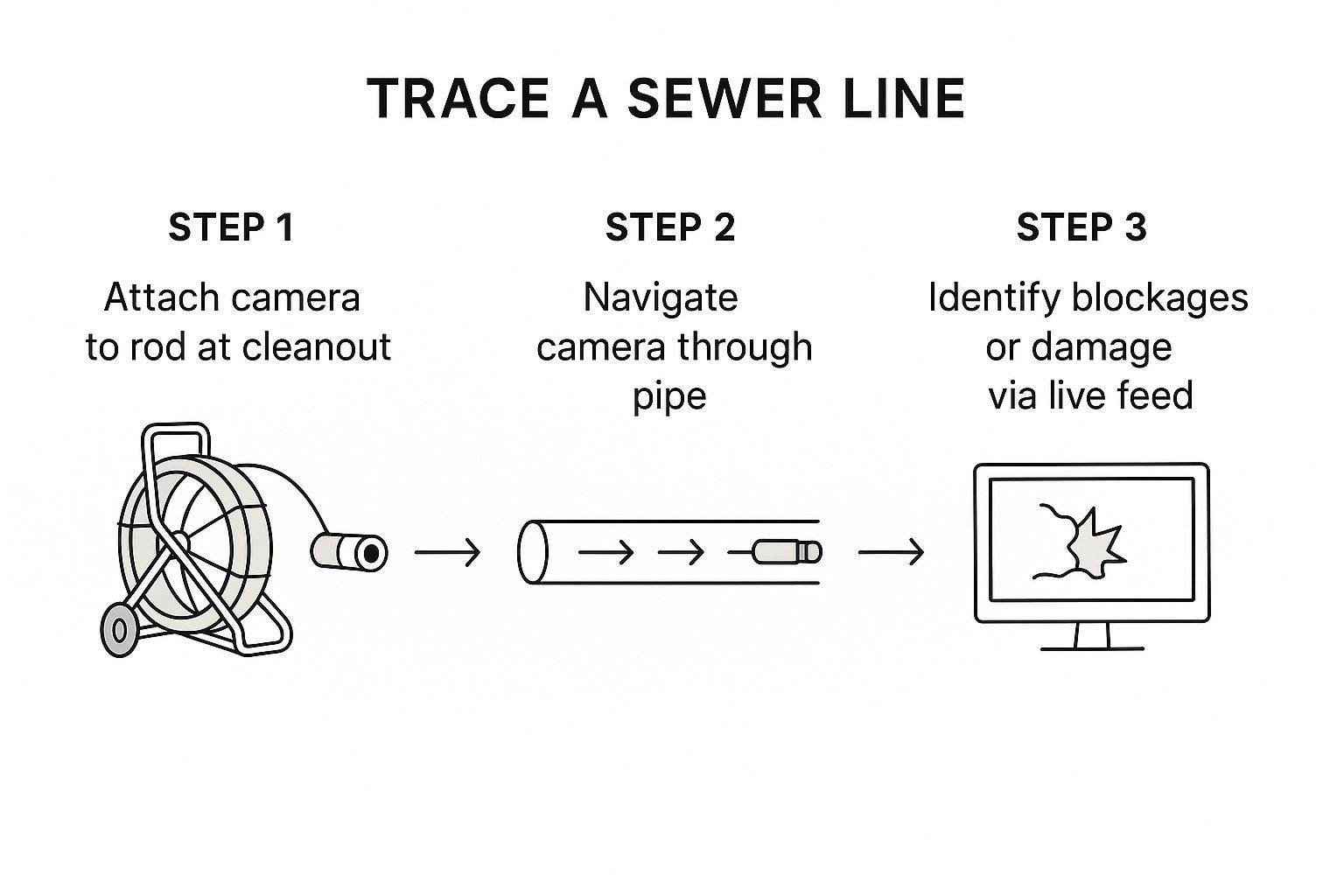
As you can see, a camera inspection does more than just confirm the pipe's location; it gives us a real-time, inside look at its condition—pinpointing cracks, roots, or blockages without any guesswork.
Why Pros Use Advanced Location Tech
Sometimes, just walking the yard and looking for clues isn’t enough. This is especially true for older homes, say in places like Pacific Grove, where property maps might be long gone. Or maybe your yard in Castroville has mature trees and landscaping that hide any sign of what’s underground.
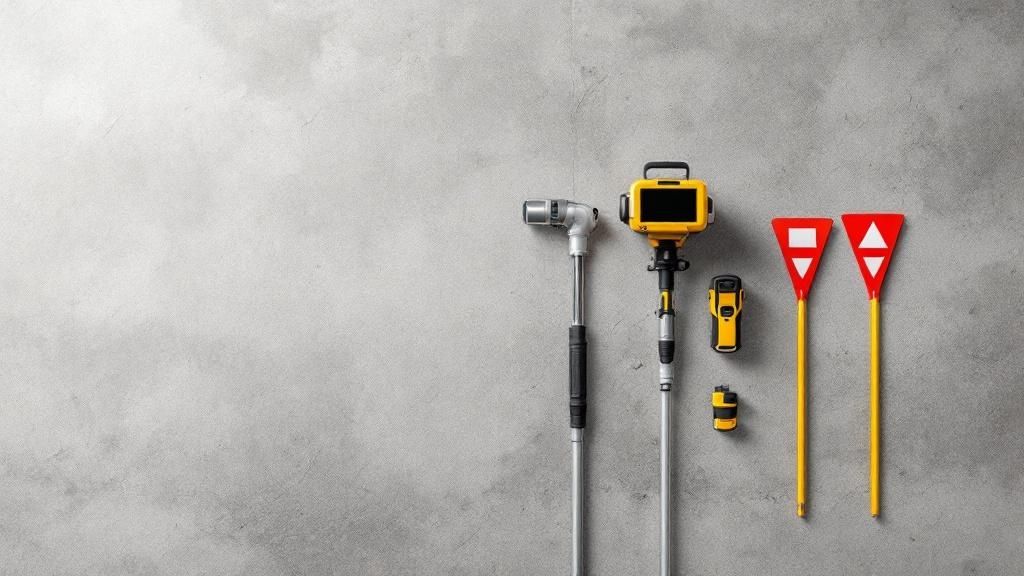
When the trail goes cold, we rely on professional tools that take the guesswork out of the equation. As a family business serving Monterey County since 1988, we’ve learned one thing for sure: the right technology saves homeowners time, money, and a torn-up yard. We use professional-grade electronic line locators that make finding your pipe simple and precise.
Pinpointing the Exact Location and Depth
These locators are pretty slick. They work by sending a signal down the pipe. Then, we use a receiver above ground to pick up that signal. This lets us trace the pipe's exact path across your property and—just as importantly—figure out how deep it is. No more exploratory digging. We know exactly where to focus our efforts.
The plumbing industry is always pushing these tools to be better. In fact, the global market for sewer inspection systems is expected to hit $226.2 million by 2025. Innovations like robotic crawlers and high-def cameras are becoming standard. If you're curious, you can learn more about the growth of sewer inspection system technology and see just how far things have come.
Seeing Inside Your Pipes with a Camera
Finding the line is only half the battle. We also need to know what’s happening inside it. This is where a sewer camera inspection becomes so important. We feed a high-definition, waterproof camera into the pipe, usually through a cleanout. This gives us a live feed of its condition, letting us spot problems like:
- Cracks or breaks in the pipe wall
- Intrusive tree roots causing a blockage
- Collapsed or "bellied" sections of the line
- Grease buildup or other obstructions
We had a perfect example of this at a home in Salinas. The family was facing a major backyard excavation to solve a recurring backup. Instead of starting with a shovel, we started with a camera. The inspection revealed a single, massive tree root cluster causing all the trouble. We cleared it out with hydro-jetting, saving them thousands of dollars and keeping their beautiful lawn intact.
A camera inspection doesn't just confirm the line’s location; it gives us a clear diagnosis. That means we can offer a targeted, effective, and often less-invasive repair. To get a better sense of our process, check out our guide on the cost of a sewer line camera inspection.
A Few Common Questions We Hear
Even after you’ve located your sewer line, a few questions usually pop up. With over 35+ years of experience working in homes across Salinas and the surrounding communities, we've heard them all. Here are the answers to the most frequent ones.
How Deep Is a Sewer Line Buried?
Sewer line depth definitely varies, but here in Monterey County, you can typically expect it to be between 18 inches and 5 feet deep. The final depth really depends on your property's slope and the local building codes in place when your home was built.
Unlike in colder climates, we don't have to worry about a deep frost line, so pipes can often be a bit shallower. Still, you should never guess the depth before you start a project.
Can I Plant or Build Over My Sewer Line?
We strongly advise against it. Honestly, tree roots are one of the biggest culprits behind sewer line damage we see in areas like Carmel Valley and Watsonville. They are naturally drawn to the moisture inside the pipes, and once they find a way in, they can cause serious cracks and blockages.
Putting up a permanent structure like a deck, shed, or patio over the line is also a bad idea. It makes getting access for future repairs or maintenance incredibly difficult and much more expensive. Always call a professional to locate your sewer line before starting any major landscaping or construction.
What Is a Sewer Cleanout and Why Does It Matter?
Think of the sewer cleanout as our direct access point to your main sewer line. It’s a capped pipe that gives us a clear entry point to insert tools, like a drain snake or a high-definition camera, to clear out a stubborn clog or check the pipe's condition.
If you have a mystery issue you can't solve, our expertise in water leak detection services can help us find the exact spot without digging up your yard unnecessarily.
Knowing where your cleanout is located is absolutely crucial for getting fast and effective service, especially during a plumbing emergency. If your home doesn't have an easily accessible cleanout, our team can usually install one for you.
If you've tried these steps and that sewer line is still playing hide-and-seek, or if you suspect a more serious problem, don't hesitate to call the pros. Contact Alvarez Plumbing today for fast, reliable service backed by more than three decades of local expertise.